

Emulator detection is how a mobile app or fraud engine decides whether it is running on a real phone or on software pretending to be one, and it matters because a single operator can use emulators to impersonate thousands of customers’ devices at once. Used well, it is one signal inside a layered risk decision. Used alone, it is easy to defeat and easy to get wrong. This article covers how emulator-driven fraud works, which signals expose it, where detection breaks down, and how to respond without punishing legitimate users.
TL;DR
- Fraudsters run emulator farms to replay stolen credentials, spoofed device IDs and fake GPS data against banking and brokerage apps at scale, so a “device” is no longer proof of a person.
- No single check is reliable. Build properties, file paths and system flags are trivially faked, so combine hardware, sensor, behavioral and server-side signals.
- Treat an emulator flag as a risk input that triggers step-up verification or restricted functionality, not as automatic proof of fraud.
- Developers, testers and some legitimate users run emulators, and sloppy rules misclassify real older phones, so calibrate and test your thresholds.
- Pair device-level detection with account-level monitoring, because the volume pattern often exposes the farm before any single device does.
Table of Contents
- What emulator detection actually covers
- Why fraudsters like emulators
- How emulator detection works
- Where detection fails
- Responding without over-blocking
- Our perspective
- Keep tracking the techniques
- FAQ
- Sources
What emulator detection actually covers
Emulator detection refers to techniques that tell when an app is running in an emulated or virtual device environment, as OWASP’s mobile weakness catalog frames it. An emulator replicates a device’s hardware and software environment, while a simulator typically reproduces only the interface and behavior without the underlying hardware or architecture, a distinction Blue Cedar’s glossary draws clearly.
Three related terms get blurred in practice, and the difference changes what you can detect:
- Emulator: software that imitates an entire device, including its processor behavior. It leaves architectural artifacts that can be found.
- Simulator: a lighter tool that mimics behavior without replicating hardware. It is mostly a developer convenience.
- Spoofed device: a real or emulated environment that has been modified so that identifiers, location and sensor data claim to be something else. This is the fraudster’s actual goal, and emulation is only the delivery mechanism.
That third category is why detection programs built only to catch “is this an emulator?” age badly. The question that matters to a fraud team is whether the device is who it claims to be. For a deeper view of how identifiers get manipulated, see our piece on device fingerprinting evasion.
Why fraudsters like emulators
Emulators give attackers a fully controlled, snapshottable environment for analyzing apps, automating interactions and running them at scale in bot farms, according to OWASP. For an attacker the economics are simple: one server can host many virtual phones, each configured to look like a different victim’s handset.
The farm that drained banks
The case that put this on every fraud team’s radar was documented in 2020. Ars Technica reported on research from IBM Trusteer showing that criminals used about 20 emulators to mimic more than 16,000 phones belonging to customers whose mobile bank accounts had been compromised, and that the operation siphoned millions of dollars from banks within days.
The mechanics are worth studying because each step defeated a control that banks relied on:
- Attackers entered victims’ usernames and passwords into banking apps, likely obtained through malware or phishing.
- They used device identifiers corresponding to the compromised account holders, so the login appeared to come from a recognized device.
- They spoofed the GPS locations those devices were known to use, defeating location-consistency checks.
The farms were also adaptive. Infosec Institute’s analysis notes that attackers recycle devices used for fraudulent transactions, replacing them with devices not yet used in the attack, and may cycle in new randomized devices when a financial institution blocks one. Blocking by device ID alone therefore becomes a game you lose on volume.
Regulators have noticed
In the US, FINRA’s Regulatory Notice 21-18 warned that fraudsters use mobile emulators to automate account takeover attacks at scale by mimicking compromised devices to reach thousands of brokerage accounts. That is an official acknowledgment that this is an operational threat for regulated firms, not a gamer’s problem.
Emulators also help with the second factor. Fraudsters may intercept SMS verification sent to a victim’s phone and use it as a second MFA factor to approve a transaction, as SEON describes. That is one more reason our coverage of the SMS one-time-passcode problem after a $33M SIM swap loss belongs in the same threat model.
How emulator detection works
OWASP states that effective detection combines several signal families: device identifiers, hardware capabilities, sensor availability, file paths, and behavioral traits that differ between emulators and physical devices. In practice a mature program layers these:
- Build and system properties. Manufacturer, model, fingerprint and product strings that match known emulator images. Cheap to check, cheap to fake.
- Hardware and sensor profile. Real phones have accelerometers, gyroscopes, battery behavior and camera characteristics with natural noise. Emulators often return perfect, static or missing values.
- File system and process artifacts. Emulator-specific files, drivers and processes.
- Instruction-level behavior. Academic work on Proteus found that differences between software-based emulators and real ARM CPUs are harder to enumerate and fix than API or file discrepancies, which makes this layer more durable against attackers.
- Behavioral and session signals. Touch dynamics, typing cadence, navigation speed and the absence of the micro-movements that a person holding a phone produces.
- Server-side and cross-account patterns. Many accounts logging in from devices with similar configurations, bursts of failed logins, or repeated reuse of device attributes.
The last layer is where most banks already have an advantage they underuse. FINRA’s notice describes back-end monitoring of anomalies, including increases in failed logins for a specific account and across many accounts, that may indicate large-scale attacks. Monitoring at both the account level and across accounts is how automated threats like emulator farms get noticed even when each individual device looks plausible. Our guide to implementing real-time fraud detection covers the pipeline that makes this possible.
What not to rely on
OWASP is explicit that relying on a single source of emulation indicators, such as system properties, is a failure point, because emulators can trivially fake them. A 2022 study of build-property detection found that some emulators, including NoxPlayer, can expose values matching real devices, and that ordinary-permission apps may be unable to read some build-property files. A detection script that checks the model string and stops there is a speed bump, not a control.
Where detection fails
The honest picture is that emulator detection is a cat-and-mouse exercise. Blue Cedar’s glossary is direct that it is not foolproof and can produce false positives and negatives, so it should be one layer among other protections. Three failure modes deserve attention.
Arms race and split personalities
Research presented at ACSAC 2014 on Morpheus explains that detection heuristics exploit discrepancies between emulators and real devices, and that malware can use the same heuristics to behave differently when it thinks it is being analyzed. The same knowledge cuts both ways. The study also reported that heuristic quality depended on the small set of real devices used for training, and that collecting artifacts took about 20 minutes per device. Representativeness is the weak point: the more your reference set diverges from the handsets your customers actually own, the worse the detector performs.
False positives on real phones
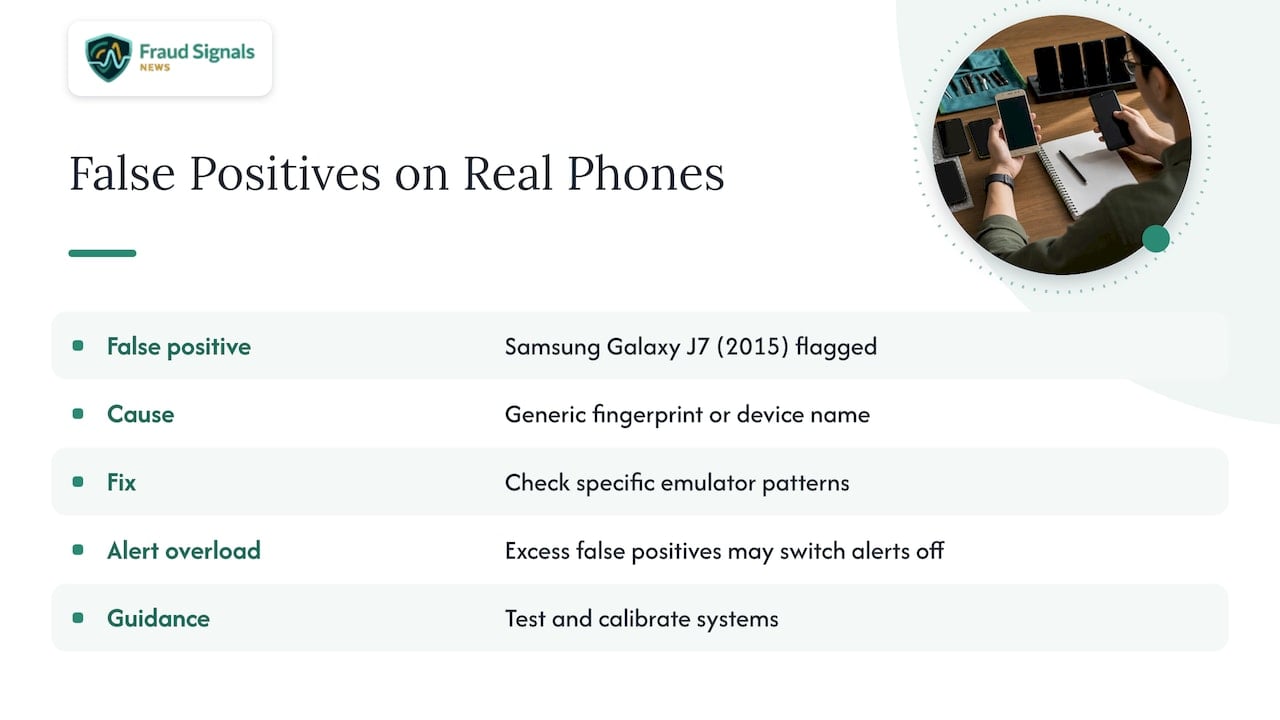
A public example shows how mundane the error can be. In one open-source project, a commit fixing a false positive explains that a Samsung Galaxy J7 (2015) was wrongly flagged as an emulator because a broad “generic” check matched its build fingerprint or device name. The fix was to check for specific emulator patterns instead. In a bank’s customer base, older and budget handsets are exactly the devices belonging to customers least able to replace them, so a careless rule has a real cost.
The FTC’s security guidance makes the operational point from a different angle: excessive false positives can overwhelm monitoring and lead organizations to switch off alerts, so systems should be tested and calibrated rather than set to a blunt threshold.
Legitimate emulator use
Emulators are normal tools. Google’s documentation describes the Android Emulator as a way to explore features and APIs, test behavior changes and simulate screen sizes, and its Espresso Device API runs tests on virtual devices with controlled configuration changes. Your own QA team, accessibility testers and third-party integrators may produce emulator traffic against staging or even production endpoints. Whitelist them deliberately, and never assume that every emulator session is hostile.
Responding without over-blocking
OWASP’s guidance is that detection should prompt a response, such as restricting sensitive functionality or requiring additional verification, according to the app’s risk profile. That is the right frame: an emulator flag changes the odds, and the response should scale with what the session is trying to do.
A workable tiering for a retail bank or fintech looks like this:
| Situation | Typical signal mix | Proportionate response |
|---|---|---|
| Emulator flag, browsing balances only | Emulator artifacts, no other anomalies | Allow, log, and watch the account |
| Emulator flag plus new device binding | Artifacts, unfamiliar device ID, location mismatch | Step-up verification before binding |
| Emulator flag plus payee change or large transfer | Artifacts, behavioral mismatch, velocity | Hold, require strong authentication, route to review |
| Cluster of accounts with near-identical device profiles | Cross-account pattern, failed-login bursts | Block the cluster, reset credentials, investigate |
This is also where compliance teams should be at the table. Framing the control as a risk-based layer, in the way fraud prevention within an ISMS is typically governed, makes it easier to document thresholds, owners and review cycles instead of leaving them as an engineer’s private configuration.
Two practices strengthen the program over time. First, learn from authorized anomalies: IBM Trusteer used what it learned from suspicious but authorized emulator access attempts to improve detection of later malicious operations. Second, widen the lens beyond the device. FINRA’s 2018 cybersecurity report recommends monitoring mobile app markets for malicious apps that impersonate your own, since fraudsters may use them alongside emulators, and it treats mobile device management as a high-security concern with clear bring-your-own-device policies and compliance staff who understand mobile security.
Emulator signals also belong upstream of onboarding. If a synthetic or stolen identity is being presented through a virtual camera on an emulated device, the problem is capture integrity, which we cover in stopping deepfake ID fraud and in our look at replay and injection attacks. For the account-opening side, see account opening fraud detection, and for post-login abuse, account takeover protection.
Our perspective
We think the industry still treats emulator detection as a product feature when it is really a measurement problem. Vendors sell a flag, banks buy the flag, and then the flag gets bypassed by an attacker who has read the same documentation. The failures documented in the research are consistent: single-source checks, stale reference devices, and thresholds nobody calibrated.
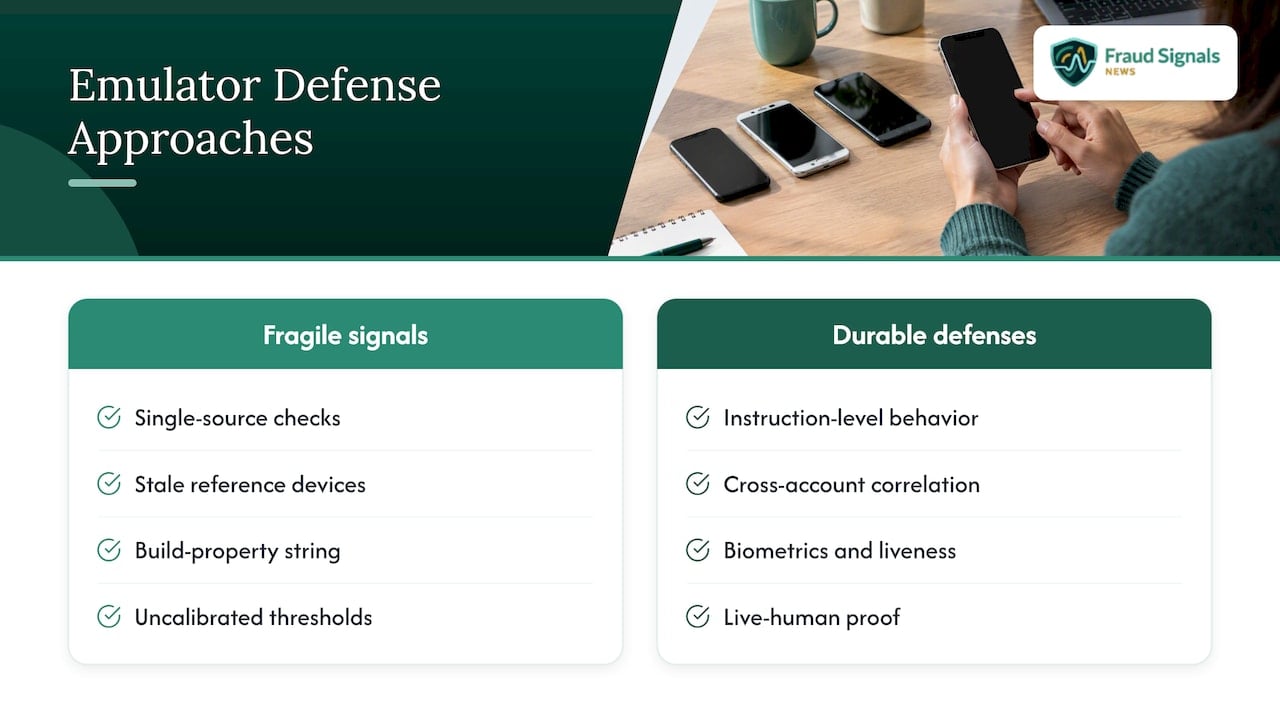
Our view is that the durable defenses sit in places attackers cannot cheaply fake. Instruction-level behavior, cross-account correlation and proof that a live human is behind the session cost more to defeat than a build-property string. That is why we keep returning to biometrics and liveness as the counterpart to device intelligence: if the device cannot be trusted, bind the transaction to the person.
We also think leadership should stop asking whether a tool “detects emulators” and start asking what fraud loss and what customer friction the program produces, measured on a representative set of real handsets. A control that blocks an older Galaxy owner while a farm rotates fresh device IDs is failing in both directions.
— Carlos Ochoa
Keep tracking the techniques
Emulator farms are one piece of a wider shift toward industrialized fraud, from SIM swaps to deepfaked onboarding. Fraud Signals News follows these techniques and the controls built to counter them, with an operations focus. If you are rebuilding your verification stack, start with our analysis of why biometrics reduce bank fraud, or browse the latest coverage on the Fraud Signals News homepage.

For the mobile channel specifically, our overview of mobile banking fraud risk and our retail banking fraud schemes guide put emulator abuse in context with the other schemes your analysts see.
FAQ
Are emulators legal to use in the United States?
The software itself is generally legal. Commentary on US law notes that courts have treated emulators as lawful, while the risk lies in what is loaded or done with them, such as pirated ROMs. Using an emulator to impersonate other people’s devices and log in to their accounts is a different matter: it can implicate computer fraud and identity theft statutes. The Supreme Court’s decision in Van Buren v. United States narrowed the Computer Fraud and Abuse Act’s “exceeds authorized access” language, but accessing accounts without authorization remains unlawful. For specific situations, consult a licensed attorney.
Can emulator detection be bypassed?
Yes. Emulators can fake system properties trivially, and some expose values matching real devices, so single-signal checks fail. Layering hardware, sensor, instruction-level, behavioral and server-side signals raises the cost, but no layer is permanent. Plan for continuous tuning.
Does an emulator flag prove fraud?
No. Developers, testers and some customers use emulators legitimately, and broad rules can misclassify real phones. Treat the flag as a risk input and respond in proportion to the action being attempted, for example by requiring step-up verification before a payee change.
How do emulator farms avoid being blocked?
They rotate devices. Attackers replace devices already used in fraudulent transactions with fresh ones and may cycle in randomized devices when an institution blocks one. That is why cross-account patterns, such as bursts of failed logins, matter as much as per-device blocking.
Sources
- MASWE-0053: Emulated or Virtual Device Detection Not Implemented (OWASP)
- Emulator Detection (Blue Cedar)
- Evil mobile emulator farms used to steal millions from US and EU banks (Ars Technica)
- Mobile emulator farms: What are they and how they work (Infosec Institute)
- Regulatory Notice 21-18 (FINRA)
- What Are Emulators in Fraud (SEON)
- Proteus: Detecting Android Emulators from Instruction-level Profiles
- A Study on Android Emulator Detection Using Build Properties
- Morpheus: Automatically Generating Heuristics to Detect Android Emulators
- Emulator detection false positive fix (GitHub commit)
- Stick with Security: Segment your network and monitor who’s trying to get out (FTC)
- Android 16 QPR2 (Android Developers)
- Test against screen configuration changes with the Espresso Device API (Android Developers)
- The New Frontier of Fraud: Massive Mobile Emulator Farms (IBM Community)
- Report on Selected Cybersecurity Practices (FINRA, 2018)
- Are Emulators Legal? What US Copyright Law Says
- Van Buren v. United States (Wikipedia)
- Fraud Prevention in ISMS: A 2026 Guide for Compliance Teams
Recommended

Document Capture Guidance: Prep, Image Quality, Controls

Selfie Verification UX: Design Choices That Cut Fraud and Drop-Off