

TL;DR:
- Account opening fraud detection uses layered controls to identify and stop synthetic and stolen identities. Effective methods combine device, behavioral, biometric signals, and ongoing post-registration monitoring. Continuous, adaptive verification balances security needs with a smooth customer experience.
Account opening fraud detection is defined as the process of identifying and blocking fraudulent attempts to create new financial accounts using stolen, synthetic, or fabricated identities. Reported losses from new account fraud reached $6.2 billion in 2024, more than doubling compared to a decade ago. That figure reflects a fraud category that has grown faster than most institutions’ defenses. The industry term for this discipline is “new account fraud” (NAF) detection, and it sits at the intersection of identity verification, behavioral analytics, and device intelligence. For compliance officers and fraud teams in banking and fintech, understanding how NAF detection works is no longer optional.
What is account opening fraud detection and why does it matter?
Account opening fraud detection is the set of controls, technologies, and processes a financial institution applies at the moment a new account is requested. Its goal is to confirm that the applicant is a real, authorized person before any account is activated. The challenge is that fraudsters have industrialized the attack. Synthetic identity fraud accounts for about 30% of all identity fraud cases, and document-based synthetic fraud grew 311% between Q1 2024 and Q1 2025. That growth rate signals a structural shift, not a temporary spike.
The detection problem is compounded by timing. Once a fraudulent account slips through onboarding, institutions take an average of 151 days to detect the fraud. That window gives bad actors time to build credit history, extract funds, or sell account access. Effective fraud controls at the new account opening stage are the only reliable way to close that window before damage accumulates.
Fraud Signals News covers this space closely because the gap between what institutions deploy and what attackers exploit keeps widening. Outdated verification methods fail not because they were poorly designed, but because the threat has evolved faster than the response.
What are the common types of fraud at account creation?
Understanding the attack surface is the first step toward building effective fraud controls for new account opening. Three fraud types dominate the current threat environment.
-
Stolen identity fraud uses real personal information obtained from data breaches, phishing campaigns, or dark web marketplaces. The attacker presents genuine credentials belonging to a real person, making the application appear legitimate on the surface. Standard knowledge-based authentication fails against this attack because the fraudster knows the answers.
-
Synthetic identity fraud combines real data elements, such as a valid Social Security number, with fabricated names, addresses, and dates of birth. These identities do not belong to any real person, which means victims rarely report them. The 311% growth in document-based synthetic fraud reflects how generative AI now produces convincing fake documents at scale.
-
Automated bot attacks submit thousands of fraudulent applications per hour using scripted tools. These attacks probe for weak verification endpoints and exploit rate-limiting gaps. Bot-driven fraud is particularly dangerous during promotional periods when institutions relax friction to attract new customers.
-
AI-generated document fraud uses generative models to produce photorealistic identity documents. These fakes defeat basic optical character recognition checks and even some first-generation document verification systems.
Pro Tip: Monitor application velocity by IP address, device, and email domain. A single device submitting five or more applications within an hour is a strong indicator of automated fraud, not human behavior.
How do modern detection methods stop fraud during account creation?
Detecting fraud during account creation requires layered controls that no single signal can replicate. Multi-layered risk scoring combining device intelligence, behavioral biometrics, and cross-network signals is the current standard for effective detection. Each layer catches what the others miss.
-
Device intelligence. Device fingerprinting collects hardware attributes, browser configurations, operating system details, and network characteristics to build a unique device profile. Device fingerprint reuse across multiple account creations is a strong indicator of automated fraud. An institution that sees the same fingerprint across 20 applications in a week has near-certain evidence of a coordinated attack.
-
Behavioral analytics. Keystroke dynamics, mouse movement patterns, scroll behavior, and copy-paste activity reveal whether a human or a script is completing the form. A legitimate applicant types their name with natural variation in speed and pressure. A bot fills fields in milliseconds with machine-perfect consistency. Behavioral signals are difficult to spoof because they require real-time human mimicry at scale.
-
Identity attribute verification. Document scanning extracts data from government-issued IDs and checks for tampering, font inconsistencies, and metadata anomalies. Biometric face verification compares the applicant’s live image against the document photo. Liveness detection confirms the image comes from a real person, not a photograph or a deepfake video. Fraud Signals News has reported extensively on biometric methods including liveness detection that are now critical at onboarding.
-
Risk scoring and anomaly detection. Cross-network signals aggregate fraud intelligence across institutions to flag identities or devices already associated with confirmed fraud. A risk score synthesizes all available signals into a single decision variable, replacing binary pass/fail logic with a probability-weighted assessment.
-
Progressive friction and step-up verification. Progressive friction applies increasing verification steps dynamically based on risk signals. A low-risk applicant completes onboarding in minutes. A high-risk applicant faces additional document checks or biometric confirmation. This approach preserves the customer experience for the majority while concentrating scrutiny where it belongs.
Pro Tip: Basic webcam liveness detection is insufficient against virtual camera and digital injection attacks. Require metadata-level integrity checks that verify the image source at the hardware level, not just the pixel level.
What are the challenges in balancing fraud detection with customer experience?
The central tension in account opening fraud prevention is that every additional verification step adds friction, and friction drives away legitimate customers. Finding the right balance between strong fraud controls and smooth onboarding is the defining challenge for financial institutions today. Getting it wrong in either direction carries real costs.
-
Excessive friction causes legitimate applicants to abandon the process. A customer who cannot complete a biometric check because of poor lighting or a slow connection is not a fraudster. Treating that person as a risk and blocking their application destroys trust and revenue.
-
Insufficient friction allows fraudsters to slip through. Institutions that prioritize conversion rates over verification rigor create low-assurance onboarding flows that fraudsters actively target.
-
False positives are a systemic problem. Allowing users to correct minor input errors reduces false positives and improves the legitimate customer experience. A name entered with a typo or a document photo taken in poor lighting should trigger a retry, not an automatic rejection.
-
Adaptive risk-based verification resolves much of this tension. When the risk score is low, the system asks for less. When signals elevate risk, the system escalates verification without interrupting the flow for everyone. This approach treats friction as a targeted tool, not a blanket policy.
-
Post-account-creation monitoring catches fraud that onboarding controls miss. Behavioral patterns such as immediate profile changes, unusual transaction sequences, or rapid fund transfers in the early life of an account signal fraudulent intent. Continuous monitoring during the first 30–90 days is a necessary extension of the detection framework, not an afterthought.
What steps should financial institutions take to implement effective fraud detection?
A fraud detection framework for new account opening requires deliberate architecture, not a collection of point solutions. The following priorities reflect current best practice for banking and fintech environments.

Layer behavioral, device, and identity signals together. No single signal is sufficient. Risk scoring that integrates device intelligence and behavioral biometrics is more effective than binary pass/fail verification. Institutions that rely on document checks alone will be defeated by synthetic identities. Those that rely on device signals alone will miss stolen-identity attacks from legitimate devices.
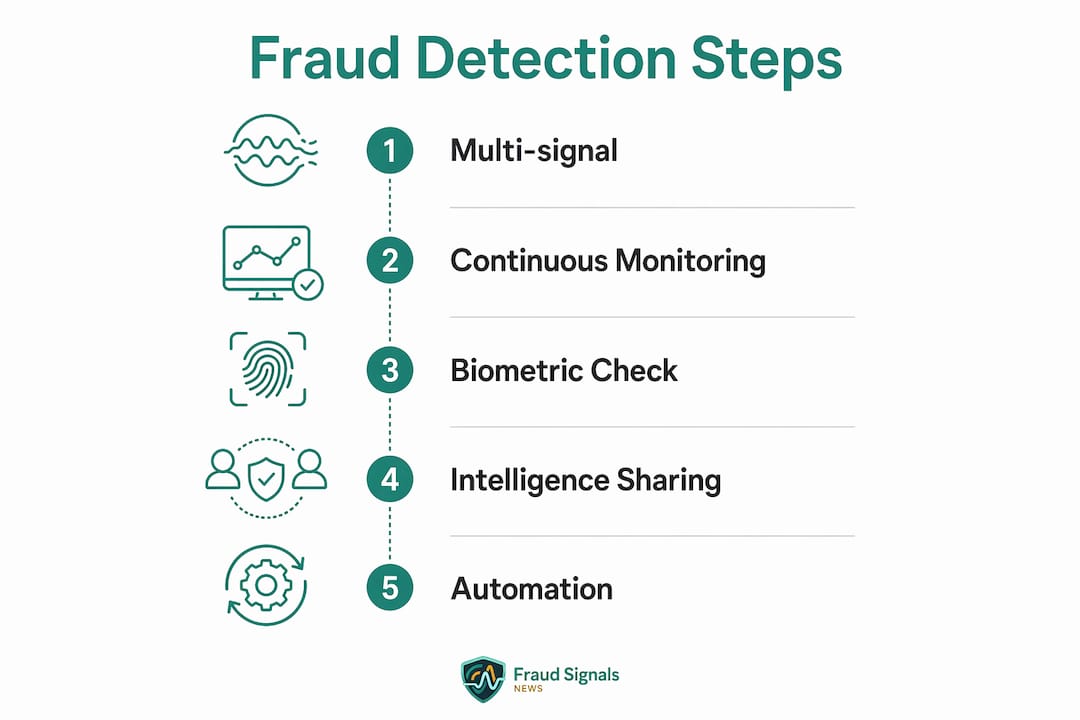
Monitor new accounts for 30–90 days post-registration. Continuous post-registration monitoring during the first 30–90 days is critical to detect dormant accounts that later commit fraud. Fraudsters sometimes open accounts and wait weeks before activating them, specifically to avoid detection systems that only watch new accounts for 24–48 hours.
Deploy biometric verification certified to recognized standards. Liveness detection and face verification should meet established certification benchmarks. Fraudsters use virtual cameras and digital injection to bypass standard liveness checks. Metadata-level integrity verification is the countermeasure. DAON (daon.com) is a recognized provider of certified biometric identity verification solutions worth evaluating for enterprise deployments.
Integrate fraud intelligence sharing. Cross-network signals from shared fraud databases give institutions visibility into identities and devices that have already been flagged elsewhere. An institution operating in isolation sees only its own fraud. One connected to a shared intelligence network sees the full attack pattern.
| Implementation Priority | What it addresses | Expected outcome |
|---|---|---|
| Multi-signal risk scoring | Synthetic and stolen identity fraud | Fewer false negatives at onboarding |
| Device fingerprint monitoring | Automated bot attacks | Early detection of scripted fraud |
| Biometric liveness detection | Deepfake and injection attacks | Higher assurance on identity claims |
| Post-registration monitoring | Dormant account fraud | Reduced losses in first 90 days |
| Progressive friction | Legitimate customer drop-off | Lower abandonment, maintained security |
Automate workflows where possible. Manual review queues create delays that frustrate legitimate customers and give fraudsters time to move funds. Automated decisioning on clear-pass and clear-fail cases reserves human review for the ambiguous middle tier. Fraud Signals News covers automation in fraud prevention as a core topic for institutions building scalable controls.
Key Takeaways
Account opening fraud detection requires layered controls combining device intelligence, behavioral analytics, biometric verification, and continuous post-registration monitoring to stop both synthetic and stolen identity fraud.
| Point | Details |
|---|---|
| Scale of the problem | New account fraud losses reached $6.2 billion in 2024, making detection a financial priority. |
| Synthetic identity growth | Document-based synthetic fraud grew 311% in one year, requiring advanced document and biometric checks. |
| Detection delay | Fraud goes undetected for an average of 151 days, making post-registration monitoring non-negotiable. |
| Multi-layer approach | Combining device, behavioral, and identity signals outperforms any single verification method. |
| Friction balance | Progressive friction protects security without blocking legitimate customers from completing onboarding. |
The uncomfortable truth about new account fraud controls
I have watched financial institutions invest heavily in onboarding technology and still get hit hard by new account fraud. The pattern is almost always the same. The institution deploys a strong document verification tool, declares the problem solved, and then gets blindsided by synthetic identities that pass document checks because the documents themselves are technically valid. The fraud is in the identity construction, not the document quality.
The second failure mode I see constantly is the dormant account problem. Institutions monitor new accounts for 24 hours, maybe 48, and then move on. Fraudsters know this. They open accounts, let them sit, build a thin transaction history, and then strike weeks later. The 151-day average detection window is not a technology failure. It is a monitoring architecture failure.
The third issue is liveness detection complacency. Basic webcam liveness checks were adequate five years ago. They are not adequate now. Virtual camera injection attacks are commoditized. Any institution still relying on pixel-level liveness without metadata integrity verification has a backdoor that sophisticated fraud rings already know about.
The institutions that are actually winning this fight share one characteristic. They treat fraud detection as a continuous process, not a gate at onboarding. They monitor behavior through the first 90 days, they share intelligence across networks, and they escalate verification dynamically rather than applying the same friction to every applicant. That is not a technology choice. It is an operational philosophy.
— Carlos Ochoa
Fraud Signals News: your source for account fraud intelligence
Staying ahead of account opening fraud requires more than a one-time technology deployment. The threat evolves continuously, and so must your detection strategy.

Fraud Signals News publishes in-depth coverage of identity verification mandates, biometric authentication advances, liveness detection developments, and emerging fraud techniques targeting financial institutions. Whether you are building a new account fraud prevention framework or auditing an existing one, the banking and fintech fraud coverage at Fraud Signals News gives you the technical depth and regulatory context to make informed decisions. Bookmark the site and check back regularly as the fraud environment shifts.
FAQ
What is account opening fraud detection?
Account opening fraud detection is the process of identifying and blocking fraudulent attempts to create new financial accounts using stolen, synthetic, or fabricated identities. It combines device intelligence, behavioral analytics, and biometric verification to confirm applicant legitimacy before account activation.
What is synthetic identity fraud?
Synthetic identity fraud combines real data elements, such as a valid Social Security number, with fabricated personal details to create an identity that does not belong to any real person. It accounts for about 30% of all identity fraud cases and grew 311% in document-based form between Q1 2024 and Q1 2025.
How long does it take to detect new account fraud?
Institutions take an average of 151 days to detect new account fraud after it has been successfully perpetrated. That delay makes post-registration monitoring during the first 30–90 days a critical component of any detection framework.
What are the signs of account fraud at onboarding?
Key signs include device fingerprint reuse across multiple applications, bot-like form completion speed, mismatches between document data and behavioral signals, and identity attributes that match known synthetic identity patterns from shared fraud databases.
How does progressive friction help prevent account fraud?
Progressive friction applies increasing verification steps dynamically based on risk signals, so low-risk applicants face minimal friction while high-risk applicants face additional checks. This approach maintains security without degrading the onboarding experience for legitimate customers.
Recommended

Biometric Performance Metrics: What to Measure and Trust

ID Security Features: What Each One Does and How to Check It