

Real-time fraud detection is the process of identifying and blocking fraudulent transactions within milliseconds, using streaming data pipelines and machine learning models before a payment settles. The core requirement is strict: sub-300ms latency with capacity for 10,000 or more transactions per second. Batch processing cannot meet that bar. Legacy rule engines, applied after the fact, cannot either. What works is a purpose-built streaming architecture where every transaction flows through five sequential stages before a decision lands.
The five stages every production system needs:
- Data ingestion: High-throughput messaging via Apache Kafka or Amazon Kinesis captures raw transaction events the moment they originate.
- Real-time feature engineering: Stateful stream processors like Apache Flink or Spark Structured Streaming compute velocity counts, geographic anomalies, and behavioral signals over sliding time windows.
- ML model scoring: Gradient-boosted or ensemble models, commonly XGBoost or RandomForest, assign a risk score to each transaction using live features.
- Policy-based decisioning: A rules engine maps scores to outcomes: approve, flag for review, or block, based on configurable thresholds.
- Action execution: The decision triggers a downstream action, whether that is approving the payment, creating a case for an analyst, or rejecting the transaction outright.
Specialized platforms including DAON, Plaid Protect, Feedzai, Sardine, and SAS Fraud Decisioning expose these capabilities through APIs, letting organizations integrate risk intelligence directly into existing transaction flows rather than building every layer from scratch.
How does real-time fraud detection architecture actually work?
The architecture is best understood as a pipeline where each stage adds intelligence and each handoff happens over a message bus. Apache Kafka sits at the entry point, receiving raw transaction events carrying card ID, amount, merchant category, geographic coordinates, and channel. Kafka’s durability guarantees mean no event is lost even under burst load, and its partitioning model is what makes 10,000+ TPS throughput achievable without redesigning the system as volume grows.
Downstream of ingestion, a stateful stream processor takes over. Apache Flink and Spark Structured Streaming in Real-Time Mode both support the operator pattern needed for per-key stateful tracking. A card that fires five transactions in sixty seconds is exhibiting classic card-testing behavior. Catching that requires the processor to maintain per-card state across the stream, not just evaluate each event in isolation. Stateful streaming treats each transaction as an independent event while preserving behavioral context over time, which is the only way to detect gradual fraud patterns.
Feature enrichment follows. Merchant risk profiles, cardholder spending baselines, and device fingerprints are pulled from an online feature store, typically a low-latency database like managed PostgreSQL or Redis, to avoid the broadcast join overhead that adds latency in streaming pipelines. The enriched record then reaches the scoring layer, where a RandomForest model trained with MLflow is loaded as a user-defined function and applied to every transaction. The output is a 0–100 risk score with explainable signal weights, not a black-box verdict.
The decisioning layer applies business policy, not detection logic. A common threshold structure routes transactions as follows:
| Risk score | Decision | Action |
|---|---|---|
| — | ALLOW | Approve payment |
| — | REVIEW | Create analyst case |
| 70 and above | BLOCK | Reject transaction |
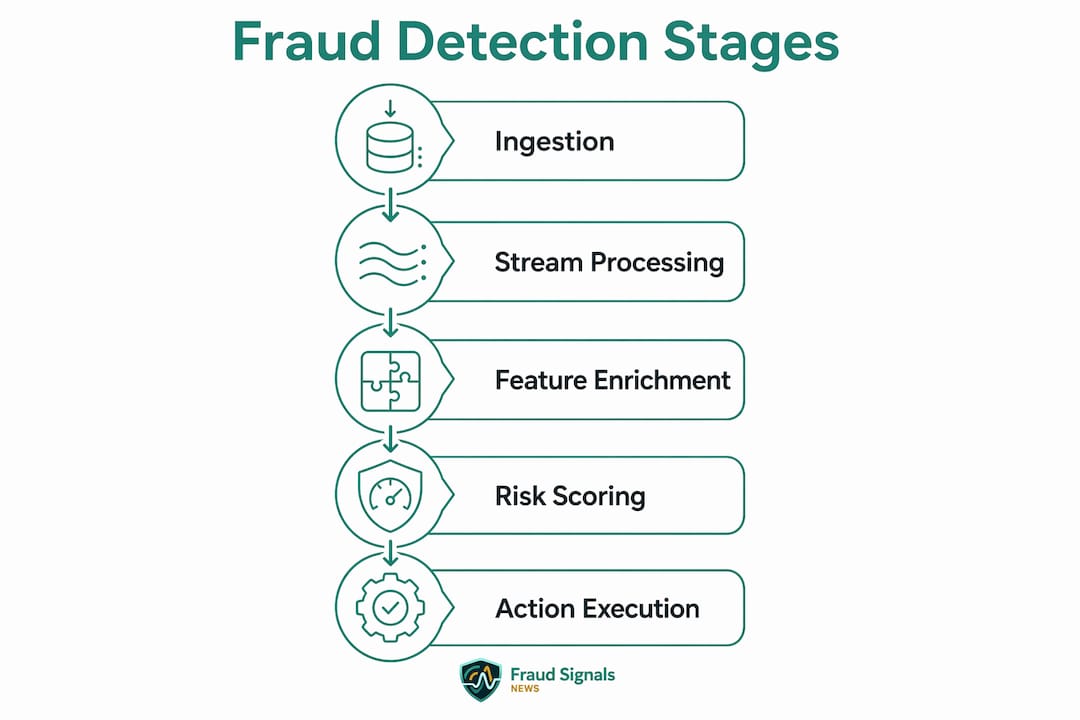
Action execution is the final stage. Each outcome writes to a dedicated output Kafka topic, and an immutable audit ledger records every decision for compliance and dispute resolution. The entire pipeline, from raw event to routed decision, must complete within the time allowed by the payment authorization window.
What are the real business benefits of real-time fraud detection?
The most direct benefit is stopping fraud before it settles. Batch systems catch fraud after the money has moved, which means recovery depends on chargebacks, disputes, and write-offs. A streaming system blocks the transaction in the authorization window, so the loss never occurs. That shift from reactive to preventive is the commercial case in one sentence.
Beyond loss prevention, real-time alerting compresses the response window for fraud operations teams. When a card is compromised, the system can flag the first suspicious transaction and suppress subsequent ones automatically, rather than waiting for a customer to call in. That speed reduces both the fraud exposure per incident and the operational cost of manual investigation.
Regulatory compliance is a third driver. Financial institutions operating under frameworks like PCI DSS and the Bank Secrecy Act need auditable, timestamped records of every risk decision. An immutable audit trail built into the pipeline satisfies that requirement without a separate compliance layer. Real-time reporting also supports the kind of live monitoring dashboards that fraud operations teams and risk managers need to work under regulatory reporting obligations.
Key outcomes organizations typically achieve after deploying streaming fraud detection:
- Reduced fraud losses by blocking transactions before settlement rather than disputing them after
- Lower false positive rates through behavioral context that static rules cannot replicate
- Faster analyst workflows because cases arrive pre-scored with explainable signal breakdowns
- Stronger customer trust, since fewer legitimate transactions are incorrectly declined
- Audit-ready decision logs that satisfy compliance requirements without additional tooling
What are the critical implementation considerations?
Latency is not a performance metric to optimize. It is a hard operational boundary dictated by the payment authorization window. Fixed network delays and issuer processing consume most of the available time budget, leaving only a small fraction for ML inference and feature access. That constraint forces every architectural decision: feature store read latency, model size, serialization overhead, and network hops all count against the same clock.

Data architecture must be designed for throughput from day one. High-throughput messaging, partitioned by card ID or account ID, distributes load evenly and prevents hot partitions from becoming bottlenecks. Idempotency keys at the ingestion layer prevent duplicate processing when producers retry on failure, which they will. The outbox pattern, where transaction intent is written to a local store before being published to Kafka, prevents data loss during service restarts.
Balancing automated blocking with human review is where most teams underinvest. Routing every uncertain case to a human analyst is not a fallback; it is a deliberate design choice that preserves customer experience while catching the edge cases that models miss. Systems that block aggressively without a review tier generate false positives that erode customer trust faster than fraud does.
Pro Tip: Assign a correlation ID at the API gateway and propagate it through every Kafka header, log entry, and audit record. Without correlation IDs, forensic investigation across distributed services becomes impractical, and compliance audits turn into guesswork.
Core design and operational best practices:
- Use sliding windows rather than tumbling windows for velocity features to avoid blind spots at interval boundaries
- Separate scoring logic from decisioning logic so thresholds can be adjusted without redeploying models
- Build idempotency into every service to handle retries safely
- Maintain an append-only audit ledger for every decision and action
- Design the review tier with analyst workflow states, not just a case queue
How do advanced identity verification methods strengthen fraud prevention?
Rule-based signals and behavioral velocity features catch a wide range of fraud patterns, but they have a structural weakness: they cannot verify that the person initiating a transaction is who they claim to be. That gap is where biometric identification and liveness detection close the loop. By confirming a live human face matches the identity document on file, these methods block account takeover attempts that would otherwise pass every behavioral check.
Deepfake detection has become a necessary component of any identity verification layer in 2026. Generative AI tools have made synthetic face creation accessible, and fraudsters use them to defeat standard photo-based checks. Eye-tracking and liveness detection technologies counter this by requiring real-time physiological responses that synthetic media cannot replicate. DAON, for example, specializes in biometric authentication and liveness verification, making it a strong option for organizations that need to integrate identity assurance directly into their transaction authorization flow.
Fraud Signals News covers these emerging verification technologies in depth, tracking how biometric methods, eye-tracking, and deepfake detection are reshaping the identity verification layer across fintech, banking, and healthcare. The practical integration point for real-time systems is the pre-authorization step: identity verification runs before the transaction enters the fraud scoring pipeline, so the ML model receives a signal confirming the user’s identity alongside behavioral features.
Technologies reshaping identity verification in real-time fraud prevention:
- Liveness detection: Confirms a live person is present, blocking replay attacks and static photo spoofing
- Biometric matching: Compares facial geometry against enrolled templates with high confidence
- Eye-tracking (eKYC): Detects gaze patterns and blink responses that synthetic media cannot produce
- Deepfake detection: Identifies AI-generated faces using texture and frequency analysis
- Document verification: Cross-references identity documents against authoritative databases in real time
How do you measure real-time fraud detection system performance?
The primary metrics for any fraud detection system fall into two categories: detection quality and operational performance. Detection quality is measured by precision, recall, and the F1 score. Precision measures how many flagged transactions are actually fraudulent. Recall measures how many actual fraud cases the system catches. F1 balances both, which matters because optimizing for one at the expense of the other produces a system that is either too aggressive or too permissive.
The false positive rate deserves its own tracking. A high false positive rate means legitimate customers are being declined or subjected to unnecessary friction, which has a direct cost in abandoned transactions and customer attrition. The false negative rate, fraud that slips through undetected, carries a different cost: direct financial loss and potential regulatory exposure. Both rates need separate dashboards, not a single aggregate metric.
Operational performance metrics cover latency percentiles (p50, p95, p99), throughput in transactions per second, and pipeline lag, the delay between an event being produced to Kafka and a decision being written to the output topic. P99 latency is the number that matters most for compliance with authorization windows, since the worst-case scenario is what determines whether the system meets its hard deadline. A live monitoring dashboard, refreshing every ten seconds, gives fraud analysts and risk managers the visibility they need to catch degradation before it becomes a breach.
Model drift is a monitoring concern that batch-era teams often underestimate in streaming contexts. Fraud patterns evolve continuously, and a model trained on six-month-old data will gradually lose accuracy as attackers adapt. Tracking score distributions over time, alongside precision and recall on labeled outcomes, surfaces drift before it becomes operationally significant.
How do you integrate fraud detection with existing business workflows?
The integration challenge is not technical complexity alone. It is organizational: fraud detection decisions need to reach the right people, in the right format, at the right time, without requiring engineering support to access them. A well-designed alert management layer is what separates a technically functional system from one that fraud operations teams can actually use.
Alert routing should follow the same threshold logic as the decisioning layer. BLOCK decisions trigger immediate automated action and write to the audit ledger. REVIEW decisions create cases in an analyst workflow system, pre-populated with the transaction record, the risk score, and the contributing signal weights. Analysts should never need to query a database to understand why a case was flagged. Transaction management integration at the workflow layer ensures decisions flow back into the core banking or payment system without manual handoffs.
API-first platforms like Plaid Protect, Feedzai, Sardine, and SAS Fraud Decisioning are built for this integration pattern. They expose risk scores and decision outputs through standard REST or event-driven APIs, which means the fraud detection layer can be inserted into an existing authorization flow without rebuilding the surrounding infrastructure. DAON adds identity verification at the pre-authorization step through a similar API model, making it composable with downstream scoring platforms.
The automation and human review balance is where workflow integration becomes a policy question. Fully automated blocking at high confidence scores is appropriate. But the REVIEW tier requires a case management system with analyst states, escalation paths, and resolution tracking. Without that infrastructure, the human-in-the-loop design becomes a bottleneck rather than a safety net.
How do you handle data privacy and compliance in real-time fraud detection?
Real-time fraud detection systems process sensitive financial data at high velocity, which creates compliance obligations that cannot be bolted on after the architecture is built. PCI DSS requires that cardholder data be encrypted in transit and at rest, with access controls limiting who can read raw transaction records. The streaming pipeline must enforce these controls at every stage, from Kafka topic-level encryption to role-based access in the feature store and audit ledger.
Data minimization is a practical compliance strategy, not just a regulatory checkbox. The fraud scoring pipeline needs behavioral signals, not raw account numbers. Tokenizing card identifiers at ingestion, before data reaches the feature engineering layer, reduces the blast radius of a breach and simplifies compliance scope. The token maps back to the original identifier only in the audit ledger, which operates under stricter access controls.
Explainability requirements are tightening across jurisdictions. The EU AI Act and emerging U.S. state-level AI regulations increasingly require that automated decisions affecting consumers be explainable on request. A scoring model that outputs a single number without signal attribution fails that requirement. Weighted multi-signal scoring, where each contributing factor is logged alongside the final score, satisfies explainability obligations and gives analysts the context they need for dispute resolution.
Retention policies for streaming data need explicit design. Kafka topics retain events for a configurable period, and feature store state accumulates indefinitely without TTL-based expiration. Setting TTLs on stateful counters and defining topic retention windows that align with regulatory requirements prevents both unbounded storage growth and inadvertent retention of data past its legal limit.
How do you minimize false positives and false negatives?
False positives and false negatives are not symmetric problems, and treating them as if they are leads to miscalibrated systems. A false positive declines a legitimate customer. A false negative lets fraud through. The acceptable trade-off between them depends on the business context: a high-value wire transfer warrants more friction than a $12 retail purchase.
Threshold tuning is the most direct lever. Moving the BLOCK threshold from 70 to 80 reduces false positives at the cost of more fraud slipping into the REVIEW tier. The right threshold is not a fixed number; it is a function of the fraud rate in a given transaction segment, the cost of a false positive in that segment, and the capacity of the review team. Segment-level thresholds, calibrated separately for card-present versus card-not-present transactions, outperform a single global threshold.
Feature quality drives model accuracy more than model architecture. Velocity features computed over sliding windows capture the latest behavioral context without the blind spots that fixed-interval tumbling windows introduce at their boundaries. Geographic anomaly signals that account for a cardholder’s travel history reduce false positives on legitimate cross-border transactions. Device fingerprinting that tracks reuse patterns across accounts catches fraud rings that rotate cards but share infrastructure.
Feedback loops close the gap between detection and improvement. When an analyst resolves a REVIEW case as legitimate or confirmed fraud, that label should flow back into the training pipeline. Models retrained on recent labeled outcomes adapt to evolving fraud patterns faster than models updated on a fixed quarterly schedule. Without that loop, model drift is inevitable.
What scalability strategies work for high-volume streaming fraud detection?
Horizontal partitioning is the foundational scalability strategy. Kafka partitions events by a consistent key, typically card ID or account ID, so all events for a given entity land on the same partition and the same stateful processor instance. Adding partitions and consumer instances scales throughput linearly without changing application logic, which is why Kafka’s partitioning model is the standard choice for high-throughput fraud detection.
Stateful processing introduces memory pressure that scales differently from throughput. Per-card state accumulates as transaction volume grows, and without TTL-based expiration, memory usage grows without bound. TTL-based state expiration, where per-card counters expire after a configurable inactivity window, keeps memory usage proportional to active card count rather than total historical volume. Spark’s transformWithState operator supports this pattern natively with automatic state cleanup.
The online feature store is often the scalability bottleneck that teams discover late. ML scoring requires sub-millisecond feature reads at transaction time, and a feature store that performs well at 1,000 TPS may degrade significantly at 10,000 TPS. Redis and managed PostgreSQL services like Lakebase are designed for this access pattern, but they require capacity planning that accounts for peak load, not average load. Sizing for the p99 throughput scenario prevents the feature store from becoming the constraint that limits the entire pipeline.
Model serving latency compounds with feature access latency inside the scoring budget. Keeping models small enough to score in single-digit milliseconds, using techniques like feature selection and model distillation, preserves headroom for feature reads and network overhead. A RandomForest model loaded as a Spark UDF and applied in-process avoids the network round-trip that a separate model serving endpoint would add, which is a meaningful latency saving at scale.
The operational reality most teams discover too late
The gap between a working prototype and a production-grade fraud detection system is wider than most engineering teams expect, and it shows up in the operational details rather than the core architecture. Meeting sub-300ms latency while maintaining model accuracy is not a configuration problem. It is a design constraint that propagates through every layer of the stack, from how features are stored to how models are serialized to how Kafka partitions are sized.
The human-in-the-loop tier is where most implementations fall short. Teams build the automated blocking layer correctly, then treat the REVIEW queue as an afterthought. The result is a case management system that analysts cannot navigate efficiently, which means uncertain cases sit unresolved and the feedback loop that would improve the model never closes. The review tier deserves the same engineering investment as the scoring pipeline.
Explainability is not a compliance checkbox. It is an operational requirement. When a fraud analyst needs to understand why a transaction was flagged, a single risk score is useless. Signal-level attribution, showing that velocity contributed 40 points and geographic anomaly contributed 25, gives the analyst the context to make a correct decision in seconds rather than minutes. Systems that cannot explain their decisions at the signal level will be overridden by analysts who do not trust them, which defeats the purpose of automation.
Emerging fraud tactics, particularly synthetic identity fraud and deepfake-assisted account takeover, are outpacing behavioral models trained on historical transaction data alone. The organizations that will stay ahead are those that layer identity verification, including biometric liveness detection and deepfake detection, into the pre-authorization step rather than treating it as a separate product. Fraud Signals News tracks these developments across fintech, banking, and healthcare, covering how ML-driven fraud scoring and advanced identity verification are converging into a single decisioning layer.
The compliance burden is also growing. Explainability mandates, data minimization requirements, and audit trail obligations are not static. Building a system that satisfies today’s requirements but cannot be extended to meet tomorrow’s is a technical debt problem with a regulatory deadline attached.
Key Takeaways
Effective real-time fraud detection requires a streaming architecture that completes every stage, from ingestion through decisioning, within the payment authorization window, typically under 300ms.
| Point | Details |
|---|---|
| Latency is a hard boundary | Fraud scoring must complete within 100–300ms, constrained by fixed payment authorization windows, not just performance targets. |
| Five-stage pipeline is standard | Ingestion, feature engineering, ML scoring, policy decisioning, and action execution are the required architectural stages. |
| Sliding windows over tumbling | Velocity features computed over sliding windows avoid blind spots that fixed-interval tumbling windows introduce at boundaries. |
| Human review tier is not optional | Routing uncertain cases to analysts with pre-scored, signal-attributed records reduces false positives and closes the model feedback loop. |
| Identity verification strengthens detection | Biometric liveness detection and deepfake detection at the pre-authorization step block account takeover attempts that behavioral models alone cannot catch. |
FAQ
What latency does real-time fraud detection require?
Production fraud detection systems must complete scoring within 100–300ms, constrained by the payment authorization window. Fixed network and issuer delays consume most of that budget, leaving only milliseconds for ML inference and feature access.
What streaming platforms are used for real-time fraud detection?
Apache Kafka is the standard ingestion layer, with Apache Flink or Spark Structured Streaming handling stateful feature computation. These platforms support the per-key stateful processing and sliding window operations that fraud velocity features require.
How do you reduce false positives in fraud detection?
Segment-level decision thresholds, behavioral features computed over sliding windows, and a human review tier for uncertain cases all reduce false positives. Feedback loops that return analyst labels to the model training pipeline improve accuracy over time as fraud patterns evolve.
What is the role of correlation IDs in fraud detection systems?
A correlation ID ties together HTTP requests, Kafka events, log entries, and audit records across distributed services. Without correlation IDs, forensic investigation and compliance audits become impractical in a multi-service pipeline.
How do biometrics improve real-time fraud detection?
Biometric liveness detection and deepfake detection verify that a live person matches the enrolled identity before a transaction enters the scoring pipeline, blocking account takeover attempts that pass every behavioral check. DAON specializes in this layer and integrates with downstream fraud scoring platforms via API.
Recommended

Biometric Performance Metrics: What to Measure and Trust

ID Security Features: What Each One Does and How to Check It