

Detecting synthetic identities requires layered signals, not a single bureau check. The most effective approach combines NIST-aligned identity proofing, device and behavioral link analysis, and machine learning models that flag networked fraud rather than isolated applications. Detection is not a one-time gate; it is continuous monitoring built on cross-institution collaboration, because synthetic identities are engineered to survive exactly the checks banks run once at onboarding and then forget about.
TL;DR:
- Detecting synthetic identities requires layered signals, such as credit file inconsistencies, velocity anomalies, and link artifacts, because no single check is sufficient.
- Continuous monitoring and cross-institution collaboration are essential to identify sleeper accounts built over months or years through small, legitimate-looking activities.
- Implementing NIST-aligned identity proofing levels and device, behavioral, and link analysis sharpens detection without overly penalizing legitimate applicants.
- Machine learning models combining supervised and unsupervised techniques, with a focus on explainability, improve detection of networked synthetic identities over time.
- Real-time risk thresholds based on combined signals and ongoing portfolio surveillance are crucial for catching fraud rings that operate across multiple lenders.
Table of Contents
- What Makes Synthetic Identity Detection So Difficult
- Red Flags and Indicators Fraud Teams Should Instrument Now
- Layered Identity Proofing Aligned to NIST Standards
- Device, Behavioral, and Link Signals That Sharpen Confidence
- Building Machine Learning Pipelines With Real Explainability
- From Onboarding Decisions to Ongoing Portfolio Monitoring
- Sharing Signals Across Institutions Without Overreaching on Privacy
- A Practical Rollout Checklist With Measurable KPIs
- What Fraud Signals News Coverage Reveals About Detection in Practice
- Where Fraud Teams Should Focus Their Investment Next
- Stay Ahead of Synthetic Identity Fraud With Fraud Signals News
- Where to Go Deeper on Synthetic Identity Detection
- Sources
- FAQ
What Makes Synthetic Identity Detection So Difficult
A synthetic identity blends fabricated information with a real Social Security number, often one belonging to a child, an elderly person, or someone who has never used credit. A stolen identity impersonates a living, credit-active consumer. A synthetic one has no victim checking a credit report, which is exactly why it survives so long undetected.
Fraudsters cultivate these identities for months or years, making small purchases, paying on time, and building a legitimate-looking credit file before executing a bust-out. The Federal Reserve’s synthetic identity fraud research documents this pattern directly and notes that traditional credit-based detection misses a large share of these cases because the file looks clean by design. Piggybacking, where a synthetic identity gets added as an authorized user on an established account, accelerates this sleeper behavior further.
Banks still operate under Customer Identification Program and Bank Secrecy Act obligations built for a world of stolen, not fabricated, identities. That regulatory foundation matters, but it was never designed to catch a persona built from scratch. Three traits explain the blind spot:
- No real consumer is monitoring the credit file, so there is no early complaint signal.
- The identity behaves like a legitimate thin-file customer for an extended period.
- Traditional models score creditworthiness, not identity authenticity, and those are different questions entirely.
Red Flags and Indicators Fraud Teams Should Instrument Now
Synthetic identity fraud rarely announces itself with one glaring error. It shows up as a cluster of small inconsistencies that, taken together, tell a different story than the application does. Fraud teams should prioritize instrumenting the following signals, roughly in order of detection value:
- Credit file depth mismatches. A credit file that is only a few months old but already carries multiple tradelines, or an SSN whose issue date doesn’t align with the applicant’s stated age, is a strong signal worth automated flagging.
- Velocity anomalies. Multiple applications originating from the same IP address, device fingerprint, or email pattern within a short window suggest identity farming rather than coincidence.
- Shared account artifacts. Repeated phone numbers, addresses, or payment instruments across supposedly unrelated applicants point to a fraud ring rather than isolated bad actors.
- Authorized-user clustering. A high number of authorized users tied to one primary account, especially where those users show no other financial relationship to the primary holder, is a classic piggybacking pattern the Fed’s mitigation toolkit flags explicitly.
- Document and biometric mismatches. Inconsistent fonts, mismatched security features, or a selfie that fails de-duplication against an existing biometric template.
- Weak knowledge-based verification performance. Applicants who answer KBV questions correctly but show no organic digital footprint, no social media presence, no prior address history that independently corroborates the application.
None of these signals alone should trigger a decline. Stacked together, they change the confidence calculus enough to justify a step-up review.
Layered Identity Proofing Aligned to NIST Standards
NIST SP 800-63A defines three identity assurance levels, and choosing the right one is a risk decision, not a compliance checkbox. IAL1 involves self-asserted attributes with minimal verification, appropriate for low-risk, low-value interactions. IAL2 requires evidence validation, either remote or in-person, and is the practical floor for most account-opening flows in banking and fintech. IAL3 demands in-person or supervised remote verification with biometric comparison, reserved for higher-risk products like large credit lines or wire-enabled accounts.
Operationalizing this tier structure means:
- Running OCR and document security-feature checks against government-issued IDs before accepting them as evidence.
- Cross-referencing SSNs against death records to catch identities built on deceased individuals’ numbers, a pattern common enough that it warrants automated screening.
- Requiring liveness detection for any remote biometric binding, since NIST treats liveness as mandatory once biometric comparison enters the proofing chain.
- Using the Social Security Administration’s electronic Consent Based SSN Verification service (eCBSV) to confirm SSN, name, and date of birth match Social Security Administration records, with proper consent captured at each request.
Pro Tip: Don’t treat IAL2 as a fixed standard across your whole portfolio. Set IAL requirements by product risk tier, and step up to IAL3 automatically when velocity or link-analysis signals from earlier in the funnel already look suspicious.
Device, Behavioral, and Link Signals That Sharpen Confidence
Document checks confirm what an identity claims to be. Device and behavioral signals reveal what it actually does, which is where synthetic identities usually slip up.
Persistent device fingerprinting, tracking browser attributes, OS configuration, and hardware-level identifiers, catches the same device reused across multiple applications under different names, a pattern manual review almost never surfaces on its own. Behavioral biometrics, including typing cadence, mouse movement, and session navigation patterns, add a second layer: synthetic identities operated by the same fraud ring often show near-identical session behavior even when the underlying PII is unique.
Cross-session linking ties it together. Shared cookies, recurring email domains, repeated phone numbers, and IP clusters across supposedly unrelated applicants are exactly the kind of relationship data that isolated PII checks cannot surface. The Fed’s follow-up mitigation white paper argues fraud teams should prioritize relationship-revealing data sources over one-off attribute confirmations for exactly this reason.
Key implementation points:
- Persist device identifiers across sessions, not just within a single application.
- Score behavioral consistency between the stated identity’s claimed history and its actual digital footprint.
- Apply step-up authentication, an additional document request or live video check, only when link signals cross a defined risk threshold, to avoid punishing legitimate thin-file applicants with friction they didn’t earn.
Building Machine Learning Pipelines With Real Explainability
Fraud teams that rely on a single classifier trained on labeled fraud tend to miss networked synthetics entirely, because those identities are individually unremarkable and only look suspicious in aggregate. The stronger architecture pairs unsupervised anomaly detection, which surfaces clusters and relationship anomalies without needing labeled fraud examples, with supervised models that score individual applicants using features drawn from those clusters.
Useful feature families include:
- PII anomaly scores (SSN issuance date versus stated age, address churn rate).
- Link-graph metrics (authorized-user degree, shared device count, shared payment instrument frequency).
- Temporal and velocity features (application bursts, time between identity elements first appearing online).
- Behavioral consistency scores from device and session data.
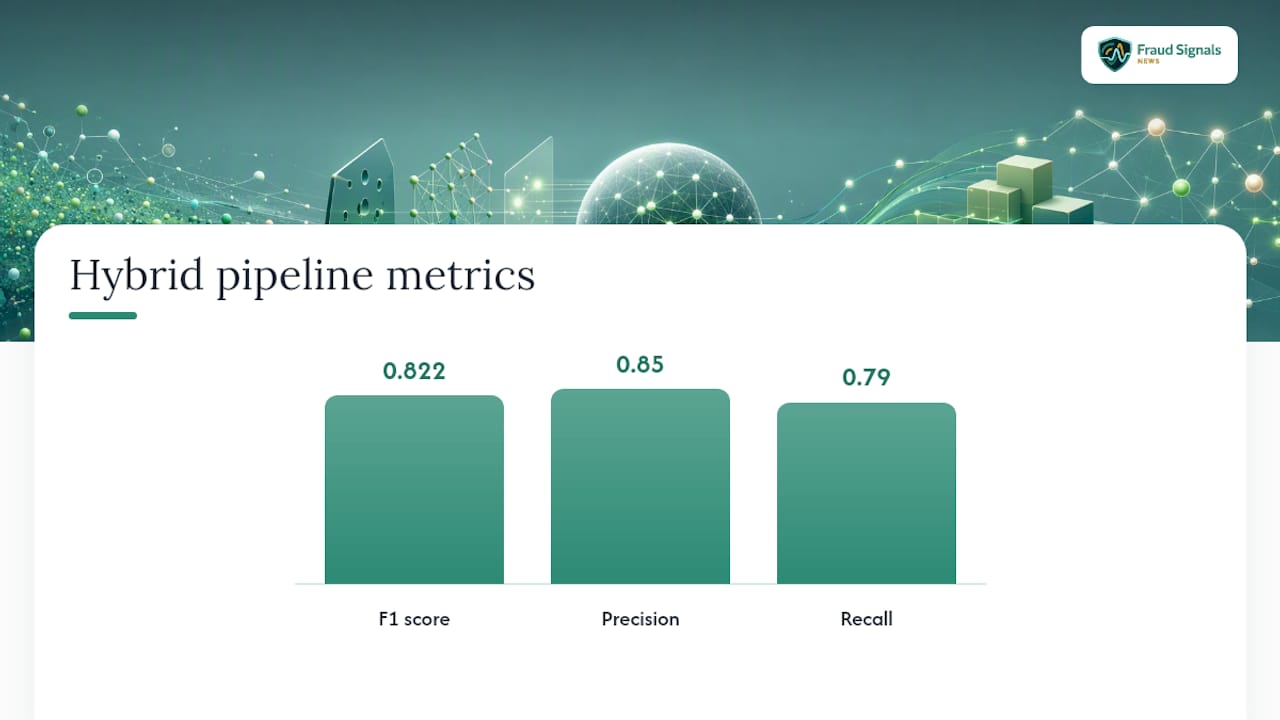
A 2026 academic pipeline combining symbolic PII transformation, behavioral profiling, anomaly scoring, and ensemble classification reported an F1 score of 0.822, with 0.85 precision and 0.79 recall on a real-world financial dataset, a strong result for a fraud task that is typically severely imbalanced. That kind of hybrid design, unsupervised scoring feeding supervised models, is increasingly the practical standard rather than the exception.
Governance can’t be an afterthought here. Explainability methods like SHAP values let investigators see which features drove a flag, which matters both for regulatory defensibility and for prioritizing manual review queues. Pair that with ongoing model monitoring and periodic red-team exercises to catch drift before fraud rings adapt around your thresholds.
From Onboarding Decisions to Ongoing Portfolio Monitoring
Detection has to run at two speeds: real-time decisioning at onboarding, and slower, deeper monitoring across the life of the account. Sleeper accounts and bust-outs are, by definition, invisible at the moment of application. They only become visible weeks or months later, once the identity has built enough credit history to cash out.
- Real-time decisioning. Apply step-up rules the moment velocity, device, or link signals cross a threshold, before a human ever touches the file.
- Case management. Route flagged applications into a prioritized investigation queue, weighted by the confidence score and potential exposure.
- Portfolio surveillance. Run link analysis across the existing book of business on a recurring basis, not just at onboarding, watching for accounts that suddenly cluster with known bad actors.
- Feedback loops. Feed confirmed loss events back into model retraining and update network-level watchlists so the same ring doesn’t succeed twice with a slightly different persona.
Pro Tip: Set an explicit escalation trigger, for example, elevated monitoring once an account reaches a defined link-degree threshold or accumulates credit above a set dollar amount within a short window, and tune that threshold to your own portfolio rather than borrowing an industry default that may penalize legitimate thin-file customers.
Sharing Signals Across Institutions Without Overreaching on Privacy
No single institution sees enough of the picture to catch a fraud ring operating across multiple lenders simultaneously, which is why cross-institution collaboration keeps showing up in every serious mitigation framework. The Fed’s mitigation toolkit is explicit that no single control stops synthetic identity fraud, and link analysis only works at scale when institutions pool relationship signals through industry consortiums and anti-fraud networks.
The eCBSV service run by the Social Security Administration gives institutions a way to verify SSN, name, and date of birth against authoritative federal records, with consumer consent required for each check. That single verification step closes off one of the most common synthetic identity building blocks: an SSN pulled from a public breach or randomly generated to pass basic format checks.
Practical guardrails for information sharing:
- Minimize shared data to what’s necessary for fraud detection, not full PII sets.
- Document consent and legal basis for every SSN verification request.
- Report confirmed synthetic identity activity through established industry channels so other institutions can update their own watchlists.
- Treat data-sharing agreements as living documents, revisited as fraud patterns and regulatory guidance evolve.
A Practical Rollout Checklist With Measurable KPIs
Standing up synthetic identity detection is a sequencing problem as much as a technology one. Build in this order:
- Data ingestion first. Get device, behavioral, and link data flowing into a unified pipeline before investing heavily in modeling.
- Identity proofing second. Set IAL requirements by product risk tier and integrate eCBSV verification with proper consent flows.
- Device and behavioral signals third. Deploy persistent fingerprinting and session analytics across the full funnel, not just at application.
- Model pipeline last. Layer unsupervised anomaly detection and supervised scoring once the upstream signals are reliable enough to train on.
| KPI | What it tells you |
|---|---|
| Detection lead time | How early sleeper accounts get flagged relative to bust-out |
| Precision at target recall | Whether alert volume is manageable at your chosen sensitivity |
| False positive rate | Friction imposed on legitimate thin-file applicants |
| Review load and ROI | Investigator hours per confirmed fraud dollar prevented |
Run backtests against historical loss data, schedule regular red-team exercises to probe for blind spots, and A/B test step-up friction to confirm it’s actually reducing fraud rather than just annoying good customers. Review thresholds and governance quarterly at minimum, and always run a post-incident review after a confirmed loss event to feed lessons back into the model. For a broader look at program-level tactics, Fraud Signals News’s guide on reducing identity fraud exposure covers implementation sequencing in more depth.
What Fraud Signals News Coverage Reveals About Detection in Practice
Fraud Signals News has tracked how multimodal ensemble models, deepfake-driven patient identity verification failures, and counterfeit ID reporting all trace back to the same operational gap: institutions checking documents once and never again. Coverage on false identity bank accounts and the site’s ongoing deepfake reporting both illustrate how liveness and biometric binding failures show up in real cases, not just lab benchmarks.
Carlos Ochoa’s reporting for the publication draws on this pattern of institutional blind spots to argue for testing regimes that mirror actual fraud ring behavior rather than static compliance checklists. That practitioner lens, grounded in real incident reporting rather than vendor marketing, is what separates Fraud Signals News’s coverage from generic fraud-prevention content.
Where Fraud Teams Should Focus Their Investment Next
The near-term priority is data-sharing infrastructure and identity proofing, in that order, because ML models trained on isolated institutional data will always underperform models fed relationship signals from across the industry. Machine learning matters, but it is a multiplier on good data, not a substitute for it.
Industry collaboration remains the hardest sell internally, since it requires accepting some operational friction and legal complexity in exchange for a detection lift that shows up gradually rather than immediately. Fraud teams that wait for a perfect data-sharing framework before acting will keep losing ground to rings that already share intelligence freely among themselves.
Measure everything, iterate fast, and treat every confirmed loss as a data point that should reach your model within weeks, not quarters.
— Carlos Ochoa
Stay Ahead of Synthetic Identity Fraud With Fraud Signals News
Fraud Signals News covers the specific technologies, deepfake ID tactics, liveness detection failures, and biometric verification gaps, that generic fraud-prevention content skips entirely. That reporting depth is the advantage: while comparison guides list vendors, Fraud Signals News tracks how detection actually breaks down in live incidents, giving your team a head start on tactics before they hit your own portfolio.

If your team is evaluating identity verification vendors for stronger document and biometric checks, DAON is worth a look as an established option in that space. For phishing-resistant step-up authentication specifically, strong two-factor authentication approaches are also worth reviewing alongside your identity proofing stack. Subscribe to Fraud Signals News’s ongoing coverage and visit the fintech fraud category hub for sector-specific case studies, or start at Fraudsignals to see the latest reporting on emerging fraud techniques.
Where to Go Deeper on Synthetic Identity Detection
For policy framing, start with the Federal Reserve’s synthetic identity mitigation toolkit. For technical identity-proofing standards, NIST SP 800-63A is the authoritative reference. For consumer-facing guidance on spotting identity misuse, the FTC’s identity theft resource covers monitoring and response steps directly.
Sources
- Detecting Synthetic Identity Fraud in the U.S. Payment System (Federal Reserve Services / FedPayments)
- NIST SP 800-63A identity proofing and verification guidance
- What to know about identity theft (FTC)
- Outsmarting synthetic identities: Robust learning pipeline for financial fraud detection (Springer, 2026)
FAQ
How Do You Detect Synthetic Identities?
Detection requires layered signals: NIST-aligned identity proofing, device and behavioral link analysis, and machine learning models trained on relationship data, since no single check reliably catches a fabricated identity built from real and fake PII.
How Do I Know if My Identity Has Been Cloned?
Monitor your credit report for accounts you don’t recognize, unexpected hard inquiries, or address changes you didn’t make, and consider a fraud alert or credit freeze if you spot anything unusual, per FTC guidance.
What Does a Potential Synthetic Identity on My Credit Report Mean?
It typically means a credit bureau’s algorithm flagged a mismatch, such as an SSN issue date that doesn’t align with the account’s reported age, or a thin file with inconsistent identity elements, patterns the Federal Reserve’s research documents as common synthetic fraud indicators.
How Can Synthetic Identities Be Detected During Onboarding?
Combine real-time device fingerprinting, velocity checks across applications, and IAL2-level document and biometric verification at the point of application, then apply step-up review whenever those signals cross a defined risk threshold rather than relying on a single credit check alone.
Recommended

ID Security Features: What Each One Does and How to Check It

Face Liveness Detection: How It Works and Where It Fails