

Effective sim swap fraud detection means correlating three signals in real time: carrier subscription-state changes, persistent service loss, and near-term spikes in authentication or account-recovery traffic. No single signal earns trust on its own. When two or more fire together, fraud teams should trigger step-up authentication, place a temporary hold on sensitive actions, and open an investigation before funds or credentials move.
TL;DR:
- Effective detection correlates carrier events, service disruptions, and authentication spikes within a configurable window of 30 minutes to 6 hours.
- Combining signals such as SIM profile changes, port-out requests, unexplained service loss, and unusual activity increases fraud detection confidence.
- Regulations now require carriers to authenticate SIM change requests securely, notify customers, and retain detailed records to prevent unauthorized swaps.
- Moving away from SMS-based OTP to phishing-resistant MFA and querying SIM-swap APIs before high-risk actions can significantly reduce fraud risk.
- Rapid response involves immediate carrier contact, revoking sessions, using non-SMS recovery methods, and preserving logs for forensic review.
Table of Contents
- What SIM Swap And Port-Out Fraud Actually Are
- What Signals And Telemetry Should You Collect?
- How Should You Build The Correlation Model?
- What Operational Controls Actually Stop These Attacks?
- What Should You Do When A SIM Swap Is Suspected?
- What Emerging Signals And Technologies Should You Watch?
- Where Detection Priorities Should Go Next
- Stay Ahead Of Identity Fraud With Fraud Signals News
- Primary Sources For SIM Swap Detection Standards
- Sources
- FAQ
What SIM Swap And Port-Out Fraud Actually Are
A SIM swap happens when a fraudster convinces a carrier to move a victim’s phone number onto a SIM card the fraudster controls, often through social engineering or a compromised help-desk agent. Port-out fraud is a close cousin: the attacker moves the number to a different carrier entirely, exploiting weaker cross-carrier verification. Both attacks strip the legitimate subscriber of SMS and call service and hand the attacker control of anything tied to that number, especially one-time passcodes.
The typical chain runs in a predictable order:
- Data gathering through breached credentials, phishing, or purchased personal data
- Social engineering against a carrier representative or a self-service portal weakness
- The SIM change or port request, executed with stolen identifiers
- Rapid account takeover across banking, email, and crypto platforms once the number is hijacked
MITRE’s T1451 technique documentation lays out this exact sequence and recommends monitoring SIM changes through mobile device management platforms as a primary countermeasure. The IC3 2023 Annual Report treats SIM swap as its own crime category. It reflects how consistently it feeds larger account-takeover losses across banking and cryptocurrency platforms.
What Signals And Telemetry Should You Collect?
Detection fails when teams watch a single data point. A subscriber changing phones legitimately looks identical, for a moment, to one who just got swapped. The difference shows up only when you stack signals against each other.
Carrier-side telemetry to log:
- SIM profile change events, tracked separately from eSIM profile downloads
- Port-out requests, including the receiving carrier and timestamp
- SIM-swap API flags such as a Boolean for “swapped in period” or a last-swap timestamp, which Twilio’s Lookup API and similar services expose
- Failed or repeated authentication attempts at the carrier’s self-service portal
Service-side and enterprise signals:
- Persistent loss of cellular service beyond what a normal handset restart produces
- A spike in SMS one-time-passcode sends or password-recovery flows tied to the same number
- Repeated contacts with customer support in a short window, especially requests to change contact details
- New device fingerprints, unfamiliar IP ranges, or impossible-travel patterns appearing alongside the number change
The trouble with any of these signals alone is noise. Legitimate roaming, device upgrades, or network outages can trigger similar events a fraud analyst would flag. MITRE’s DET0658 detection strategy makes this point directly: service loss by itself is a weak signal because ordinary handset replacement produces similar telemetry. Confidence rises when service loss coincides with an authentication anomaly in the same window.
Statistic Callout: The IC3 2023 Annual Report emphasizes losses tied to SIM swap as a distinct crime category, underscoring why fraud teams increasingly treat it as a primary attack vector into banking and crypto accounts rather than a marginal edge case.
Filtering the noise means building baselines per carrier and per customer segment. A prepaid account with a history of frequent device swaps needs a different threshold than a decade-old postpaid line that has never changed a SIM. Static thresholds applied uniformly across a subscriber base will drown analysts in false positives within weeks.
How Should You Build The Correlation Model?
Detection works as a timing problem: how close together did the carrier event and the authentication event happen? MITRE’s DET0658 guidance recommends correlation windows ranging from 30 minutes to 6 hours, depending on the confidence level you’re aiming for and how aggressive fraudsters in your customer base tend to be.
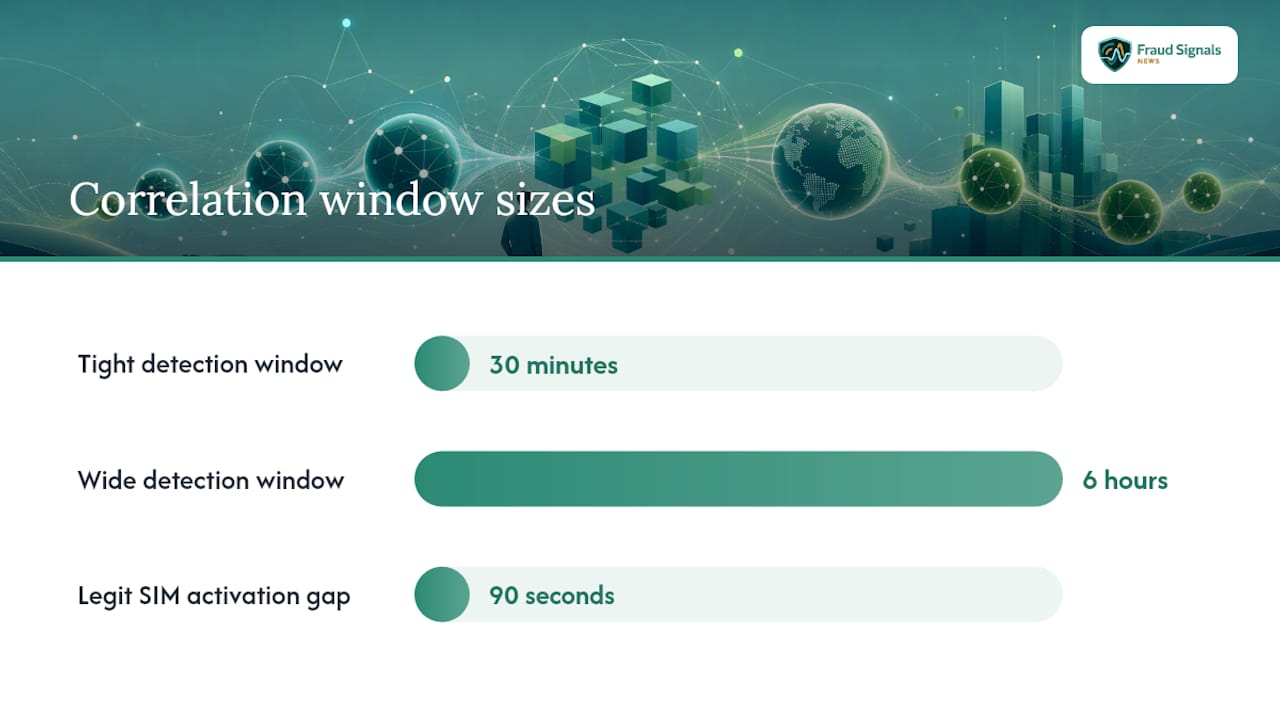
A tight 30-minute window catches the classic pattern: swap the SIM, then immediately request an OTP for the target bank account. A wider 6-hour window catches slower-moving fraud rings that wait to avoid tripping instant alerts, but it also pulls in more legitimate coincidences and raises your false-positive rate.
Three normalization and tuning steps make this workable at scale:
- Normalize event types separately. Treat physical SIM changes, eSIM profile downloads, and port-out requests as distinct event categories rather than collapsing them into one generic “SIM changed” flag. Collapsing them destroys the analytic granularity you need to spot which attack pattern you’re facing.
- Set differentiated thresholds by risk tier. A $50 transaction and a $50,000 wire transfer should not share the same correlation window or the same friction response.
- Track catch rate and false-positive rate as separate metrics. A model that catches 95% of swaps but locks out 20% of legitimate handset upgrades will burn through customer trust and support capacity fast.
Pro Tip: Log service-loss duration as its own field, not just a binary flag. A 90-second gap during a legitimate SIM activation looks nothing like the multi-hour outage typical of a hostile takeover, and that duration alone can cut false positives significantly.
What Operational Controls Actually Stop These Attacks?
Detection only matters if it triggers a control that blocks the fraud in time. The FCC’s Report and Order, effective November 15, 2023, now requires wireless carriers to use secure authentication before any SIM change or port request, notify customers when a change is requested, retain records of the request and the authentication method used, and offer customers an account-lock option. That last requirement matters most for enterprise risk teams: if your vendor contracts don’t reference these obligations explicitly, you have no leverage when a carrier drags its feet during an active incident.
On the enterprise side, the fix is architectural, not procedural:
- Move away from SMS OTP wherever the account’s risk profile allows it, replacing it with phishing-resistant MFA built on FIDO or WebAuthn standards
- Query SIM-swap APIs before authorizing high-risk actions like wire transfers, password resets, or new payee additions
- Apply step-up authentication or a short delay on any account that shows a SIM event within the past 24 to 72 hours
- Audit help-desk agent access and require dual sign-off for identity-verification overrides
Pro Tip: Scattered Spider and similar threat actors don’t stop at the carrier. They use the hijacked number to reset credentials into corporate single sign-on. If your account takeover defenses don’t ingest carrier signals, you’re leaving the door open on the identity side even after the phone number is secured.
What Should You Do When A SIM Swap Is Suspected?
- Contact the carrier’s fraud channel immediately and request a formal investigation, an account hold, and preservation of authentication and request records.
- Revoke active sessions and tokens tied to the affected account across every connected platform, not just the one where the fraud surfaced first.
- Force account recovery through non-SMS channels such as a security key, authenticator app, or in-person verification.
- Lock or delay pending transfers and payment changes until the identity is reconfirmed through a secondary channel.
- Preserve logs covering the carrier event timeline, login attempts, OTP sends, and support contacts for forensic review.
- Report the incident to the IC3, local law enforcement where required, and run an internal postmortem to close the gap that let it happen.
Speed matters more here than in almost any other fraud category. Once a number is hijacked, every minute of delay is a minute the attacker spends resetting credentials elsewhere.
What Emerging Signals And Technologies Should You Watch?
SIM-swap APIs are useful but imperfect. Twilio’s documentation notes that last-swap-date data is only available for some countries, so any risk model leaning on it needs explicit fallback logic for uncovered carriers. The CAMARA Open Gateway SIM Swap API offers a standardized alternative, but coverage and timestamp semantics still vary by operator, so validate before you trust a flag blindly.
- Treat carrier signals as one input to a risk score, never as standalone proof of identity
- Stop anchoring account recovery to phone number possession alone
- Watch for biometric and liveness checks moving into high-assurance recovery flows, an area Fraud Signals News tracks closely as identity verification shifts beyond SMS-based trust
Where Detection Priorities Should Go Next
The gap most teams miss isn’t the carrier signal. It’s the failure to join carrier telemetry with IAM and help-desk logs into one timeline. Replace SMS OTP where you can, and negotiate carrier notification and lock guarantees into every vendor contract now.
— Carlos Ochoa
Stay Ahead Of Identity Fraud With Fraud Signals News
This source offers operational coverage for teams that need SIM swap fraud detection guidance they can act on quickly, rather than abstract trend pieces. Where general security outlets treat SIM swap as a footnote, The coverage includes carrier API changes, MITRE detection updates, and identity-verification shifts that impact how fraud teams build their models.

If your team is still weighing SMS OTP replacement or evaluating how DAON’s identity verification tools fit into a layered authentication stack, that comparison belongs in a broader account opening fraud detection review rather than a single vendor pitch. Fraud Signals News publishes the briefings that connect carrier-level detection to the identity-verification layer, including mobile banking fraud risk coverage most trade outlets miss entirely. Visit Fraudsignals to request a deeper briefing or sign up for ongoing analysis as carrier rules and detection standards evolve.
Primary Sources For SIM Swap Detection Standards
- MITRE ATT&CK Detection Strategy DET0658 and Technique T1451
- FCC Report and Order on SIM swapping
- IC3 2023 Annual Report
- Twilio SIM Swap Lookup API docs
- CAMARA Open Gateway SIM Swap API docs
- FBI/IC3 Cyber Safety Alert on Scattered Spider
Sources
- Detection of SIM Card Swap, Detection Strategy DET0658 | MITRE ATT&CK®
- SIM Swap — Twilio Lookup API docs
- FCC announces effective compliance date for SIM swapping item
- Internet Crime Complaint Center (IC3) 2023 Annual Report
- SIM Card Swap, Technique T1451 – Mobile | MITRE ATT&CK®
FAQ
How Can You Tell If Someone SIM Swapped You?
The clearest sign is sudden, unexplained loss of cellular service, including no calls, texts, or data, combined with account alerts you didn’t trigger yourself. If that coincides with password-reset emails or login notifications from unfamiliar devices, contact your carrier’s fraud line immediately.
Can You Protect Yourself From SIM Swapping?
Yes, though no single step guarantees protection. Setting a carrier account PIN, requesting an account-lock option now required under the FCC’s rules, and moving away from SMS-based two-factor authentication toward an authenticator app or security key meaningfully cuts your exposure.
How Is SIM Swap Fraud Typically Carried Out?
Attackers gather personal details through phishing or breached data, then use that information to impersonate the victim to a carrier representative or self-service portal. Once the carrier approves the SIM change or port, the attacker controls the phone number and intercepts SMS codes needed to break into banking, email, and crypto accounts, a chain MITRE’s T1451 documentation outlines in detail.
How Do You Check If Your SIM Was Cloned Or Swapped?
Check your carrier account for recent SIM or port-out activity you didn’t request, and watch for a sudden service outage with no explanation. Enterprise risk teams can query SIM-swap APIs like Twilio’s Lookup service to check for a recent swap flag before authorizing a sensitive action tied to that number.
Recommended

21 Day Pilot: Layer Behavioral and Physical Biometrics for Fraud Teams
Fraud Ops: 5 ID Document Forgery Classes That Beat Lab Tests