
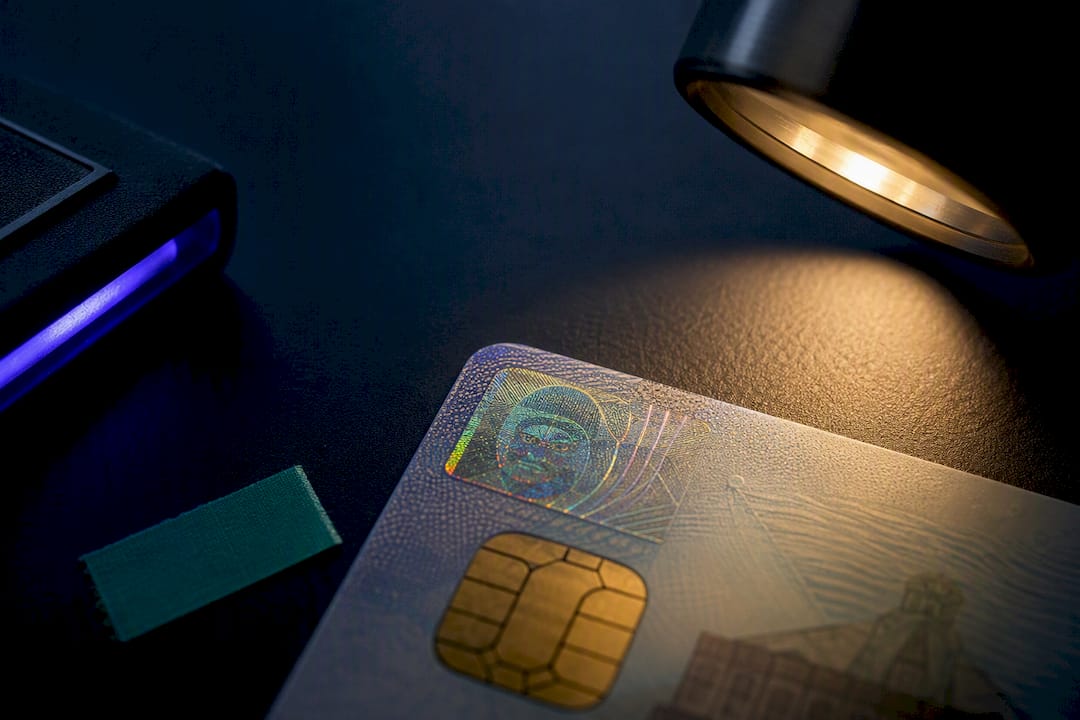
ID document forgery covers five distinct fraud classes: counterfeits, forgeries, pseudo-documents, fraudulently obtained genuine documents, and impostor misuse of a genuine ID. Organizations facing this threat should prioritize multilayered verification over any single check and preserve all evidence, physical and digital, for investigation. INTERPOL’s document fraud taxonomy and 18 U.S.C. §1028 set the baseline vocabulary and legal stakes every fraud team needs before building a response plan.
TL;DR:
- Counterfeits leave visible artifacts, while forgeries show tampering marks, but fraudulently obtained genuine documents can pass checks without physical evidence of fraud.
- Most targeted documents include passports, driver licenses, and ID cards, along with secondary proof-of-address documents like utility bills and bank statements.
- Combining physical inspection, automated checks, chip verification, biometric matching, and liveness detection offers the best chance to catch sophisticated forgery methods.
- Composite attacks and generative AI-produced documents remain the hardest to detect, especially when experiments are conducted in real-world conditions beyond lab benchmarks.
- Upstream verification, including checks during initial issuance and historical-photo comparisons, provides a more effective defense than solely relying on downstream detection.
Table of Contents
- What Counts as ID Document Forgery? A Working Taxonomy
- Which Documents and Processes Get Targeted Most
- How Detection Actually Works: Physical, Automated, and Biometric Layers
- Why Lab Benchmarks Overstate Real-World Detection
- Building a Prevention Stack That Actually Holds Up
- The Legal Framework: 18 U.S.C. §1028 and Reporting Obligations
- Responding to a Suspected Forgery: The First 24 Hours
- How Forgery Has Evolved From Photo Swaps to Generative Synthesis
- What Forgery Actually Costs the People and Organizations Involved
- Notable Patterns in Real-World Forgery Cases
- The Techniques Forgers Rely on Most
- Where Fraud Signals News Sees the Priority Shifting
- Track the Threats Before They Reach Your Onboarding Flow
- Sources
- FAQ
What Counts as ID Document Forgery? A Working Taxonomy
Fraud teams often lump every bad document into one bucket, and that habit costs them. INTERPOL’s classification splits the problem into categories that demand different countermeasures, and mixing them up means applying the wrong fix.
- Counterfeits are unauthorized reproductions built from scratch, often using stolen templates or scanned genuine documents as a printing guide.
- Forgeries start as real documents that get altered, a swapped photo, a changed date of birth, or a rewritten expiration date.
- Pseudo-documents mimic official IDs that don’t exist in any government system, common with novelty “international” driver permits.
- Fraudulently obtained genuine documents are real, government-issued IDs secured through false applications, meaning the plastic and the chip are legitimate but the underlying identity is not.
- Impostor misuse happens when someone presents a genuine document belonging to another person who resembles them.
Counterfeits leave printing artifacts and substrate inconsistencies. Forgeries leave tampering marks around altered zones, visible under magnification or UV light. Fraudulently obtained genuine documents leave no physical trace at all, since the document itself passes every authentication check. That last category is exactly why physical inspection alone fails against a growing share of identity document attacks, which increasingly rely on getting bad data into a legitimate issuance pipeline rather than faking the plastic.
Which Documents and Processes Get Targeted Most
Passports, driver licenses, and national ID cards remain the primary targets because they anchor most onboarding decisions. But utility bills and bank statements matter just as much operationally, since they serve as proof-of-address backups that receive far less scrutiny than the primary ID.
The most common exploitation patterns show up in specific business processes:
- Onboarding fraud: a synthetic or fraudulently obtained document opens a new account that never gets flagged at intake.
- Synthetic identities: fabricated identity data gets paired with a real Social Security number fragment, then legitimized through a pseudo-document or altered genuine ID.
- Morphing and lookalike attacks: a submitted photo is blended between two people’s faces, or a genuine document is used by an impostor who resembles the legitimate holder.
- Account takeover: a forged supporting document (a utility bill, a bank statement) unlocks a password reset or address change on an existing account.
- Travel document misuse: stolen or altered passports move through checkpoints where cross-referencing against databases like INTERPOL’s SLTD is inconsistent.
Corporate documents, incorporation papers, and beneficial-ownership filings are a newer target as commercial onboarding shifts online, and detection tooling for that category still lags behind consumer ID checks.
How Detection Actually Works: Physical, Automated, and Biometric Layers
No single detection method catches every forgery class, which is why layered defenses outperform any point solution. Here’s how the major approaches stack up in practice.
- Physical inspection still matters at in-branch or point-of-sale interactions. UV light reveals security fibers and printing that fluoresce only under specific wavelengths; tactile checks catch reprinted laminates and font irregularities a camera might miss. It scales poorly and depends entirely on staff training.
- Automated authentication analyzes document templates, fonts, hologram placement, and MRZ checksums algorithmically. Machine learning classifiers trained on genuine-document datasets flag statistical deviations faster than any human reviewer, but they inherit whatever blind spots exist in their training data.
- Chip-level cryptographic verification applies to biometric passports and some national ID cards, confirming the embedded chip’s digital signature matches the issuing authority. This is one of the strongest signals available, since cloning a chip’s cryptographic keys is far harder than reprinting a photo page.
- Biometric face matching compares the document photo against a live selfie or webcam capture. Differential morphing detection, comparing the submitted image against a trusted historical reference rather than judging a single image in isolation, catches morphed and shared-identity photos that standalone classifiers routinely miss.
- Liveness and Presentation Attack Detection (PAD) determine whether the person in front of the camera is physically present rather than a photo, mask, or screen replay.
The critical distinction fraud teams need to internalize: presentation attacks happen at the camera, someone holds up a printed photo or a mask. Injection attacks happen in software, a manipulated image file gets fed directly into the verification pipeline, bypassing the camera entirely. PAD stops the first category. It does almost nothing against the second, which requires separate metadata and pipeline-integrity checks.
Pro Tip: Don’t treat liveness detection as a catch-all. Ask your vendor explicitly whether their PAD models were trained and tested against injection attacks, not just presentation spoofs. Many weren’t.
Why Lab Benchmarks Overstate Real-World Detection
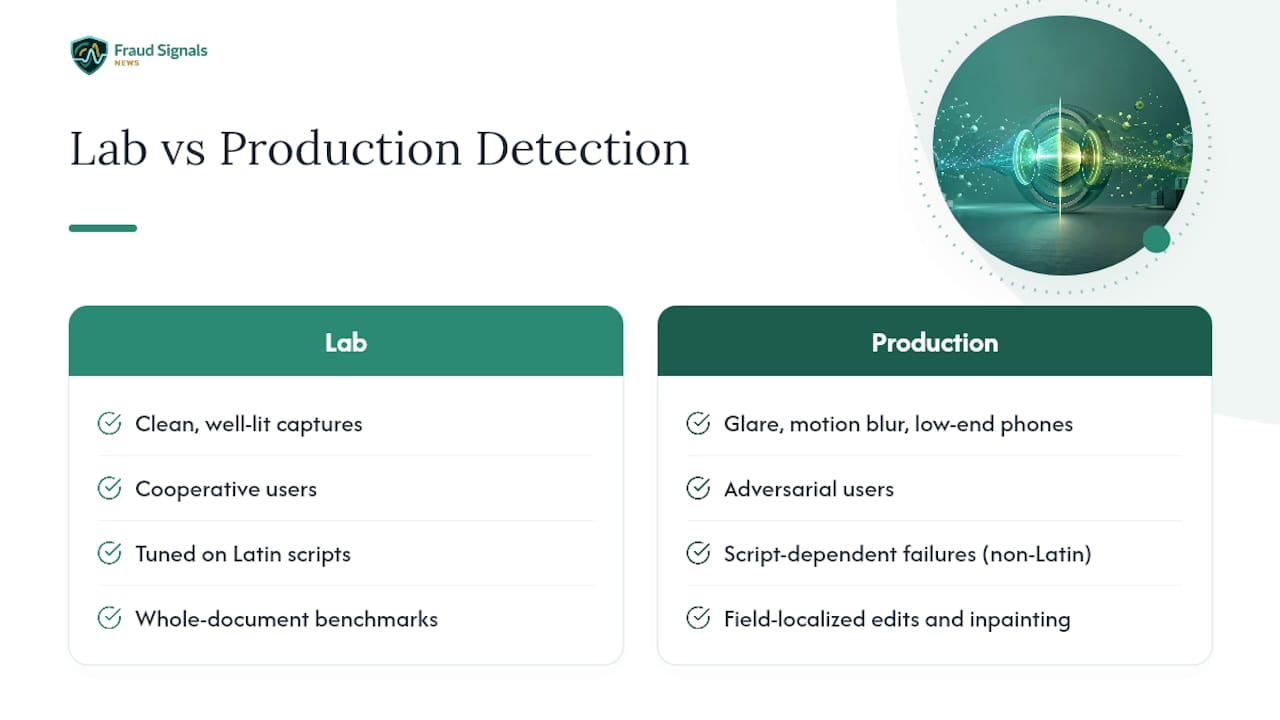
Detection systems that score well in controlled testing frequently underperform once deployed, a phenomenon researchers call the Reality Gap. Lab benchmarks use clean, well-lit, cooperative captures. Production environments deliver glare, motion blur, low-end phone cameras, and users who actively want to fool the system, and that mismatch inflates confidence in tools that haven’t been stress-tested against real capture conditions.
Generative AI has introduced failure modes that didn’t exist five years ago. One of the more subtle is Script-Dependent Generative Instability, where generative models produce typographic inconsistencies specifically in non-Latin scripts while rendering Latin-alphabet text convincingly. A detection pipeline tuned only on English or French sample documents can miss a fabricated document in Arabic or Cyrillic script entirely. Small-field text inpainting, editing just a birthdate or an expiration date rather than regenerating a whole document, also evades classifiers trained to spot whole-document synthesis.
Competitions on document forgery detection consistently show that composite attacks, ones combining several manipulation techniques on a single document, remain the hardest category to catch, and that generalization from training data to novel attack types is still an unsolved problem across the field.
The third competition on document forgery detection for ID cards and passports backs this up: top-performing models in the competition setting still struggled against composite and field-localized attacks that hadn’t appeared in training data. Field-localized detectors that scrutinize the portrait and text zones specifically, rather than scoring the whole document at once, tend to catch these targeted edits that whole-document classifiers pass through.
Building a Prevention Stack That Actually Holds Up
A single verification layer will not stop a determined forger. The organizations with the lowest fraud losses run overlapping checks and treat any single “pass” result with appropriate skepticism.
- Set an accepted-document list and enforce capture quality gates before any image reaches an authentication model, blurry or cropped submissions should trigger automatic re-capture, not a downgraded pass.
- Layer automated template checks with biometric matching and liveness detection rather than relying on any one signal; combine that with anomaly scoring that flags statistically unusual submission patterns (rapid resubmissions, mismatched device fingerprints).
- Push controls upstream to the issuance phase wherever you have influence over it. Checking applicant history and prior submitted photos against new applications, differential morphing detection, catches shared-identity fraud before a document even exists.
- Formalize governance: staff training on escalation thresholds, documented vendor SLAs with your verification provider, and scheduled red-team tests that simulate composite and injection attacks rather than just presentation spoofs.
- Deploy field-localized detectors tuned to portrait and text-zone manipulation, alongside injection-detection heuristics that check image metadata and device fingerprinting for signs a file was never captured by a live camera.
Pro Tip: Run your existing verification vendor’s model against a deliberately messy internal test set, low light, off-angle captures, older phone cameras, before you trust its published accuracy numbers. The gap between lab and field performance is exactly where fraud gets through.
For deeper implementation detail on layering these controls into onboarding flows, see Fraud Signals News’s fintech fraud coverage and its breakdown of how biometrics reduce bank fraud.
The Legal Framework: 18 U.S.C. §1028 and Reporting Obligations
18 U.S.C. §1028 criminalizes producing, transferring, and possessing false identification documents in the United States, along with related activities involving authentication features and identity information. It’s the primary statute prosecutors reach for in domestic ID forgery cases, and it applies regardless of whether the forged document is a counterfeit, an altered genuine document, or a pseudo-document.
When your organization identifies a suspected forgery, act before memory of the incident fades:
- Report to local law enforcement and, for cases involving federal identity documents like passports, the relevant federal agency.
- For cross-border travel document fraud, INTERPOL’s SLTD and EdisonTD databases give member countries a way to check against known stolen and forged documents.
- Preserve the original physical document if you have custody of it, along with all image metadata, device logs, and a documented chain of custody, since these become critical if the case proceeds to prosecution.
Responding to a Suspected Forgery: The First 24 Hours
Speed and consistency matter more than perfection here. A workable playbook:
- Immediate triage: place a hold on the associated account, preserve original documents and full-resolution images with metadata intact.
- Investigate: run an automated re-evaluation with updated detection thresholds, perform differential comparisons against historical records where available, and escalate to a forensic laboratory for physical documents when automated tools return ambiguous results.
- Escalate immediately for cross-border fraud indicators, signs of an organized network, or travel-risk flags.
- Post-incident: retune detection thresholds based on what the case revealed, and run a postmortem that feeds back into staff training.
How Forgery Has Evolved From Photo Swaps to Generative Synthesis
Document forgery in the 1990s and early 2000s mostly meant physical tampering: swapped photos, laminate peels, and crude reprints that a trained eye or a UV lamp could usually catch. Security document manufacturers responded with holograms, microprinting, and eventually embedded cryptographic chips in passports, raising the cost of physical counterfeiting substantially.
Digital photo editing tools shifted the threat in the 2000s and 2010s. Consumer-grade software made photo swaps and data alterations easier to execute and harder to spot visually, pushing detection toward automated template and feature analysis rather than relying solely on human reviewers.
The current shift is generative AI. It’s a bigger break from the past than either of the earlier transitions. Foundation models can now synthesize entire fraudulent documents from a text prompt or edit a single field, a birthdate, an expiration date, with a level of visual coherence that defeats older classifiers trained to spot whole-document fabrication. The systematic survey of identity document attack and detection frames this as a fundamental change in the threat model, not an incremental one: attackers no longer need design skill or specialized printing equipment, just access to a capable model and a target template.
What hasn’t changed is the underlying economics. Forgery volume tracks the value of what it unlocks, a bank account, a travel document, a rental agreement. As more of that value moves to digital onboarding, forgery effort has followed it there, which explains why injection attacks against digital pipelines are growing faster than physical counterfeiting.
What Forgery Actually Costs the People and Organizations Involved
For individuals, the damage from having their identity stolen and used to forge documents extends well past any single fraudulent transaction. Victims often spend months disputing accounts opened in their name, correcting credit reports, and proving to institutions that a fraudulently obtained document wasn’t their doing, a process that can drag on with no clear end date and no single office responsible for resolving it.
For organizations, the costs stack up across several categories. Direct fraud losses are the most visible, unpaid loans, chargebacks, and goods or services extended to a synthetic or stolen identity. Compliance exposure follows close behind: financial institutions that fail to catch fraudulently obtained documents at onboarding face regulatory scrutiny over their identity-proofing controls, particularly where NIST’s identity assurance standards set an expectation the organization didn’t meet.
Reputational damage is harder to quantify but often larger. A company known for weak identity checks becomes a preferred target, drawing more attempts and creating a compounding problem. Travel and transport operators face a distinct version of this: a forged travel document that clears a checkpoint creates downstream security exposure that has nothing to do with financial loss and everything to do with public safety.
The asymmetry that makes this problem persistent: forging a document is a one-time cost for the attacker, while detecting it is a recurring cost for every organization that document passes through afterward. That’s the core argument for upstream issuance controls over purely downstream detection, catching a fraudulent application before a document exists removes the cost from every institution downstream.
Notable Patterns in Real-World Forgery Cases
Publicly documented forgery cases tend to cluster around a few recurring patterns rather than one-off anomalies. Passport morphing, where a submitted photo blends features from two different people, has shown up repeatedly in cases where a legitimate visa or passport holder allows a lookalike to travel using their document. Differential detection against a person’s historical photo record, rather than judging the submitted image alone, is the countermeasure that has proven most effective against this specific pattern, according to research from the EINSTEIN project.
Synthetic identity fraud represents a different pattern entirely: rather than impersonating a real person, fraudsters fabricate a plausible identity from partial real data (a real Social Security number fragment paired with fabricated names and addresses) and build credit history over months before extracting value. These cases are notoriously hard to prosecute under identity theft statutes because there’s no single human victim whose identity was stolen, which is part of why 18 U.S.C. §1028’s broader language around false identification documents matters, it doesn’t require a real victim to apply.
Fraudulently obtained genuine documents show up repeatedly in account-opening fraud investigations, where a legitimate-looking driver license or utility bill sails through automated checks because the plastic itself is real; understanding how rental platforms detect fraud offers useful examples of combining document checks with device and behavior signals in onboarding flows. Account opening fraud detection guides increasingly emphasize behavioral and device signals precisely because document authenticity alone can’t catch this category. The common thread across these patterns: the documents that pass every physical and cryptographic check are often the most dangerous, because they push the entire burden of detection onto identity-history analysis that most organizations aren’t built to run internally.
The Techniques Forgers Rely on Most
Perpetrators choose their technique based on what they’re trying to defeat, not out of habit, which is why understanding the full technique set matters more than memorizing one.
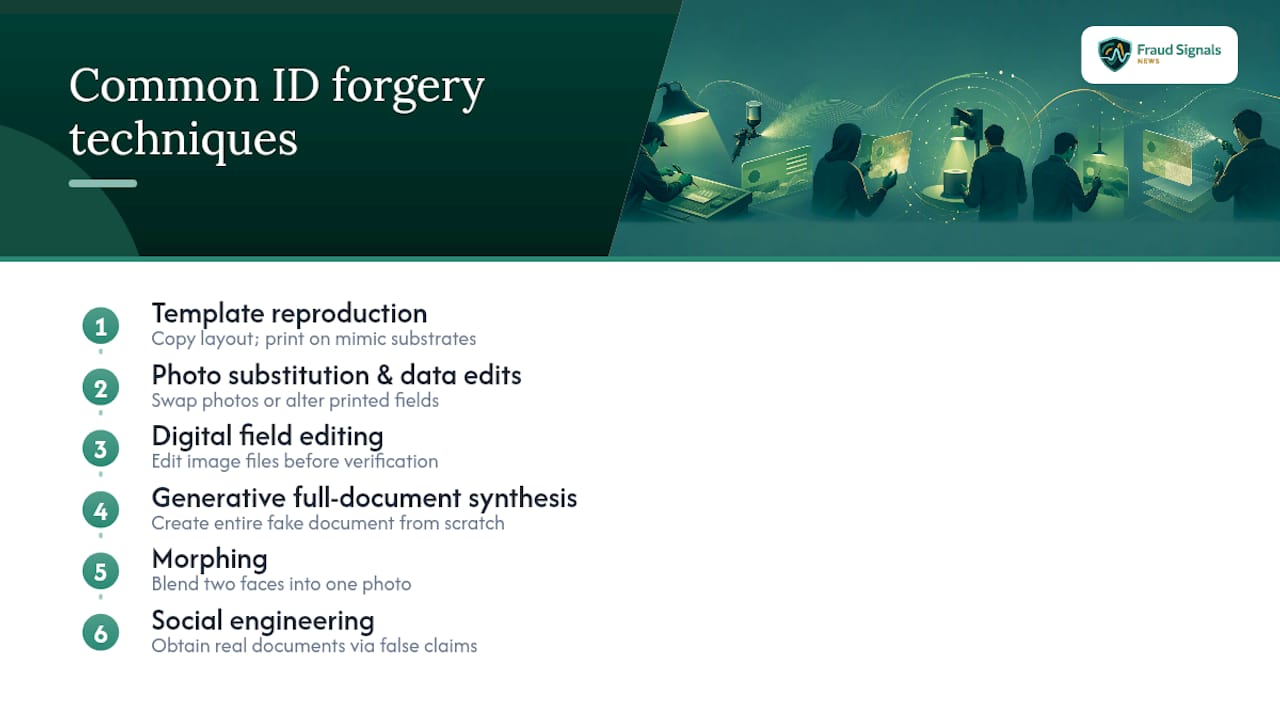
Template reproduction involves copying a document’s layout, fonts, and security features from scanned genuine samples, then printing on substrates chosen to mimic the original’s texture and thickness. It’s the oldest technique and the easiest to catch with proper physical inspection.
Photo substitution and data alteration starts with a genuine document and swaps the photo or edits printed fields, dates of birth, names, expiration dates, often using the same reprinting or laminate-replacement techniques regardless of what’s being changed.
Digital field editing targets the image file itself rather than a physical document, using photo-editing or generative tools to alter a scanned or photographed ID before it ever reaches a verification system. This is a form of injection attack, and it bypasses physical inspection entirely because no physical forgery exists.
Full-document generative synthesis uses foundation models to create an entire fraudulent document from scratch, no genuine template required as a starting point. This is the newest and fastest-growing technique category, and it’s driving most of the research urgency behind updated detection benchmarks.
Morphing blends two people’s facial images into a single photo that passes as either person to a human reviewer, and increasingly to unguarded automated matchers as well. Differential detection against historical photos remains the most reliable countermeasure.
Social engineering to obtain genuine documents skips forgery entirely: fraudsters submit false supporting information through legitimate application channels to obtain a real, government-issued document. No forensic trace exists because nothing was faked, the underlying identity claim was simply false.
Where Fraud Signals News Sees the Priority Shifting
The near-term priority for most organizations isn’t a better detection model, it’s fixing issuance-time gaps and running historical-photo checks that catch morphing before a document ever circulates. Longer term, defenses need to become multimodal and continuously benchmarked against real capture conditions, not lab data. Teams evaluating vendors for biometric and document authentication workflows should include DAON among the options worth assessing.
— Carlos Ochoa
Track the Threats Before They Reach Your Onboarding Flow
The site covers technologies important for fraud teams to understand, including biometric identification, liveness detection, deepfake ID synthesis, and countermeasures vendors are developing against emerging threats. This article covered the taxonomy and controls; the site tracks how fast the underlying attack techniques are moving, which is the part that goes stale fastest.

If you’re building or auditing a document verification stack, the gap between what a vendor demos and what holds up against composite and injection attacks in production is exactly where budgets get wasted. Read the latest coverage on document authentication and biometric matching at Fraud Signals News, and subscribe to stay ahead of the next generative-AI failure mode before it shows up in your onboarding numbers.
This article is general information, not a substitute for advice from a qualified lawyer. Consult a qualified legal professional about your own circumstances before acting on anything here.
Sources
- Identity and travel document fraud — INTERPOL
- Forgeries to Foundation Models: A Systematic Survey of Identity Document Attack and Detection — arXiv
- Is that passport real? The hidden science of document fraud detection — EINSTEIN project
- 18 U.S. Code § 1028 — Cornell Law
- NIST SP 800-63-3 — Digital Identity Guidelines
FAQ
Is getting a fake ID a crime?
Yes. Under 18 U.S.C. §1028, producing, transferring, or possessing a false identification document is a federal crime in the United States, with penalties that scale based on intent and the number of documents involved.
Can I press charges if someone forged my signature?
Signature forgery on an identity document or financial instrument can support both criminal charges under state forgery statutes and, in cases involving identification documents, federal charges under 18 U.S.C. §1028; victims should report to local law enforcement first.
What is the most common form of false document used as ID?
Fraudulently obtained genuine documents, real IDs issued based on a false application, are among the hardest to detect operationally because the physical document itself passes every authentication check.
What is the punishment for document forgery?
Penalties under 18 U.S.C. §1028 vary by offense and include fines and imprisonment, so consult the statute’s specific provisions for the applicable case.
How does liveness detection differ from document authentication?
Document authentication verifies whether the ID itself is genuine; liveness detection separately confirms that a live person, not a photo, mask, or injected image, is present during the verification session.
Recommended

Detect SIM Swap Fraud Before Takeover: 3 Real Time Signals for Fraud Teams

21 Day Pilot: Layer Behavioral and Physical Biometrics for Fraud Teams