

Onboarding bot detection is the assessment of a signup or account-opening request, before any account exists, to decide whether a person or a script is behind it. It works best as one input to a risk-based onboarding flow, not as a standalone gate, and the institutions that treat it as an automatic rejection rule tend to block real customers while sophisticated automation walks through. This guide explains what the control does, which signals feed it, where it fails, and how fraud teams in U.S. banking and fintech can tune it.
TL;DR
- Bot detection scores each onboarding request for the likelihood of automation and uses that score to decide whether to add a challenge, not to deliver a final verdict on identity.
- The strongest programs combine behavioral signals (typing, pasting, entry order), device and network signals, and identity checks such as document verification and liveness.
- Every threshold is a trade-off: stricter settings challenge more humans, looser ones let more bots pass, and neither error rate ever reaches zero.
- Customers wrongly flagged as bots should go to manual review, not be treated as confirmed fraud.
- U.S. institutions with covered accounts must keep a written identity-theft program, and bot signals belong in its red-flag logic.
Table of Contents
- What bot detection does during onboarding
- Why bots target account opening
- The signals that separate bots from customers
- Why the line between bot and customer keeps blurring
- Building a layered, risk-based onboarding flow
- Tuning thresholds without punishing real customers
- When a real person is flagged as a bot
- U.S. compliance considerations
- Our perspective
- Where to go next
- FAQ
- Sources
What bot detection does during onboarding
In a digital onboarding context, bot detection is a pre-account assessment. Okta’s published model card for its bot detection describes a machine-learning model that evaluates signup requests and produces a risk determination, which a downstream service uses to decide whether an additional verification step is required. The same documentation notes that the feature operates during sign-up as well as sign-in and password recovery, and that the model uses both stateful and stateless inputs.
Two points in that description matter for risk leaders. First, the output is a probability, not a fact. The model card states plainly that the system can produce false positives and false negatives and does not guarantee detection of every bot. Second, the output triggers an action, usually a challenge, step-up verification or a block, which means the real design work sits in what happens after the score, not in the score itself.
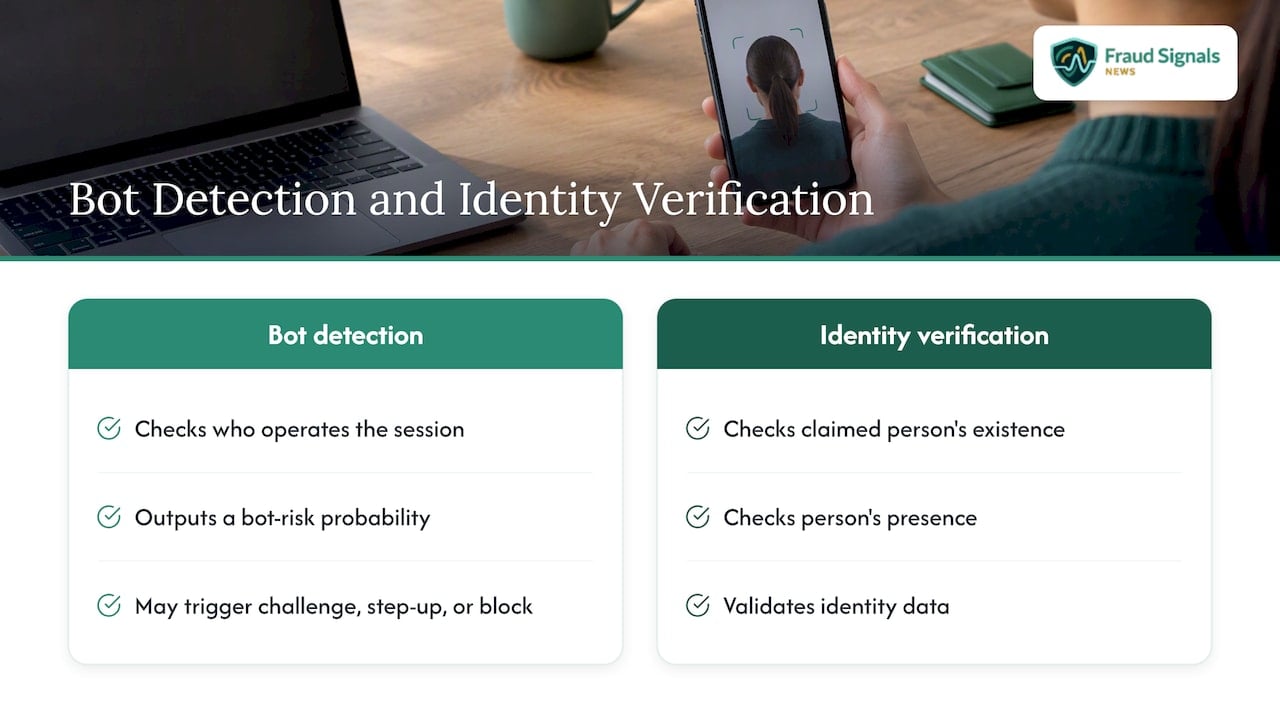
Bot detection is also distinct from identity verification. Identity verification asks whether the claimed person exists and is present. Bot detection asks whether a human is operating the session at all. A fraud ring can pass the second question with low-cost human labor or a headless browser driven by a person, and a bot can attempt to pass the first with stolen or fabricated data. You need both questions answered.
Why bots target account opening
Account opening is attractive because it is the one point where an institution must accept unknown input from the public, at volume, and decide quickly. The FedPayments Improvement initiative notes that bots can be used to attempt account openings or to gather intelligence on how a financial institution’s account-opening procedures work. That reconnaissance function is often overlooked: an attacker who probes a form thousands of times learns which data combinations pass, which fail, and where manual review begins.
Generative AI has widened the problem. In November 2024 the Treasury’s Financial Crimes Enforcement Network issued alert FIN-2024-Alert004 on fraud schemes involving deepfake media, and it reported that criminals used generative AI to create falsified documents, photographs and videos, including driver’s licenses and passports, to circumvent customer identification and verification procedures. Automation and synthetic media are now paired: scripts submit applications at scale, and generated artifacts supply the documents and faces that older checks were built to trust.
The resulting accounts are used for mule activity, credit abuse and bust-out schemes. We cover the downstream patterns in our guides on new account fraud prevention and false identity bank accounts.
The signals that separate bots from customers
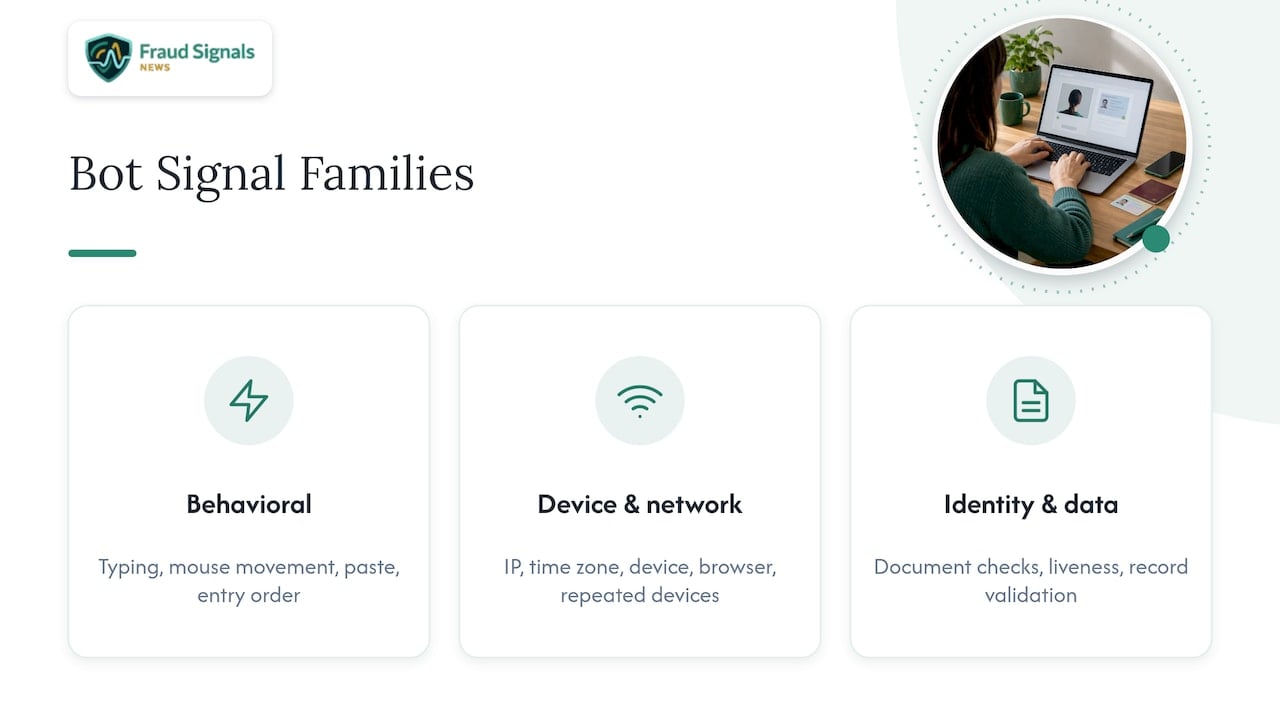
No single signal is reliable on its own. Programs that work stack signals from three families and read them together.
Behavioral signals
FedPayments Improvement lists keystroke speed, mouse movements, and copying and pasting among the behavioral indicators an institution can assess. Plaid’s customer documentation describes the same idea in operational terms: its onboarding behavioral analysis evaluates how quickly and accurately a person enters personal information, whether data is pasted, and the order of entry, and behavior consistent with fraud rings or bots can raise a user-behavior risk flag.
The caution is that pasting is not proof of anything. Password managers, autofill and accessibility tools all produce machine-like input from legitimate people, which is why behavioral flags should raise risk rather than decide the outcome.
Device and network signals
The same FedPayments guidance says time zone, geolocation, IP address, device specifications, and software or browser configurations can be analyzed to judge whether a user is likely to be legitimate. IDWise’s device-intelligence documentation adds detail on what automation looks like: it says onboarding bot detection identifies non-human behavior such as automation tools or crawlers, alongside signals including VPNs, proxies, emulators, virtual machines, browser tampering and repeated use of the same device.
Repeated device use deserves special attention. A single device that creates dozens of applications under different names is a stronger indicator than any individual browser quirk, and it is invisible if you evaluate each application in isolation.
Identity and data signals
The third family moves from the session to the claimed identity. FedPayments Improvement names document verification, liveness checks and third-party data validation as part of the toolkit. The Federal Reserve Banks suggest that triangulating customer-provided data with public records, such as property deeds, voter registrations or criminal records, helps surface red flags in identity proofing. On the media side, FinCEN advises that investigating suspected deepfake imagery can include reverse image searches to see whether a photo matches existing online galleries of AI-generated faces.
For the liveness layer, see our explainers on face liveness detection and replay and injection fraud. Liveness only helps if the capture channel is trustworthy, a point we take up in our piece on capture integrity and deepfake ID fraud.
Why the line between bot and customer keeps blurring
The difficulty is not only that bots imitate people. It is that the fraud that matters most is often not purely automated. A synthetic identity combines real and fabricated data, and the Federal Reserve Banks observe that such identities can be hard to detect after the account relationship starts because their transaction activity can mimic that of a legitimate customer. Detection at the front door is therefore the cheapest point of intervention, and also the point with the least behavioral history to analyze.
There is a second blur on the legitimate side. Aggregators, partner integrations, accessibility software and corporate proxies all generate automated or unusual traffic that is not malicious. A model that treats every non-standard session as hostile will punish exactly the customers who are hardest to win back. For a deeper look at the synthetic problem, see our synthetic identity detection playbook.
Building a layered, risk-based onboarding flow
FedPayments Improvement’s position is that digital account opening needs dynamic, risk-based approaches designed for the digital world, with verification methods chosen in light of user interaction, cost, risk tolerance and system sophistication. In practice that means the bot score decides how much further proof to ask for. Ping Identity’s guidance reflects this by treating bot detection as one predictor in registration risk policies, alongside anonymous-network detection, email and IP reputation, suspicious-device traffic, anomalies and user velocity.
A workable sequence looks like this:
- Score the session before collecting sensitive data. Evaluate device, network and early behavior on the first screen, so high-risk sessions can be challenged before they test data against your decisioning.
- Combine the bot score with velocity and reputation. Email age, IP reputation and the number of applications from one device change the meaning of a moderate score.
- Choose the next action by risk tier. Low risk proceeds; medium risk gets a challenge or step-up verification; high risk goes to review or is declined with a defensible reason.
- Run identity proofing on what remains. Document checks, liveness and data validation address the question bot detection cannot.
- Feed outcomes back. Confirmed fraud and confirmed false positives should retrain thresholds, not sit in a case-management silo.
The table below summarizes how the layers divide the work.
| Layer | Question it answers | Typical weakness |
|---|---|---|
| Bot and behavior analysis | Is a human operating this session? | Human-operated fraud farms; false flags from autofill |
| Device and network intelligence | Is this environment credible and new? | Residential proxies; shared corporate networks |
| Document and data verification | Does the identity exist and match? | Generated documents; thin-file customers |
| Liveness and biometrics | Is the real person present now? | Injection attacks that bypass the camera |
| Transaction and account monitoring | Does behavior after opening make sense? | Slow-burn synthetic accounts |
Vendors in this space range from specialist identity verification providers, Daon among them, to bot-management platforms and identity-platform add-ons. Which type fits depends on whether your gap is traffic filtering, proofing or both. Our broader walk-through of account opening fraud detection and the survey of identity verification alternatives can help you frame that decision. Teams building the control framework around these layers can also find a compliance-oriented view in this guide to fraud prevention in ISMS.
Tuning thresholds without punishing real customers
Every bot model forces a choice, and Okta documents it directly: lower thresholds can create more false positives and challenge humans more often, while higher thresholds can create more false negatives and allow some bots to avoid a challenge. There is no setting that removes both errors, so the question is which error costs more for a given product.
For a high-value account such as a business checking product, a stricter threshold with a smooth fallback is usually justified. For a low-balance consumer app where abandonment is the main loss, a looser threshold with stronger downstream monitoring may be the better economic choice. Both are defensible. An unexamined default is not.
Ping Identity’s guidance adds discipline to the process: it recommends testing risk policies against production data and identifying false positives, then adjusting predictors and thresholds. Its implication is that effective bot detection is a tunable policy, reviewed regularly, and that the risk level should select the next action rather than trigger automatic rejection.
Practical measures to track:
- Challenge rate and challenge completion rate, by channel and device type.
- Abandonment immediately after a challenge, which shows friction cost.
- Confirmed-fraud rate among passed, challenged and reviewed populations.
- Share of manual-review outcomes that reverse the automated decision.
If reviewers overturn a large share of automated blocks, the threshold or a single predictor is probably too aggressive.
When a real person is flagged as a bot
The people searching “why am I being detected as a bot” are usually customers who hit a loop of challenges or an unexplained rejection. The common causes are a VPN or privacy tool, an outdated or heavily modified browser, rapid autofill, or a shared network where other users triggered reputation flags. From the institution’s side, these are edge cases, and they should be designed for.
Stripe’s documentation acknowledges that automated verification is probabilistic and valid users can fail in edge cases, and it recommends a manual-review workflow for users rejected by automated checks. That is the right posture: a rejected applicant is an unresolved case, not a confirmed fraudster. Give declined applicants a clear path, such as an alternative verification channel or a branch or phone option, and avoid messages that reveal which signal tripped, since that teaches attackers how to adapt.
U.S. compliance considerations
Bot detection is not itself a mandated control, but it supports obligations that are. The interagency identity theft guidelines require financial institutions and creditors that offer or maintain covered accounts to maintain a written identity-theft program addressing relevant red flags, and they call for attention to applicable suspicious-activity reporting requirements. Documented bot and device signals are natural red-flag inputs, and the records they create support later reviews.
The enforcement record shows what happens when account-opening controls fail. The CFPB found that Wells Fargo opened deposit accounts and submitted credit-card applications using consumers’ information without their knowledge or consent, and it found that Bank of America violated TILA by issuing credit cards without consumers’ consent or a request or application and violated FCRA by obtaining consumer reports without a permissible purpose. Those cases involved internal conduct rather than bots, but they illustrate that regulators treat unauthorized or unverified account creation as a consumer-protection failure whatever its origin. For the regulatory framing of biometrics, see why biometrics satisfy compliance requirements. Confirm program details with your compliance counsel and primary regulator.
Our perspective
We see the same mistake across retail banking and fintech: onboarding bot detection is bought as a product and then left on default settings. The vendor dashboard reports blocked bots, which looks like success, while nobody measures the humans who were challenged, abandoned or rejected. A control that cannot show its false-positive rate is a liability dressed as a safeguard.
We also think the industry still over-relies on one-time checks. A bot score at the first screen, a document scan in the middle and nothing afterward is a sequence designed for the attackers of several years ago. Generated documents, injected video and human-assisted farms mean the front door should be treated as one stage in a continuous assessment, with signals carried into account monitoring.
Our recommendation is plain. Treat bot detection as a tunable risk input, tie it to a step-up path instead of a hard block, give legitimate users a human fallback, and review outcomes on a fixed cadence. Institutions that do so reduce fraud without paying for it in lost customers, and they can explain every decision to an examiner.
— Carlos Ochoa
Where to go next
If you are deciding how bot detection fits with identity proofing, start with our overview of why every online business needs identity verification, then read why biometrics reduce bank fraud. Fraud Signals News publishes operations-focused reporting on liveness, deepfake ID and onboarding fraud for fraud and risk leaders, and you can find all of it from our homepage.
FAQ
Why am I being detected as a bot?
Usually because your session looks automated or unfamiliar to a risk model: a VPN or proxy, an outdated or modified browser, very fast autofill or pasting, or a device and network with a poor reputation. Models produce false positives by design, and the vendor documentation says so. Try a standard browser without privacy extensions, type fields manually, or contact the institution for an alternative verification route.
What does it mean to have a bot detected?
It means a risk model rated the request as likely to come from automation. That rating typically triggers a next step, such as a challenge, extra verification or review, rather than proof that you are a bot. The score is a probability and can be wrong in both directions.
Which signals matter most for detecting onboarding bots?
No single signal wins. Behavioral inputs such as typing speed, pasting and entry order, device and network inputs such as IP address, emulators and repeated device use, and identity checks such as document verification and liveness work best in combination. Velocity, meaning many applications from one device or network, is often the most telling pattern.
Should suspected bots be blocked automatically?
Not as a default. Guidance from identity platforms treats bot detection as one predictor in a risk policy, with the risk level selecting the next action. Blocking outright is reasonable for the highest-confidence cases, while moderate scores are better served by a challenge or manual review.
Sources
- Okta Model Card for Auth0 Bot Detection
- Okta: Bot protection
- FinCEN Alert FIN-2024-Alert004
- FedPayments Improvement: Digital Account Onboarding
- Federal Reserve Banks: Identifying a Synthetic at Account Opening
- Plaid: Fraud and risk checks in Plaid IDV
- IDWise: Device Intelligence
- Ping Identity: Best practices for PingOne Protect
- Stripe: Additional verifications
- Interagency Guidelines on Identity Theft (Appendix J)
- CFPB consent order: Wells Fargo
- CFPB consent order: Bank of America
Recommended

Biometric Performance Metrics: What to Measure and Trust
ID Security Features: What Each One Does and How to Check It