

Mobile banking fraud risk is defined as the threat of unauthorized access, account takeover, and fraudulent transactions executed through mobile banking apps by exploiting device and application vulnerabilities. With 54% of consumers relying on mobile apps as their primary banking channel, the attack surface has shifted decisively to the device in the user’s hand. A 271% increase in unique malware packages targeting financial apps was recorded in 2025 alone, with 255,090 distinct threats identified. That figure signals one thing clearly: mobile banking security risks are no longer a peripheral concern for IT teams. They are the central battlefield of financial fraud in 2026.
What is mobile banking fraud risk, and why does it matter?
Mobile banking fraud risk is the industry term for a category of financial crime that targets the mobile channel specifically, exploiting weaknesses in app code, device configuration, and user behavior. The broader concept of banking fraud covers any unauthorized use of financial accounts, but mobile fraud is distinct because the attack originates inside the device itself.
Traditional fraud defenses were built for the web browser and the bank’s backend. Mobile apps changed the equation. The app runs on hardware the bank does not control, on operating systems that users can modify, and over networks that may be unsecured. Each of those conditions creates an entry point that fraudsters now exploit systematically.

The scale of the problem is not theoretical. 31% of global mobile app traffic was classified as invalid or fraudulent in Q1 2025. That means nearly one in three sessions on a mobile platform carries some signal of abuse, whether from bots, emulators, or compromised devices. For financial institutions and their customers, that ratio is unsustainable without active countermeasures.
What are the common types and tactics of mobile banking fraud?
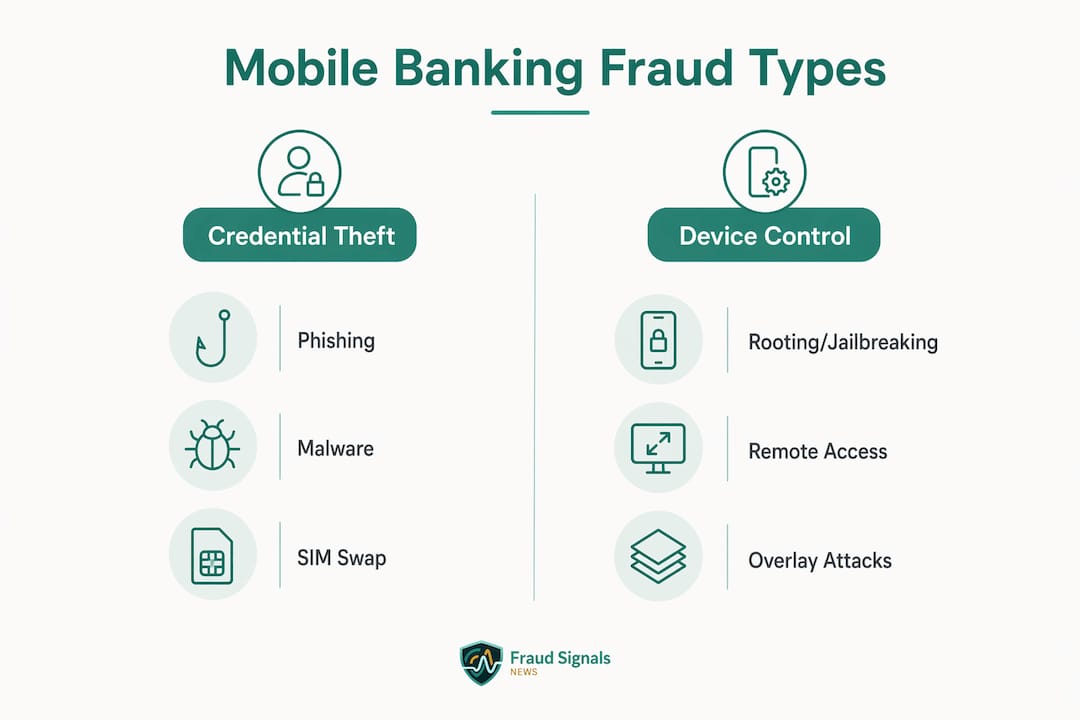
Mobile banking fraud types fall into two broad categories: credential theft and device control. Credential theft includes phishing, smishing, and social engineering attacks designed to capture usernames, passwords, and one-time passcodes. Device control attacks go further, placing malware directly on the device to intercept or initiate transactions without the user’s knowledge.
The most dangerous current threat is banking malware that achieves full device takeover. 85% of modern banking malware families carry transaction takeover capabilities, and 73% allow full remote device control. That means a fraudster can initiate a wire transfer from the victim’s own device, using the victim’s authenticated session, and the bank’s backend systems see nothing unusual.
Common attack methods include:
- Overlay attacks: Malware places a fake screen over the legitimate banking app, capturing credentials as the user types them into what appears to be the real interface.
- Session hijacking: Attackers intercept an active authenticated session and execute transactions before the session expires.
- Remote Access Trojans (RATs): Malware grants the attacker live control of the device, allowing them to operate the banking app in real time.
- Credential stuffing: Automated bots test stolen username and password combinations at scale against banking login endpoints.
- SIM swapping: Fraudsters convince a mobile carrier to transfer a victim’s phone number to a SIM they control, intercepting SMS-based one-time passcodes.
AI has accelerated every one of these tactics. AI-assisted malware attacks grew 400% year over year, and AI-generated phishing messages are now five times more convincing than manually crafted ones. The speed of attack development now outpaces the detection cycles of most fraud teams.
Pro Tip: If your banking app asks for permissions it has never requested before, such as accessibility services or screen overlay access, treat that as a red flag. Legitimate banking apps do not need those permissions after initial setup.
How do mobile app and device vulnerabilities increase fraud risk?
The risks of mobile banking are amplified by structural weaknesses in how apps are built and how devices are used. Over 60% of mobile banking apps lack basic code protection, leaving them open to reverse engineering. An attacker who can decompile an app’s binary can identify API endpoints, extract hardcoded credentials, and tailor malware to exploit that specific app’s logic.
Device compromise is the second major vulnerability category. Rooting an Android device or jailbreaking an iPhone removes the operating system’s security boundaries. Once those boundaries are gone, malware can access memory regions, intercept network traffic, and hook into app functions at runtime. Hooking frameworks allow attackers to modify app behavior in real time without altering the app’s code on disk, making detection extremely difficult.
| Vulnerability type | Attack method | Detection difficulty |
|---|---|---|
| Unprotected app code | Reverse engineering, API extraction | Low without binary protection |
| Rooted or jailbroken device | Malware installation, memory access | Medium with device attestation |
| Insecure key storage | Cryptographic key extraction | High without hardware-backed storage |
| Overlay attack | Credential capture via fake UI | High at runtime without RASP |
| Unsecured Wi-Fi | Man-in-the-Middle interception | Medium with certificate pinning |
Insecure key storage is a particularly underappreciated risk. When cryptographic keys used for session authentication are stored in software rather than hardware-backed keystores, attackers can extract them and forge authenticated requests. Security experts confirm that device cryptography and key management are among the most exploited failure points in mobile banking today.
User behavior compounds every technical vulnerability. Connecting to public Wi-Fi without a VPN, reusing passwords across apps, and granting excessive permissions to third-party apps all create low-effort entry points. 1 in 20 mobile verification attempts is fraudulent, a rate that reflects how aggressively attackers probe the mobile channel.
Pro Tip: Enable hardware-backed biometric authentication in your banking app where available. Biometric credentials stored in a device’s Secure Enclave or Trusted Execution Environment are significantly harder to extract than PIN codes or passwords.
What fraud prevention methods reduce mobile banking fraud risk effectively?
Effective fraud prevention in mobile banking requires layered detection, not a single control. No individual technique stops all attack types. The goal is to make the cost of a successful attack prohibitive by stacking multiple independent detection signals.
-
Runtime Application Self-Protection (RASP): RASP embeds security logic directly into the app binary. It detects tampering, hooking frameworks, and code injection at the moment of execution, not after the fact. Embedding security at build-time and implementing RASP is the only reliable way to catch in-memory attacks that traditional backend systems cannot see.
-
Device integrity attestation: Before authenticating a user, the app checks whether the device is rooted, jailbroken, or running in an emulator. FFIEC guidance explicitly requires device integrity controls for banking apps. A device that fails attestation should receive a degraded session or be blocked entirely.
-
Behavioral analytics and session scoring: Real-time analysis of how a user interacts with the app, typing cadence, navigation patterns, transaction velocity, generates a continuous risk score. Anomalies trigger step-up authentication or session termination. Layered detection combining app telemetry, device posture, and behavioral signals reduces false positives while improving detection accuracy.
-
Transaction velocity controls and server-side authorization: Rate limiting on transaction endpoints prevents automated fraud at scale. Server-side authorization checks verify that each transaction request matches expected session parameters before execution.
-
Continuous monitoring of rejection rates: A sudden spike in rejected transactions signals an active attack campaign. Fraud prevention measures including real-time filtering and behavioral analysis reduce fraud impact by 70–90% when implemented together. That range reflects the difference between reactive and proactive detection postures.
The machine learning fraud detection methods now available to financial teams make behavioral analytics far more accurate than static rule sets. Rules break when attackers adapt. Models retrain.
How can individuals and businesses minimize mobile banking fraud risk in practice?
Reducing mobile banking risk requires different actions depending on whether you are an individual user or an organization deploying a banking app. Both groups share responsibility for the security of the mobile channel.
For individuals:
- Download banking apps only from official app stores and verify the publisher name before installing.
- Keep the device operating system and banking app updated. Patches close the vulnerabilities that malware exploits.
- Avoid using public Wi-Fi for banking transactions. If you must, use a reputable VPN.
- Enable multi-factor authentication and prefer biometric authentication over SMS-based one-time passcodes, which are vulnerable to SIM swapping.
- Review app permissions regularly. A banking app that requests microphone or location access beyond what is needed for its stated function warrants scrutiny.
- Report suspicious transactions immediately. Early reporting limits the window for fraudsters to move funds.
For businesses and financial institutions:
- Conduct regular mobile app security assessments, including static analysis of the app binary and dynamic testing at runtime.
- Implement device fingerprinting and device trust scoring before allowing authentication to proceed.
- Monitor transaction patterns continuously and set velocity thresholds that trigger automatic holds on anomalous activity.
- Train customer-facing staff to recognize social engineering scripts targeting account holders.
- Review retail banking fraud schemes regularly to keep detection rules aligned with current attack patterns.
Identifying fraud in mobile banking requires treating device signals, behavioral signals, and transaction signals as a unified data set. Organizations that silo these inputs miss the correlations that reveal fraud before a transaction completes.
Key takeaways
Mobile banking fraud risk is a device-level problem that backend security alone cannot solve; effective defense requires layered controls spanning app code, device integrity, behavioral analytics, and server-side authorization.
| Point | Details |
|---|---|
| Fraud starts on the device | 85% of banking malware families carry transaction takeover capabilities, bypassing backend defenses. |
| App code protection is non-negotiable | Over 60% of banking apps lack basic code protection, enabling reverse engineering and targeted attacks. |
| Layered detection outperforms single controls | Combining RASP, device attestation, and behavioral analytics reduces fraud impact by 70–90%. |
| User behavior creates entry points | Public Wi-Fi use, credential reuse, and excessive app permissions each expand the attack surface. |
| Continuous monitoring is required | Static fraud rules fail against adaptive attackers; real-time session scoring and rejection rate monitoring are the standard. |
The device is the new perimeter: a frank assessment
By A. Johnson
The fraud industry has industrialized. Overlay attacks, remote access toolkits, and AI-generated phishing messages are no longer the province of sophisticated state actors. They are commoditized, available to low-skill fraudsters through underground markets. That shift changes the calculus for every financial institution still relying primarily on backend fraud rules.
What I have seen consistently is that organizations underestimate how much information a compromised device hands to an attacker. The device holds the authenticated session, the biometric template reference, the stored credentials, and the behavioral baseline. When malware controls the device post-authentication, it controls all of those assets simultaneously. Backend systems see a clean session because the session is clean. The fraud is invisible until the money is gone.
The institutions that are getting this right are not necessarily the largest ones. They are the ones that treat device trust as a prerequisite for authentication, not an afterthought. They check device integrity before the login screen loads. They score sessions continuously, not just at login. They combine automation in fraud prevention with human review for high-value anomalies.
User education matters too, but it is not a substitute for technical controls. Telling customers to avoid phishing is correct advice that fraudsters have already accounted for. The defense has to operate at a layer the attacker cannot social-engineer away.
— A. Johnson
Stay ahead of mobile banking fraud with Fraud Signals News
Mobile banking fraud evolves faster than most security teams can track individually. Fraud Signals News covers the techniques, technologies, and regulatory developments that define the current threat environment, from biometric binding and liveness detection to emerging malware families targeting financial apps.

The site publishes in-depth analysis on consumer fraud tactics and the identity verification methods that stop them. Whether you are a security professional building a fraud detection stack or an individual trying to understand your exposure, the coverage at Fraud Signals News gives you the context to make informed decisions. Bookmark it and check back regularly. The threat landscape does not pause, and neither does the reporting.
FAQ
What is mobile banking fraud risk in simple terms?
Mobile banking fraud risk is the danger that criminals will access your bank account or execute unauthorized transactions through your mobile banking app by exploiting weaknesses in the app, your device, or your behavior.
What are the most dangerous mobile banking fraud types in 2026?
Banking trojans with remote device control capabilities are the most dangerous, with 73% of current malware families allowing full remote access. Overlay attacks and SIM swapping also remain highly effective against standard authentication methods.
How can I tell if my banking app has been compromised?
Signs include unexpected transactions, login alerts you did not trigger, the app requesting new permissions, or the device behaving unusually such as overheating or draining battery rapidly. Report any of these to your bank immediately.
Does multi-factor authentication prevent mobile banking fraud?
Multi-factor authentication reduces risk significantly but does not eliminate it. SMS-based codes are vulnerable to SIM swapping, and malware with device control can intercept them. App-based authenticators and biometrics provide stronger protection.
What is the most effective way to prevent mobile fraud for businesses?
Layered detection combining Runtime Application Self-Protection, device integrity attestation, and real-time behavioral analytics is the most effective approach. Research shows this combination reduces fraud impact by 70–90% compared to backend-only defenses.
Recommended

Ways to Reduce Identity Fraud Exposure in 2026

How to Implement Real-Time Fraud Detection in 2026