

TL;DR:
- False-identity bank accounts are opened using stolen or fabricated identities to commit fraud or launder money. Detecting these accounts requires layered controls like biometric verification, device fingerprinting, and industry data sharing, as traditional checks are insufficient. Victims should act swiftly by freezing credit, reporting to authorities, and monitoring credit reports to minimize damage.
A false-identity bank account is a financial account opened using either a stolen real identity or a fabricated synthetic identity to commit fraud, launder money, or abuse credit systems. If you suspect one has been opened in your name, act immediately.
If you suspect a false-identity account:
- Contact your bank’s fraud department now and request a freeze or closure of any unauthorized accounts.
- File a report at IdentityTheft.gov (the FTC’s official recovery portal).
- Place a credit freeze with Equifax, Experian, and TransUnion.
- Verify any unfamiliar bank by name or URL using the FDIC BankFind Suite.
The scale of this problem is not theoretical. New account fraud losses hit an estimated $6.2 billion in 2024, driven largely by synthetic identity schemes that exploit gaps in digital onboarding. The Federal Reserve has flagged synthetic identity fraud as the fastest-growing financial crime in the United States. For consumers, the immediate risk is damaged credit and unauthorized debt. For financial institutions, it is unrecoverable charge-offs and compounding compliance costs.
Table of Contents
- What “false identity” and “synthetic identity” actually mean
- How fraudsters build and operate false-identity bank accounts
- Why fraudsters open false-identity accounts — the common use cases
- Warning signs: how consumers and institutions spot fake or fraudulent accounts
- How banks and fintechs detect and prevent synthetic identity accounts
- What to do if an account was opened in your name
- Legal and financial consequences for victims and institutions
- Key Takeaways
- Synthetic identity is the fraud threat most institutions are still underestimating
- Fraud Signals News covers the identity verification threats that matter most
- Useful sources
- FAQ
What “false identity” and “synthetic identity” actually mean
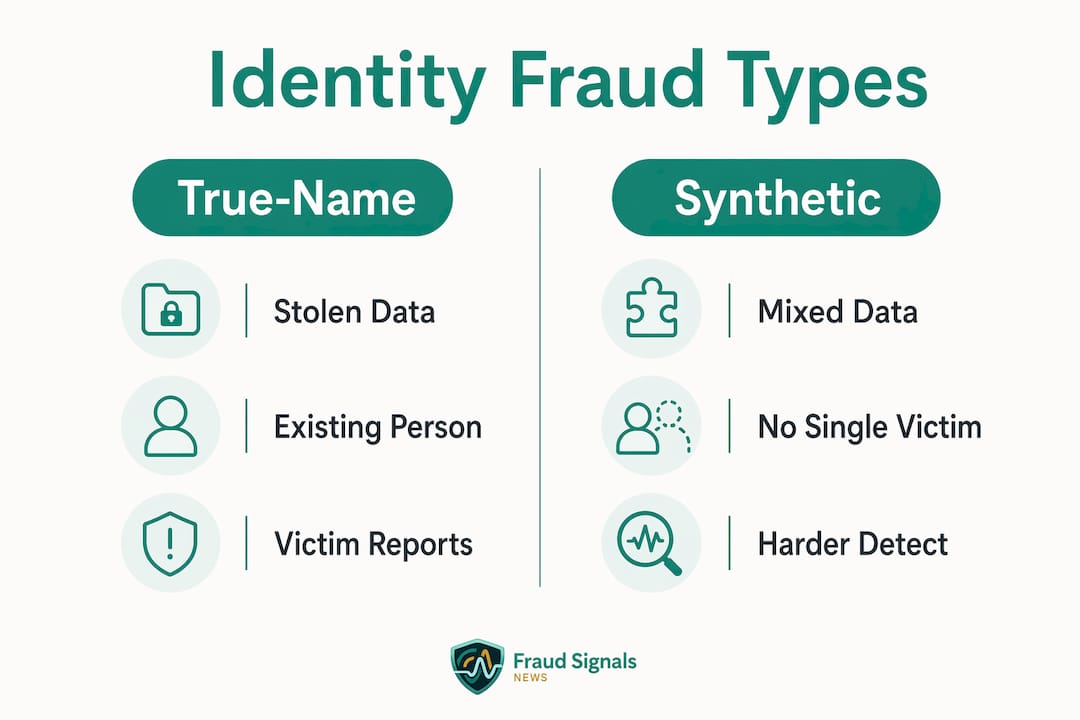
The industry uses two distinct terms here, and conflating them leads to misdiagnosis. Two forms of identity theft exist: true-name identity theft and synthetic identity fraud, and they behave very differently.

True-name identity theft means a criminal steals an existing person’s personally identifiable information (PII) — Social Security number (SSN), date of birth, address — and uses it wholesale to open accounts. The victim is a real person who will eventually notice unauthorized activity on their credit report or receive collection calls for debts they never incurred.
Synthetic identity fraud is more insidious. Per the Federal Reserve–led industry definition, it involves combining real and fabricated PII to create a new, fictitious person. A fraudster might pair a real SSN (often from a child, elderly person, or someone with a thin credit file) with a fake name, address, and date of birth. Because no single real victim exists, no one files a complaint — the synthetic identity can operate undetected for months or years.
A third subtype, full fabrication, involves entirely invented credentials. This is less common because fully invented SSNs are easier for automated systems to flag, but generative AI is eroding that advantage.
| Dimension | True-name theft | Synthetic identity |
|---|---|---|
| Real victim? | Yes — existing person | No single victim |
| Who reports it? | The victim, when they notice | Often no one (detected by institution) |
| Detection difficulty | Moderate | High |
| Typical lifecycle | Days to weeks | Months to years |
| Credit file at opening | Existing (hijacked) | Thin or nonexistent, then built up |
Short examples of each in practice:
- A fraudster uses a 10-year-old’s SSN (which has no credit history) combined with an adult name and address to apply for a secured credit card online. The child won’t notice for years.
- A stolen driver’s license from a data breach is used at a bank branch to open a checking account under the victim’s real name. The victim discovers it when a collection agency calls.
- A fully fabricated persona, complete with a generative AI–produced utility bill and social media profile, passes an automated onboarding flow at a digital bank.
How fraudsters build and operate false-identity bank accounts
The mechanics follow a recognizable playbook, even as the tools evolve. Understanding the lifecycle is the first step toward disrupting it.
-
Reconnaissance and data acquisition. Fraudsters source PII from data breaches, dark-web marketplaces, and phishing campaigns. SSNs belonging to children or the elderly are particularly valued because thin credit files generate fewer automated alerts.
-
Automated probing of onboarding flows. Criminal networks deploy bots to test digital account-opening systems at scale, identifying which institutions apply weak KYC controls and which fields can be manipulated without triggering rejection. Application velocity — dozens of attempts from the same device or IP range — is a key signal that most legacy systems miss.
-
Account creation and initial seeding. Once a viable onboarding gap is identified, the synthetic or stolen identity is used to open a checking or savings account, sometimes with a small initial deposit to establish legitimacy.
-
Credit building (the “nurturing” phase). This is where synthetic identity fraud diverges sharply from simple account takeover. The fraudster spends months behaving like a model customer — making small purchases, paying balances on time, and sometimes getting added as an authorized user on a real person’s account to bootstrap a credit history. This phase can last 12–24 months.
-
Monetization and bust-out. Once credit limits are elevated, the fraudster maxes out every available credit line simultaneously, withdraws cash, and disappears. By the time the institution flags the account, the losses are already realized.
-
Layering and exit. Proceeds are transferred through multiple accounts (often other synthetic-identity accounts) to obscure the trail before being withdrawn or converted.
Pro Tip: Application-velocity signals and device-sharing patterns are among the clearest early indicators of a scaled synthetic identity attack. If multiple applications share a device fingerprint, IP address, or email domain pattern within a short window, that cluster warrants immediate review — even when each individual application appears clean.
Generative AI has accelerated steps 1 and 3 considerably, making realistic fraudulent documents easier to produce, which challenges detection efforts that rely solely on document authenticity like those discussed in AETHER Pulse. Fraudulent documents — utility bills, pay stubs, even government IDs — can now be produced in minutes, making the visual inspection layer of KYC increasingly unreliable. AI-generated fake documents are now a standard component of synthetic identity kits sold on criminal forums.
Why fraudsters open false-identity accounts — the common use cases
Not every false-identity account serves the same purpose. The use case shapes the fraud timeline, the account behavior, and the indicators worth monitoring.
- Bust-out credit fraud. The most common synthetic identity end game. The fraudster builds credit over months, then exhausts every line simultaneously. Institutions absorb the charge-off because the “borrower” never existed.
- Money laundering and layering. False-identity accounts serve as pass-through nodes in layering schemes, receiving and forwarding illicit funds to obscure their origin. The account looks like a normal consumer account until transaction-monitoring rules flag unusual velocity.
- Fake-check and check-cashing schemes. A fraudster deposits a counterfeit check into a false-identity account, withdraws funds during the availability window, and disappears before the check bounces. Banks are required by law to make funds available quickly after deposit, but that availability does not confirm the check is legitimate — chargebacks can arrive weeks later.
- Payroll and benefits fraud. False-identity accounts receive fraudulent payroll deposits, unemployment benefits, or pandemic-era relief payments. The account is abandoned once the payment clears.
- Scam facilitation. Fraudsters use false-identity accounts as the destination for wire transfers in romance scams, tech-support scams, and business email compromise (BEC) attacks. The account is a one-time collection point.
- Account takeover staging. A synthetic account can be used to test stolen credentials or to receive funds from compromised real accounts, adding a layer of separation between the criminal and the victim.
The fraud timeline varies significantly by use case. A fake-check scheme may run its full cycle in under two weeks. A bust-out synthetic identity scheme typically requires 12 months or more of patient credit-building before the monetization event. That timeline difference matters for detection: short-cycle fraud demands real-time transaction monitoring, while long-cycle synthetic fraud requires longitudinal behavioral analysis.
Warning signs: how consumers and institutions spot fake or fraudulent accounts
What consumers should watch for
The signals that a false-identity account has been opened in your name are often subtle until they aren’t.
- Unexpected mail from banks or lenders you never contacted — new card mailers, welcome letters, or billing statements.
- Collection calls or letters for debts you don’t recognize.
- Credit report entries for accounts you never opened (pull your free report at AnnualCreditReport.com).
- Login prompts or password-reset emails for financial accounts you didn’t initiate.
- Suspicious communications that mimic your bank — bank impersonation scams often use urgency-creating language and near-identical logos to extract PII.
- URL mismatches on banking sites: a letter transposed, a hyphen added, or the bank name appearing as a subdomain of an unfamiliar domain.
Pro Tip: Before entering any credentials on a banking website, verify the institution using the FDIC BankFind Suite. Search by bank name or web address. If the site doesn’t appear in the registry, treat it as fraudulent and contact the FDIC directly at 1-877-ASK-FDIC.
What institutions should flag
Institutional red flags cluster around two phases: onboarding and early account behavior.
At onboarding:
- The same SSN appears across multiple applications in a short window.
- The applicant’s credit file is thin or newly established, with a sudden recent credit inquiry spike.
- Device fingerprinting reveals the same device or browser profile linked to multiple distinct applicants.
- The address submitted is associated with dozens of other identities in consortium data.
- Document metadata (fonts, creation timestamps, printer artifacts) is inconsistent with the claimed issuer.
In early account behavior:
- Rapid balance build-up followed by large cash withdrawals or wire transfers.
- Authorized-user additions that don’t match the account holder’s stated relationships.
- Transaction patterns that mirror known bust-out sequences: small purchases, on-time payments, then sudden maximum utilization across all credit lines.
The estimated $6.2 billion in new account fraud losses recorded in 2024 reflects how consistently these signals go undetected in institutions still relying on single-source document checks and static credit bureau pulls.
How banks and fintechs detect and prevent synthetic identity accounts
Traditional KYC — document upload, credit bureau check, address verification — was designed for true-name fraud. Synthetic identities are specifically engineered to pass those checks. The limitations of single-source KYC are well-documented: a synthetic identity with a seeded credit file and a generative AI–produced document will clear most legacy onboarding flows without triggering a single alert.

Effective defense requires layered controls across multiple signal types.
Technology stack for synthetic identity detection:
- Identity document verification with liveness detection. Verifying that the document is authentic is necessary but not sufficient. Liveness detection — confirming that a real, living person is present during onboarding — closes the gap that static selfie checks leave open. DAON (daon.com) is one example of a vendor offering biometric liveness and identity verification capabilities designed for financial services onboarding. For a deeper look at how biometrics reduce bank fraud, the underlying mechanisms are worth understanding before selecting a vendor.
- Device fingerprinting and behavioral biometrics. How a user types, moves a mouse, holds a phone, and navigates an application form generates a behavioral signature. Anomalies — robotic form-fill speed, inconsistent typing cadence, emulated device environments — flag automated or assisted fraud attempts.
- Consortium and shared-blacklist signals. No single institution sees the full picture of a synthetic identity’s activity. Shared fraud intelligence networks allow institutions to cross-reference application data against known fraud indicators from across the industry, surfacing identities that look clean in isolation but show suspicious patterns at scale.
- Machine-learning models trained on longitudinal behavior. Static rule sets are too slow and too rigid. ML models that score identity risk across the full account lifecycle — not just at onboarding — catch the slow-build patterns characteristic of synthetic fraud.
- Network intelligence. Mapping the connections between identities (shared addresses, phone numbers, devices, and email domains) reveals clusters of synthetic accounts that would be invisible when reviewed individually.
Best practices for operations teams:
- Apply multi-source verification: cross-reference document data against credit bureau, phone carrier, and email age signals simultaneously.
- Calibrate onboarding friction to risk tier — high-risk applicant profiles warrant step-up verification (liveness check, knowledge-based authentication) without applying that friction universally.
- Implement continuous monitoring post-onboarding; the fraud event in a synthetic identity scheme rarely happens at account opening.
- Participate in industry consortium data-sharing programs to benefit from cross-institutional signal intelligence.
- Set manual review triggers for thin-file applicants with recent credit history spikes, shared device indicators, or addresses flagged in consortium data.
Pro Tip: Prioritize “identity depth” signals over document authenticity alone. A real person accumulates years of credit history, a stable email address, a consistent device profile, and verifiable social connections. A synthetic identity, however well-constructed, tends to be shallow — recently created, with few cross-entity connections. Measuring that depth is more reliable than any single document check.
For practitioners building or auditing onboarding controls, Fraud Signals News’s account opening fraud detection guide covers operational implementation in detail.
What to do if an account was opened in your name
Speed matters. The longer a false-identity account operates, the more damage accumulates — to your credit file, your financial standing, and the institution’s loss exposure.
Consumer reporting and recovery steps
- Contact your bank immediately. Call the fraud department using the number on the back of your card or the bank’s official website — not a number provided in a suspicious message. Request a freeze or closure of any unauthorized accounts and ask for written confirmation.
- File a report at IdentityTheft.gov. The FTC’s IdentityTheft.gov portal generates a personalized recovery plan and an official Identity Theft Report, which you will need for disputing fraudulent accounts.
- Place a credit freeze with all three major bureaus. Contact Equifax, Experian, and TransUnion individually. A freeze prevents new credit from being opened in your name. A fraud alert is a lighter option — it requires lenders to take extra verification steps — but a freeze is stronger.
- Dispute fraudulent accounts in writing. Send dispute letters to each credit bureau and to the creditor directly, attaching your FTC Identity Theft Report. Request written confirmation of account closure and removal from your credit file.
- File a police report if needed. Some creditors and bureaus require a police report in addition to the FTC report. Your local police department can issue one.
- Monitor your credit continuously. After a false-identity incident, pull your credit reports regularly and consider enrolling in a credit monitoring service.
Pro Tip: Document every interaction — dates, names of representatives, reference numbers, and the content of each conversation. Request written confirmation from every institution you contact. This paper trail is your primary evidence if disputes escalate.
What institutions should do when notified
- Freeze the suspicious account immediately and preserve all associated logs (IP addresses, device identifiers, session data, application records).
- Open an internal investigation and assign a case number.
- Report to relevant regulators and, where applicable, to industry fraud-sharing consortia.
- Notify the consumer victim in writing and provide clear guidance on their next steps.
- Share fraud indicators (device fingerprints, email domains, address clusters) with partner institutions through established channels.
Legal and financial consequences for victims and institutions
Who absorbs the loss
Liability in false-identity fraud depends on the fraud type and timing. For true-name identity theft, federal law generally limits consumer liability for unauthorized electronic fund transfers — but only when the victim reports promptly. The longer the delay, the greater the potential consumer exposure. For synthetic identity fraud, there is typically no consumer victim to bear liability; the institution absorbs the charge-off entirely.
- Consumers who report unauthorized transactions quickly are generally protected under the Electronic Fund Transfer Act (EFTA) and the Fair Credit Billing Act (FCBA).
- Victims of true-name identity theft may face months of credit dispute processes before fraudulent accounts are removed.
- Synthetic identity fraud losses fall almost entirely on financial institutions, which cannot recover from a borrower who never existed.
Typical timelines
Simple fake-check schemes can complete their full cycle — deposit, withdrawal, chargeback — in under two weeks. Synthetic identity bust-out schemes typically run 12–24 months from account opening to monetization. Detection after the fact adds another 30–90 days for investigation and reporting. Full credit restoration for a true-name victim can take six months to over a year, depending on the number of fraudulent accounts and the responsiveness of creditors.
Financial and operational consequences for banks
- Unrecoverable charge-offs on credit products extended to synthetic identities.
- Increased compliance costs as regulators demand stronger KYC controls following fraud incidents.
- Elevated onboarding friction for legitimate customers when institutions overcorrect with blanket verification requirements.
- Reputational damage when fraud incidents become public, particularly in the fintech sector where trust is a primary competitive asset.
The $6.2 billion in new account fraud losses estimated for 2024 represents only reported and industry-estimated figures. The actual number, accounting for unreported synthetic identity charge-offs, is likely higher. For institutions, the cost of prevention is almost always lower than the cost of remediation.
This article provides general information about identity fraud and is not legal or financial advice. Confirm your specific situation and rights with a qualified professional or the relevant regulatory authority.
Key Takeaways
Synthetic identity fraud is the dominant form of false-identity bank account fraud in the United States, and it requires layered detection — not just document checks — to stop it effectively.
| Point | Details |
|---|---|
| Synthetic vs. stolen identity | Synthetic identities have no single victim to report them, making them far harder to detect than true-name theft. |
| Scale of the problem | New account fraud losses reached an estimated $6.2 billion in 2024, driven largely by synthetic identity schemes. |
| Consumer first steps | Freeze credit at all three bureaus and file at IdentityTheft.gov immediately if you suspect an account was opened in your name. |
| Institutional defense | Layered controls — liveness detection, device fingerprinting, consortium data, and behavioral monitoring — outperform single-source KYC. |
| Verify banks and report | Use the FDIC BankFind Suite to confirm any unfamiliar institution; report fraud to the FTC at IdentityTheft.gov. |
| Fraud Signals News | Fraud Signals News covers biometric liveness detection, eKYC, and synthetic identity fraud in depth for practitioners building or auditing identity verification systems. |
Synthetic identity is the fraud threat most institutions are still underestimating
The conventional wisdom in financial services fraud prevention has long been that better document verification solves the problem. It doesn’t. The institutions that have invested heavily in document authentication — optical character recognition, hologram detection, database cross-referencing — are still absorbing synthetic identity losses at scale, because the attack has moved upstream of the document.
What actually works is measuring identity depth: how long has this email address existed, how many devices has this person used over time, does the credit history show organic growth or a sudden engineered spike? Generative AI has made it trivially easy to produce a convincing document. It has not yet made it easy to fabricate 10 years of consistent behavioral history across multiple unconnected data sources. That gap is where detection lives right now.
The other underestimated variable is the cost of false positives. Institutions that respond to synthetic identity risk by adding friction to every onboarding flow end up rejecting legitimate customers at rates that damage revenue and customer trust. The goal is not maximum friction — it is precision. Behavioral signals and consortium intelligence allow institutions to apply step-up verification selectively, targeting the risk tier that actually warrants it.
For security teams, the practical priorities are: instrument your onboarding for depth signals, not just document authenticity; share fraud indicators through industry consortia; test your onboarding flow the way attackers do (automated, at scale, from multiple device profiles); and measure the false-positive cost of every new control you add. The institutions winning this fight are not the ones with the most aggressive rejection rules. They are the ones with the most accurate risk scoring.
Fraud Signals News covers the identity verification threats that matter most

False-identity and synthetic identity fraud are moving faster than most compliance teams can track, largely because the underlying technology — generative AI, automated onboarding probing, deepfake document generation — is evolving continuously. Fraud Signals News publishes in-depth analysis on exactly these threats: biometric liveness detection, eKYC architecture, deepfake ID countermeasures, and the fraud patterns that exploit gaps in legacy verification systems.
For practitioners who need to stay current on detection technology and emerging attack vectors, the site’s eKYC coverage and identity fraud analysis go beyond surface-level summaries to cover the operational and technical detail that actually informs vendor selection and control design. If you’re building or auditing an identity verification program, fraudsignals.news is where to start — and where to keep coming back as the threat evolves.
Useful sources
The following U.S.-focused resources provide authoritative guidance on false-identity fraud, synthetic identity, reporting, and prevention. Each serves a distinct purpose.
| Source | Type | What it covers |
|---|---|---|
| FDIC BankFind Suite | Regulatory / consumer tool | Verify whether a website or institution is a real FDIC-insured bank; identify impostor sites |
| IdentityTheft.gov (FTC) | Consumer recovery portal | File an identity theft report; generate a personalized recovery plan |
| FTC — Fake Check Scams | Consumer guidance | Explains check availability vs. authenticity and how to report fake-check fraud |
| Federal Reserve Bank of Boston — Synthetic Identity Fraud | Industry / regulatory analysis | How generative AI is accelerating synthetic identity fraud construction |
| FedPayments Improvement — New Account Fraud | Industry analysis | Scale of new account fraud losses and digital onboarding vulnerabilities |
| ACAMS — Nature of Synthetic Identity Fraud | Industry / compliance | Federal Reserve–led standard definition and compliance implications |
| USAGov — Identity Theft | Consumer guidance | Broad overview of identity theft types, warning signs, and reporting steps |
| FBI — Identity Theft Resources | Law enforcement | Victim resources and how to engage federal law enforcement |
FAQ
What is an example of a false identity bank account?
A fraudster pairs a real child’s Social Security number with a fabricated name and address, builds credit over months, then maxes out all credit lines and disappears — a classic synthetic identity bust-out scheme.
What is considered a false identity?
A false identity is any combination of stolen, fabricated, or manipulated personally identifiable information used to misrepresent who someone is. This includes both true-name theft (using another real person’s credentials) and synthetic identity fraud (mixing real and invented PII to create a fictitious person).
Can someone steal my identity and open a bank account?
Yes. Using your Social Security number, date of birth, and address, a fraudster can open checking, savings, or credit accounts in your name. File at IdentityTheft.gov and place a credit freeze with all three major bureaus if you suspect this has happened.
How do you identify a fake bank account or fraudulent institution?
Check any unfamiliar bank by name or web address using the FDIC BankFind Suite. Watch for URL misspellings, urgency-creating messages, and unofficial “Member FDIC” logos — these are common signals of bank impersonation scams.
Why is synthetic identity fraud harder to detect than regular identity theft?
Synthetic identities have no single real victim to report suspicious activity, so the fraud can operate undetected for months or years. Traditional KYC checks — document review and credit bureau pulls — are specifically the controls synthetic identities are built to pass, which is why layered defenses including liveness detection and behavioral signals are necessary.
Recommended

Fraud Teams: NIST Aligned VPN Detection for Onboarding, Score First

Prevent a Biometric Breach: 6 Operational Controls for Identity Teams