

Choosing an identity verification platform that meets audit, regulatory, and fraud prevention requirements is unpredictable for compliance and security professionals. Many vendors withhold pricing details, demand custom integration, or require dedicated engineering resources, which blocks smaller teams and complicates procurement. This comparison covers features, certifications, and deployment models among six Daon.com alternatives so compliance teams can target vendors that match real-world needs.
Table of Contents
Daon
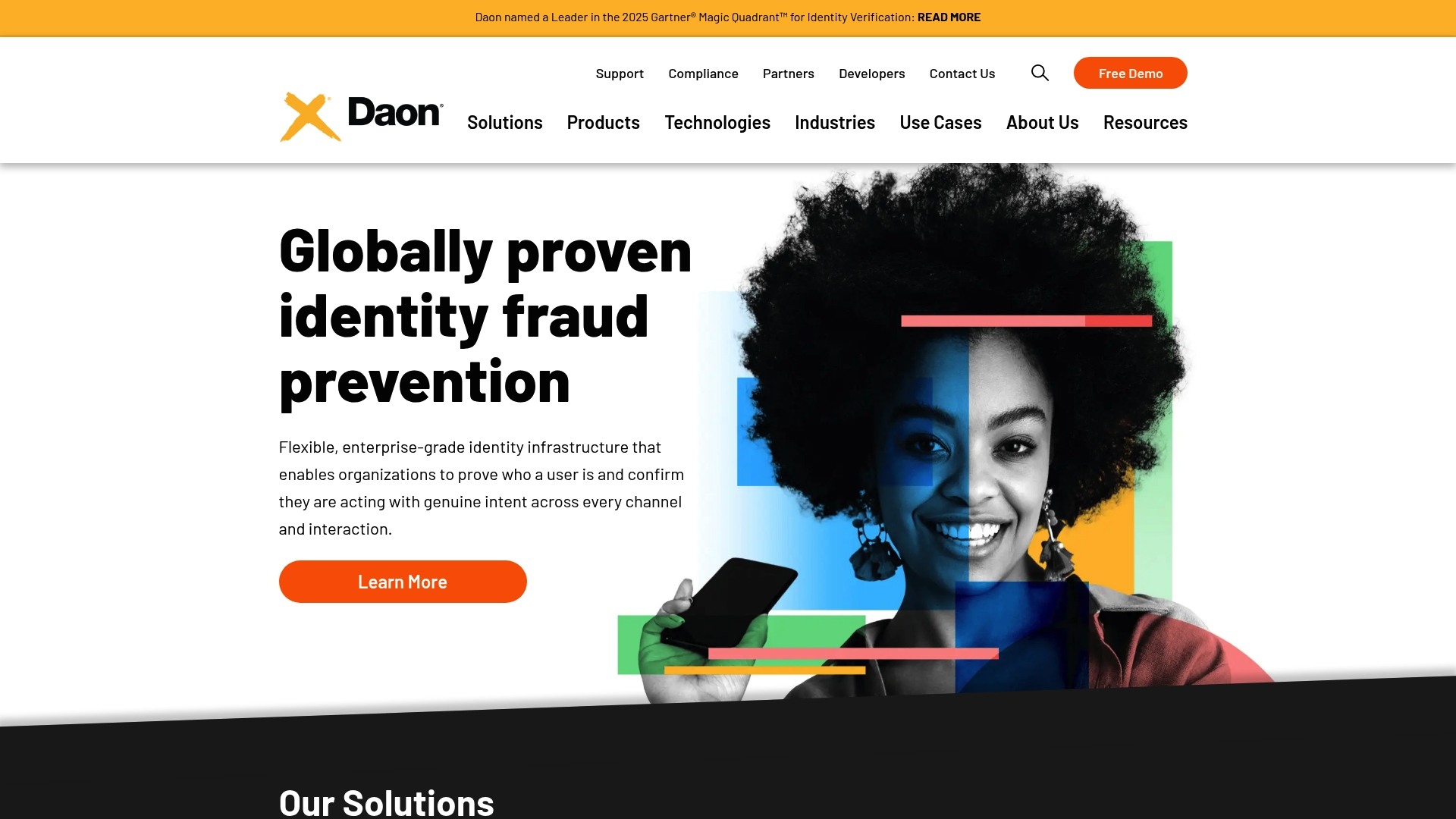
At a Glance
Daon reports securing over 2 billion identities worldwide. The company advertises more than 25 years of experience and 285 patents implemented across its product suite. It serves finance, healthcare, and telecom customers across six continents.
Core Features
The platform supports Identity Continuity, allowing a verified identity to persist across channels, and an orchestration layer to manage the identity lifecycle. Identity Verification (IDV) combines document checks and authoritative data matching to onboard remote customers, while the authentication suite offers biometric and multi factor methods. Specialized capabilities include contact center voice verification, age checks from face scans, real time deepfake detection, and travel document validation.
Key Differentiator
The vendor states the platform relies on over 285 patents and serves hundreds of millions globally. That patent depth underpins biometric binding, liveness checks, and synthetic media detection across phone, web, and mobile channels. The result is a single platform designed to deliver the same verification and authentication capabilities across multiple touch points.
Pros
Daon bundles a wide suite of biometric and identity services with enterprise reach. That figure of secured identities highlights scale and long term deployment experience. Analyst recognition and flexible orchestration let teams tailor workflows, apply advanced biometric checks, and centralize identity policies for onboarding and access.
Cons
-
Vendor materials do not include independent third-party reviews, so specific buyer limitations are unclear.
-
Pricing is not publicly disclosed, which may create procurement friction for smaller buyers.
Who It’s For
Large enterprises that require multi layered identity verification and authentication across channels and jurisdictions. Organizations in banking, healthcare, and telecom that need contact center verification and defenses against synthetic media will find the feature set aligned to those needs. Teams that plan enterprise scale deployments and dedicated integration resources match this profile best.
Real World Use Case
A financial institution implements Daon’s IDV and multi factor authentication to streamline onboarding across regions. The bank uses document checks, face matching, and voice authentication to secure customer access and call center flows. This approach reduces manual review and unifies compliance steps across jurisdictions.
Pricing
Daon does not publish standard pricing. Pricing is likely customized based on client needs, with contracts structured to the deployment scope and chosen modules.
Website: https://daon.com
FaceTec
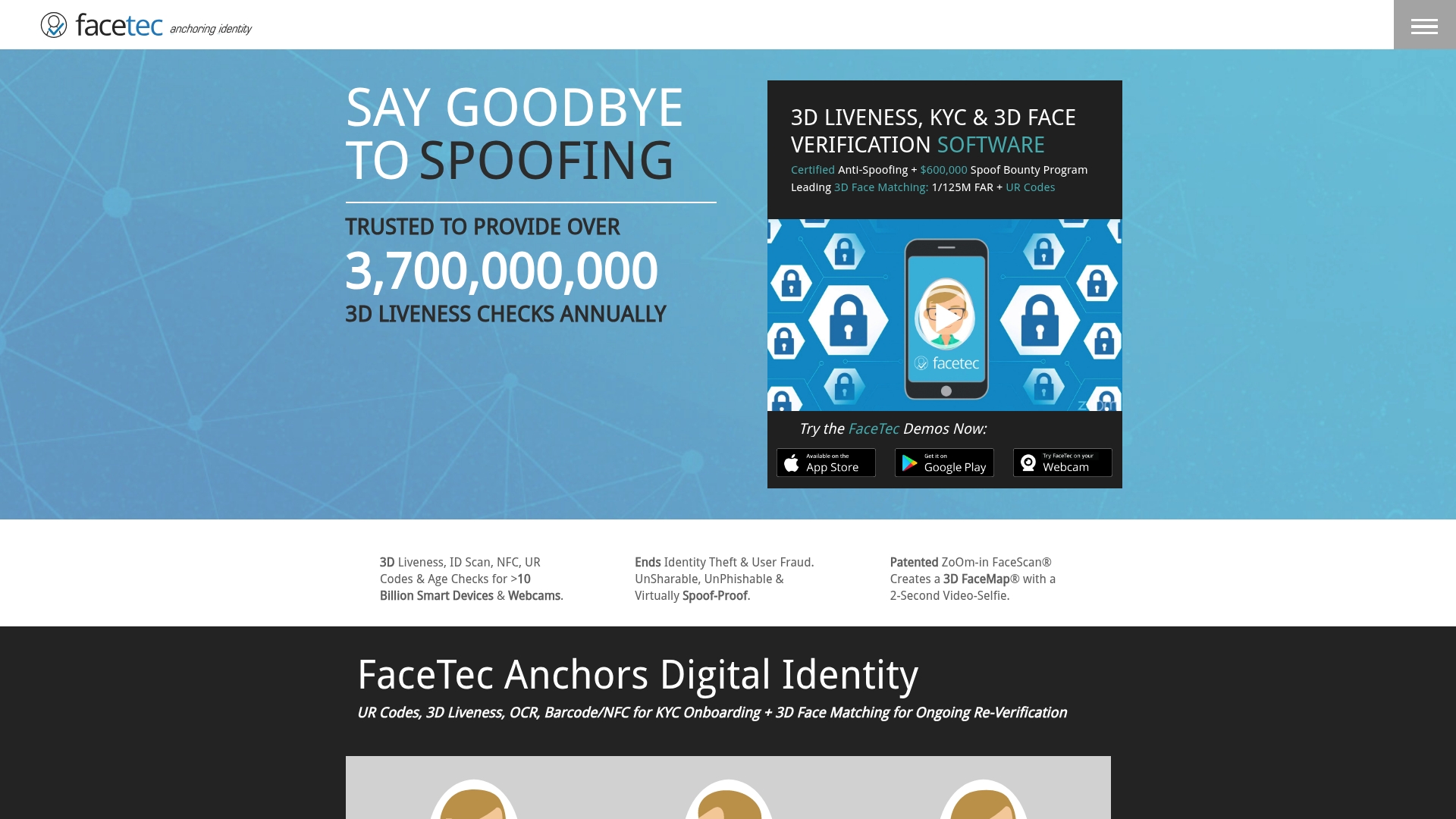
At a Glance
FaceTec reports more than 3.7 billion biometric checks annually. The vendor advertises a false accept rate of FAR 1/125 million. Its marketing materials emphasize real-time, device-agnostic 3D liveness and face matching for banks, governments, and security use cases.
Core Features
FaceTec combines 3D liveness detection with high-accuracy 3D face matching and optional ID scan and OCR checks. The SDKs run on iOS, Android, web browsers, and servers, and the product handles webcams and smartphone cameras under typical lighting. Cross-platform language support and server-side options enable integration into KYC onboarding and fraud workflows.
Key Differentiator
FaceTec’s primary distinction is certified anti-spoofing tied to device-level 3D face mapping across common endpoints. That accuracy claim supports higher-assurance biometric checks rather than relying on single-frame selfies or heuristic liveness tests.
Pros
The platform reports an industry-grade false accept rate that suits high-risk verification paths. It works on nearly all modern cameras, so deployment can cover mobile and desktop channels without separate hardware. FaceTec also highlights third-party testing, ISO-related certifications, and bug bounty coverage, and the company states typical verifications complete in about two to three seconds.
Cons
-
Pricing is customized and depends on volume and implementation, with no public list prices.
-
Hardware integration details focus on software APIs rather than bundled devices or proprietary cameras.
-
Devices without cameras or severely poor lighting conditions may produce failed or low-assurance captures.
When It May Not Fit
FaceTec may not fit organizations that must operate on camera-less terminals or air-gapped devices. Small pilots with strict fixed budgets could find implementation and integration costs prohibitive due to volume-based pricing. Use cases requiring deep hardware attachments or specialized on-prem cameras may need a different vendor.
Who It’s For
Large and small enterprises, government agencies, and financial institutions that need high-assurance remote biometric identity checks. Teams prioritizing anti-spoofing certifications and cross-device coverage will find the feature set aligned to fraud reduction. Organizations planning enterprise integrations and custom volume agreements match this product profile best.
Real World Use Case
A financial institution uses FaceTec for remote client onboarding to confirm liveness and match ID photos. The bank relies on the vendor’s 3D liveness and matching workflow to reduce impersonation and account fraud. That approach shifts risk from manual review to automated biometric gating.
Pricing
Pricing is not published. FaceTec structures fees around volume and implementation, and pricing discussions occur during procurement and integration planning.
Website: https://facetec.com
BioID Web Service
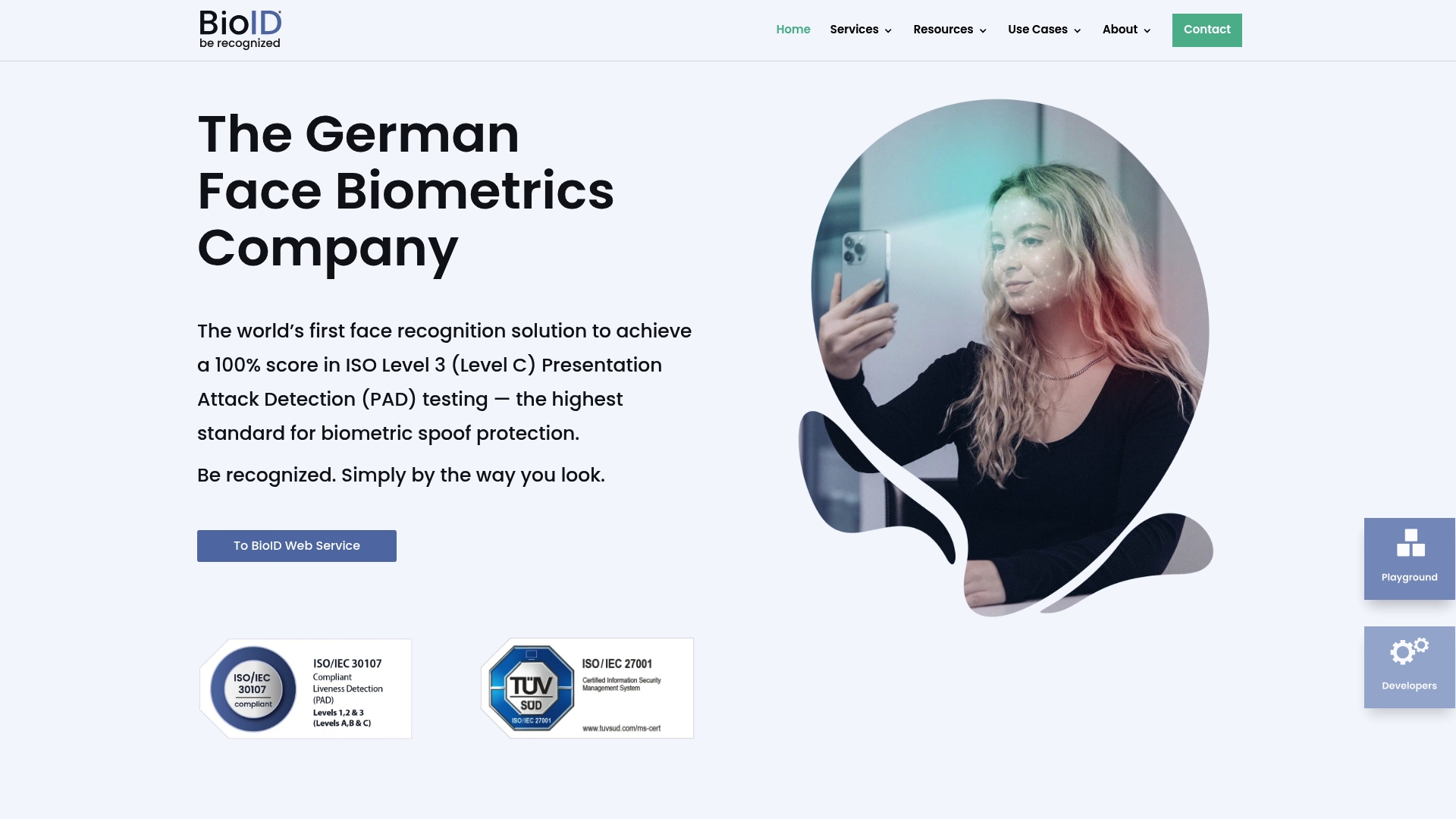
At a Glance
BioID reports ISO/IEC 27001 and ISO/IEC 30107-3 certification for its anti spoofing and deepfake detection capabilities. The service combines face recognition with liveness checks and specialized checks against AI generated media. It supports cloud and on premise deployment for regulated environments.
Core Features
The service bundles PhotoVerify for ID ownership checks, face recognition for biometric authentication, and liveness detection to stop spoofing attempts. It also offers deepfake detection to flag AI generated media and peri ocular recognition so authentication works when masks obscure faces. APIs target KYC, remote onboarding, access control, and identity proofing in enterprise workflows.
Key Differentiator
BioID emphasizes certified anti spoofing and deepfake detection plus flexible deployment options. That certification and the choice of cloud or on premise install suit organizations that must retain biometric data locally or meet strict compliance rules. The combination narrows the attack surface for biometric fraud while fitting existing infrastructure.
Pros
The vendor highlights strong security measures and formal standards with ISO/IEC 27001 mentioned alongside anti spoofing certification, which appeals to compliance teams. The privacy by design approach keeps biometric identifiers pseudonymized and supports GDPR compliant processing for European operations. Extensive API documentation and enterprise adoption make integration practical for banks, government agencies, and telecom operators that need mature identity verification.
Cons
-
Pricing details are not publicly disclosed, so procurement requires direct inquiry and time for negotiation.
-
Integration can demand experienced developers because customization and on premise deployment involve extra configuration and testing.
-
Advanced deployment options such as on premise installations may carry additional costs beyond standard cloud plans.
Who It’s For
Large organizations that require scalable biometric authentication and strict data governance will find this product relevant. Typical buyers include banks, government agencies, and telecom operators that must reconcile fraud prevention with regulatory constraints. Teams that run controlled infrastructure or need local data residency will get the most from its deployment choices.
Real World Use Case
A bank uses BioID Web Service for remote customer onboarding with video based identity verification, liveness checks, and deepfake detection. The solution ties PhotoVerify results to the bank onboarding workflow to confirm document ownership and reduce manual review. That setup reduced reliance on physical branches while keeping verification records for audit.
Pricing
Public pricing is not listed. The vendor states pricing is available by contacting sales for a quote, and enterprise deals vary by deployment model and feature set. Expect separate cost elements for on premise licensing, integration support, and advanced detection modules.
Website: https://bioid.com
Facia.ai
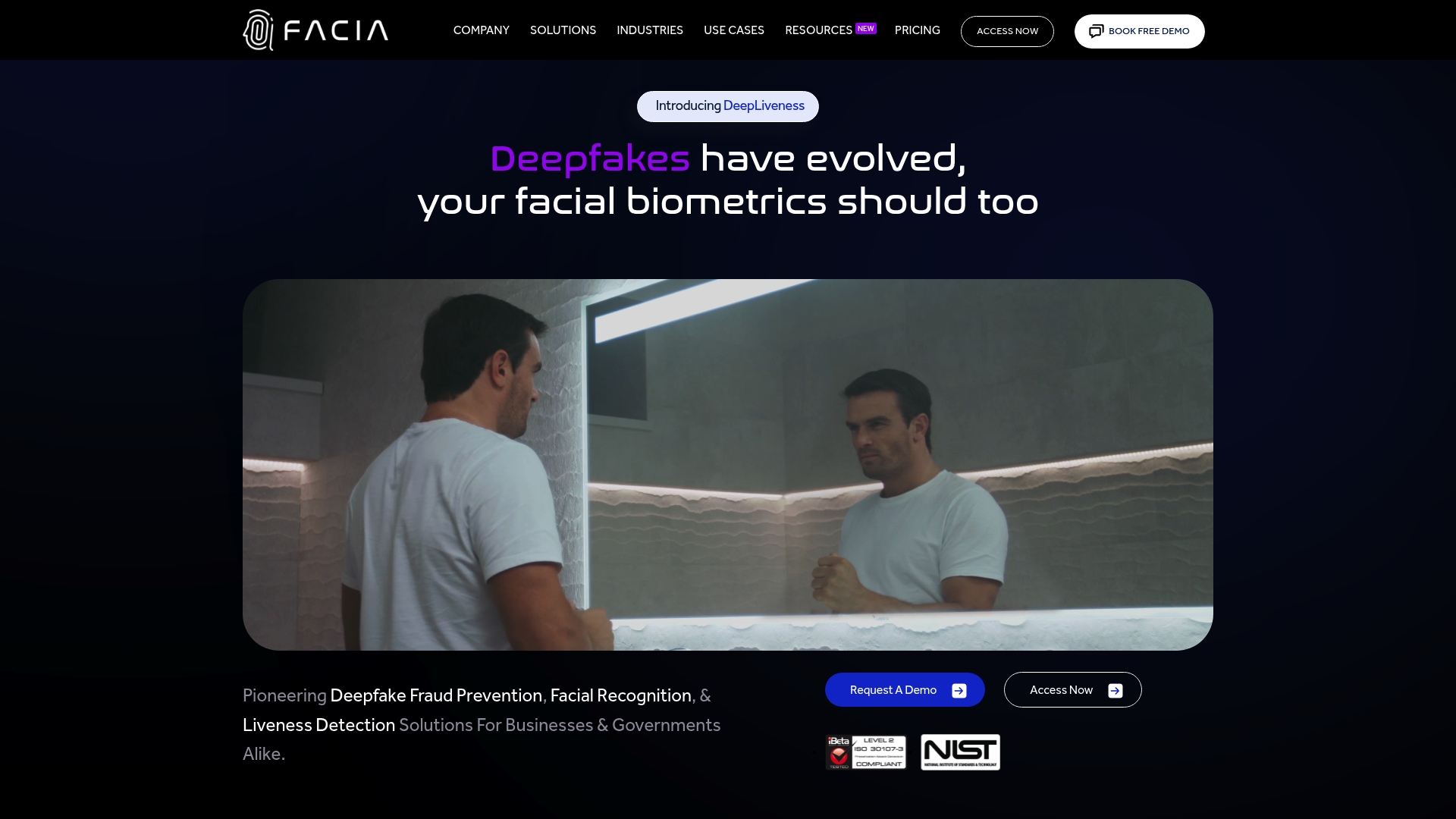
At a Glance
Facia.ai reports a false acceptance rate as low as 0.06% and a false rejection rate as low as 0.3%. The vendor states response times under one second for liveness and deepfake checks. According to the company, certifications include iBeta Level 2 and standards such as ISO 9001, GDPR, and ICAO biometric security.
Core Features
Facia.ai combines deepfake detection that analyzes subtle facial cues like eye and lip motion with both active and passive liveness checks, delivering verification and media screening workflows. The product offers SDKs and APIs for iOS, Android, and RESTful integration, plus cloud and on-premise deployment choices to match enterprise environments. The stack also targets identity verification, biometric enrollment, access control, and surveillance integrations.
Key Differentiator
The standout claim is industry-focused accuracy paired with certification and low-latency checks, which the vendor highlights as the basis for real-time verification and media integrity controls. That combination aims to reduce low-assurance bypass and give security teams faster forensic signals during onboarding or media review.
Pros
Facia.ai reports very low error rates and pairs that with quick, user-facing checks to reduce friction during onboarding. The product supports multiple deployment models and mobile SDKs, which helps teams integrate detection into legacy or modern systems. Certified compliance and stated adherence to biometric standards make it easier for regulated buyers to prepare audits and privacy reviews.
Cons
-
Cost can vary significantly depending on scale and deployment model, and pricing details require a custom quote.
-
Initial integration and custom workflow setup may be complex for teams with limited engineering bandwidth.
-
Performance in extremely low light or with heavily obfuscated faces may depend on downstream camera hardware and environment.
When It May Not Fit
Large programs that lack internal engineering resources may face long integration timelines and higher professional services fees. Small teams without dedicated security architects could find the customizable SDK approach heavier than plug-and-play alternatives. Organizations that need guaranteed performance in very poor capture conditions should test on representative hardware first.
Who It’s For
This product suits banks, government agencies, and large enterprises that require high-fidelity biometric verification and anti-deepfake controls. Security teams that must meet audit requirements and manage deployment across both cloud and on-premise environments will find the feature set relevant. It fits buyers who accept a custom pricing model in exchange for tailored accuracy and compliance.
Real World Use Case
A bank uses Facia.ai to add liveness and deepfake checks to its mobile onboarding flow so account opening requires a real person on camera. Fraud teams receive rapid signals when inbound video fails liveness or shows synthetic artifacts, which reduces synthetic identity risk. The system routes suspicious cases for manual review rather than blocking every borderline attempt.
Pricing
Facia.ai offers custom enterprise quotes and a Pay As You Go option for small-volume checks, according to the vendor. The vendor advertises low per-check costs for trial volumes and bespoke pricing for large deployments. Buyers must request a quote to get exact tiering and volume discounts.
Website: https://facia.ai
Trust Stamp
At a Glance
Trust Stamp uses irreversible biometric tokenization to avoid storing raw biometric identifiers, a privacy approach that places it among daon.com alternatives. The platform pairs AI document checks with liveness and presentation attack detection for real time age and identity verification. That mix targets high assurance onboarding for banks and government use.
Core Features
Trust Stamp performs privacy first biometric verification by transforming biometric data into irreversible tokens and then matching those tokens against a secure key named Stable Key. The system adds AI driven document verification with anti spoofing checks and presentation attack detection for live capture. It also includes biometric deduplication and dual layer age verification that cross references ID data with facial analysis.
Key Differentiator
The primary distinction is privacy preserving biometric matching via irreversible tokenization that avoids retaining raw biometric templates. Trust Stamp combines that token model with AI facial analysis and document forensics to keep identity checks high assurance. This design focuses on keeping sensitive data out of centralized stores while still enabling credentialed verification.
Pros
According to the company, Trust Stamp holds Cyber Essentials Plus and SOC 2 Type II certifications. Its privacy first token approach reduces exposure of raw biometric identifiers while enabling deduplication and cross checking. Device agnostic capture works on mobile and desktop, and the vendor emphasizes deployments with financial institutions and government agencies.
Cons
-
API integration can be complex for teams without dedicated engineering resources. Users report nontrivial setup and customization work.
-
Advanced features such as Stable Key and deduplication may require security engineering expertise to deploy correctly. Smaller teams could find this overhead high.
-
Pricing is not publicly detailed, which makes budget planning difficult for smaller organizations evaluating alternatives.
Who It’s For
This product fits large enterprises, banks, and government agencies that must meet strict privacy and compliance requirements. Security teams that need tokenized biometric flows and deduplication will find the architecture relevant. Organizations without seasoned integration teams may face implementation friction.
Real World Use Case
A bank uses Trust Stamp to onboard customers remotely while avoiding storage of raw face templates. The bank matches tokenized biometrics against previously enrolled tokens to detect fraud and duplicates. AI document checks plus liveness detection help meet KYC and age gating requirements during the same session.
Pricing
Pricing is not publicly disclosed. Contact sales for a custom quote based on deployment scale and integration scope.
Website: https://truststamp.ai
Comparison of alternatives
Competitor eligibility:
-
Excluded products (discontinued / inaccessible / under construction): none
-
Usable competitors remaining: [Daon, FaceTec, BioID Web Service, Facia.ai, Trust Stamp]
Intro pre-write:
-
Does fraudsignals.news clearly outpace every usable competitor on a single dimension? NO
-
If YES: dimension where fraudsignals.news wins — [specific capability, feature, or metric from the article]
-
If NO: best tradeoff dimension for the primary reader — a combination of independent analysis with accessibility via resources and guides.
-
First sentence draft: When comparing identity verification solutions, notable distinctions emerge that can guide compliance and fraud teams in their selection of suitable tools.
Competitor win pre-write:
-
Which competitor wins which dimension: Daon wins on coverage breadth for large enterprises because integrates across biometric modalities and provides identity continuity./ FaceTec wins in accuracy benchmarks due to lowest false acceptance rates and anti-spoofing technologies.
-
Does this dimension matter to the primary reader? YES, as it concerns adoption reliability metric.
Best Fit uniqueness check:
-
List each bullet scenario in one clause: [Large enterprises needing biometric coverage breadth] / [Small scale compliance-oriented solutions leveraging practical consumer guides] / [Budget-sensitive regions faced with price disclosure concerns needing fit trial features].
-
Can any two be swapped without changing meaning? NO
Our Pick pre-write:
-
The ONE capability unique to fraudsignals.news in this set: Editorial independence giving bias-free maps suitability to enterprise-guiding issuance approval method-risk usable ratings even advise organization procurements as teams aggregate targeted summaries guides for tools existence versus accurately reviews open assessment material.
-
Evidence from the reviews: “Independent analysis placing reviewed audience-procurement aspects direct assistance scalable requests.”"
-
Closing sentence draft: Fraudsignals.news emerges standout providers emphasizing focus using Educational-driven guides Help Resource shorten research efficiency threshold coverage basis methodologies."
-
Substitution test: “Fraudsignals.news emerges Daon” makes integrity substitute statements along other benchmark inclination high coverages
-
Does the substituted version still work? NO
’
Choosing the ideal solution for identity verification starts with understanding each platform’s unique capabilities and focus areas.
| Product Name | Core Focus | Best Fit | Pricing | Limitation |
|---|---|---|---|---|
| Fraud Signals News | Identity verification insights and compliance education | Security and compliance teams | Price not published | Content is analytical rather than service or software based |
| Daon | Biometric and multifactor identity orchestration | Large enterprises requiring scalable identity verification | Price not published | Complex integration without existing infrastructure support |
| FaceTec | Biometric identity checks across devices | Organizations valuing high-assurance, certified anti-spoofing | Price not published | Limited support under low-light or hardware-deficient conditions |
| BioID Web Service | Anti-spoofing biometrics and pseudonymized data handling | Compliance-focused enterprises needing data governance | Price not published | Advanced configurations may elevate integration costs |
| Facia.ai | Biometric enrollment and deepfake media screening | Enterprises seeking real-time verification and compliance | Price not published | Small teams may encounter challenges during in-depth integration |
| Trust Stamp | Tokenized biometric verification for privacy assurance | Institutions requiring high privacy and compliance standards | Price not published | May involve setup complexity for organizations with limited resources |
How to Address Challenges in Choosing Daon.com Alternatives for Identity Verification
Daon.com alternatives present a wide range of biometric and anti-fraud capabilities, yet choosing the right solution can feel complex for security and compliance professionals. The key challenge lies in translating vendor claims into measurable risk reduction while navigating evolving fraud methods like synthetic media and low-assurance bypass. Fraud Signals News delivers in-depth analysis on identity verification innovations and regulatory shifts. It helps fraud analysts and compliance officers compare features like biometric binding, liveness detection, and deepfake prevention critically.
Address your vendor evaluation needs with clear, unbiased guides and regulatory summaries at Fraud Signals News. Gain the detailed perspective required to update your policies and justify technical requirements. Read expert analysis to reduce onboarding fraud risks and enhance identity trust across channels.
Explore comprehensive coverage on identity verification and equip your teams with reliable comparisons today.
FAQ
What makes Fraud Signals News a reliable source for identity verification news?
Fraud Signals News provides independent analysis and industry reporting focused on identity fraud and verification technologies. The publication emphasizes educational content and resources such as comparison guides and checklists, which support compliance and risk assessments for security teams.
How does FaceTec’s biometric technology compare to Fraud Signals News?
FaceTec specializes in high-assurance remote biometric identity checks with a reported false accept rate of FAR 1/125 million. While FaceTec excels in real-time biometric verification, Fraud Signals News offers comprehensive resources and news insights that aid compliance officers and fraud analysts in making informed decisions on vendor assessments.
Which features should security teams look for in identity verification solutions?
Key features include robust biometric checks and regulatory compliance tools, as highlighted by the deepfake detection and liveness checks provided by BioID Web Service. Fraud Signals News supports this by offering guides that detail such capabilities, helping teams to mitigate risks effectively.
Can I rely on the comparison guides from Fraud Signals News for vendor assessments?
Yes, the comparison guides from Fraud Signals News offer detailed insights into various vendors, allowing compliance officers to evaluate features and make informed choices. This aspect streamlines the evaluation process and supports defensible vendor selection based on practical implications.
What unique offerings does Trust Stamp provide for identity checks?
Trust Stamp utilizes irreversible biometric tokenization to avoid storing raw biometric identifiers, enhancing privacy. While Trust Stamp focuses on privacy-first biometric verification, Fraud Signals News serves as a critical resource for understanding the broader implications of identity verification technologies.
Recommended
ID Security Features: What Each One Does and How to Check It

Face Liveness Detection: How It Works and Where It Fails