

False positive costs are the analyst hours, lost revenue, and infrastructure spend burned when a detection system flags a legitimate transaction, login, or identity as fraudulent. Most fraud and security teams underprice this drastically. The fix starts with a unit-cost model: multiply your alert volume by your false positive rate, by minutes per investigation, by your fully loaded hourly rate, and the number that comes out usually stuns whoever is reading the budget line.
TL;DR:
- False positive costs can amount to hundreds of thousands of dollars annually when factoring in analyst investigation time, escalation, infrastructure, and missed opportunities.
- Most false positives stem from vendor defaults, lack of context, environmental drift, and a mismatch between alert volume and true fraud rarity.
- Reducing false positives requires a staged approach, starting with rule tuning, then detection-as-code, and finally adopting entity-based scoring with cross-domain correlation.
- Better identity verification upstream significantly decreases downstream noise, reducing manual review and false positive rates across fraud and security workflows.
- Addressing false positives benefits team morale and retention, as noise-induced alert fatigue and burnout are costly and undermine detection effectiveness.
Table of Contents
- Calculating False Positive Costs: The Unit-Cost and Opportunity-Cost Model
- Where False Positive Costs Actually Show Up in the Budget
- What ‘Good’ Looks Like: Benchmarks by Use Case
- Root Causes: Why Detectors Keep Crying Wolf
- The Reduction Ladder: From Quick Wins to Advanced Fixes
- How Identity Signals Change the False Positive Equation
- The Human Cost: Morale and Burnout Behind the Alert Queue
- False Positive Costs Across Finance, Healthcare, and Cybersecurity
- False Positives vs. False Negatives: The Trade-Off You’re Actually Managing
- Real-World Numbers: What False Positive Costs Look Like in Practice
- Building the Business Case: A Cost-Benefit Framework for Reduction
- The Executive Memo: What to Tell Your CISO or CFO
- Keep Reading: Fraud Signals News Guides on Identity and Detection
- Where These Numbers Come From
- Sources
- FAQ
Calculating False Positive Costs: The Unit-Cost and Opportunity-Cost Model
Every false positive has a price tag, and you can calculate it with four inputs: total alerts, false positive rate, average investigation minutes, and fully loaded hourly analyst cost. Practitioner models place average investigation time at roughly 70 minutes per alert, with fully loaded analyst cost landing between $70 and $93 per alert once benefits, tooling, and overhead are factored in.
At $80 per alert, that is $320,000 a year spent chasing nothing.
That base figure understates the real damage. Add these multipliers:
- Escalation overhead. Tier 2/3 analysts often cost 1.5 to 2 times the Tier 1 rate, and a share of false positives escalate before anyone realizes they’re noise.
- SIEM ingestion and storage. Every alert, real or not, consumes licensing and compute tied to volume based pricing models.
- Opportunity cost. Alerts that age out unreviewed because analysts are buried in noise represent missed true positives, and that cost has no ceiling.
| Cost Component | Formula | Example (monthly alerts, 40% FP rate) |
|---|---|---|
| Analyst time | Alerts × FP% × 70 min × hourly rate | $320,000/year |
| Escalation overhead | Escalated FPs × Tier 2 rate multiplier | Adds a significant percentage |
| SIEM/infrastructure | Volume-based licensing | Varies by platform |
| Opportunity cost | Aged-out true alerts × average loss per missed fraud event | Often exceeds direct labor cost |
Where False Positive Costs Actually Show Up in the Budget
False positive costs rarely live in one line item. They spread across four categories, and most finance teams only see the first one.
Operational and staffing costs hit hardest.
Customer and revenue friction follows close behind. A false positive on a legitimate transaction means a declined purchase, a frozen account, or a delayed onboarding, each of which drives support tickets, SLA violations, and abandoned signups.
Infrastructure costs climb quietly. Every unnecessary alert still gets ingested, indexed, and stored in your SIEM, and that volume-based pricing model punishes noisy detection the same way it punishes real threats.
Regulatory and audit costs round it out. Documentation burden for high false-positive sanctions or KYC screening programs consumes compliance hours, and a missed true positive buried in the noise carries its own enforcement risk.
What ‘Good’ Looks Like: Benchmarks by Use Case
There is no universal false positive rate target, because the base rate of real fraud differs wildly by domain. SOC alert triage, sanctions screening, and KYC onboarding each operate on different math, and benchmarking against the wrong one wastes effort.
In the security operations center, the SANS/Anvilogic State of Detection Engineering survey found median false positive rates running 40 to 50%, with practitioners widely treating anything under 10% as world-class performance.
In sanctions and KYC screening, false positive rates commonly run 85 to 95% before remediation, driven by fuzzy name-matching against sanctions lists and thin identifying data. That gap between SOC and KYC benchmarks isn’t a performance failure. It reflects how rare the underlying true positive event is relative to alert volume in each domain.
- Set your target false positive rate based on your actual capacity to investigate, not an industry average.
- Track the rate by rule or model, not as one blended organizational number.
Root Causes: Why Detectors Keep Crying Wolf
Most false positives trace back to a small set of preventable causes, and the SANS/Anvilogic data puts a number on the biggest one: 66% of false positives originate in vendor-supplied rules that were never adapted to the environment they’re running in.
- Unadapted vendor defaults. Out-of-the-box rule packs and content libraries are tuned for a generic customer, not yours, and they generate noise until someone customizes them.
- Missing context at detection time. A rule firing on a single signal, without device history, session behavior, or identity metadata, cannot distinguish a risky pattern from a normal one.
- Base-rate mismatch. When true fraud events are rare, even a highly accurate detector produces mostly false alarms in raw alert counts, a statistical reality that surprises teams who only look at precision on paper.
- Drifted baselines. Environment changes, a new product line, a shift to remote work, an updated payment flow, silently invalidate the assumptions a detector was tuned against.
The Reduction Ladder: From Quick Wins to Advanced Fixes
Reducing false positive costs works best as a sequence, not a single project. Start cheap and fast, then layer in engineering discipline.
Immediate (weeks 1 to 4): Pull your top 10 noisiest rules by alert volume and false positive rate. Tune the thresholds or retire the rule outright. Every suppression needs a documented approver and timestamp, because NIST’s governance guidance treats undocumented threshold changes as an audit gap waiting to happen.
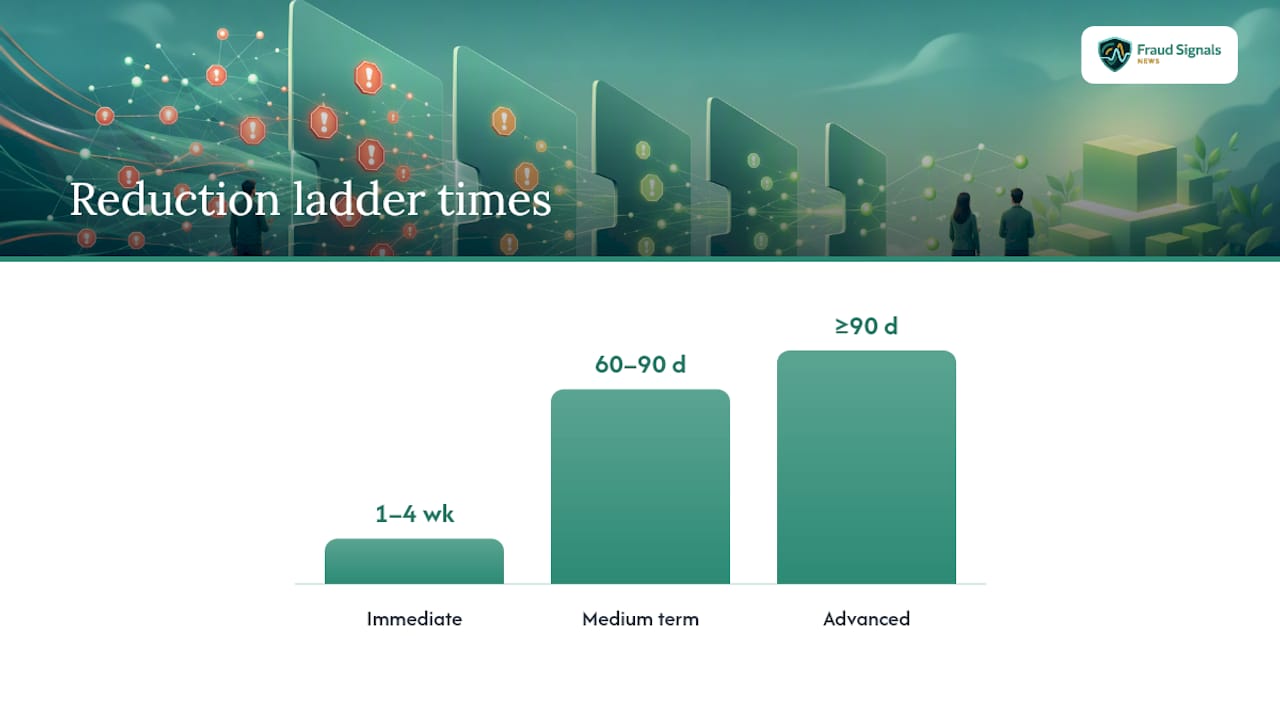
Medium term (60 to 90 days): Move to detection-as-code, where rules live in version control and get tested continuously against labeled false positive datasets before deployment. Segment alert thresholds by risk tier instead of applying one blanket sensitivity setting across dissimilar transaction types.
Advanced (90 days and beyond): Shift from single-event alerting to entity- or sequence-based scoring, which collapses a dozen low-confidence signals about the same account into one high-fidelity alert. Layer in cross-domain correlation and AI-assisted triage, but validate every vendor reduction claim against your own data before trusting it. AI-driven screening can shorten disposition time when properly tuned, though the same research stresses operational validation over vendor marketing.
- Track precision per rule (true positives divided by total alerts), not blended team accuracy.
- Require false-negative testing every time you loosen a threshold. A quieter queue that misses real fraud is not progress.
Pro Tip: Before retiring any noisy rule, run it in shadow mode against your labeled false positive dataset for two weeks. Rules that look useless in isolation sometimes catch the one fraud pattern nothing else covers.
How Identity Signals Change the False Positive Equation
Identity verification quality sits upstream of most fraud detection false positives, and Fraud Signals News cover this intersection closely because it’s where a lot of avoidable cost hides. Account-opening and login workflows that rely on thin, unverified identity data force downstream fraud models to guess, and guessing produces noise.
Biometric matching, liveness checks, and eKYC data reduce ambiguity at the point of capture, so the fraud model receives a cleaner signal instead of a partial one it has to compensate for with broader, noisier rules. Better structured identifiers upstream, verified document data, device binding, biometric confidence scores, mean fewer downstream alerts need human review at all.
- Weaker identity signals at onboarding correlate with higher false positive volume in later transaction monitoring.
- Structured, verified identity data reduces the guesswork that drives over-broad detection rules.
- Teams implementing the reduction ladder above should start with identity verification fixes before tuning downstream models, since garbage identity data undermines even well-tuned rules.
The Human Cost: Morale and Burnout Behind the Alert Queue
False positive costs don’t stop at the budget line. They erode the people working the queue, and that erosion compounds quietly until someone quits or a real threat slips through.
Analysts drowning in noise develop what practitioners call alert fatigue: a state where every notification starts to look the same, regardless of severity. The hidden cost of high false positive rates is degradation of institutional trust in the detection system itself. Once analysts stop believing the alerts, they start triaging on gut feeling or skipping investigations altogether, and that is precisely when a genuine fraud attempt walks through.
Burnout in fraud and SOC teams isn’t abstract. It shows up as slower mean time to triage, rising error rates on the alerts that do get reviewed, and eventually attrition. Replacing a mid-level fraud analyst costs months of ramp time on top of recruiting spend, and the departing analyst often takes institutional knowledge about your specific fraud patterns with them.
The morale damage also feeds back into the cost model from earlier: a burned-out team investigates alerts more slowly, which raises your effective minutes-per-investigation figure and inflates every dollar calculation downstream. Reducing false positive volume isn’t just a cost-control measure. It’s a retention measure, and treating it as purely a technical problem misses half the picture.
False Positive Costs Across Finance, Healthcare, and Cybersecurity
False positive costs take different shapes depending on the industry, though the underlying math, alerts times investigation time times hourly rate, stays constant.
The cost here splits between analyst hours and customer friction: a wrongly frozen account during a KYC review damages the relationship immediately, sometimes permanently.
In healthcare, false positives in fraud detection systems flag legitimate claims or patient billing patterns as suspicious, delaying reimbursement and consuming provider staff time on appeals. The friction lands on both the payer’s investigation team and the provider chasing a payment that should have cleared automatically.
The common thread across all three sectors is that false positive costs scale with alert volume and detection sensitivity, not with actual fraud or threat prevalence. A sector processing more transactions, claims, or events pays more in absolute dollars for the same false positive rate, which is why high-volume fintech and banking operations tend to feel this cost most acutely.
False Positives vs. False Negatives: The Trade-Off You’re Actually Managing
Every fraud detection system sits on a dial between two failure modes, and tightening one loosens the other. A false positive wastes analyst time on a legitimate case. A false negative lets real fraud through undetected, and that cost is harder to see but often larger.
Whether a false positive is worse than a false negative depends entirely on what’s at stake in the specific workflow. In a low-value transaction monitoring system, a false positive that annoys a customer is a survivable cost. In a sanctions screening program, a false negative that lets a sanctioned entity open an account carries regulatory and reputational risk that can dwarf a full year of false positive labor costs.
The practical mistake most teams make is optimizing purely for a lower false positive rate without measuring what happens to the false negative rate at the same time. Tightening thresholds to cut noise can quietly let more real fraud through, and that cost often only surfaces months later during an audit or a loss event. This is why the reduction ladder above insists on false-negative testing every time a threshold changes: a quieter alert queue that misses fraud is not an improvement, it’s a cost transfer from the analyst’s desk to somewhere far more expensive.
Real-World Numbers: What False Positive Costs Look Like in Practice
The unit-cost model from earlier isn’t theoretical. Applying Strike48’s practitioner benchmarks of 70 minutes per investigation and $70 to $93 per alert to a mid-size SOC handling several thousand monthly alerts at a 40% false positive rate produces annual waste in the low hundreds of thousands of dollars, before counting escalation overhead or SIEM licensing tied to that volume.
Sanctions screening tells a starker story. A false positive rate in the 85 to 95% range, as commonly reported in industry analyses of sanctions screening programs, means the overwhelming majority of alerts a compliance team reviews will never be a genuine match. Every one of those reviews still consumes analyst time, documentation effort, and audit trail maintenance, at scale, across an entire KYC onboarding pipeline.
The pattern across both examples is consistent: false positive costs don’t announce themselves as a single line item. They accumulate through thousands of small, repeated investigations, each one individually cheap and collectively enormous. That’s precisely why so many organizations underestimate this cost until someone runs the multiplication.
Building the Business Case: A Cost-Benefit Framework for Reduction
Justifying spend on false positive reduction, whether that’s a detection-as-code initiative, a new identity verification layer, or additional tuning headcount, requires a framework that compares investment cost against the unit-cost savings calculated earlier.
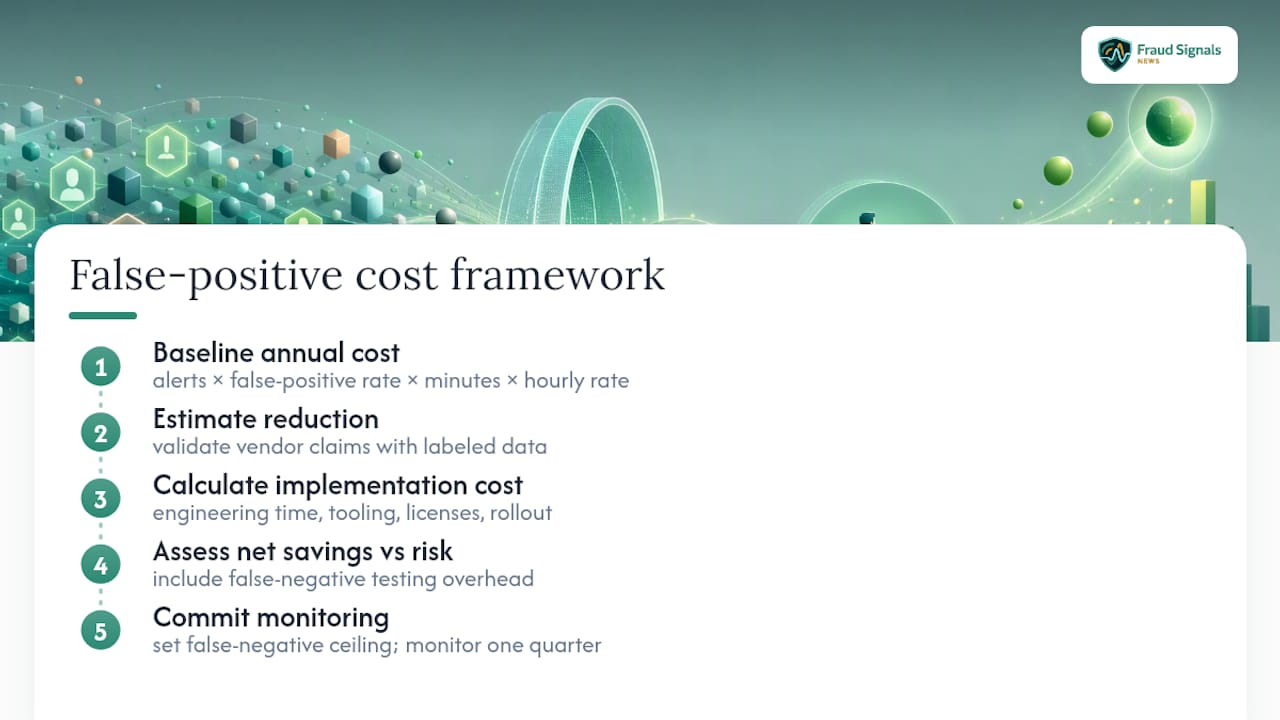
Start with your current annual false positive cost, using the formula from the quantification section: alerts times false positive rate times minutes times hourly rate, plus escalation and infrastructure overhead. That’s your baseline.
Next, estimate the reduction a given intervention realistically achieves. Detection-as-code and continuous testing programs target rule-level precision improvements. Identity verification upgrades reduce false positives specifically in account-opening and onboarding flows, where thin data is the primary driver. Neither intervention is free, and vendor claims about reduction percentages should be validated against your own labeled data before they enter the calculation, not accepted at face value.
Weigh the projected savings against implementation cost, engineering time, tooling licenses, and the false-negative testing overhead a responsible rollout requires. A project that cuts false positive costs by a meaningful margin but quietly raises the false negative rate has not created value, it has shifted risk. The strongest business cases pair a dollar reduction target with a documented false-negative ceiling the team commits to monitoring for at least one full quarter after any threshold change.
The Executive Memo: What to Tell Your CISO or CFO
If you need to summarize this for leadership in one paragraph: false positive costs are quantifiable, currently underpriced at most organizations, and reducible through a documented pilot rather than a wholesale platform replacement. Recommend a 60 to 90 day pilot on your top five noisiest rules using detection-as-code testing, then report results against three KPIs: precision (share of alerts that are real), false positive rate by rule, and mean time to triage. Those three numbers, tracked before and after, make the case for further investment on their own.
— Carlos Ochoa
Keep Reading: Fraud Signals News Guides on Identity and Detection
Fraud Signals News cover the identity verification and fraud operations landscape in the depth that general security news outlets skip, from biometric authentication to the model-level causes of alert noise.

If you’re building the business case outlined above, start with the operational specifics: our guide to machine learning fraud detection breaks down how model choices affect alert fidelity, and our walkthrough on implementing real-time fraud detection covers the staffing and architecture trade-offs that determine your actual minutes-per-investigation figure. For teams evaluating identity verification vendors as part of a false positive reduction strategy, DAON is a name worth putting on your shortlist alongside the identity signal improvements discussed above. Visit Fraud Signals News for ongoing coverage of the tools and techniques shaping fraud prevention operations.
Where These Numbers Come From
The unit-cost figures and benchmarks in this article draw from the SANS/Anvilogic State of Detection Engineering survey, NIST SP 800-63-4 governance guidance, and practitioner cost modeling from Strike48 and Splunk’s detection engineering guide.
This article is general information, not a substitute for advice from a qualified financial advisor. Consult a qualified financial professional about your own circumstances before acting on anything here.
Sources
- Vectra
- NIST SP 800-63-4
- The Real Cost of False Positives in Your SOC — Strike48
- Detection engineering best practices — Splunk blog
FAQ
What Is an Example of a False Positive?
A common example is a legitimate customer transaction flagged as fraudulent because it matches a broad velocity rule, triggering an unnecessary account freeze and a support ticket.
What Can Cause Multiple False Positives in a Row?
A cluster of false positives usually traces back to an unadapted vendor default rule, a drifted baseline after an environment change, or a data quality gap feeding incomplete context into the detection model.
Is a False Positive Worse Than a False Negative?
Not universally. A false positive wastes analyst time, while a false negative lets real fraud or risk through undetected, and which one costs more depends on what’s at stake in that specific workflow, such as sanctions exposure versus a declined low-value purchase.
Recommended

Detect SIM Swap Fraud Before Takeover: 3 Real Time Signals for Fraud Teams

21 Day Pilot: Layer Behavioral and Physical Biometrics for Fraud Teams