
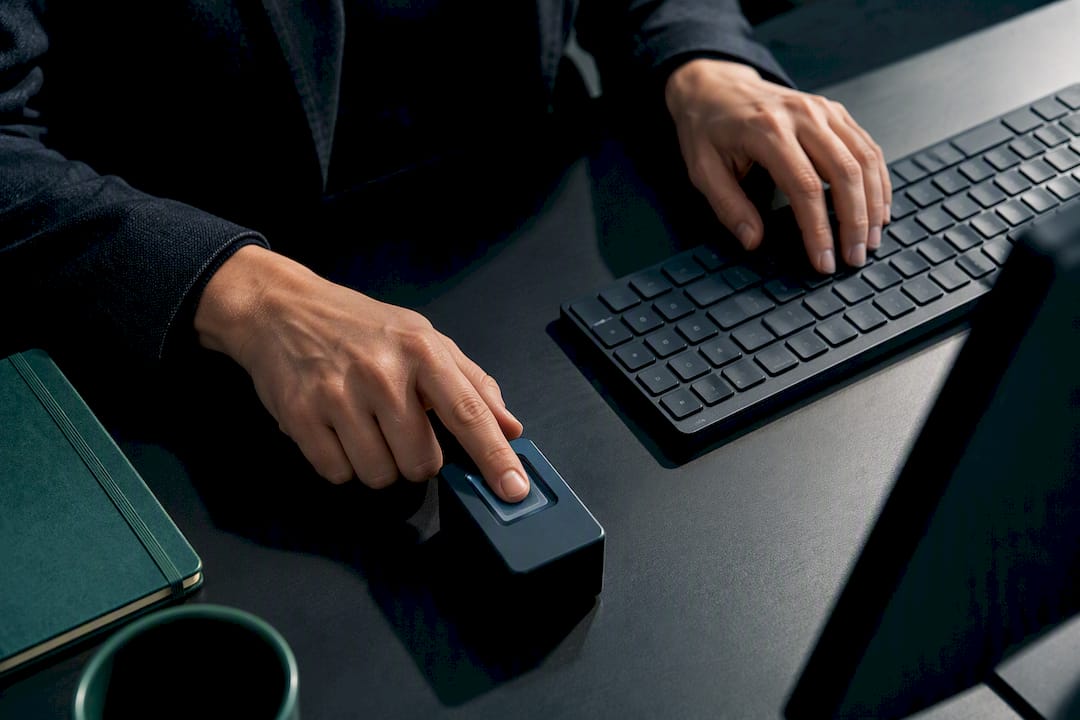
Physical biometrics prove who someone is at a single point in time; behavioral biometrics keep verifying that same person for as long as the session runs. Neither modality covers the other’s blind spot alone, which is why the strongest fraud programs layer both: a physical check at the gate, behavioral scoring running underneath it. Peer-reviewed work on combined models backs this up, showing that pairing behavioral biometrics with transaction risk scoring drives down false positives while keeping detection fast.
TL;DR:
- Combining physical and behavioral biometrics significantly reduces false positives and enhances detection speed by leveraging their complementary strengths.
- Physical biometrics are usually used for onboarding and identity proofing, relying on one-time captures like face or fingerprint scans, while behavioral biometrics monitor sessions continuously without user interruption.
- Behavioral signals, including keystroke dynamics and device movement, require ongoing model retraining to account for natural changes and drift over time.
- Deploying physical checks at login with behavioral scoring during sessions offers the most effective balance for fraud prevention across different use cases.
- Integration of both modalities through score or decision-level fusion improves overall security and resilience against spoofing and account takeover.
Table of Contents
- Behavioral Biometrics vs. Physical: The Technical Differences That Matter
- What Are the Types of Physical and Behavioral Biometrics?
- How Do Behavioral Biometrics Work Compared to Physical Systems?
- Where Should You Use Each Biometric Type?
- Best Practices for Implementing Behavioral and Physical Biometrics
- How Do You Measure Behavioral Biometrics Fraud Detection Success?
- How Do You Combine Physical and Behavioral Biometrics in One System?
- What Does the Research Say About Combined Biometric Models?
- A Practical Roadmap for Adopting Both Biometric Types
- Where to Go Deeper on Biometric Fraud Defense
- Sources
- FAQ
Behavioral Biometrics vs. Physical: The Technical Differences That Matter
The distinction is not just “what you are” versus “how you act.” It’s a difference in operating model, and that difference dictates where each fits in a security stack.
Physical biometrics run 1:1 verification (is this face the one on file?) or 1:N identification (whose face is this, out of a database of millions?). Either mode captures a snapshot, checks it, and returns a decision in milliseconds. Behavioral biometrics never stop running. They score a session continuously, updating a risk value every few seconds as a person types, scrolls, and navigates.
- Physical checks happen once, at login or onboarding; behavioral scoring runs for the entire session.
- 1:N identification (airport gates, watchlists) costs more compute than 1:1 authentication (unlocking your own phone) and is reserved for higher-stakes decisions.
- Physical capture is active and visible (look at the camera, press your finger); behavioral capture is passive, collected from telemetry the user never notices.
That last point explains a lot about user experience complaints in fraud programs. Physical biometrics ask something of the user. Behavioral biometrics ask nothing, which is exactly why they’re better suited to catching a fraudster mid-session, long after the visible checks are done.
What Are the Types of Physical and Behavioral Biometrics?
Vendors market dozens of “biometric” products, but nearly all of them reduce to a short list of physiological and behavioral signals.
Physical (physiological) biometrics rely on a fixed body trait captured by a dedicated sensor:
- Face — camera-based, works at a distance, sensitive to lighting and occlusion (masks, sunglasses).
- Fingerprint — capacitive or optical sensor, fails on wet, dry, or worn ridges.
- Iris — near-infrared camera, high precision, requires cooperative positioning.
- Vein maps — infrared scan of subdermal vessels, hard to spoof, expensive hardware.
- Voice — microphone capture, vulnerable to background noise and, increasingly, synthetic voice cloning.
Behavioral biometrics rely on patterns extracted from ordinary device interaction:
- Keystroke dynamics — timing between key presses, common on desktop and web forms.
- Mouse and gesture movement — cursor velocity, swipe pressure, scroll rhythm.
- Gait and device-hold angle — accelerometer and gyroscope data from a phone in a pocket or hand.
- Transaction navigation patterns — the order and speed a user moves through an app or checkout flow.
Accessibility matters here: voice and gait signals can be unreliable for users with motor or speech impairments, which is why most behavioral engines run as one input among several rather than a gatekeeper. Fraud Signals News’s biometrics coverage tracks how vendors are adjusting signal weighting for exactly this reason.
How Do Behavioral Biometrics Work Compared to Physical Systems?
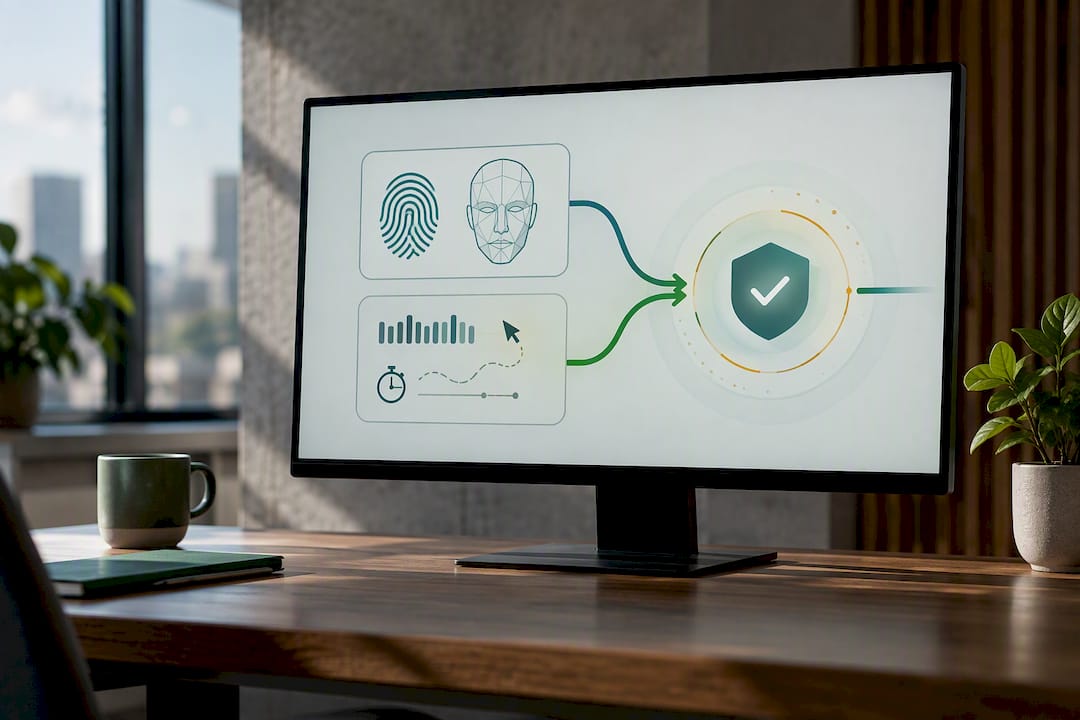
Physical systems extract a mathematical template from a scan (a fingerprint minutiae map, an iris code, a facial embedding) and store it, encrypted, for future matching. The match is a one-shot comparison against that stored template, and the template rarely changes.
Behavioral systems build something closer to a moving fingerprint. Raw events (keystroke timing, swipe vectors, session navigation) get converted into feature embeddings, then fed through sequence models like LSTMs or transformer-based architectures that score risk continuously rather than once. That score updates with every new action, which means the system is always comparing current behavior against a learned baseline, not a fixed record.
- Physiological templates are matched once per session and rarely require retraining.
- Behavioral embeddings require continuous scoring and periodic retraining to track natural change in how a person types, walks, or navigates.
- Drift, caused by a new phone, an injury, stress, or simply months of habit change, degrades behavioral accuracy unless the model adapts. Ensemble and mixture-of-experts approaches are becoming the preferred fix, blending several specialized models instead of relying on one static baseline.
- Privacy-conscious teams extract features on-device and never transmit raw event data; federated learning keeps that principle intact across institutions.
Longitudinal research on this shows behavioral patterns stabilize after roughly 14 to 21 days.2025.78) of regular use. That window has direct operational meaning: don’t trust the confidence score during a user’s first three weeks on a new device.
Pro Tip: Set a lower step-up threshold during a user’s first 21 days of enrollment. Treat that period as a training phase for the model, not a full-trust window for the account.
Where Should You Use Each Biometric Type?
Matching modality to workflow is the single highest-leverage decision a fraud team makes. Get it backwards, physical checks on every login, no behavioral monitoring mid-session, and you end up with a system that’s expensive and still misses live account takeovers.
- Onboarding and identity proofing. Lean on physical biometrics paired with liveness detection. A synthetic-ID applicant needs to be stopped before an account exists, not after.
- Account takeover and session fraud. Behavioral continuous scoring is the core detector here. A stolen password gets a fraudster past the front door; behavioral drift from the account’s normal user gets them flagged mid-session.
- High-value transactions. Combine an initial physical check at authorization with behavioral monitoring for the duration of the transaction, catching cases where a legitimate login is later hijacked.
- Physical access control and forensic identification. Physical biometrics remain primary. A building badge or a criminal case needs a definitive identity match, not a probability score.
Best Practices for Implementing Behavioral and Physical Biometrics
Deployment mistakes usually come down to treating one modality as sufficient on its own. Practitioners caution against using behavioral biometrics as a standalone factor, since behavior is inherently probabilistic and shifts with stress, injury, or a new device.
- Keep raw behavioral events local; export feature vectors, never PII-laden raw data, to central models.
- Run latency-sensitive checks (unlock, in-app authentication) on-device; reserve server-side models for cross-device correlation and fraud-ring detection.
- Deploy drift detectors and a retraining cadence, and use ensemble gating rather than a single model’s verdict to cut false positives.
- Pair biometric signals with device-bound credentials through FIDO and WebAuthn standards, with clear step-up rules for when a session needs a stronger check.
- Log match decisions and confidence scores in a form that supports audit and explainability, not just a pass/fail flag.
Pro Tip: If your compliance team can’t explain why a specific session got flagged, your logging is insufficient, not your model. Store the contributing feature weights, not just the final score.
How Do You Measure Behavioral Biometrics Fraud Detection Success?
Three metrics anchor every serious evaluation: False Acceptance Rate (FAR), the rate at which an impostor gets accepted; False Rejection Rate (FRR), the rate at which a legitimate user gets rejected; and Equal Error Rate (EER), the point where FAR and FRR cross, used as a single comparable accuracy figure across systems. Continuous behavioral systems add a fourth dimension: detection window, how long it takes the system to flag a session after behavior turns anomalous.
- Test with synthetic attack scenarios, not just clean historical data, since fraud patterns rarely mirror pilot conditions.
- Compare lab EER against in-field EER before trusting vendor benchmarks.
- Track operational KPIs: account takeover incidents, chargeback rates, customer friction (step-up frequency), and time-to-detect.
Field data from a BTFA study found sensor-driven behavioral models (motion and accelerometer signals) reached an AUC of 97.28% with an EER of 6.84%, compared with 78.67% AUC and 28.48% EER for touch-gesture-only approaches. That gap is the difference between a model worth deploying and one that generates constant analyst review.
How Do You Combine Physical and Behavioral Biometrics in One System?
Fusion happens at two levels: score-level fusion, where physical and behavioral confidence values get weighted into one composite risk score, and decision-level fusion, where each system makes an independent pass/fail call and a policy engine decides how to combine them. Score-level fusion suits continuous risk stacks; decision-level fusion suits hard gates like onboarding.
- Onboarding flow: physical biometric match plus liveness check produces a single go/no-go decision before an account is created.
- Session monitoring: behavioral scoring runs continuously; an anomaly trips a step-up event rather than an outright block.
- Transaction authorization: a behavioral anomaly during checkout triggers a request for a physical biometric or MFA challenge, not an automatic decline.
Combining orthogonal signal types like this measurably lowers equal error rates and raises spoof resistance, since an attacker now has to defeat two unrelated defenses instead of one.
What Does the Research Say About Combined Biometric Models?
The evidence for layering is consistent across recent studies. Combined behavioral and transaction-risk models have produced high recall and precision with low false positives at production-grade inference speed. A separate analysis found financial institutions using continuous behavioral monitoring saw meaningful drops in fraud rates and false positives after deployment.
- Temporal complementarity, physical gates at the start, behavioral scoring throughout, is the operative pattern across the literature.
- Drift handling isn’t optional; it’s the difference between a pilot that works and one that degrades within a quarter.
- Fraud Signals News’s guide to biometric fraud reduction covers pilot design in more depth.
A Practical Roadmap for Adopting Both Biometric Types
Pilot behavioral scoring on one narrow product first. Tune thresholds against real false-positive rates. Add a physical gate only where identity assurance truly demands it. Measure fraud reduction before scaling further.
— Carlos Ochoa
Where to Go Deeper on Biometric Fraud Defense
Coverage tracks the technology gaps that let sophisticated fraud slip past outdated verification. Where legacy vendors bolt on one biometric type and call it complete, this coverage focuses on the layered reality security teams actually operate in.

For teams evaluating vendors, DAON is one option worth a look for organizations building layered identity assurance across physical and behavioral signals. Beyond vendor selection, Fraud Signals News’s machine learning fraud detection guide walks through concept drift and ensemble architecture in more technical depth, and this biometric authentication primer is a useful reference for teams still mapping modalities to use cases. Visit the Fraud Signals News homepage for ongoing coverage of pilot design, compliance frameworks, and emerging fraud techniques as they surface, and start there before your next vendor evaluation.
Sources
FAQ
What Type of Biometrics Is the Most Accurate?
Accuracy depends on the metric and use case, but iris and vein-map systems typically post the lowest error rates among physical modalities. Among behavioral approaches, sensor-driven models combining motion data have shown an EER of 6.84%, far tighter than touch-gesture-only systems.
What Are Examples of Behavioral Biometrics?
Common examples include keystroke dynamics, mouse and touchscreen gesture patterns, gait captured through a phone’s accelerometer, device-hold angle, and transaction navigation behavior. Each one builds a profile from how a person interacts with a device, not from a physical trait.
What Are the Downsides of Using Biometrics?
Physical biometrics raise privacy concerns since a compromised template can’t be reset like a password, and they can exclude users with certain disabilities or injuries. Behavioral biometrics drift over time and shouldn’t be used as a standalone authentication factor, since stress, illness, or a new device can temporarily look like fraud.
What Is the Most Commonly Used Type of Behavioral Biometrics?
Keystroke dynamics remains the most widely deployed behavioral signal, largely because it works on any keyboard-based login without extra hardware. Mouse movement and touchscreen gesture analysis follow closely behind in web and mobile banking applications.
Should I Choose Behavioral or Physical Biometrics for Fraud Prevention?
Neither should stand alone. Physical biometrics fit identity proofing and access control, while behavioral biometrics fit continuous session monitoring and account takeover detection, and pairing both in a layered architecture consistently outperforms either used in isolation.
Recommended

Detect SIM Swap Fraud Before Takeover: 3 Real Time Signals for Fraud Teams
Fraud Ops: 5 ID Document Forgery Classes That Beat Lab Tests