

Machine learning fraud detection is defined as the use of statistical algorithms trained on historical transaction and behavioral data to identify fraudulent activity automatically, in real time, and at scale. The role of machine learning fraud detection in financial services has shifted from experimental to foundational: AI-powered systems increase fraud detection accuracy by 40% compared to traditional rule-based approaches while cutting false positives significantly. With global cybercrime losses projected to reach $23 trillion by 2027, the economic case for deploying machine learning in fraud prevention is no longer debatable. Regulatory pressure for explainability and audit trails adds a second layer of urgency, making model selection and integration decisions consequential for compliance teams as much as for fraud analysts.
How does machine learning detect fraudulent patterns and anomalies?
Machine learning detects fraud by training models on labeled datasets of legitimate and fraudulent transactions, then applying those models to score new activity in real time. This supervised learning approach excels at catching known fraud patterns: account takeover sequences, card-not-present abuse, and credential stuffing attacks all leave statistical signatures that classifiers learn to recognize.
Unsupervised anomaly detection handles the harder problem. When fraud tactics evolve, labeled examples do not yet exist. Unsupervised models identify transactions that deviate from established behavioral baselines without needing prior fraud labels. Graph neural networks extend this further by mapping relational signals across accounts, devices, and merchants to surface fraud rings that individual transaction scoring would miss entirely.
The signals feeding these models matter as much as the algorithms themselves. Common feature categories include:
- Behavioral signals: typing cadence, session duration, navigation patterns, and transaction timing relative to a user’s historical baseline
- Device signals: device fingerprinting, IP geolocation, browser configuration, and SIM-swap indicators
- Contextual signals: merchant category, transaction amount relative to account history, and time-of-day patterns
- Relational signals: shared device identifiers, linked email addresses, and network connections between accounts
Relational and behavioral signals provide more stable predictive power than raw velocity metrics in many operational datasets. Velocity features, such as transaction count per hour, were shown to be redundant in large e-commerce datasets while relational features added measurable lift to model performance.
Modern fraud engines combine all these signals into a single risk score. Real-time AI fraud decision engines analyze hundreds of signals and return risk scores within 5–15 milliseconds, meeting the speed requirements of card authorization networks. Explainability outputs follow within 200 milliseconds to support compliance documentation.

Pro Tip: When building feature sets, prioritize behavioral baselines over rolling velocity windows. Behavioral baselines encode timing patterns more accurately and degrade more slowly as fraud tactics shift.
Why optimizing ML models for accuracy alone fails fraud teams
Statistical accuracy metrics like F1-score and AUC are necessary but insufficient for fraud model selection. A model with a high F1-score can still generate operational costs that exceed the fraud losses it prevents, if its false positive rate is high enough to trigger excessive manual reviews.
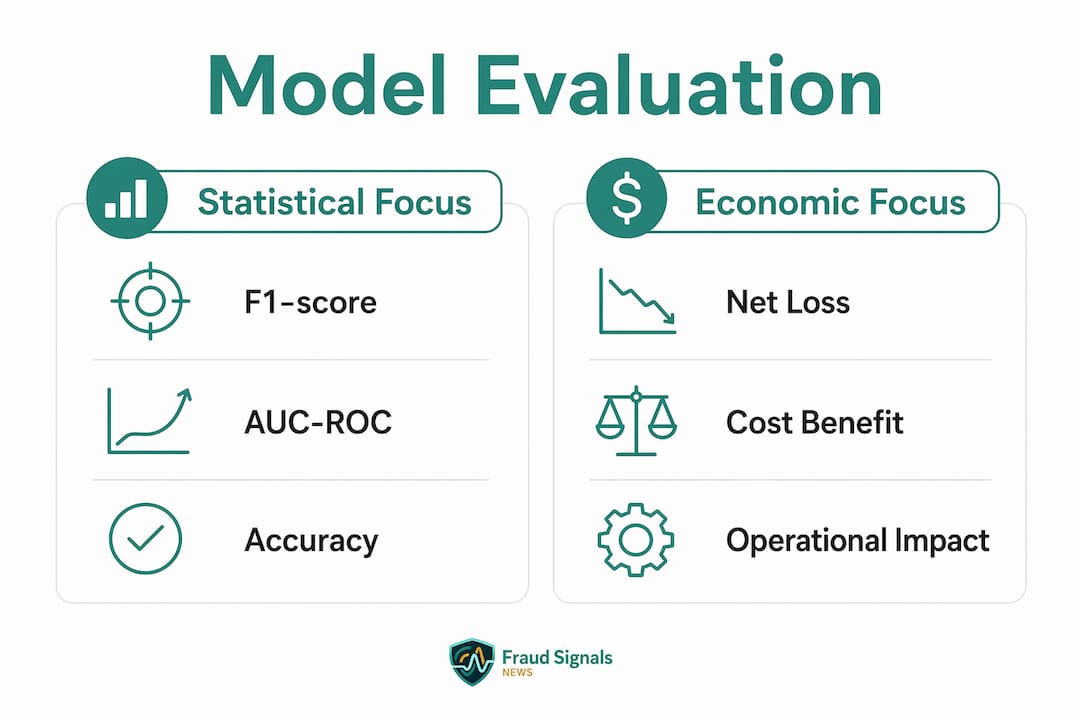
Optimizing fraud detection models solely for statistical accuracy can increase operational costs. The correct framework evaluates models on economic outcomes: total fraud loss prevented minus the cost of false positives, investigation labor, and customer friction from declined legitimate transactions. Two models with identical AUC scores can produce materially different financial outcomes depending on where their decision thresholds sit.
The table below illustrates how economic evaluation differs from statistical evaluation in practice:
| Evaluation dimension | Statistical focus | Economic focus |
|---|---|---|
| Primary metric | F1-score, AUC-ROC | Net fraud loss reduction |
| False positive treatment | Counted in aggregate | Costed per review hour |
| Threshold selection | Maximizes detection rate | Balances detection and operational cost |
| Model comparison basis | Accuracy on test set | Dollar impact on P&L |
| Preferred model type | Highest AUC classifier | Ensemble balancing precision and cost |
Ensemble methods offer the best balance of predictive power and financial efficiency in fraud detection contexts. Combining gradient boosting classifiers with anomaly detectors and rule overlays captures a wider range of fraud patterns while keeping false positive rates manageable.
Pro Tip: Run a cost-benefit simulation before finalizing any model threshold. Assign a dollar value to each false positive review and each missed fraud case, then find the threshold that minimizes total cost rather than maximizing detection rate.
How do hybrid systems and explainable AI strengthen fraud workflows?
Layered architectures combining machine learning with rule-based systems outperform either approach alone. Rules enforce hard business and regulatory constraints: blocking transactions from sanctioned countries, flagging amounts above defined thresholds, or enforcing velocity limits mandated by compliance policy. ML models handle the probabilistic judgment that rules cannot encode.
AI-powered fraud detection systems deploy layered architectures combining supervised classifiers for known fraud, unsupervised anomaly detectors for novel fraud, and rule overlays for policy enforcement. This ensemble approach improves accuracy and reduces false positives compared to any single layer operating independently.
A typical hybrid workflow operates in this sequence:
- Pre-transaction device and bot screening: Device fingerprinting and bot detection models run before the transaction reaches the scoring engine. Bot detection and device risk scoring block approximately 30% of fraud attempts before any transaction is processed.
- Real-time ML scoring: The transaction passes through supervised and unsupervised models that produce a risk score with contributing feature weights.
- Rules engine overlay: Hard rules accept, decline, or escalate based on policy constraints independent of the ML score.
- Escalation to analyst queue: High-risk transactions flagged by both ML and rules route to human review with full explainability output attached.
- Feedback loop: Analyst decisions on reviewed cases feed back into model retraining pipelines, continuously improving accuracy.
Explainability is not optional in regulated environments. Explainable AI techniques are increasingly integrated into ML fraud detection to meet regulatory transparency requirements, enabling institutions to justify automated decisions to auditors and communicate decline reasons to customers. The black-box nature of deep learning models remains a compliance liability without XAI layers built into the architecture.
“The inability to explain a fraud decision to a regulator or a customer is not a technical limitation. It is a governance failure.” This framing from the explainable AI research community reflects the standard financial regulators now apply to automated decision systems.
What does ML fraud detection look like in practice for financial institutions?
Deployment in banking and fintech follows a consistent pattern. Transaction monitoring systems ingest payment events, apply the layered ML architecture described above, and route decisions back to the authorization network within the required latency window. The fraud detection and prevention coverage at Fraud Signals News tracks how institutions are adapting these architectures to new payment rails, including real-time payments and push payment fraud scenarios.
The operational benefits are measurable. Fraud analysts shift from reviewing every flagged transaction manually to focusing on cases the ML system cannot resolve with high confidence. This frees analyst capacity for strategic work: investigating fraud ring patterns, tuning model thresholds, and coordinating with compliance on regulatory reporting.
Common implementation challenges include:
- Data quality: ML models trained on incomplete or mislabeled historical data produce unreliable scores. Garbage in, garbage out applies with particular force in fraud detection, where class imbalance between legitimate and fraudulent transactions is extreme.
- Model drift: Fraud tactics evolve continuously. A model trained on last year’s attack patterns degrades without regular retraining on recent labeled data.
- Integration latency: Adding ML scoring to an existing authorization stack introduces latency. Architectures must be designed to meet the sub-200-millisecond decision window without sacrificing model complexity.
Large Language Models are entering fraud operations, but not in the core scoring role. LLMs are primarily used for sidecar tasks like processing customer dispute narratives, summarizing investigation notes, and analyzing unstructured data from customer tickets. They add value in investigative analysis without disrupting real-time transaction scoring. For push payment fraud prevention, ML models trained on behavioral and relational signals remain the primary detection layer.
The role of automation in fraud prevention extends beyond detection. Automated case management, alert triage, and regulatory reporting reduce the operational burden on fraud teams while maintaining the audit trails that compliance requires.
Key Takeaways
Machine learning fraud detection delivers its highest value when models are selected for economic impact, integrated with rule-based systems, and supported by explainable AI outputs that satisfy regulatory requirements.
| Point | Details |
|---|---|
| Economic optimization over accuracy | Select models based on net fraud loss reduction, not F1-score or AUC alone. |
| Layered architecture is standard | Combine supervised classifiers, anomaly detectors, and rule overlays for best results. |
| Behavioral and relational signals win | These features outperform velocity metrics for stability and predictive lift. |
| Explainability is a compliance requirement | XAI outputs are necessary to justify automated decisions to regulators and customers. |
| LLMs augment, not replace, core models | Use large language models for investigative tasks, not real-time transaction scoring. |
The economic argument that most fraud teams still miss
I have watched financial institutions spend months selecting fraud models based on AUC scores, then express surprise when operational costs rise after deployment. The statistical metrics are not wrong. They are just answering the wrong question.
The question that matters is: what does this model cost to run, and does that cost stay below the fraud losses it prevents? I have seen gradient boosting models with lower AUC scores outperform technically superior deep learning models on that measure, because their false positive rates were low enough to keep analyst queues manageable.
The second thing I would push back on is the assumption that more signals always means better detection. Behavioral baselines and relational features consistently outperform velocity aggregations in production environments. Adding more velocity features to a model that already has behavioral baselines often adds noise, not signal. Feature selection discipline matters as much as algorithm selection.
The integration of LLMs into fraud operations is real and growing, but the hype outpaces the current reality. LLMs are genuinely useful for processing dispute narratives and summarizing investigation threads. They are not ready to replace the sub-15-millisecond scoring engines that authorization networks require. Professionals who treat LLMs as a fraud detection solution rather than an investigative tool will be disappointed by the latency alone.
The institutions that will pull ahead are those that treat fraud model development as an economic engineering problem, not a data science competition. That means cost-sensitive evaluation, explainability built in from the start, and continuous retraining pipelines that keep pace with evolving attack patterns.
— A. Johnson
Fraud Signals News: your source for ML fraud intelligence
Fraud professionals need more than theory. They need current intelligence on how machine learning and AI are reshaping fraud detection across banking, fintech, and payments.

Fraud Signals News covers the technologies, techniques, and regulatory developments that matter to fraud and risk teams in financial services. From AI and machine learning fraud trends to deep dives on identity verification and liveness detection, the coverage is built for practitioners who need to stay ahead of the threat. Visit Fraud Signals News to access the full library of fraud intelligence resources.
FAQ
What is the role of machine learning in fraud detection?
Machine learning detects fraud by training algorithms on historical transaction and behavioral data to identify patterns associated with fraudulent activity. It scores new transactions in real time, flagging anomalies that rule-based systems would miss.
How does machine learning improve on rule-based fraud detection?
Rule-based systems fail against novel fraud tactics because they can only catch patterns explicitly coded into their logic. Machine learning models learn from data and adapt to new attack patterns through retraining, catching fraud that no predefined rule anticipated.
What are the most predictive fraud signals for ML models?
Behavioral and relational signals, including transaction timing baselines, device fingerprinting, and account network connections, provide more stable predictive power than velocity metrics in many production datasets.
Why does explainable AI matter in fraud detection?
Regulators require financial institutions to justify automated decisions, including fraud declines. Explainable AI outputs document why a model flagged a transaction, reducing compliance risk and supporting customer communication.
How fast must ML fraud detection systems operate?
Real-time fraud detection engines must return risk scores within 5–15 milliseconds to meet card authorization network requirements, with full explainability outputs delivered within 200 milliseconds for compliance documentation.
Recommended

ID Security Features: What Each One Does and How to Check It

Face Liveness Detection: How It Works and Where It Fails