

Anti-money mule checks are the controls a bank uses to stop accounts from being opened, or quietly repurposed, to receive and forward criminal proceeds. They work in three layers: identity verification at onboarding, transaction and behavioral monitoring once the account is live, and a disciplined escalation path (investigation, then a Suspicious Activity Report) when the signals line up. A bank that relies on only one of those layers is, in practice, leaving a backdoor open.
This guide is written for fraud and AML leaders at retail banks, credit unions and fintechs. It explains what to check, which red flags matter, what U.S. rules require, and how to tighten detection without burying analysts or good customers in alerts.
TL;DR
- Mule defense is a lifecycle problem: strong identity proofing at account opening, then continuous validation of the account holder, transactions and device activity afterward.
- The most useful red flags are funds arriving from several unrelated people followed by fast outgoing transfers, conversion to crypto or gift cards, and identities that look synthetic or stolen.
- Monitor inbound and outbound flows together, and use a documented customer risk profile as the baseline against which “unusual” is measured.
- Once a check flags an account, U.S. banks generally have 30 calendar days to file a SAR, with a hard outer limit of 60 days when no suspect is identified.
- Tune rules and models continuously: untested monitoring and unexplained machine-learning alerts create the false positives that make mule programs fail.
Table of Contents
- What anti-money mule checks are meant to catch
- Layer one: identity checks at account opening
- Layer two: monitoring the account after it opens
- The red flags that deserve analyst time
- Telling mules from legitimate customers
- What happens after a check flags an account
- Cutting false positives without loosening controls
- A practical checklist for a mule-aware program
- Our perspective
- Keep learning how identity controls stop mule accounts
- FAQ
- Sources
What anti-money mule checks are meant to catch
A money mule moves illegally obtained funds on behalf of someone else, sometimes knowingly and sometimes as the victim of a romance or job scam. The FDIC Office of Inspector General warns that mule activity can involve synthetic, stolen or fictitious identities used to open accounts, which means a bank may be dealing with a real person who was recruited, a real person whose identity was stolen, or a person who does not exist at all.
That distinction drives control design. A recruited customer passes identity checks honestly and only reveals the problem through behavior. A stolen or synthetic identity may fail, or pass, at onboarding depending on how robust the proofing is. Federal Reserve Banks’ research on synthetic money mules notes that synthetic identities can be used to open accounts specifically to receive or move illegally acquired funds, and that ongoing monitoring and routine validation of the account holder, transactions and account activity can help identify them.
So the checks have to answer three separate questions:
- Is this person who they say they are? (identity proofing)
- Does this account behave the way this customer should behave? (profile-based monitoring)
- Is this account connected to others in ways that suggest coordination? (device, address and link analysis)
Banks that treat mule detection as a transaction-monitoring problem alone tend to find mules only after the money has left. Banks that treat it as an onboarding problem alone discover that a clean identity can be rented out later.
Layer one: identity checks at account opening
For U.S. banks, the floor is the Customer Identification Program. Under the CIP rule for banks, an institution must collect an individual’s name, date of birth, address and identification number before opening the account. Its risk-based verification procedures must let it form a reasonable belief that it knows the customer’s true identity, and verification may occur within a reasonable time after the account is opened.
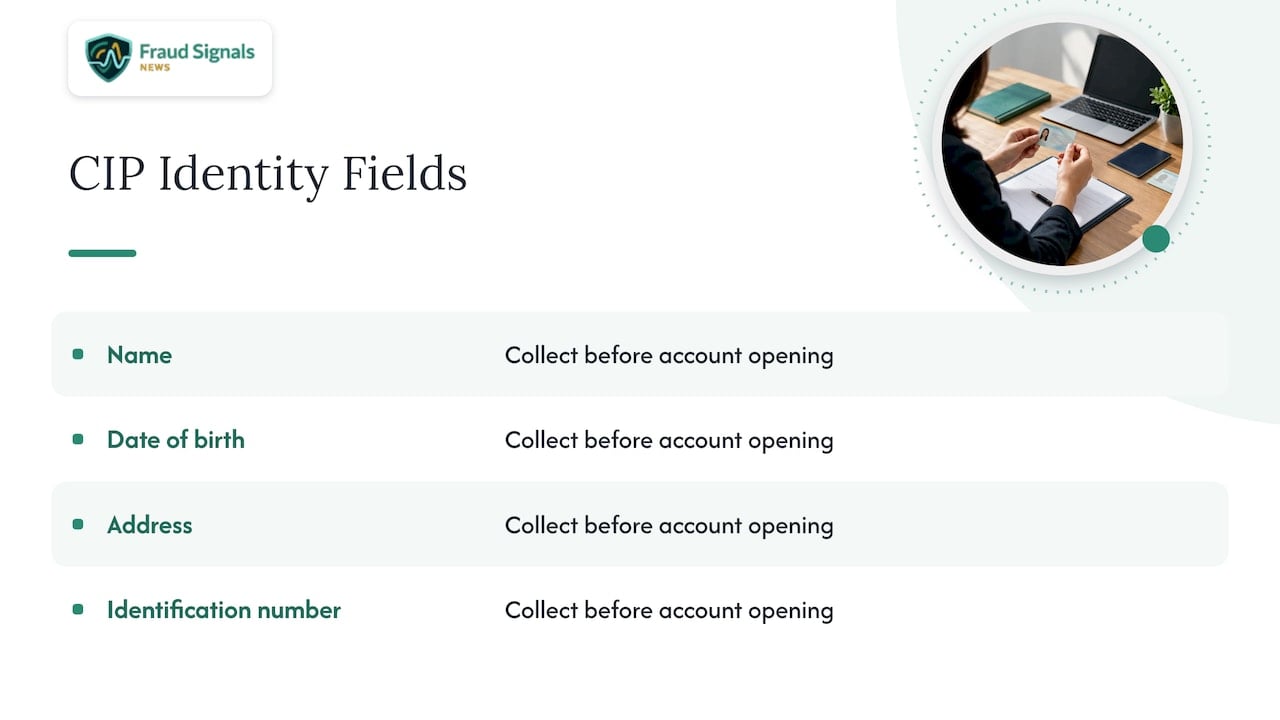
That last clause is the weak point for mule prevention. A account can be live, funded and moving money before verification is complete, which is exactly the window a mule operator needs.
What nondocumentary verification can include
The same rule permits nondocumentary methods. They include contacting the customer, comparing supplied information with consumer-reporting, public-database or other sources, checking references with other financial institutions, and obtaining a financial statement. These are legitimate tools, but a static data match only proves that an identity exists, not that the person applying owns it. Synthetic identities in particular are built to pass database lookups.
That is why many institutions add layers on top of the regulatory minimum:
- Document and selfie verification with liveness detection, so a stolen ID cannot be paired with a replayed or injected image. Our explainers on selfie identity verification and face liveness detection cover how these checks work and where they fail.
- Capture integrity controls, because deepfaked or injected media defeats a camera check that trusts whatever the app receives. See our analysis of stopping replay and injection fraud.
- Synthetic identity signals, such as thin or oddly assembled credit files and shared attributes across applications, covered in our synthetic identity detection playbook.
For a deeper look at the account-opening problem itself, read false identity bank accounts and our guide to new account fraud prevention strategies.
Collect expected-activity data while you have the customer
One of the cheapest controls is also one of the most neglected. The UK Financial Conduct Authority’s 2025 review of mule detection reported that collecting salary or turnover information at onboarding helps firms identify suspicious transactions and avoid unnecessary monitoring alerts. The review is a UK document, but the logic transfers directly: if you know a new customer says they earn a modest salary, a sudden stream of high-value credits is far easier to judge.
Layer two: monitoring the account after it opens
The Federal Reserve Banks’ synthetic-mule research frames prevention as a lifecycle problem. Onboarding controls matter, but ongoing validation becomes crucial once a synthetic identity has already opened an account. In operational terms, onboarding is where you lower the volume of bad accounts; monitoring is where you catch the ones that got through.
Start with the customer risk profile
U.S. interagency guidance on risk-based customer due diligence calls for procedures that help a bank understand the nature and purpose of customer relationships, conduct ongoing monitoring to identify and report suspicious transactions, and maintain or update customer information, including beneficial-owner information for legal-entity customers.
The FFIEC examination manual adds the operational point: customer information and risk profiles should help the bank understand the transactions a customer would normally be expected to make, which gives it a baseline for spotting suspicious ones. Put differently, transaction monitoring only works if the institution first knows what normal looks like for that customer. A rule that fires on “large incoming wire” is noise for a small business and a strong signal for a student account.
Monitor both directions
Many programs concentrate on outbound payments because that is where the loss occurs. The FCA’s review found that focusing only on outbound monitoring can miss rapid turnover, dormant accounts suddenly receiving large funds, and high-value incoming payments followed by similar outgoing debits. Those are classic pass-through patterns. By the time the outbound leg is visible, the inbound leg has often already told you everything.
Use device and address links
Using the same device or physical address across multiple customer accounts can be a mule characteristic, according to the Federal Reserve Banks’ research, and firms should investigate whether there is a reasonable explanation. Families share addresses and devices legitimately, so this is an investigative trigger rather than a verdict. The FCA also encourages firms to consider device profiling, geolocation and behavioral biometrics. Our overview of why biometrics reduce bank fraud explains how these signals fit into a layered program.
The red flags that deserve analyst time
The FDIC OIG’s public service alert lists patterns that map well onto monitoring rules. Together they form the core of most mule scenarios:
| Red flag | What it looks like in the data | Where to detect it |
|---|---|---|
| Many unrelated senders, fast exit | Credits from multiple unrelated individuals followed by rapid outgoing transfers | Transaction monitoring, counterparty analysis |
| Conversion requests | Pressure to move funds into cryptocurrency, gift cards, wire transfers or cash | Payment-type rules, customer contact notes |
| Fictitious or stolen identity | Synthetic, stolen or fictitious identity used to open the account | Onboarding verification, link analysis |
| Check cycling | Large checks withdrawn immediately, later returned as fraudulent or nonsufficient funds | Deposit hold and return monitoring |
| Shared attributes | Same device or physical address across multiple accounts | Device fingerprinting, address matching |
| Dormant account awakening | Little activity, then sudden large inbound funds | Behavioral baselines |
No single row proves anything. The value comes from combinations: a newly opened account, a shared device, several unrelated senders and a same-day outbound wire is a very different case from any one of those on its own.
Telling mules from legitimate customers
The hardest practical question is separating a mule from a customer whose life simply changed. The FFIEC manual gives useful review criteria: significant unexplained activity, activity inconsistent with the bank’s understanding of the relationship or the customer’s risk profile, monitoring red flags, law-enforcement inquiries and negative-media results may all justify reviewing a relationship. It also says material changes in relevant customer information should be updated and the risk profile reassessed where appropriate.
In practice, a good review asks:
- Does the activity contradict the stated purpose of the account or the income information collected at opening?
- Is there a plausible, documentable explanation, such as a property sale, a business launch or a gift?
- Is the pattern isolated, or does it repeat across linked accounts, devices or addresses?
- Has the customer recently changed contact details, device or login behavior?
The interagency statement is also a reminder that no customer type automatically presents a uniform level of risk, and that agencies generally do not direct banks to open, close or maintain specific accounts. That supports individualized judgment over blanket de-risking of whole segments such as students or gig workers, who are frequent mule recruitment targets but overwhelmingly legitimate customers.
What happens after a check flags an account
A flag starts an investigation, not an automatic closure. If the investigation supports suspicion of a violation, the bank has reporting duties. The rule text below is for FDIC-supervised institutions; banks supervised by other agencies follow parallel rules under their own regulators, so confirm the one that applies to you.
Under 12 CFR 353.3:
- A SAR is required for suspected federal criminal violations involving $5,000 or more when a suspect can be identified, $25,000 or more regardless of whether a suspect is identified, and $5,000 or more involving potential money laundering or Bank Secrecy Act violations under the stated conditions.
- A bank generally must file within 30 calendar days after initial detection of facts that may support filing. If no suspect is identified, it may take an additional 30 days to identify one, but reporting cannot be delayed beyond 60 days.
- For violations requiring immediate attention, the bank must immediately notify appropriate law enforcement by telephone.
- The SAR and its supporting documentation must be retained for five years.
Two operational consequences follow. First, the 30-day clock starts at initial detection of facts, so case management must timestamp when an alert became a credible lead. Second, supporting documentation is part of the record, which means analysts should write down why a pattern was judged suspicious, not only that it was.
Cutting false positives without loosening controls
Mule programs fail in two ways: they miss real mules, or they drown analysts in alerts until nobody investigates carefully. The FCA’s findings offer concrete guidance on the second problem.
- Do not treat machine learning as self-explanatory. The FCA reported that new or thin-file customers may lack enough history for reliable models, that firms must understand model inputs and outputs, and that analysts should understand why an alert triggered. Thin-file customers are, unfortunately, precisely where mules and synthetic identities concentrate.
- Test continuously. Monitoring systems should be tested so alerts trigger when parameters are met and stay quiet when they are not.
- Update rules quickly. When new mule characteristics or emerging risks are identified, rules should be revised promptly rather than waiting for an annual model review.
- Feed onboarding data into monitoring. Expected income or turnover collected at opening removes a large class of pointless alerts.
The broader lesson matches what we see across the industry: static, rules-only programs built years ago are easily defeated at scale, because mule operators learn thresholds and structure payments beneath them. Our piece on why outdated fraud prevention fails in financial services examines that dynamic, and our catalog of retail banking fraud schemes shows where mule accounts typically sit in the cash-out chain.
A practical checklist for a mule-aware program
- Verify identity robustly at opening, with liveness and capture-integrity controls where you accept remote applications.
- Record expected activity (income, turnover, account purpose) and keep it current.
- Link accounts by device, address, phone and behavioral signals, and investigate clusters.
- Monitor inbound and outbound together, including dormant-account activation and rapid pass-through.
- Re-validate after opening, particularly for new accounts that suddenly change behavior.
- Document case reasoning so SAR decisions meet the 30-day and 60-day limits.
- Test and tune rules and models on a regular schedule, and make sure analysts can explain every alert.
- Share patterns internally between fraud, AML and customer operations, since mule cases cross all three.
Our perspective
Mule accounts are where identity fraud, scam victimization and money laundering meet, and most institutions still fund the three disciplines separately. The result is predictable: onboarding teams optimize for conversion, AML teams inherit the consequences, and the fraud team sees only the loss.
We think the industry’s central error is treating identity verification as a one-time gate. A verified face and a matched database record at day zero say very little about who is operating the account on day thirty. The institutions that perform best treat identity as a continuing assurance problem: strong proofing with liveness at the door, behavioral and device signals afterward, and a customer profile detailed enough to make deviations obvious.
Biometric and liveness technology is the practical way to close that gap, because it ties the account to a living person rather than a set of data points that a synthetic identity can imitate. Used together with transaction monitoring, it lets teams spend their analyst hours on genuine cases rather than on thousands of alerts that a better onboarding record would have prevented.
Our editorial position is simple: if your mule controls were designed before remote onboarding, deepfakes and injection attacks became ordinary, they are probably measuring a threat that has already moved on.
Carlos Ochoa
Keep learning how identity controls stop mule accounts
Fraud Signals News tracks the technology and the tactics behind this problem: biometric identification, liveness detection, deepfake ID fraud and the operational frameworks for measuring fraud prevention ROI. If you are rebuilding onboarding controls, start with our guide to why biometrics satisfy compliance requirements, then work through deepfake ID fraud and capture integrity.

Browse the full library of analysis on Fraud Signals News to see how fraud leaders are modernizing verification across banking, fintech, healthcare and travel.
FAQ
What is a key red flag for identifying a money mule account?
The strongest single pattern is money arriving from several unrelated individuals and leaving quickly in outgoing transfers. Requests to convert funds into cryptocurrency, gift cards, wires or cash, and large deposited checks withdrawn immediately and later returned, are also highlighted by the FDIC OIG. Treat these as a combination to investigate, not as proof on their own.
What triggers AML checks at a bank?
Triggers include activity inconsistent with the customer’s profile, significant unexplained transactions, monitoring red flags, law-enforcement inquiries and negative-media results, which the FFIEC lists as criteria for reviewing a relationship. Material changes in customer information can also prompt a refreshed risk assessment. Specific thresholds and scenarios are set by each institution’s risk-based program.
How quickly must a bank report a suspected mule account?
For FDIC-supervised banks, a SAR generally must be filed within 30 calendar days of initial detection of facts that may support filing. If no suspect is identified, the bank may take up to 30 more days to find one, but no more than 60 days in total. Situations needing immediate attention also require an immediate phone call to law enforcement.
Can the same device or address across accounts prove mule activity?
No. It can be a mule characteristic, but households and shared workplaces create legitimate overlaps. The Federal Reserve Banks’ research recommends investigating whether a reasonable explanation exists, so treat shared attributes as a reason to look closer, together with other signals such as rapid pass-through of funds.
Sources
- Public Service Alert: Money Mules, FDIC OIG
- The Danger of Synthetic Money Mules, Federal Reserve Banks
- Section 1020.220, Customer Identification Program requirements for banks
- Joint Statement on the Risk-Based Approach to Assessing Customer Relationships
- FFIEC BSA/AML Assessing Compliance with BSA Regulatory Requirements
- 12 CFR 353.3, Reports and records
- Proceeds of fraud: Detecting and preventing money mules, FCA
Recommended

Proof of Life Video: How Liveness Checks Work and Where They Fail

ISO 30107 Liveness: What Compliance Really Proves