

The defining eKYC onboarding trends in the United States right now are the arrival of cryptographically verifiable credentials such as mobile driver’s licenses, a forced move from image-based checks to layered defenses because of deepfakes and injection attacks, and growing pressure to remove friction without weakening Customer Identification Program (CIP) controls. Institutions that treat eKYC as a speed project alone are exposing themselves to the same synthetic identity and capture-layer fraud that has already made older document-and-selfie flows unreliable.
This article walks through each trend, the evidence behind it, and what a fraud or compliance lead should decide next.
TL;DR
- Verifiable credentials are becoming the new baseline. In September 2026 the federal banking agencies confirmed that an unexpired state-issued mobile driver’s license can satisfy the CIP Rule’s identification requirement.
- Image-only verification is obsolete. Deepfakes, virtual cameras and injection attacks defeat selfie-and-document flows, so capture integrity and layered controls now decide outcomes.
- Friction costs customers and still misses fraud. Long or repetitive checks drive abandonment, while inconsistent verification results leave gaps criminals exploit.
- The CIP Rule has not changed. Faster onboarding must still collect, verify and retain the same identifying data for the same periods.
Table of Contents
- What eKYC onboarding involves for U.S. banks
- Trend 1: Mobile driver’s licenses and verifiable credentials move into onboarding
- Trend 2: Deepfakes and injection attacks break image-based checks
- Trend 3: Layered defense replaces the single verification step
- Trend 4: The speed expectation keeps rising
- Trend 5: Reusable verification records
- Trend 6: Privacy law shapes the biometric layer
- Perspective: where we think onboarding should go
- How to modernize an eKYC process without repeating old mistakes
- Keep tracking the shift with Fraud Signals News
- FAQ
- Sources
What eKYC onboarding involves for U.S. banks
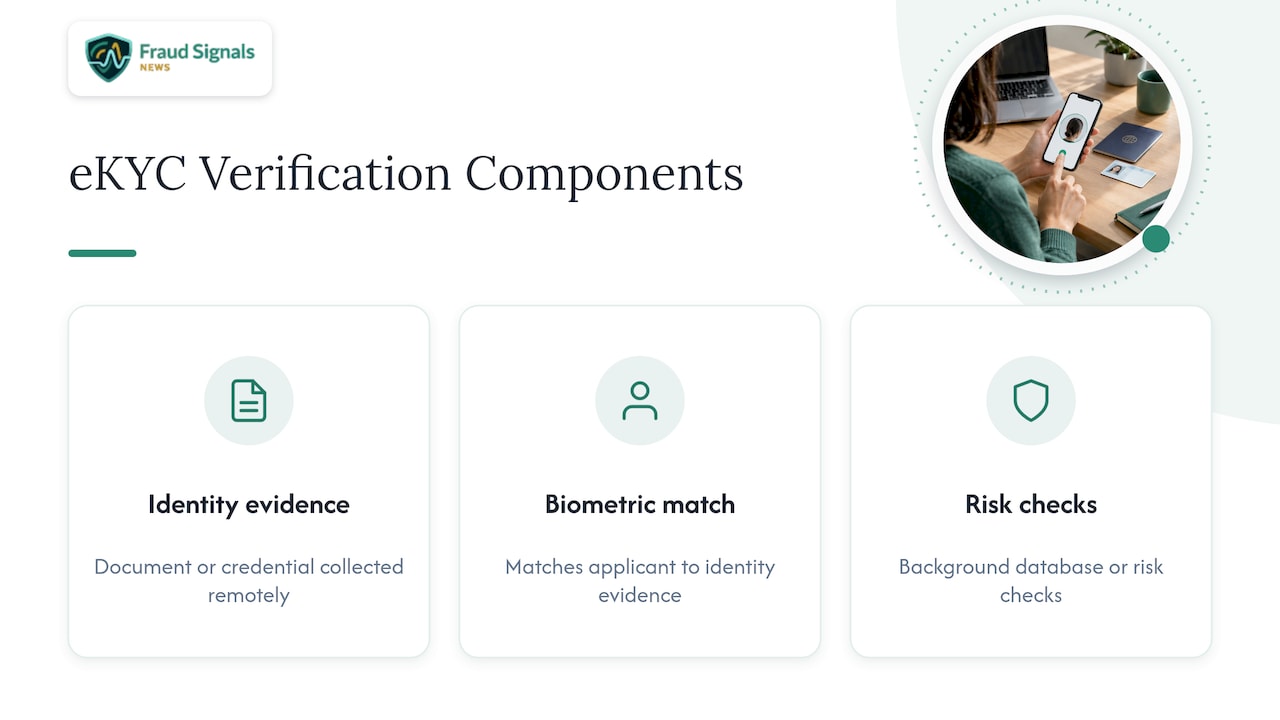
Electronic KYC replaces branch-based paperwork with remote collection and verification of identity evidence: a document or credential, a biometric match to the person applying, and database or risk checks run in the background. For a U.S. bank, the legal frame is the CIP Rule. Before opening an account, the bank must obtain the customer’s name, date of birth for an individual, address and identification number, then verify identity within a reasonable time after account opening and retain the records for five years. The CIP must also include procedures for giving customers adequate notice that identifying information is being collected.
Nothing in that rule says verification must happen in a branch, which is why eKYC is permissible. What the rule does not do is guarantee that any given digital method is reliable, and that gap is where most of the trends below originate. For a deeper compliance walk-through, see our exam-ready guide to the bank Customer Identification Program and our explainer on eKYC versus EYKC.
Trend 1: Mobile driver’s licenses and verifiable credentials move into onboarding
The most consequential shift is regulatory and architectural at once. On September 8, 2026, the OCC, FinCEN, the Federal Reserve, the FDIC and the NCUA issued joint FAQs clarifying that an unexpired government-issued verifiable digital credential, such as a state-issued mDL, qualifies as government-issued identification for CIP purposes, provided it evidences nationality or residence and carries a photograph or similar safeguard. The same FAQs state that the CIP Rule neither requires nor prohibits reliance on these credentials. Adoption is permitted, not mandated.
The technical definition matters. A verifiable credential, as described in the FAQs, is a data structure digitally signed by the issuing source, cryptographically bound to a device and protected by an activation factor such as a PIN, face or fingerprint. For non-government third-party credentials, the bank remains responsible for ensuring the third party applies the same level of authentication the bank itself would.
This lines up with standards work. NIST’s NCCoE Special Publication 1800-42 offers a roadmap that replaces passive data collection with cryptographically verifiable identity evidence signed by the state DMV and checked by the financial institution, grounded in NIST 800-63-4. The OpenID Foundation responded in April 2026 by announcing an eKYC work item, arguing that deepfakes and agentic AI attacks render traditional image-based verification obsolete.
What it means operationally:
- Inventory which states your customer base holds mDLs from, because coverage is uneven and you will need a fallback path.
- Decide where credential verification sits in the flow: as the primary route, or as a step-up for higher-risk applications.
- Document your reliance decision in the CIP, since the agencies left that judgment with the bank.
- Keep a non-credential route available for customers who cannot or will not use one.
Trend 2: Deepfakes and injection attacks break image-based checks
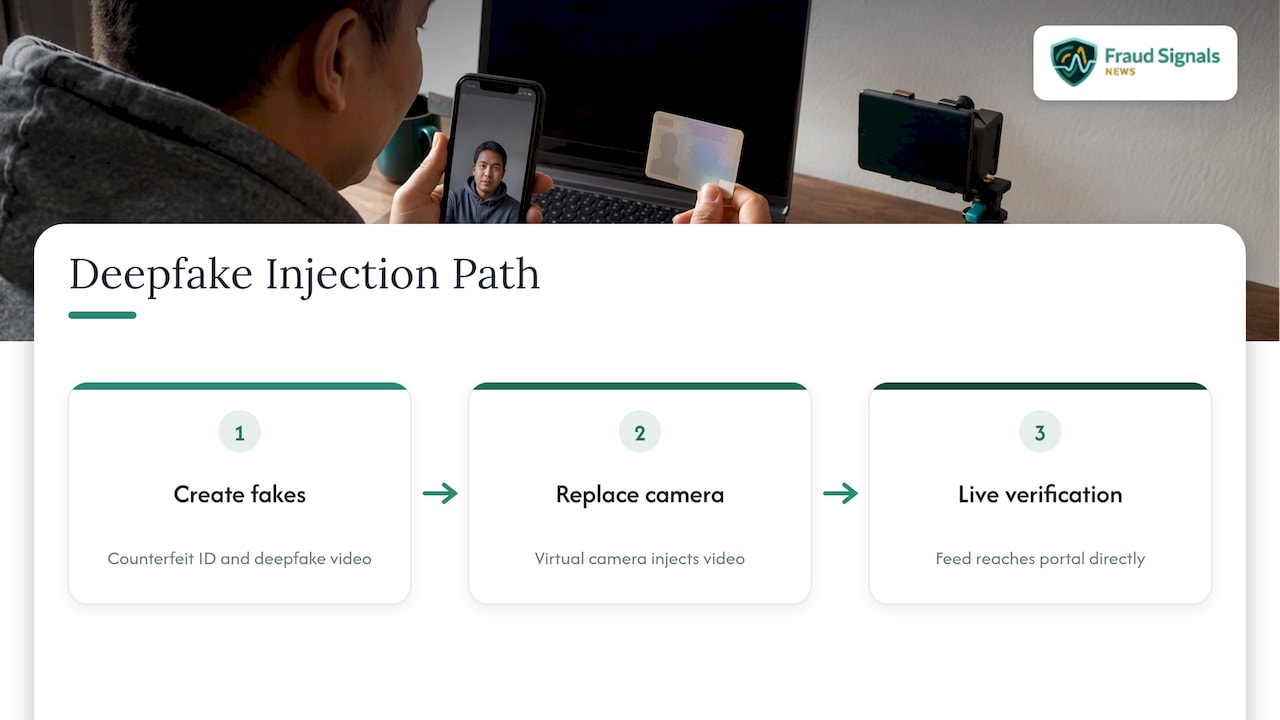
The second trend is the one that makes the first urgent. Reporting in American Banker describes how, for less than $300, a criminal can assemble a stolen Social Security number, a background report, a printer for synthetic passport material and an AI face generator, enough to open an account with a real name and a fake face in under five minutes. The same report describes software that generates a counterfeit document, builds a deepfake video and uses a virtual camera to feed it straight into a live verification portal.
That last step is the point. The attack does not fool the camera, it replaces it. FinCEN’s November 2024 alert said generative AI tools have greatly reduced the resources needed to produce convincing synthetic content, and that criminals use third-party webcam plugins to show pre-generated deepfake videos during live checks, circumventing the control entirely.
Vendor-reported data shows the scale, with the usual caveat that each vendor sees only its own traffic. Entrust’s analysis of more than a billion verification events, as summarized by Axis Intelligence, found that deepfakes account for one in five biometric fraud attempts and injection attacks rose 40% year over year. Separately, Group-IB documented a single institution recording over 8,000 attempts to bypass liveness checks on digital loan applications in eight months, all using biometric injection with AI-generated deepfakes.
Human review is not a backstop. iProov’s data, again via Axis Intelligence, found only 0.1% of consumers could reliably tell real from AI-generated content even when told to look for fakes. And voice is no safer: a University of Waterloo study cited in the Washington & Lee Law Review Online found that voice biometric authentication from major providers could be bypassed by deepfakes in six attempts.
FinCEN’s alert also changed reporting practice: it directs institutions to use a specific deepfake fraud tag in suspicious activity reports and lists nine red flags, among them third-party camera plugins during live verification, reverse-image matches to AI-generated face galleries and mismatches between document metadata and visual content. If your onboarding telemetry cannot see camera plugins or capture-path anomalies, you cannot act on those red flags. Our pieces on capture integrity and deepfake ID fraud and replay and injection defenses cover the technical controls in detail.
Trend 3: Layered defense replaces the single verification step
Identity failures are now treated as systemic. The American Bankers Association, publishing Datos Insights research, reports that identity-related suspicious activity makes up 42% of BSA filings across the U.S. banking system, and that regulators are holding banks accountable for verification failures through enforcement actions. The research also argues that threats have split into three categories, third-party fraud, synthetic identity fraud and first-party fraud, each needing a different defense.
The consequence is that no single control is sufficient. The recommended stack combines behavioral analytics, biometric verification, document validation, fraud scoring, consortium participation, continuous model retraining and cross-channel monitoring. In practice, a modern eKYC flow looks less like a gate and more like a scored pipeline:
- Capture integrity: confirm the image comes from a real, untampered camera path before analyzing it.
- Document or credential validation: authenticate the document features or verify the credential signature.
- Biometric match and liveness: compare the face to the evidence and test for presentation attacks.
- Device and behavioral signals: device fingerprinting, session behavior and velocity across applications.
- Consortium and database checks: cross-institution intelligence on known synthetic or mule identities.
- Ongoing monitoring: treat onboarding as the first score, not the final one.
The drawback of stacking vendors is inconsistency. A PYMNTS Intelligence report found in January 2026 that 74.6% of financial services firms said their verification technology produces inconsistent identity results, and 46.5% said different identity platforms give different results for the same person. Layering only works if the layers are reconciled into one decision logic. Our guide on why biometrics reduce bank fraud explains where the biometric layer fits in that design.
Trend 4: The speed expectation keeps rising
Customers have been trained by neobanks to expect an account in minutes. Finextra reports that two out of three consumers expect a fully digital onboarding experience, that automated KYC can cut onboarding times by up to 80%, and that effective onboarding can raise retention by 50%. Those are industry figures rather than guarantees, and your own results will depend on where your time is spent today.
The cost of friction is measurable in the PYMNTS data: 56.3% of firms reported customer friction from excessive checks, 43.7% cited high manual review costs, and 55% cited onboarding abandonment caused by friction. More striking, 76.1% said KYC and KYB processes had prevented them from adding or expanding customers, markets or geographies.
A practitioner source on credit union onboarding adds a design benchmark: verification flows longer than three to four minutes see abandonment above 50%, with complexity and confusion accounting for 34% of failures and technical failures for 27%. Its recommended pattern is progressive disclosure, revealing requirements gradually rather than presenting everything at once.
Where speed gains actually come from
The realistic sources are prepopulating profiles from data already collected, reusing credentials instead of re-scanning documents, and risk-based step-up so that low-risk applicants are not subjected to the full battery. Finextra’s commentary points to integrated data collection that cuts redundant requests and creates a single customer view. What does not work is trimming controls to hit a time target, because the fraud that follows costs more than the abandonment saved.
Trend 5: Reusable verification records
Repeat checks are the quiet irritant of onboarding: the same customer is verified again by every institution and product line. One emerging response is standardized verification records. Under the SOLO model described by PYMNTS, participating institutions create auditable records documenting the evidence reviewed, work performed and standards applied, so a receiving institution can evaluate that record against its own compliance requirements without automatically accepting another institution’s conclusion.
The design principle is worth copying even outside such networks: reliance is a risk decision the receiving bank still owns. Verifiable credentials and verification records both point the same way, toward portable evidence with clear provenance rather than repeated image capture.
Trend 6: Privacy law shapes the biometric layer
Biometric eKYC runs into state law. Guidance for credit unions notes that explicit, informed consent is required under state biometric privacy laws including Illinois’ BIPA and the Texas and Washington statutes, with plain-language consent screens, an affirmative checkbox or button, alternatives offered, and a link to the full biometric privacy policy. Treat the consent screen as part of the control, not as decoration.
The Federal Reserve Bank of Atlanta takes a balanced view in its paper on digital identity: new technologies can improve KYC efficiency, and digital IDs could streamline compliance, cut costs and strengthen privacy and security. It also flags remaining barriers such as digital divides, authentication hurdles and public concern, and notes that FATF guidance favors a risk-based approach evaluated at every stage of verification. In practice that means a documented alternative path for customers without a compatible phone or credential.
Legal exposure is also unsettled at the federal level. The Washington & Lee note observes that the U.S. currently has no law banning the creation or distribution of deepfakes, and argues for comprehensive federal biometric privacy rules and public-private key infrastructure inside financial institutions. Treat that as a scholarly position, not a forecast, and keep your counsel close on state requirements.
Perspective: where we think onboarding should go
We read the current shift as a correction long overdue. For years, onboarding was built around the assumption that a photo of a document and a selfie were hard to fake, and many institutions kept that assumption long after the tooling to defeat it became cheap and commoditized.
Our view is that the right question is no longer which vendor has the best face match. It is whether the evidence entering your flow can be trusted before any matching begins. That is why our coverage keeps returning to capture integrity, liveness and credentials signed by an authoritative source.
We also think the industry undersells the operational side. A Director of Fraud Risk Management needs to know how a control changes abandonment, manual review load and suspicious activity reporting, not only its detection rate. That operations-first lens is what we publish: in-depth analysis of biometrics, eKYC, liveness and deepfake ID technology, with practical frameworks for judging fraud prevention ROI across banking, fintech, healthcare and travel.
The common thread is simple. Speed and security are not opposites when the verification is designed around trustworthy evidence, and they become opposites only when legacy methods are asked to do a job they can no longer do.
Carlos Ochoa
How to modernize an eKYC process without repeating old mistakes
Finextra’s guidance, echoed by the ABA research, is to start by evaluating legacy systems, identifying inefficiencies, risk and data silos, and choosing whether the priority is onboarding speed or cost reduction. A practical sequence:
- Baseline the funnel. Measure completion time, abandonment by step, manual review rate and confirmed fraud by channel before changing anything.
- Map attacks to layers. For third-party, synthetic and first-party fraud, list which control stops each one. Gaps become your roadmap.
- Test the capture path. Confirm you can detect virtual cameras, emulators and replayed media, and that results feed your SAR process with the deepfake tag.
- Add credential acceptance. Pilot mDL verification where state coverage allows, with the reliance decision recorded in your CIP.
- Design the consent and fallback paths. Plain-language biometric consent, and an alternative for customers who cannot use the primary method.
- Reconcile results. If multiple platforms feed one decision, standardize how conflicting outputs are resolved.
For teams comparing tools, our guide to reducing identity fraud exposure and our look at false identity bank accounts help frame the problem before vendor conversations begin. Teams working with open banking data should also read how fintechs layer open banking ID verification.
Keep tracking the shift with Fraud Signals News
Eligibility rules, agency guidance and attack tooling are all moving in the same year. We publish ongoing analysis for fraud, compliance and fintech leaders on biometric identification, liveness detection and deepfake ID technology, with a focus on what changes operations.

Start with our digital identity and fraud prevention trends archive, or go straight to face liveness detection and where it fails if capture-layer defense is your next project.
FAQ
Can a bank accept a mobile driver’s license for eKYC under the CIP Rule?
Yes. The September 8, 2026 joint FAQs from the OCC, FinCEN, the Federal Reserve, the FDIC and the NCUA say an unexpired government-issued verifiable digital credential, such as a state-issued mDL, can count as government-issued identification. It must evidence nationality or residence and bear a photograph or similar safeguard. The rule neither requires nor prohibits relying on one, so the decision stays with your institution.
What information must be collected before opening an account?
For an individual, a bank must obtain name, date of birth, address and an identification number before opening the account. It must verify identity within a reasonable time afterward. Identifying information is retained for five years after the account closes, and verification records for five years after they are made.
Why do deepfakes defeat many selfie-based onboarding flows?
Because attackers often bypass the camera instead of fooling it. Tools can feed a pre-generated deepfake video through a virtual camera or webcam plugin directly into the verification session, which FinCEN’s November 2024 alert flagged as a way to circumvent live checks. Detecting the capture path, not just the face, is what closes this gap.
How long can onboarding take before customers leave?
One practitioner guide for credit unions reports abandonment above 50% when identity verification takes longer than three to four minutes. Treat it as a design benchmark rather than a universal threshold, and measure abandonment by step in your own funnel. Progressive disclosure and risk-based step-up are the usual ways to shorten the path for low-risk applicants.
Sources
- Solving modern KYC challenges (Finextra)
- Banks Target Repeat Checks That Drive Customers Away (PYMNTS)
- OIDF welcomes NIST SP 1800-42 and announces eKYC work item (OpenID Foundation)
- $300 AI tool kits let criminals bypass bank security (American Banker)
- Face Card Declined: The Deepfake Threat to Biometric Authentication (Washington & Lee Law Review Online)
- Digital Identity Fraud Statistics 2026 (Axis Intelligence)
- How Deepfakes Bypass Video KYC Verification (DuckDuckGoose)
- Bank Secrecy Act/Anti-Money Laundering FAQs, OCC Bulletin 2026-44
- Section 1020.220 Customer Identification Program requirements for banks (Federal Reserve)
- The Identity Trust Gap (American Bankers Association)
- FinCEN’s Digital ID Credential Guidance (SOLO)
- Using Digital Identity to Support Access to Payments (Federal Reserve Bank of Atlanta)
- Digital identity verification and KYC experience for credit unions (Credit Union Web Solutions)
Recommended

Proof of Life Video: How Liveness Checks Work and Where They Fail

ISO 30107 Liveness: What Compliance Really Proves