

Outdated fraud prevention is defined as any static, rule-based, compliance-focused system that treats identity verification as a one-time pass/fail event rather than a continuous, adaptive process. This is precisely why outdated fraud prevention fails against modern threats. The confirmed fraud rate in financial services has spiked to 3.89%, meaning nearly 1 in 26 verification requests is a confirmed fraud attempt driven by AI-generated identities and synthetic documents. Legacy systems were built to catch altered physical documents. They were not built to catch an AI that can generate a photorealistic passport in seconds. The gap between what these systems can detect and what attackers can produce has never been wider.
Why outdated fraud prevention fails: the core technical limitations
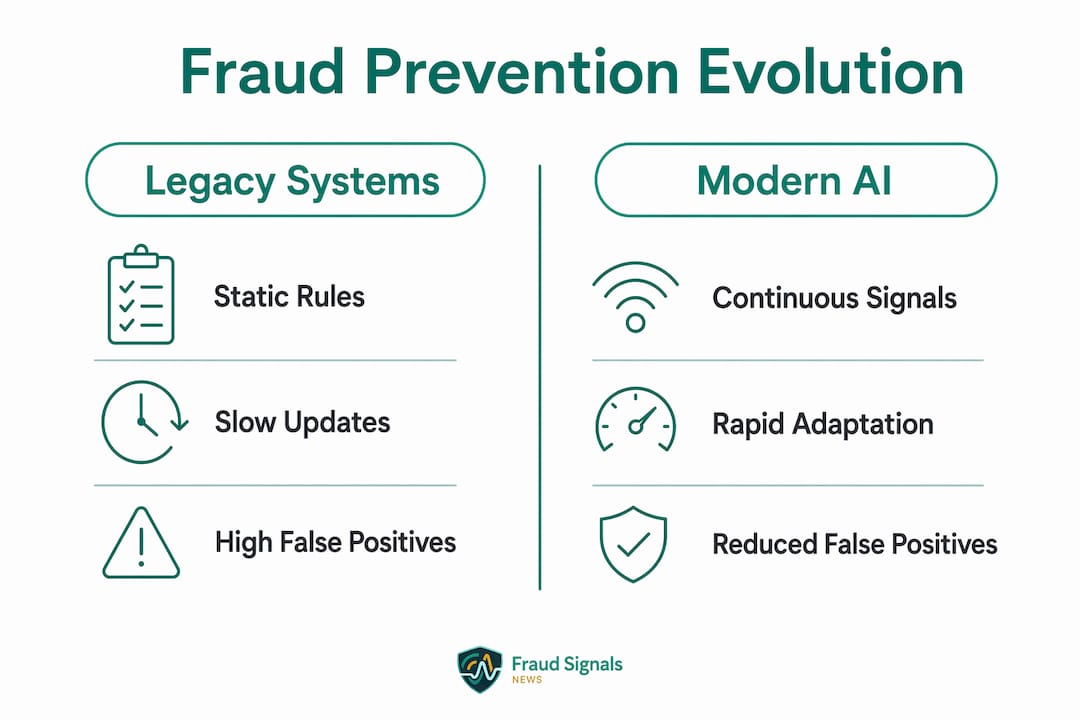
Legacy fraud systems operate as static checkpoints. They apply a fixed set of rules at a single moment in time, then move on. That architecture was adequate when fraud was opportunistic and manual. It is obsolete when fraud is industrialized and AI-driven.
The most damaging limitation is rule decay. Fraud tactics evolve constantly, but rule updates in legacy systems can take weeks to deploy. Detection-to-rule update latencies of weeks are common in systems tethered to slow core banking infrastructure. That window is exactly what sophisticated attackers exploit.
Three additional technical failures compound the problem:
- Static identity signals. Legacy systems capture identity data at onboarding and rarely revisit it. A fraudster who passes initial verification can operate undetected for months.
- Fragmented data pipelines. Siloed databases prevent cross-channel correlation. A credential stuffing attack hitting mobile, web, and API endpoints simultaneously often goes undetected because no single system sees the full pattern.
- Manual review dependency. 68% of businesses spend up to half their time on manual compliance tasks. That volume slows response times and creates inconsistent outcomes.
Only 33% of fraud practitioners feel their programs can effectively handle modern AI threats. That statistic reflects a structural gap between static rule engines and the behavioral intelligence that modern fraud demands.
Pro Tip: Audit your rule update cadence. If your team cannot push a new fraud rule within 24 hours of identifying a new attack pattern, your infrastructure is already a liability.
How has AI and synthetic identity fraud changed the threat landscape?
AI fraud actors now deploy deepfakes, synthetic identities, and multi-vector attacks that bypass control points designed for static threats. Fraud has become industrialized. Attackers use AI to optimize attack sequences, test verification systems at scale, and generate synthetic credentials that pass document authenticity checks.

Synthetic identity fraud is particularly damaging in financial services. A synthetic identity combines real data fragments, such as a valid Social Security number, with fabricated biographical details to create a profile that does not correspond to any real person. These identities pass traditional Know Your Customer checks because the document appears legitimate and the underlying data elements are real.
The AI fraud categories tracked by Fraud Signals News show this threat accelerating across payments, banking, and trading platforms. The attack surface has expanded because digital onboarding removed the physical document inspection that once served as a friction point.
Legacy verification was built around four assumptions that no longer hold:
- Documents are physical and can be inspected for tampering.
- Identity data is stable and does not change after onboarding.
- Fraud attempts are low-volume and detectable by rule thresholds.
- Attackers operate manually and cannot scale quickly.
AI invalidates all four. Digitally manipulated credentials defeat optical character recognition checks. Synthetic profiles age gracefully over time, building credit histories before executing fraud. Automated attack toolkits probe verification systems at thousands of requests per minute. The result is a confirmed fraud rate that legacy systems were never designed to absorb.
Why treating identity as a continuous signal is the critical shift
The fundamental flaw in legacy verification is viewing identity as a static onboarding event. A user who passes KYC in january is not necessarily the same behavioral entity operating the account in september. Behavioral drift, account takeover, and SIM swapping all produce identity signals that a one-time check cannot capture.
Continuous identity verification treats identity as a dynamic, evolving trusted signal rather than a binary gate. It incorporates device fingerprinting, behavioral biometrics, geolocation consistency, and transaction pattern analysis into an ongoing risk score. That score updates in real time as new signals arrive.
“Legacy failures stem from viewing identity as a static event. Continuous identity signals improve detection accuracy and reduce false declines simultaneously, delivering better security and better customer experience at the same time.”
The operational benefits are concrete. Continuous scoring reduces false positives by flagging anomalies in context rather than applying blunt rule thresholds. A user logging in from a new device in a new country is not automatically fraudulent. But a user logging in from a new device, in a new country, at 3:00 AM, attempting a large wire transfer, after three failed PIN attempts, is a high-risk signal cluster that warrants intervention.
Feedback loops are the engine of continuous improvement. When a fraud case is confirmed, that outcome feeds back into the model, sharpening future detection. Legacy systems do not have this loop. They apply the same rules until a human analyst updates them, which happens slowly and inconsistently.
The identity fraud coverage at Fraud Signals News documents how institutions that adopt continuous identity intelligence report measurable reductions in both fraud losses and false decline rates. The two outcomes are not in conflict. They are complementary when the underlying model is behavioral rather than rule-based.
What are the operational costs of outdated fraud controls?
The operational burden of legacy fraud controls is significant and often underreported. 50% of businesses report rising manual review costs, and 10% of legitimate users are falsely declined. That combination destroys revenue and customer trust simultaneously.
False declines are particularly insidious because they create silent churn. A legitimate customer who is declined does not usually call to complain. They abandon the transaction and move to a competitor. False declines generate millions in annual lost revenue without triggering any alert in the fraud system. The loss is invisible to the teams responsible for preventing it.
| Control type | Primary cost | Visibility of loss |
|---|---|---|
| Manual review queues | Staff time, delayed decisions | High, tracked in ops metrics |
| False declines | Lost revenue, customer churn | Low, rarely attributed to fraud controls |
| Slow rule updates | Exploitable attack windows | Medium, visible only after breach |
| Fragmented systems | Missed cross-channel signals | Low, requires unified data view |
Fragmented infrastructure compounds every one of these costs. When fraud, payments, and identity systems do not share data in real time, each operates with an incomplete picture. A fraudster executing a multi-channel attack exploits exactly these blind spots.
Pro Tip: Track your false decline rate as a revenue metric, not just a fraud metric. If your team does not own that number, no one does.
Practical steps to upgrade outdated fraud prevention systems
Upgrading legacy fraud controls requires a shift in architecture, not just tooling. The goal is to replace compliance checkboxes with an active fraud prevention layer that operates continuously.
- Adopt liveness detection and forensic document analysis. Liveness detection confirms that a biometric submission comes from a live person, not a photo or deepfake. Forensic analysis examines document metadata, font consistency, and pixel-level anomalies that optical character recognition misses entirely.
- Integrate AI as infrastructure, not an overlay. AI integrated into infrastructure adapts faster and more precisely than bolt-on tools layered over legacy systems. It supports explainable decisions and continuous policy updates, which regulators increasingly require.
- Implement geography-aware risk controls. Rate limiting and velocity checks should incorporate geolocation signals. A login attempt from a jurisdiction with no prior account activity should trigger additional verification, not a binary block.
- Prioritize governed, clean customer data. Unique competitive advantage comes from governed customer data that AI models cannot replicate or fabricate. Institutions that invest in data quality build a detection capability that is genuinely difficult to attack.
- Build automation into the review pipeline. Automation reduces the manual review burden that consumes half the working hours of compliance teams. The role of automation in fraud prevention is no longer optional. It is the baseline for competitive fraud operations in financial services.
The institutions that treat fraud prevention as a product feature rather than a compliance obligation are the ones building durable defenses. The shift requires investment, but the cost of inaction is measurable in fraud losses, false declines, and regulatory exposure.
Key Takeaways
Outdated fraud prevention fails because static, rule-based systems cannot detect AI-generated synthetic identities, behavioral anomalies, or multi-vector attacks that evolve faster than manual rule updates allow.
| Point | Details |
|---|---|
| Rule decay is the core flaw | Legacy rule updates take weeks, giving attackers an exploitable window after each new tactic emerges. |
| AI fraud has industrialized | Synthetic identities and deepfakes defeat document checks built for physical tampering, not AI generation. |
| Continuous identity signals matter | Dynamic scoring and behavioral monitoring detect fraud that one-time onboarding checks structurally cannot. |
| False declines destroy revenue silently | 10% of legitimate users are falsely declined, creating churn that never appears in fraud loss reports. |
| AI must be infrastructure, not a bolt-on | Integrated AI supports real-time policy updates and explainable decisions that overlay tools cannot deliver. |
The uncomfortable truth about fraud prevention complacency
I have spent years watching financial institutions treat fraud prevention as a compliance exercise rather than a security discipline. The pattern is consistent. A team passes an audit, checks the regulatory boxes, and then defends the status quo until a breach forces a reckoning. By that point, the damage is done.
The most dangerous assumption in fraud prevention is that passing yesterday’s controls means you are protected today. It does not. The confirmed fraud rate hitting 3.89% in financial services is not a statistical anomaly. It is the predictable outcome of systems that stopped evolving while attackers kept accelerating.
What I find most overlooked is the false decline problem. Fraud teams obsess over fraud loss rates and largely ignore the revenue destroyed by blocking legitimate customers. Both numbers belong on the same dashboard. An institution that reduces fraud losses by 20% while increasing false declines by 15% has not won. It has shifted the loss from the fraud column to the revenue column.
The institutions getting this right share one characteristic. They treat identity verification as an ongoing product capability, not a one-time compliance gate. They invest in banking and fintech fraud intelligence continuously, not reactively. That posture is the difference between a fraud program that adapts and one that waits to be defeated.
— A. Johnson
Stay ahead with Fraud Signals News
Fraud prevention strategy requires current intelligence, not last year’s playbook.

Fraud Signals News covers the technologies, tactics, and regulatory developments that financial services and technology professionals need to stay ahead of evolving threats. From liveness detection and biometric binding to synthetic identity trends and AI-driven attack analysis, the coverage goes deeper than headlines. Explore the authentication and identity coverage to understand how modern verification methods are replacing the static controls that attackers have already learned to defeat. Visit Fraud Signals News for ongoing analysis built for professionals who cannot afford to be reactive.
FAQ
Why do legacy fraud systems fail against AI-generated identities?
Legacy systems apply fixed rules to static document checks. AI-generated synthetic identities and deepfakes produce credentials that pass those checks because the systems were designed to detect physical tampering, not AI fabrication.
What are the signs of outdated fraud prevention systems?
Key signs include slow rule update cycles measured in weeks, high manual review volumes consuming staff time, rising false decline rates, and no real-time behavioral monitoring after initial onboarding.
How does continuous identity verification reduce fraud risk?
Continuous verification tracks behavioral signals, device fingerprinting, and transaction patterns over time. It detects account takeover and synthetic identity fraud that one-time onboarding checks structurally miss.
What is the cost of false declines in legacy fraud controls?
50% of businesses report rising manual review costs and 10% of legitimate users are falsely declined. False declines create silent revenue loss because affected customers abandon transactions without reporting the friction.
How should financial institutions upgrade outdated fraud prevention?
The upgrade path requires integrating AI as core infrastructure rather than an overlay, adopting liveness detection and forensic document analysis, implementing continuous identity scoring, and building automation into the compliance review pipeline.
Recommended

Biometric Performance Metrics: What to Measure and Trust

ID Security Features: What Each One Does and How to Check It