

An anti-fraud legislative framework is a structured set of statutory requirements, agency rules, and organizational policies that together define how fraud must be prevented, detected, reported, investigated, and remediated. In the United States, this framework is not a single statute. It is a layered ecosystem enforced by bodies including the Department of Justice (DOJ), the HHS Office of Inspector General (OIG), and the Centers for Medicare & Medicaid Services (CMS), with the Association of Certified Fraud Examiners (ACFE) providing widely adopted professional standards that translate legal obligations into operational practice.
The immediate elements any such framework implies:
- Statutes and regulations — federal laws such as the False Claims Act, Anti-Kickback Statute, and Civil Monetary Penalties Law that define prohibited conduct and sanctions
- Agency guidance and directives — OIG compliance program guidance, CMS program integrity rules, and Executive Orders directing minimum anti-fraud requirements
- Organizational policy — written internal policies, governance assignments, and control procedures that implement legal obligations at the program level
- Enforcement actions — exclusion from federal programs, civil monetary penalties, criminal prosecution, and repayment demands that give the framework its teeth
Table of Contents
- What does an anti-fraud legislative framework actually cover?
- What are the core components every framework must include?
- What U.S. laws and agencies form the legal backbone?
- How do you implement an anti-fraud framework step by step?
- How do you measure whether your framework is actually working?
- What does implementation actually cost, and how long does it take?
- What should your anti-fraud policy actually say?
- How are modern identity controls reshaping legislative expectations?
- What do real-world implementations look like?
- Key Takeaways
- Why most organizations are still treating this as a document exercise
- Useful sources for deeper reading
- FAQ
What does an anti-fraud legislative framework actually cover?
The framework sits at the intersection of three distinct layers: federal law, agency-level administrative rules, and required organizational policy. Each layer does different work. Federal statutes set the outer boundary of prohibited conduct and maximum penalties. Agency directives translate those statutes into program-specific compliance expectations. Organizational policy converts both into day-to-day controls that staff can follow and auditors can test.
The core objectives are four: prevention (designing fraud out of processes before it occurs), detection (identifying fraud that slips past preventive controls), response (investigating and reporting confirmed or suspected fraud), and remediation (recovering losses, correcting root causes, and disciplining responsible parties).
Coverage is broad. Frameworks typically govern benefit program eligibility and payments, federal procurement and contracting, health care claims and billing, account opening and identity verification, and vendor and third-party relationships. A formal framework is not optional for organizations that receive federal funds, participate in Medicare or Medicaid, or operate under federal contracts. For private-sector organizations, it is increasingly expected as a condition of regulatory good standing and, in some sectors, a prerequisite for cyber liability and directors and officers insurance underwriting.
What are the core components every framework must include?
An effective anti-fraud policy framework is not a single document. It is an integrated set of components, each with a defined owner and measurable outputs.
-
Policy and governance. A written anti-fraud policy approved by the board or governing body, linked to the code of conduct, and assigned to a named senior officer. ACFE research consistently shows that organizations with formal, written anti-fraud policies and active governance experience lower fraud losses than peers without them.
-
Fraud risk assessment. A periodic, structured assessment that identifies the organization’s exposure across programs, processes, and third parties. The risk register produced here drives control design and resource allocation.
-
Preventive controls. Segregation of duties, pre-payment integrity checks, identity verification at enrollment, vendor due diligence, and access controls that reduce the probability of fraud occurring.
-
Detective controls. Data analytics, transaction monitoring, exception reporting, and machine learning fraud detection that surface anomalies after preventive controls are bypassed.
-
Reporting and whistleblowing. A confidential reporting channel (hotline, web portal, or designated officer) with documented whistleblower protections that comply with federal law. Employees who fear retaliation do not report; the channel is only as useful as the protection behind it.
-
Investigation and sanctions. Documented investigation protocols, clear authority lines, defined timelines, and a sanctions matrix that specifies disciplinary outcomes from written warnings through termination and referral to law enforcement.
-
Assurance and audit. Periodic internal audit of control effectiveness, external review where required, and documented evidence of control testing. Federal auditors expect evidence, not only the existence of a written policy.
-
Training and culture. Annual mandatory training for all staff, role-specific training for high-risk functions, and visible leadership commitment. Culture is the control that operates when no one is watching.
-
Vendor controls. Contractual anti-fraud clauses, vendor risk assessments, audit rights, and onboarding due diligence for third parties with access to funds or data.
-
Data sharing and recovery. Protocols for sharing fraud intelligence with law enforcement, peer organizations, and federal agencies, plus documented recovery procedures for improper payments.
Pro Tip: “Tone at the top” is not a slogan. It requires the board and senior leadership to visibly enforce the policy, not merely sign it. If the first confirmed fraud case results in a quiet resignation rather than a documented disciplinary action, the policy becomes decorative. Connect written policy to measurable enforcement outcomes: discipline rates, referral counts, and recovery amounts reported to the audit committee quarterly.
What U.S. laws and agencies form the legal backbone?
The legal foundation of any U.S. anti-fraud framework draws from several federal statutes and the administrative authorities of multiple agencies. Compliance teams need to map their program rules to these obligations before designing controls.

| Statute / Authority | Primary Risk Addressed | Typical Sanctions | Where to Look |
|---|---|---|---|
| False Claims Act (FCA) | Fraudulent claims for federal funds | Treble damages, civil penalties per claim, exclusion | DOJ Civil Division |
| Anti-Kickback Statute (AKS) | Improper financial inducements in health care | Criminal fines, imprisonment, exclusion, CMPs | HHS OIG |
| Stark Law | Physician self-referral in Medicare/Medicaid | Repayment, CMPs, exclusion | CMS |
| Civil Monetary Penalties Law (CMPL) | Broad range of fraud and abuse conduct | Civil monetary penalties, exclusion | HHS OIG |
| Exclusion Authorities | Participation in federal programs | Mandatory or permissive exclusion from Medicare/Medicaid | HHS OIG exclusion database |
| 18 U.S.C. (Mail Fraud) | Schemes using mail or wire to defraud | Up to 20 years imprisonment | DOJ Criminal Division |
The HHS OIG and DOJ are the primary federal enforcers. OIG can impose administrative exclusion and civil monetary penalties without a criminal conviction. DOJ pursues both civil FCA actions (often triggered by qui tam whistleblowers) and criminal prosecutions. State attorneys general and Medicaid Fraud Control Units add a parallel enforcement layer for state-funded programs.
Beyond health care, the framework extends to procurement fraud (enforced by agency Inspectors General and DOJ), financial fraud (SEC, FinCEN, CFPB), and benefit program integrity (Social Security Administration OIG, Department of Labor OIG).
The 2026 Executive Order establishing the Task Force to Eliminate Fraud adds a cross-agency layer. The Task Force directs agencies to identify transactions susceptible to fraud and recommend minimum anti-fraud requirements within specified deadlines. Critically, the Federal Register publication of that Order lists specific required controls: screening, proof of identity, pre-payment integrity controls, information sharing, and audit and remedial measures. Jurisdictions or partners that fail to implement these requirements risk having federal funds withheld.
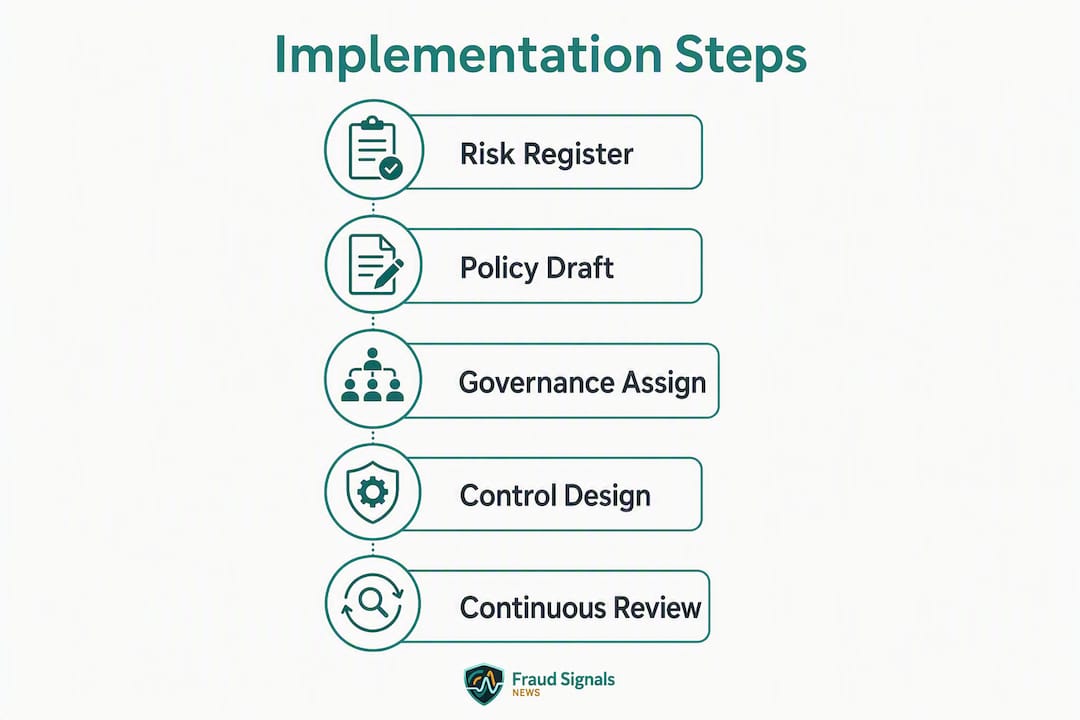
How do you implement an anti-fraud framework step by step?
Converting policy theory into an operating program requires sequenced effort. A medium-sized organization should expect a full framework implementation to run 9–18 months, depending on IT complexity and the number of programs in scope. A policy-only refresh can be completed in 60–90 days. Controls retrofit for a single high-risk program typically runs 3–6 months.
-
Prioritize scope. Identify which programs, payment streams, and third-party relationships carry the highest fraud risk. Start with the areas where federal funds flow or where prior audit findings exist.
-
Conduct a baseline fraud risk assessment. Map threats to processes, estimate likelihood and impact, and produce a risk register. This document drives everything that follows and is the artifact auditors ask for first.
-
Draft the written anti-fraud policy. The policy must name the fraud risk owner, define prohibited conduct, establish reporting channels, and specify sanctions. Link it to the code of conduct and vendor contracts.
-
Assign governance roles. Designate a senior fraud risk officer accountable to the board or audit committee. Define the roles of the audit committee, legal counsel, HR, and program managers in the framework.
-
Design and implement controls. Build the control matrix: preventive controls (identity verification at enrollment, pre-payment checks, access controls) and detective controls (transaction monitoring, data analytics). Quick wins here include deploying a confidential hotline and adding identity verification at account opening before the broader rollout completes.
-
Pilot and test. Run the control set against a defined program or transaction type. Document results, identify gaps, and refine before full rollout.
-
Train all staff. Deliver mandatory training covering the policy, reporting obligations, and whistleblower protections. Role-specific modules for finance, procurement, and clinical staff should go deeper.
-
Roll out and communicate. Publish the policy, activate the hotline, and communicate leadership’s commitment visibly. The first communication from the CEO or board chair sets the cultural tone.
-
Monitor, test, and improve. Establish a governance cadence: quarterly control testing, semi-annual fraud risk assessment updates, and annual board reporting. The framework is a program, not a project.
Artifacts to produce at each stage: fraud risk register, written anti-fraud policy, governance assignment memo, control matrix, investigation protocol, whistleblower channel documentation, training completion records, and audit committee reporting template.
How do you measure whether your framework is actually working?
A framework that cannot demonstrate effectiveness will not survive an audit, and it will not secure continued investment from leadership. Measurement requires both leading indicators (controls operating as designed) and lagging indicators (fraud losses and recoveries).
| KPI | Why It Matters | Measurement Frequency | Owner |
|---|---|---|---|
| Improper payments prevented | Quantifies pre-payment control value; supports budget justification | Monthly | CFO / Fraud Risk Officer |
| Losses recovered post-detection | Measures remediation effectiveness and deterrence signal | Quarterly | Legal / Investigations |
| Time to investigate (days) | Indicates investigation capacity and process efficiency | Per case; reported quarterly | Investigations Lead |
| Hotline referral volume and substantiation rate | Tracks reporting culture and signal quality | Monthly | Compliance Officer |
| Control testing pass rate | Confirms controls are operating, not just documented | Quarterly | Internal Audit |
| Training completion rate | Measures culture investment and policy awareness | Semi-annual | HR / Training |
Governance cadence matters as much as the metrics themselves. The senior fraud risk officer should report to the audit committee at least quarterly, with an annual written action plan that sets targets for the coming year. The board should receive an annual summary that includes loss data, referral outcomes, and control testing results. This structure mirrors the governance expectations set by standards like GovS013 and the Public Sector Fraud Authority’s delivery plan, both of which require defined governance, annual action plans, and assurance frameworks tied to risk and value.
What does implementation actually cost, and how long does it take?
Budget and timeline vary significantly by scope, but the main cost drivers are consistent across sectors.
Timeline by scope:
- Policy-only refresh: 60–90 days
- Controls retrofit for one high-risk program: 3–6 months
- Full framework implementation (policy, governance, controls, technology, training): 9–18 months for a medium-sized organization
Primary cost drivers:
- Identity and verification technology. Biometric enrollment, liveness detection, and document verification platforms carry licensing fees that scale with transaction volume. This is often the largest single line item for organizations with high enrollment volumes.
- Investigative staff. A dedicated fraud investigator or a contracted investigations firm. Understaffing investigations is a common failure mode that leaves referrals unresolved and losses unrecovered.
- Hotline and case management systems. Third-party ethics hotlines and case management platforms typically run on annual subscription models.
- Audit and control testing. Internal audit hours plus periodic external review. Organizations subject to federal oversight should budget for at least one external fraud risk assessment per year.
- Training. Development or licensing of training content, plus staff time for completion.
- Legal counsel. Particularly for FCA exposure, AKS compliance, and investigation support.
The most effective way to secure executive buy-in for this budget is to tie expenditure directly to prevented improper payment estimates. If pre-payment identity checks stop even a fraction of fraudulent enrollments, the avoided loss typically exceeds the technology cost within the first year. Framing the investment as audit risk reduction, rather than compliance overhead, tends to move budget conversations faster. Organizations that receive federal funds should also note that the 2026 Task Force framework contemplates withholding funds from noncompliant jurisdictions, which converts the cost of compliance into a direct revenue protection argument.
For organizations managing vendor relationships at scale, outsourced fintech support models can absorb some of the operational burden of hotline management and case intake, reducing the internal headcount required during the initial rollout phase.
What should your anti-fraud policy actually say?
A policy document that passes legal review but fails operational use is a common and costly gap. The following checklist covers the elements auditors and enforcement bodies expect to find.
Required policy elements:
- Purpose and scope — what the policy covers, which programs and entities it applies to, and its relationship to applicable law
- Definitions — clear definitions of fraud, waste, abuse, and related terms (bribery, kickback, conflict of interest)
- Roles and responsibilities — named owners: board, audit committee, senior fraud officer, legal counsel, HR, program managers, and all staff
- Reporting channels — hotline number, web portal, and named compliance officer; explicit statement that anonymous reports are accepted
- Investigation protocols — who investigates, timelines, evidence handling, confidentiality obligations, and referral criteria for law enforcement
- Sanctions and remedial actions — a graduated sanctions matrix from written warning through termination, exclusion, and criminal referral
- Vendor controls — anti-fraud representations and warranties in vendor contracts, audit rights, and consequences for vendor non-compliance
- Recordkeeping — retention periods for investigation records, training records, and control testing documentation
Sample policy clauses:
Definition of fraud: “For purposes of this policy, fraud means any intentional act or omission designed to deceive the organization, a federal or state program, or a third party for financial gain, including but not limited to false claims, identity misrepresentation, and improper billing.”
Whistleblower protection: “No employee, contractor, or vendor who reports a good-faith concern about suspected fraud, waste, or abuse will be subject to retaliation, demotion, suspension, or termination as a result of that report.”
Disciplinary sanctions: “Confirmed fraud by any employee will result in termination and referral to appropriate law enforcement authorities; the organization reserves the right to pursue civil recovery of all losses.”
Vendor due diligence: “All vendors with access to federal program funds or beneficiary data must complete a fraud risk assessment prior to contract execution and annually thereafter; contracts must include audit rights and anti-fraud representations.”
Place the policy within the governance artifact hierarchy: linked from the code of conduct, referenced in procurement rules, and incorporated by reference into vendor contracts and grant agreements.
How are modern identity controls reshaping legislative expectations?
The policy direction in 2026 is unambiguous: pre-payment controls and high-assurance identity verification are no longer optional enhancements. They are minimum requirements. The Task Force to Eliminate Fraud’s Federal Register order explicitly lists proof of identity and pre-payment integrity controls among the baseline requirements agencies must adopt. This shifts the compliance floor upward for any organization that touches federal benefit payments.
Biometric-backed identity verification and liveness detection address the two most common enrollment fraud vectors: synthetic identity fraud (where no real person exists behind the application) and identity takeover (where a real person’s credentials are used without their knowledge). Liveness checks defeat the most common bypass attempt, which is presenting a photograph or deepfake video to a camera-based verification system. Organizations that have deployed these controls at enrollment report materially lower rates of fraudulent account creation compared to those relying on knowledge-based authentication alone.
Reducing identity fraud exposure requires selecting verification technology that matches the assurance level the program demands. Not every transaction requires biometric verification, but high-value benefit enrollment, account opening for financial products, and credentialing in health care almost always do. The identity verification mandate now extends into sectors that previously relied on document-only checks.
DAON (daon.com) is a commonly referenced provider in identity-critical workflows, particularly for biometric enrollment and liveness detection in regulated industries. That reference is illustrative of the vendor category, not an endorsement. Any vendor selection requires documented due diligence.
Risk callout on vendor reliance: When integrating identity vendors and biometric controls, organizations must include vendor due diligence, contractual audit rights, SLA metrics for false positive and false negative rates, and data-protection controls. A biometric vendor that produces high false negative rates (failing to catch fraudulent enrollments) or high false positive rates (blocking legitimate applicants) creates both fraud risk and regulatory exposure. These metrics belong in the contract and in the quarterly governance report. Deepfake-based identity attacks are an accelerating threat; organizations should also review their vendor’s deepfake detection capabilities as part of due diligence.
What do real-world implementations look like?
Public sector: benefit program integrity
A state Medicaid agency facing rising enrollment fraud deployed pre-payment identity verification as part of a Task Force-aligned remediation plan. Before payment was authorized, applicants were required to complete a biometric liveness check against a government-issued ID. The agency also implemented automated cross-matching against the HHS OIG exclusion database at enrollment and at each annual recertification. The lesson: pre-payment controls catch fraud that post-payment audits miss entirely, because the fraudulent payment never leaves the account. The practical implication for other agencies is that the sequence matters. Identity verification must occur before eligibility determination is finalized, not after.
Private sector: financial services onboarding
A mid-sized fintech lender conducting a fraud risk assessment discovered that its account opening process relied on knowledge-based authentication questions that credential-stuffing attacks were defeating at scale. The risk assessment drove deployment of real-time document verification with liveness detection at onboarding, combined with device fingerprinting and behavioral analytics for ongoing transaction monitoring. Vendor onboarding was simultaneously tightened: new vendor contracts required anti-fraud representations, annual certifications, and audit rights. The lesson: a risk assessment that stays on a shelf changes nothing. The value is in the control redesign it triggers. For fintech fraud teams, the combination of enrollment-time identity controls and real-time transaction monitoring produces the most durable reduction in fraud losses.
Key Takeaways
An anti-fraud legislative framework requires layered governance, statutory grounding in U.S. law, and operational controls that auditors can test, not merely a written policy.
| Point | Details |
|---|---|
| Assign a named fraud risk owner | A senior officer accountable to the board is the single most important governance decision. |
| Run a fraud risk assessment first | The risk register drives control design; skipping it produces misaligned controls and wasted budget. |
| Deploy pre-payment identity checks early | Biometric and liveness controls at enrollment stop fraud before losses occur, satisfying 2026 Task Force requirements. |
| Set measurable KPIs | Track improper payments prevented, investigation timelines, and control testing pass rates quarterly. |
| Treat the framework as a program | Annual action plans, regular audits, and technology upgrades are required; a signed policy alone fails federal review. |
Why most organizations are still treating this as a document exercise
The most persistent failure mode in anti-fraud compliance is treating the framework as a documentation project rather than an operating program. Organizations produce a policy, file it with legal, and consider the obligation met. Then an audit arrives, or a qui tam whistleblower files, and the absence of control testing evidence, investigation records, and governance reporting becomes a liability rather than a defense.
The 2026 Task Force directive makes this gap more consequential than it has ever been. Federal agencies are now required to identify fraud-susceptible transactions and implement minimum controls within defined deadlines. Organizations that receive federal funds are, by extension, expected to demonstrate alignment. A policy document that has not been tested, trained against, or enforced is not a compliance program. It is a paper shield that fails at the moment it is needed most.
The practical implication is that leadership must fund the framework as an ongoing operational line, not a one-time project. Annual action plans, quarterly governance reporting, periodic external review, and technology upgrades for identity verification and transaction monitoring are not optional enhancements. They are the difference between a framework that satisfies auditors and one that creates liability. Run a fraud risk assessment now if you have not done one in the past 12 months. Deploy pre-payment identity controls before the next enrollment cycle. Set KPIs and report them to the board before the next audit cycle begins.
Useful sources for deeper reading
The following primary sources are worth bookmarking for audit readiness and enforcement monitoring. When regulators or auditors ask for your legal foundation, these are the documents you cite.
- False Claims Act and HHS OIG Fraud & Abuse Laws — the definitive OIG summary of the FCA, AKS, Stark Law, CMPL, and exclusion authorities; the starting point for any health care or benefit program compliance analysis.
- Fact Sheet: Task Force to Eliminate Fraud (The White House) — the 2026 Executive Order summary; defines minimum anti-fraud requirements now expected of federal agencies and their program partners.
- Federal Register: Establishing the Task Force to Eliminate Fraud — the full regulatory text; lists specific required controls (screening, proof of identity, pre-payment integrity, information sharing, audit measures) and the funding consequences of noncompliance.
- ACFE Anti-Fraud Laws, Regulations, and Compliance — the ACFE’s practitioner-facing resource mapping legal obligations to organizational controls; useful for policy drafting and training program design.
- GovS013: Counter Fraud Government Functional Standard — a structured governance template from the UK government; the policy content, governance roles, and assurance workflows translate directly to U.S. organizational frameworks as a model.
- Public Sector Fraud Authority 2025/2026 Delivery Plan — illustrates how a government body operationalizes annual action plans, governance rhythms, and assurance frameworks; useful as a benchmark for public-sector organizations.
Save these sources before your next audit cycle. Enforcement bodies and oversight agencies update guidance regularly; checking for revisions annually is a minimum standard.
FAQ
What does “anti-fraud” mean in a legislative context?
Anti-fraud, in a legislative context, refers to the body of statutes, regulations, and agency rules that prohibit fraudulent conduct, define enforcement authority, and specify penalties. In the U.S., this includes laws like the False Claims Act, Anti-Kickback Statute, and Civil Monetary Penalties Law, enforced by the DOJ and HHS OIG.
What is the best example of anti-fraud measures in practice?
Pre-payment identity verification combined with automated cross-matching against exclusion databases is among the most effective anti-fraud measures currently in use. The 2026 Task Force to Eliminate Fraud explicitly lists proof of identity and pre-payment integrity controls as minimum requirements for federal benefit programs.
Who enforces anti-fraud laws in the United States?
The DOJ and HHS OIG are the primary federal enforcers, with CMS, agency Inspectors General, the SEC, FinCEN, and state Medicaid Fraud Control Units covering sector-specific programs. Enforcement actions range from civil monetary penalties and exclusion to criminal prosecution.
What is the difference between anti-fraud policy and an anti-fraud legislative framework?
An anti-fraud policy is an internal organizational document. An anti-fraud legislative framework is the broader ecosystem of statutes, agency rules, and organizational policies that together create legal obligations and enforcement risk. Policy implements the framework; it does not replace it.
How often should a fraud risk assessment be conducted?
Federal auditors and bodies like the ACFE expect fraud risk assessments at least annually, with updates triggered by significant program changes, new technology deployments, or audit findings. A risk assessment that is more than 12 months old is generally considered stale during a federal review.
Recommended

Fraud Teams: NIST Aligned VPN Detection for Onboarding, Score First

Prevent a Biometric Breach: 6 Operational Controls for Identity Teams