
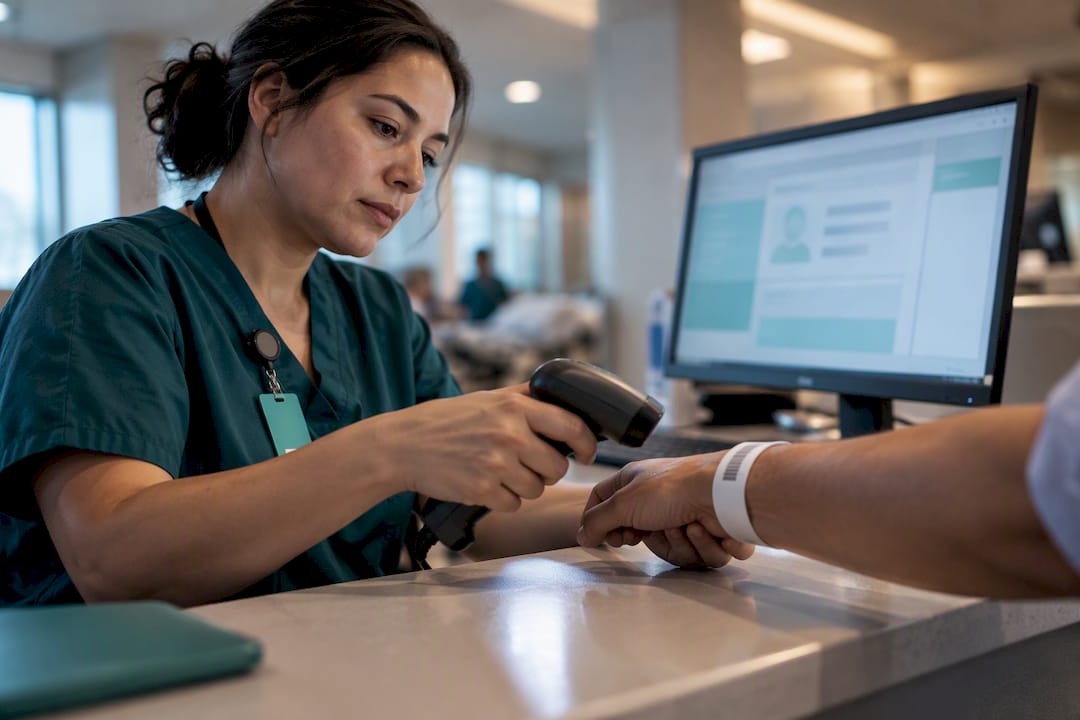
Healthcare identity verification is the end-to-end process of resolving, validating, and verifying who a patient actually is, not just confirming they can log into a portal. NIST’s SP 800-63A-4 and the ONC SAFER Guide both treat this as a three-stage discipline, not a single login check. Implementers who skip resolution or validation and jump straight to authentication leave the door open to wrong-patient errors, medical identity theft, and matching failures across systems.
TL;DR:
- Screening and deduplication of patient records at registration are critical to prevent synthetic identities and false matches across all care transitions.
- Identity resolution, evidence validation, and live identity verification must be sequential; skipping any phase risks mismatches, fraud, and patient safety errors.
- Automated biometric and liveness detection are essential for remote proofing, but only effective if integrated with clean data and high-quality document validation.
- In-person checks should verify two identifiers at high-risk moments, and multi-factor authentication must reinforce initial proofing efforts at portals and clinical points.
- A governance-driven, tiered approach to verification, with continuous monitoring and vendor testing, is necessary to build a resilient healthcare identity program.
Table of Contents
- What Healthcare Identity Verification Actually Covers
- The Three-Stage Model: Resolution, Validation, Verification
- Where Attackers Actually Break In
- Building a Verification Program That Actually Holds Up
- The Standards Every Implementer Should Have Open
- Fraud Signals News on Where Programs Actually Stall
- Primary Sources Worth Bookmarking
- An Editorial Take on Where the Real Risk Sits
- Sources
- FAQ
What Healthcare Identity Verification Actually Covers
Identity proofing, patient matching, and authentication get used interchangeably in most hospital hallways, and that confusion causes real damage. Identity proofing confirms a person is who they claim to be at the moment of first contact. Patient matching links that verified identity to the correct existing record inside an EHR or across a health information exchange. Authentication confirms, on every subsequent visit or login, that the person accessing an account is the same one who was originally proofed. Each does a different job, and treating one as a substitute for another is where most breakdowns start.
Verification matters at specific, repeatable moments in a patient’s path through care:
- Initial registration and insurance intake, where synthetic identities and stolen benefits most often surface
- Telehealth onboarding, where there’s no physical wristband or in-person clerk to catch a mismatch
- Release of records to a patient portal or a requesting third party
- Medication administration and blood transfusions, where a wrong-patient error can be fatal
- Specimen collection and lab result delivery, where mismatched identifiers corrupt downstream diagnoses
HL7’s interoperable patient-matching guidance makes a point administrators underweight: verified demographic attributes, once captured correctly, travel with the record and improve matching accuracy every time that patient’s data crosses into a new system. A verification event done once, done right, pays dividends at every subsequent care transition.
The Three-Stage Model: Resolution, Validation, Verification
NIST’s SP 800-63A-4 breaks identity proofing into three sequential stages, and skipping any one of them undermines the whole chain.
- Identity resolution collects enough identifying attributes (name, date of birth, address, government ID number) to distinguish one applicant from every other person in the system. This is where an Enterprise Master Patient Index (EMPI) earns its budget line: it deduplicates records and flags near-matches before they become two charts for one person, or one chart shared by two people.
- Evidence validation checks whether the documents or credentials presented are genuine and current, cross-referencing against authoritative sources like a state DMV database or a passport issuer, and inspecting security features that distinguish a real ID from a forgery.
- Identity verification confirms the live applicant is the same person the evidence describes. NIST is explicit that a document scan alone does not constitute verification without a live-binding step: visual comparison by trained staff, automated biometric facial comparison, liveness detection to defeat photo or deepfake spoofing, or a control-of-account proof like a confirmed microtransaction.
Remote settings raise the stakes on stage three. In-person registration lets a clerk compare a face to a badge photo in real time. Telehealth and remote patient onboarding have no such backstop, which is exactly why liveness detection and automated biometric comparison matter more, not less, outside clinic walls. NIST’s assurance-level framework (IAL, AAL, and FAL) gives administrators a way to scale requirements to risk. A prescription refill portal doesn’t need the same rigor as a request to release a full medical record to a new provider.
Pro Tip: Never accept knowledge-based verification (KBV), questions about past addresses or old loan amounts, as a stand-alone method at higher assurance levels. NIST has moved away from KBV because data brokers and breach dumps make those answers guessable, and it should never anchor a proofing decision above IAL1.
Where Attackers Actually Break In
Fraud against healthcare identity systems clusters into a few repeatable patterns, and each one has a corresponding control that meaningfully reduces it.
Medical identity theft and insurance fraud usually start with a stolen or purchased identity used to obtain treatment, prescriptions, or durable medical equipment billed to someone else’s coverage. Synthetic identities, built from real and fabricated data blended together, are harder to catch because no single stolen record triggers an alert. Deepfake risk is climbing fastest in remote proofing flows, where a fraudster presents a synthetic video or manipulated photo instead of a live face. Account takeover through reused or recycled contact information, an old phone number or email address tied to someone else’s inbox, lets attackers reset credentials and hijack a legitimate patient’s portal access.
- Medical identity theft and insurance fraud → document validation against authoritative sources plus EMPI deduplication checks at intake
- Synthetic identity fraud → identity resolution steps that cross-reference multiple independent data sources rather than trusting a single applicant-supplied set
- Deepfake and photo-spoofing attacks in telehealth → liveness detection paired with automated biometric comparison, not visual review alone
- Account takeover via stale contact data → periodic re-verification triggers and staff training to flag suspicious change-of-contact requests
Poor registration practices and inconsistent data entry are a documented driver of duplicate records, and duplicates are exactly what synthetic identity fraud exploits to slip past matching logic, according to ASPE and ONC pilot findings. Clean intake data isn’t a back-office nicety. It’s a frontline fraud control.
Building a Verification Program That Actually Holds Up
A workable program starts with a governance decision, not a technology purchase: what assurance level does each workflow actually need, and who owns the written policy that says so?
Policy and assurance decisions
- Map each patient-facing workflow (registration, telehealth, portal access, record release) to an IAL/AAL tier before evaluating vendors
- Publish a written verification policy that names acceptable evidence types, exception paths, and who approves overrides
- Set a re-verification cadence for high-risk transactions like address changes or new prescription requests
Technology and workflow controls
- Combine document verification with automated biometric comparison and liveness detection for remote proofing events
- Use the two-identifier check ONC SAFER recommends (name plus date of birth, or MRN) at every clinical touchpoint: admission, medication pass, transfusion, specimen draw
- Deploy barcode or RFID wristbands tied to EMPI records to catch mismatches at the bedside before an error reaches the patient
- Require MFA for portal and clinician access, layered on top of the initial proofing event, not as a replacement for it
Monitoring and equity safeguards
- Log every verification decision and exception with enough detail to support an audit trail
- Test vendor biometric systems for liveness resistance and false-match/false-reject rates across different skin tones and lighting conditions before signing a contract; a security review from an outside group, similar to the penetration testing services healthcare suppliers use for infrastructure, applies the same logic to identity vendors
- Build a documented exception path for patients without standard photo ID, using alternatives HealthCare.gov lists as acceptable: passports, military ID, naturalization certificates, or supervisor-reviewed manual submission
Pro Tip: Pilot one workflow at a time. Start with registration intake and EMPI clean-up, since that’s where duplicate records originate, then move to a single remote proofing flow with liveness testing before touching the rest of the system. Trying to overhaul everything simultaneously is how pilots die in committee.
Track KPIs that reflect real outcomes, not just adoption: reduction in wrong-patient events, drop in confirmed fraud incidents, and false-reject rate for legitimate patients, since a system that locks out real people to catch fraud has simply moved the harm elsewhere.
The Standards Every Implementer Should Have Open
- NIST SP 800-63A-4 defines IAL, AAL, and FAL, the proofing steps, and explicitly restricts KBV at higher assurance tiers.
- The 2025 ONC SAFER Guide recommends two-identifier checks, barcode and RFID wristband workflows, and EMPI used to cut wrong-patient errors.
- HL7’s identity-matching guidance and the FHIR Patient $match operation explain how verification metadata improves cross-organization matching.
- HHS confirms there is still no federally adopted patient identifier, which means providers must lean on governed demographic data, local MRNs, and disciplined matching rules instead of a single national number.
That last point deserves emphasis: collecting more identifiers isn’t automatically safer. HHS guidance warns against blindly merging records on ambiguous matches; normalize authoritative attributes, preserve prior values, and route uncertain cases to trained human review rather than an automated merge.
Fraud Signals News on Where Programs Actually Stall
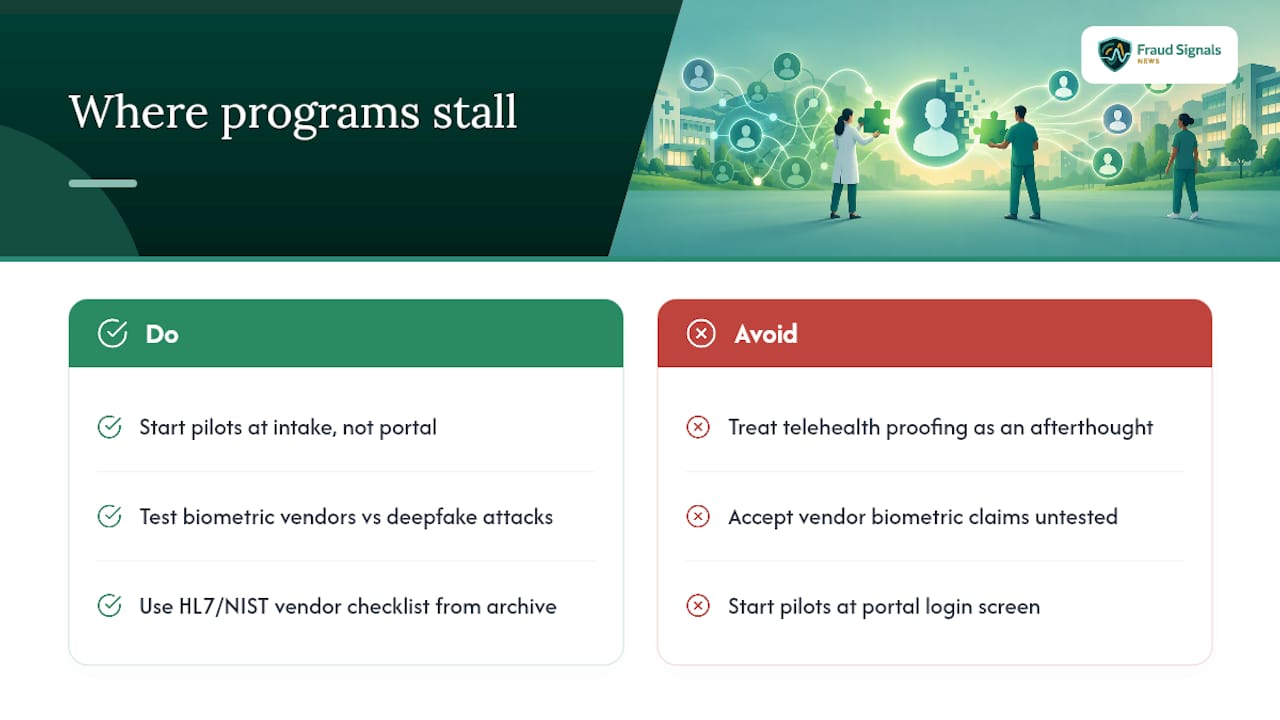
Most healthcare organizations stall on the same three fronts: dirty EMPI data inherited from legacy systems, telehealth proofing treated as an afterthought, and vendor biometric claims accepted without adversarial testing. Start pilots at intake, not at the portal login screen. For a deeper technical breakdown of how HL7 and NIST requirements intersect with wrong-patient prevention, and for a working vendor-evaluation checklist, our archive has the operational detail this section can’t fit. Test any biometric vendor against deepfake and photo-injection attacks before it touches a single live patient.
Primary Sources Worth Bookmarking
- NIST SP 800-63 family for the full proofing and authentication framework
- ONC SAFER Guide for patient-identification workflow design
- HL7 identity-matching guidance for interoperability and FHIR implementation
An Editorial Take on Where the Real Risk Sits
The conventional advice on healthcare identity verification treats it as a compliance checkbox: buy a biometric tool, satisfy an auditor, move on. That framing misses where the actual damage happens. Duplicate EMPI records and inconsistent intake data cause more wrong-patient events than any sophisticated fraud scheme, yet they get a fraction of the budget attention that a shiny facial-recognition vendor demo receives.
The standards bodies got the sequencing right and most implementations get it backwards. NIST’s resolution, validation, verification model only works if resolution happens first, with clean, deduplicated data. Skip that and every downstream biometric check is verifying the wrong record with high confidence. If Fraud Signals News’s reporting on this space has a consistent theme, it’s that liveness detection and deepfake resistance matter enormously in telehealth, but they cannot compensate for a registration desk that’s been feeding garbage into the EMPI for a decade. Fix the boring problem first. The sophisticated attacks get easier to catch once the basic plumbing is clean.
— Carlos Ochoa
Sources
- Digital Identity Guidelines: Identity Proofing and Enrollment (SP 800-63A-4)
- 2025 SAFER Guide: Patient Identification
- Interoperable digital identity and patient matching guidance (HL7)
- Healthcare
FAQ
How long does it take to verify identity for a healthcare portal or benefits application?
Automated document and biometric checks typically resolve in minutes, but manual review triggers, mismatched documents, name changes, low-quality photos, can extend the process to several business days. HealthCare.gov’s own guidance notes that when automated verification fails, applicants may need to submit documents for manual review, which adds processing time beyond the instant check.
Why does automated identity verification sometimes fail for legitimate patients?
Automated systems can fail when submitted documents are expired, blurry, or inconsistent with other records on file, such as a maiden name still listed at one agency but not another. This is why NIST’s model treats resolution and validation as separate, sequential steps rather than a single automated pass, and why every program needs a documented human-review exception path.
How do hospitals verify a patient’s identity in person?
Hospitals typically check at least two identifiers, commonly full name and date of birth, against a wristband, barcode, or the record in the EMPI, per the ONC SAFER Guide’s recommendation. This two-identifier check repeats at high-risk moments like medication administration and specimen collection, not just at admission.
Is knowledge-based verification still acceptable for healthcare identity checks?
No, not at higher assurance levels. NIST’s guidance explicitly restricts KBV from being used as a stand-alone verification method above IAL1, because data breaches have made many knowledge-based answers guessable or purchasable.
What should patients do if they don’t have a driver’s license or passport?
Acceptable alternatives include a military ID, naturalization or citizenship certificate, or other government-issued identification, and HealthCare.gov outlines a manual submission process for cases where automated systems can’t confirm identity from standard documents. Healthcare organizations should build a similar documented exception path rather than turning away patients without a standard photo ID.
Recommended

Fraud Teams: NIST Aligned VPN Detection for Onboarding, Score First

Prevent a Biometric Breach: 6 Operational Controls for Identity Teams