

Consumer identity protection law is the body of federal and state statutes that regulate how personal identifying information is used, safeguarded, and recovered when stolen or misused. Federal law under 18 U.S.C. § 1028 criminalizes identity theft with penalties reaching 15 years imprisonment, and regulators received over 1.1 million identity theft reports in 2024 alone. That volume signals a systemic failure, not isolated incidents. The Federal Trade Commission (FTC) and Consumer Financial Protection Bureau (CFPB) sit at the center of enforcement, while statutes like the Fair and Accurate Credit Transactions Act (FACTA) and the Fair Credit Reporting Act (FCRA) define the civil rights consumers can actually use.
What is consumer identity protection law and how does it work?
Consumer identity protection law is defined as a layered legal framework combining criminal statutes, consumer protection regulations, and civil remedies to prevent identity theft and enable recovery. The framework rests on three pillars: criminalization of theft, consumer rights to dispute and freeze credit, and mandatory business compliance programs.
The Identity Theft and Assumption Deterrence Act (ITADA), codified at 18 U.S.C. § 1028, is the foundational federal criminal statute. Standard violations carry up to 15 years imprisonment. Aggravated identity theft, such as theft linked to terrorism, carries penalties up to 30 years. These are not civil fines. They are federal criminal sentences.

FACTA and FCRA operate on the civil side. They give consumers the right to place fraud alerts, freeze credit files, and obtain free credit reports after a theft event. The FTC enforces these rights against credit bureaus and creditors who fail to comply. The CFPB handles enforcement against financial institutions under its supervisory authority.
The Red Flags Rule, issued under FACTA, requires financial institutions and creditors to maintain written Identity Theft Prevention Programs. These programs must identify warning signs of fraud, respond to detected threats, and be updated regularly. The rule applies to banks, credit unions, mortgage lenders, and many other creditors.
Key federal laws at a glance:
- 18 U.S.C. § 1028 (ITADA): Criminalizes identity theft; penalties up to 15 years, or more for aggravated offenses
- FACTA: Establishes fraud alerts, credit freezes, and the Red Flags Rule for businesses
- FCRA: Governs credit reporting accuracy and consumer dispute rights
- Red Flags Rule: Mandates written prevention programs for financial institutions
- FTC Act Section 5: Enables FTC enforcement against unfair or deceptive practices involving consumer data
Pro Tip: File a complaint directly with the FTC at IdentityTheft.gov before contacting your bank. The site generates a personalized recovery plan and creates the formal Identity Theft Report that triggers your statutory rights.
How do state laws complement federal identity protection laws?
Federal law sets a baseline. State laws frequently exceed it, and that gap matters enormously for both victims and compliance officers. State statutes like Texas Business & Commerce Code § 521.002 provide enhanced civil remedies that federal law does not, including statutory damages and attorney fee awards that make litigation viable for individual victims.
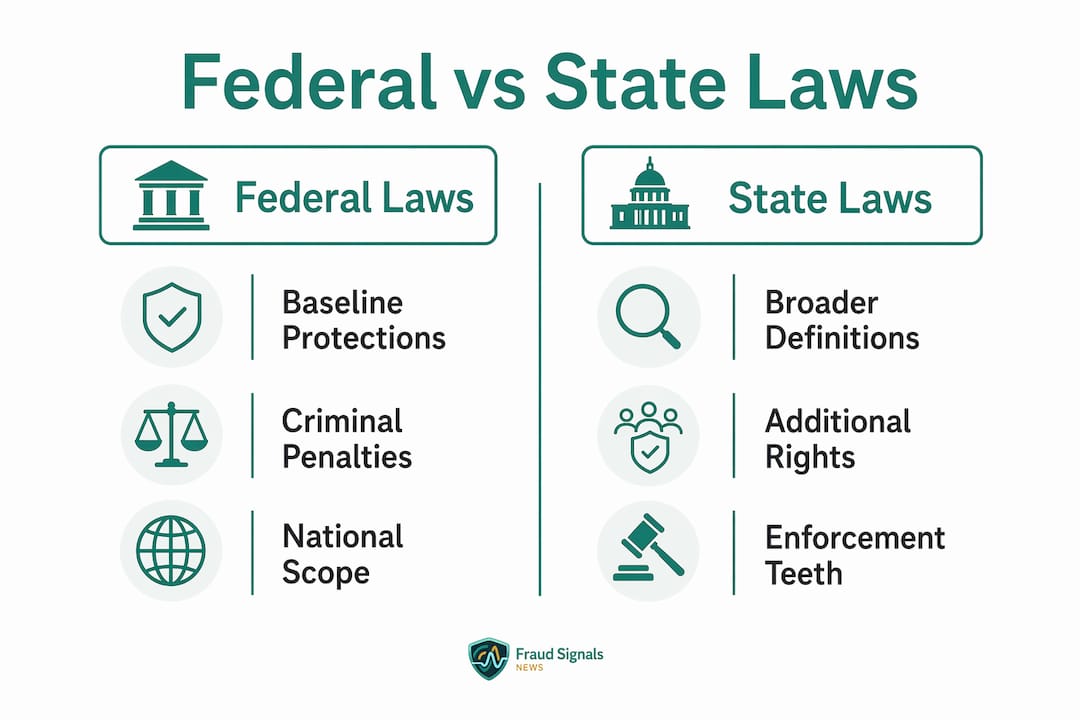
The variation across states is significant. Some states define “personal information” broadly to include biometric data, geolocation, and medical records. Others still use narrow definitions tied to Social Security numbers and financial account data. This inconsistency creates real compliance exposure for businesses operating across state lines.
State laws also differ on notification timelines. Some require breach notification within 30 days. Others allow 60 or 90 days. A compliance officer managing a national operation cannot apply a single standard and expect full coverage. Multi-jurisdictional mapping is not optional. It is a legal requirement.
Why state law variability matters:
- Civil remedies unavailable under ITADA become accessible through state statutes
- Victims in states with stronger laws can recover statutory damages without proving actual loss
- Businesses face different breach notification deadlines in each state they operate
- Some states grant consumers the right to place a security freeze on their minor children’s credit files, a right not uniformly available under federal law
Federal laws offer a uniform baseline, but state laws create the enforcement teeth that make civil recovery practical. Compliance officers who treat federal compliance as sufficient are accepting legal risk they may not have priced.
What practical rights and tools do consumers have?
Consumers hold three primary legal tools under identity protection regulations: credit freezes, fraud alerts, and the formal Identity Theft Report. Each serves a distinct function, and using the wrong one at the wrong time reduces protection.
A credit freeze blocks all access to a consumer’s credit file. Lenders cannot pull the file, so new accounts cannot be opened in the consumer’s name. Credit freezes are free and do not affect credit scores. Consumers must place a freeze separately at each of the three major credit bureaus: Equifax, Experian, and TransUnion. Lifting a freeze temporarily for a legitimate application takes minutes online.
A fraud alert is a notice placed on a credit file requiring lenders to verify identity before extending credit. An initial fraud alert lasts one year. An extended alert lasts seven years and is available to confirmed identity theft victims. Active duty military members can place a one-year active duty alert. Fraud alerts are free and require only one bureau to notify the others.
The Identity Theft Report is the most underused tool. Filing a formal report at IdentityTheft.gov creates a legal document that triggers statutory protections under FCRA and FACTA. Credit bureaus must block fraudulent information from appearing on a victim’s report once this document is submitted. Informal complaints to a bank or police department do not carry the same legal weight.
Steps to protect your identity under current law:
- Place a credit freeze at all three major bureaus immediately after any suspected theft
- File a formal Identity Theft Report at IdentityTheft.gov to activate statutory rights
- Place an extended fraud alert if you are a confirmed victim
- Request free credit reports from all three bureaus and dispute fraudulent accounts in writing
- Notify affected creditors using the Identity Theft Report as supporting documentation
Pro Tip: The FTC designates the credit freeze as the most effective first step for consumers. A fraud alert still allows lenders to pull your file. A freeze does not. If you suspect your data is compromised, freeze first, then investigate.
What obligations do businesses and compliance officers have?
Financial institutions face the most direct compliance burden under consumer identity protection law. The Red Flags Rule requires a written Identity Theft Prevention Program that identifies specific fraud warning signs, called “red flags,” and prescribes responses. Static compliance documents are legally insufficient. Programs must be updated as fraud tactics evolve, and regulators have made clear that a program written in 2020 and never revised does not meet the standard.
Willful violations of FACTA and FCRA carry civil penalties of $100–$1,000 per violation, plus actual damages and attorney fees. For a large financial institution processing thousands of accounts, per-violation penalties compound quickly. The FTC and federal banking regulators, including the Office of the Comptroller of the Currency and the Federal Reserve, share enforcement authority.
Core compliance obligations for businesses:
- Maintain a written, board-approved Identity Theft Prevention Program under the Red Flags Rule
- Update the program at least annually and after any significant fraud event
- Train staff to recognize and respond to red flags in account applications and transactions
- Implement data security controls that meet or exceed applicable state breach notification standards
- Integrate biometric authentication and liveness detection where high-risk transactions occur
- Document all program updates and staff training for regulatory examination
ITADA does not provide victims a private right of action. That means criminal prosecution of a fraudster does not automatically compensate the victim. Civil recovery flows through FACTA, FCRA, or state statutes. Businesses that violate those civil statutes face direct liability to consumers, separate from any criminal case against the fraudster.
The compliance gap most organizations miss is the dynamic update requirement. Regulators do not accept a program that identifies yesterday’s fraud patterns. Identity Theft Prevention Programs must keep pace with emerging tactics including synthetic identity fraud, account takeover, and credential stuffing.
How to apply identity protection law knowledge effectively
Applying consumer identity protection law knowledge requires different actions depending on whether you are an individual consumer or a compliance officer. Both groups share one common failure mode: treating protection as a one-time event rather than an ongoing practice.
For individual consumers:
- Freeze your credit at Equifax, Experian, and TransUnion now, before any theft occurs
- Set up free credit monitoring through your bank or a credit bureau’s free tier
- Review your credit reports annually at AnnualCreditReport.com for unfamiliar accounts
- Store a copy of your Identity Theft Report if you have filed one, as you will need it repeatedly during recovery
- Report suspected theft to the FTC at IdentityTheft.gov, not just to your bank
For compliance officers:
- Map your organization’s operations against both federal requirements and the specific state laws of every jurisdiction where you operate
- Schedule annual reviews of your Identity Theft Prevention Program with documented sign-off from senior leadership
- Test red flag detection procedures with simulated fraud scenarios at least twice per year
- Integrate eKYC verification into onboarding workflows to catch synthetic identities before accounts are opened
- Maintain a breach notification calendar with deadlines for every state where customer data is held
Pro Tip: The FTC’s credit freeze guidance is explicit: a freeze is more protective than a fraud alert because it prevents file access entirely. Compliance officers advising consumers or employees should lead with freeze instructions, not alert instructions.
The most common compliance failure is treating the Red Flags Rule as a document exercise. Regulators examine whether programs are actually implemented and whether staff can demonstrate they recognize red flags in practice. A binder on a shelf does not satisfy the rule.
Key Takeaways
Consumer identity protection law requires a layered response: federal criminal statutes set penalties, FACTA and FCRA deliver civil rights, and state laws fill the gaps that federal law leaves open.
| Point | Details |
|---|---|
| Federal law criminalizes identity theft | 18 U.S.C. § 1028 carries penalties up to 15 years, with aggravated cases reaching 30 years. |
| Credit freezes outperform fraud alerts | The FTC designates credit freezes as the most effective first step because they block all file access. |
| Formal reporting activates legal rights | An Identity Theft Report from IdentityTheft.gov triggers statutory protections; informal complaints do not. |
| Business programs must be dynamic | Red Flags Rule compliance requires ongoing program updates, not a static document filed once. |
| State laws extend civil remedies | States like Texas provide statutory damages and attorney fees that federal ITADA does not offer victims. |
The enforcement gap no one talks about
The part of consumer identity protection law that frustrates me most is the synthetic identity problem. Synthetic identity fraud creates enforcement challenges because fabricated identities built from partial real data do not clearly meet the “another person” requirement in 18 U.S.C. § 1028. Prosecutors face a genuine legal ambiguity. Fraudsters know it and exploit it.
The “knowing” intent element compounds this. Federal law requires prosecutors to prove the defendant knowingly used another person’s identity. With synthetic identities, that proof is harder to construct. The result is that a significant category of modern identity fraud sits in a legal gray zone where criminal prosecution is difficult and civil recovery depends entirely on whether the victim can identify a specific creditor who violated FCRA or FACTA.
My view is that the regulatory framework has not kept pace with fraud innovation. The Red Flags Rule was designed for a world where fraudsters used stolen real identities. Synthetic fraud, AI-generated documents, and deepfake-assisted account takeover require a different detection model entirely. Financial institutions that rely on static rule sets are not compliant in any meaningful sense. They are compliant on paper while remaining exposed in practice. The organizations doing this right are the ones treating biometric fraud prevention as a compliance function, not just a product feature.
— A. Johnson
Fraud Signals News: stay current on identity protection
Identity protection law changes faster than most compliance calendars can track. New state breach notification deadlines, updated FTC guidance, and emerging fraud tactics like AI-assisted synthetic identity creation all affect what your program needs to do today versus what it needed to do last year.

Fraud Signals News covers the intersection of identity verification technology, regulatory enforcement, and fraud prevention with the depth that compliance officers and security teams actually need. From consumer fraud trends to the latest in biometric authentication standards, the site delivers analysis grounded in how fraud actually works, not how regulators wish it did. Subscribe to stay ahead of the enforcement curve and ensure your identity protection program reflects 2026 realities, not 2020 assumptions.
FAQ
What is consumer identity protection law?
Consumer identity protection law is the set of federal and state statutes that criminalize identity theft, establish consumer rights to dispute and freeze credit, and require businesses to maintain fraud prevention programs. Key federal laws include 18 U.S.C. § 1028, FACTA, and FCRA.
What is the difference between a credit freeze and a fraud alert?
A credit freeze blocks all access to a consumer’s credit file, preventing new accounts from being opened. A fraud alert only requires lenders to verify identity before extending credit, leaving the file accessible.
Does ITADA give identity theft victims the right to sue?
No. ITADA is a criminal statute and does not provide a private right of action. Victims must pursue civil claims under FACTA, FCRA, or applicable state laws to recover damages.
What triggers consumer rights under identity theft laws?
Filing a formal Identity Theft Report at IdentityTheft.gov triggers statutory protections under FCRA and FACTA. Informal complaints to a bank or local police department do not activate the same legal rights.
What must businesses do under the Red Flags Rule?
Businesses must maintain a written Identity Theft Prevention Program that identifies fraud warning signs, prescribes responses, and is updated regularly. Willful violations carry civil penalties of $100–$1,000 per violation plus damages.
Recommended

ID Security Features: What Each One Does and How to Check It

Face Liveness Detection: How It Works and Where It Fails