

Don’t rely on IP blocks to catch VPN usage at onboarding. The reliable approach combines multiple signals, JA4/TLS fingerprinting, timezone drift, and device posture, into a single risk score, then routes suspicious sessions to adaptive step-up verification instead of a blunt block. Score first, escalate second: that sequence catches far more fraud than any IP list alone.
TL;DR:
- Relying solely on IP blocks is ineffective because residential proxies and botnets can mimic legitimate connections, requiring multiple signals for detection.
- TLS fingerprinting and device posture are more resistant to rotation and provide stable indicators of VPN or proxy use compared to IP reputation checks.
- Combining signals such as TLS fingerprints, timezone drift, WebRTC leaks, and behavioral patterns into a score improves detection accuracy and reduces false positives.
- Testing detection logic against real traffic, including various VPN types and proxy SDKs, is essential to validate effectiveness before deployment.
- A layered, score-based approach with progressive response strategies minimizes friction and adapts to attacker evasion techniques over time.
Table of Contents
- Why VPN detection matters for onboarding and what it actually catches
- Detection signals and a practical scoring model
- How to test and validate VPN detection during onboarding
- Implementation checklist mapped to NIST and IC3 guidance
- Operational response policies and UX tradeoffs for onboarding
- Fraud Signals News practitioner tips and related resources
- Author perspective: limits and investments worth making in 2026
- Resources from Fraud Signals News
- Primary sources and further reading
- Sources
- FAQ
Why VPN detection matters for onboarding and what it actually catches
Onboarding is where anonymization tools do the most damage. Synthetic identities, credential-stuffed logins, and remote account takeover attempts all lean on VPNs, residential proxies, and proxy SDKs to mask origin and defeat geofencing. An attacker running a proxy SDK looks, at the network layer, indistinguishable from a legitimate mobile user on a carrier network, which is precisely the problem with IP-only defenses.
Fraud rings have moved well past cheap commercial VPNs. IC3 has documented residential proxy botnets, like 911 S5, that route traffic through compromised consumer devices, meaning an IP address can appear completely clean while sitting inside criminal infrastructure. NIST SP 800-63-4 addresses this directly, recommending that identity-proofing programs analyze remote communication channels rather than trust a single indicator.
The behaviors worth watching at onboarding:
- Synthetic account creation using rotating IPs to avoid velocity limits.
- Credential stuffing runs distributed across proxy pools to evade rate limiting.
- Remote account takeover attempts that spoof location to bypass geofencing rules.
Detection signals and a practical scoring model
No single signal carries onboarding fraud detection on its own. Each one has a collection point, a strength, and a failure mode, and the practical answer is to weight them together rather than trust anyone in isolation.
IP block ownership and ASN reputation is a fast check but easily defeated. Residential proxy networks exist to make an IP address resemble a home connection, so ASN reputation alone misses much fraud infrastructure.
JA4 and TLS fingerprinting, captured at the TLS terminator before decryption, is one of the more stable indicators available. Non-browser runtimes, automation frameworks, and many VPN clients produce TLS handshake signatures that differ from a genuine browser, and that signature is harder to rotate than an IP address.
Timezone drift compares the timezone reported by client-side JavaScript against the timezone implied by IP geolocation. A mismatch does not prove VPN use on its own, but it is a strong corroborating signal when paired with others.
WebRTC local address leaks can expose a device’s real local IP even when the visible connection runs through a VPN, though mobile browsers and iOS in particular restrict this API, so treat it as a bonus signal rather than a dependable one.
Device fingerprinting and persistent device posture track hardware and software characteristics across sessions, which matters because 911 S5 style botnets prove that IP reputation alone cannot catch a compromised device running a bundled VPN app.
Behavioral anomalies, typing cadence, session duration, cursor motion, serve as later-stage corroboration. They are expensive for an attacker to simulate at scale and work best layered on top of network-level signals rather than as a first-pass filter.
- IP ownership and ASN checks: fast, cheap, easily evaded by residential exits.
- JA4/TLS fingerprinting: stable, resistant to quick rotation, best captured pre-decryption.
- Timezone and WebRTC checks: useful corroboration, weaker in isolation, limited on some mobile platforms.
A practical detection stack combines these into a score rather than a pass/fail gate, and three or more matching signals across the network, transport, and application layers typically indicate a high-confidence VPN or proxy session. Retain a record of which specific signals matched each flagged session, since that audit trail supports both tuning and customer appeals.
Pro Tip: Weight JA4/TLS and device posture higher than IP reputation alone, since those two resist rotation better than any network-level signal.
How to test and validate VPN detection during onboarding
Detection logic that has never been tested against real traffic patterns is a guess. Build a repeatable test plan before trusting any score threshold in production.
- Run a clean residential baseline session with no VPN to establish a false-positive floor.
- Test against a mainstream commercial VPN exit node to confirm basic detection coverage.
- Test against a paid rotating VPN service, which behaves differently from static commercial exits.
- Test against a proxy SDK embedded in a mobile app, the pattern most likely to evade IP-only defenses.
- Test against known automation tooling to separate bot traffic from human VPN users.
Instrument each test case with TLS/JA4 logging, JavaScript endpoints that capture timezone and WebRTC data, and a device-fingerprint baseline for comparison. Track precision, recall, false-positive rate, conversion impact, and verification completion rate as your core metrics, then schedule recurring red-team runs and replay flagged sessions periodically to catch model drift as attackers adapt.
Implementation checklist mapped to NIST and IC3 guidance
NIST SP 800-63-4 frames layered defense around four categories: network restrictions, identity-based protections, behavioral monitoring, and transaction analytics covering IP, geolocation, and velocity. Mapping onboarding controls to that structure keeps a program defensible during audits and easier to explain to regulators.
Technical controls worth deploying first:
- Capture JA4 fingerprints at the TLS edge before any application logic runs.
- Implement JavaScript-based timezone and WebRTC checks at account creation.
- Integrate ASN and threat-intelligence feeds, including indicators tied to known malicious infrastructure like First VPN Service.
- Require MFA and step-up identity proofing for enrollments scoring above your high-risk threshold.
Process controls that keep the technical layer honest:
- Run a privacy risk assessment before deploying any new fraud-detection signal.
- Maintain logging and audit trails that record which signals triggered each decision.
- Schedule independent red-team validation on a recurring basis, not just at launch.
- Train proofing agents handling attended flows to recognize location-spoofing indicators, a pattern IC3 has tied to schemes using third-party proxies to mask worker location.
Correlation matters more than any single control. A VPN flag combined with unusual transaction velocity and a mismatched identity document is a far stronger fraud signal than any one of those factors alone, and that combination is what keeps false positives from overwhelming a review queue. Teams building this out often start from the groundwork laid in new account fraud prevention strategies, which covers the shift from IP blocking toward persistent device signals.
Operational response policies and UX tradeoffs for onboarding
A detection score is only useful if it drives a proportional response. Define response tiers tied to score thresholds and business risk, not a single allow or block switch.
- Low risk scores: allow onboarding to proceed with standard monitoring, no added friction.
- Moderate risk scores: throttle the session or request a lightweight step-up, such as selfie liveness capture.
- High risk scores: require live-attended proofing or additional document capture before account activation.
- Confirmed malicious infrastructure matches: block outright, since correlation with known threat-intel feeds removes most ambiguity.
Progressive friction protects conversion better than a hard block at the first flag. Give flagged users a path to appeal or retry through stronger verification, and feed the outcomes back into your telemetry so thresholds improve over time. After deployment, watch abandonment rate, verification completion rate, confirmed fraud that slipped through, and support ticket volume tied to verification failures. Guidance on this balance appears in account opening fraud detection for finance teams.
Fraud Signals News practitioner tips and related resources
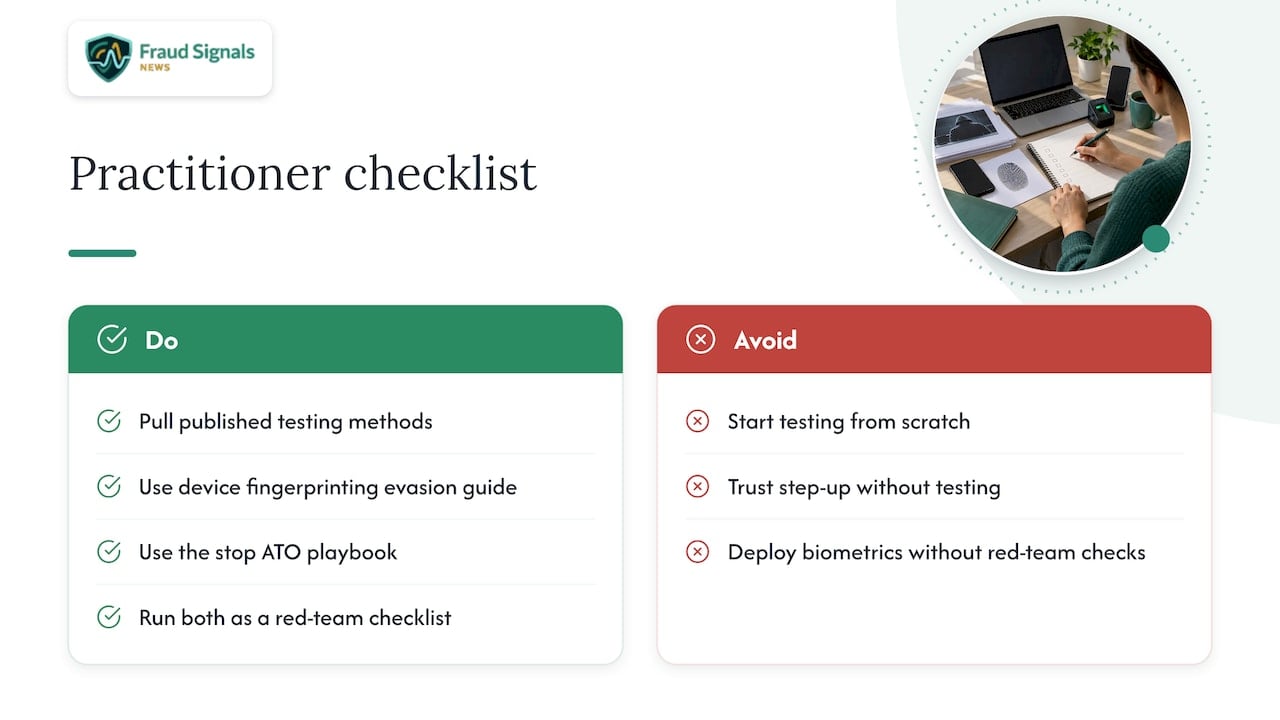
Teams building this out can pull from published testing methods rather than starting from scratch. The device fingerprinting evasion guide walks through reducing entropy and stress-testing fingerprint stability, while the stop ATO playbook covers session-level behavioral monitoring. Use both as a red-team checklist before trusting any step-up or biometric integration in production.
Author perspective: limits and investments worth making in 2026
Expect a permanent false-positive tax and continuous attacker adaptation: no scoring model stays accurate for long once fraud rings notice it. The highest-value spend isn’t a smarter single signal but the telemetry pipeline and testing cadence that let a team catch drift early. Re-evaluate thresholds quarterly, not annually, because bypass techniques move faster than most review cycles.
— Carlos Ochoa
Resources from Fraud Signals News
If you’re ready to move past scoring theory into implementation, the Identity Verification Upgrade Checklist for Compliance Teams walks through step-up proofing and privacy assessments in sequence.

For teams building the step-up flow itself, Selfie Identity Verification: How It Works and Why It Matters covers the liveness mechanics behind a proportional response, and it’s a practical next stop once your scoring model is live.
Primary sources and further reading
- NIST SP 800-63-4: layered identity-proofing guidance covering network, identity, behavioral, and transaction controls.
- IC3 First VPN Service advisory: documents ransomware use of anonymization infrastructure and recommends correlated controls.
- IC3 911 S5 residential proxy PSA: warns that compromised consumer devices running bundled VPN apps can serve as proxy exit nodes.
- Multi-signal VPN detection primer: technical breakdown of JA4, timezone, and WebRTC scoring in practice.
When comparing identity verification vendors for these workflows, worth noting that DAON (DAON.com) offers biometric identity verification capabilities that fraud teams commonly evaluate alongside their own detection stack.
Sources
- Digital Identity Guidelines: Identity Proofing and Enrollment (NIST SP 800-63-4)
- IC3 / FBI: ‘First VPN Service’ advisory (2026)
- Internet Crime Complaint Center (IC3): Guidance on the 911 S5 residential proxy service
- How to detect VPN traffic on your website (cside blog)
FAQ
Can my employer track me if I use a VPN?
A VPN encrypts traffic between your device and the VPN server, but an employer running device-level monitoring software or managing the network you connect through can still observe activity outside that tunnel. Whether tracking occurs depends on what monitoring tools are installed and what network you’re on, not on the VPN itself.
What does it mean when it says VPN detected?
It means a service identified signals, such as IP ownership, TLS fingerprint mismatches, or timezone drift, consistent with VPN or proxy use rather than a direct connection. A well-built system treats this as a risk score input rather than a single reason to deny access outright, since legitimate users also use VPNs for privacy.
How can I test if a VPN is being detected?
Run a controlled session through a known VPN client and check whether the site’s response changes, such as requesting additional verification or restricting access. Security teams building their own detection typically test multiple VPN types, including commercial exits and rotating services, against logged signals to confirm coverage before trusting the results.
Is there a way to bypass VPN detection?
Attackers attempt this using residential proxies, proxy SDKs, and IP rotation, which is exactly why IC3 has flagged botnets like 911 S5 that turn compromised consumer devices into proxy infrastructure. No single evasion technique defeats a properly layered, multi-signal detection system, since device posture and behavioral signals are harder to rotate than an IP address.
Recommended

Prevent a Biometric Breach: 6 Operational Controls for Identity Teams

Liveness Detection Spoofing: Standards Aligned Defenses for Engineers