

Treat every biometric identifier as sensitive, irrevocable, and permanently compromised the moment it leaks: that single premise should drive every architectural decision your organization makes. Biometrics must operate only inside a risk-managed, privacy-first design that pairs them with multi-factor authentication, device binding, and strict data minimization, combined with template protection, encryption, presentation attack detection, documented privacy risk assessments, and continuous vendor oversight, as outlined in NIST Special Publication 800-63B.
TL;DR:
- Biometric systems must pair identifiers with multi-factor authentication and strict data minimization to mitigate irrecoverable privacy risks if data leaks occur.
- Vendors require rigorous performance testing, including presentation attack detection validation and transparency about bias and PAD failure rates broken out by demographic groups.
- Retention policies should be purpose-driven with automatic deletion, verifiable logs, and avoidance of indefinite storage to reduce breach surfaces and legal liabilities.
- Regular oversight of third-party vendors must include contract clauses specifying data use, deletion timelines, audit rights, and real-time bias and PAD testing updates.
- Ethical considerations demand bias testing across demographics, clear purpose limitation, and governance measures to prevent misuse or repurposing of biometric data beyond fraud prevention.
Table of Contents
- Operational privacy checklist: controls to implement now
- Privacy risk assessment and compliance documentation
- Vendor and third-party oversight for biometric systems
- Technical controls: matching architecture and template protection
- Retention, data flows, and deletion policies
- Governance and breach response for biometric data
- Legal frameworks beyond NIST and FTC guidance
- User rights: access, correction, deletion, and portability
- Ethical considerations in biometric data collection
- Privacy-enhancing technologies in biometric systems
- User education and transparency about biometric usage
- Where privacy programs go wrong first
- Resources to put this checklist into practice
- Sources
- FAQ
Operational privacy checklist: controls to implement now
Most biometric privacy failures trace back to skipped steps, not exotic attacks. The fix is a prioritized, ordered checklist your engineering and compliance teams can execute together.
- Bind biometrics to multi-factor authentication. NIST guidance is explicit that biometric characteristics should never serve as a lone secret because they are irrevocable and often obtainable without consent, so pair every biometric check with a hardware or device-bound factor, per NIST SP 800-63B.
- Minimize collection to what identity proofing requires. Capture only the attributes needed for the specific fraud-mitigation or proofing purpose, and reject vendor defaults that gather more.
- Enforce template protection and immediate sample erasure. Extract features in an authenticated protected channel, then delete the raw sample; store only protected templates with proper key management.
- Test presentation attack detection against real conditions. Validate PAD using ISO/IEC testing methodologies and realistic spoofing attempts, not vendor marketing claims.
- Set risk-based retention with automatic deletion. Retention windows should map to documented purpose and risk, not to storage convenience.
- Preserve audit evidence. Keep privacy impact assessments, risk decisions, and test results on file for regulators and internal audits.
Pro Tip: Run your PAD validation before your vendor contract renews, not after, so the results inform whether the vendor keeps the account.
Privacy risk assessment and compliance documentation
A defensible biometric program produces paperwork before it produces matches. NIST SP 800-63B requires privacy risk assessments alongside biometric activation factors, and your assessment needs to stand up to scrutiny from regulators and auditors alike.
- Scope and data flows: document every system that touches biometric data, from capture device to storage to deletion.
- Purpose limitation: state exactly why each attribute is collected and tie it to a specific fraud or identity outcome.
- Threat model and mitigations: list realistic attack paths, spoofing, insider misuse, vendor breach, and the control that addresses each.
- Residual risk and acceptance: name who signed off on remaining risk and when the assessment gets revisited.
Federal contexts often trigger formal privacy impact assessments or System of Records Notices, and enterprise programs handling comparable volumes of sensitive identifiers should hold themselves to the same disclosure and consent standard the FTC’s biometric policy statement describes. Structure the output so it feeds directly into vendor selection criteria, retention policy limits, and your incident response playbook rather than sitting in a compliance folder nobody reopens.
Vendor and third-party oversight for biometric systems
Your organization remains accountable for a vendor’s biometric practices even when the vendor built the model, collected the training data, and runs the matching engine. The FTC’s enforcement order against Everalbum and Paravision established that clear, conspicuous disclosure and affirmative consent are required before biometric data trains a model, and deletion deadlines apply to derived data as well as raw samples.
- Contract clauses: permitted uses, deletion obligations tied to specific timeframes, clear data ownership, breach notification deadlines, and standing audit rights.
- Performance and bias testing: require documented test methods, named datasets, and demographic breakdowns rather than aggregate accuracy claims.
- PAD validation: insist on evidence the vendor’s liveness detection was tested against current spoofing techniques, not a static benchmark from years earlier.
- Supply-chain provenance: ask where training data originated and whether consent was obtained for that use.
- Ongoing monitoring: set a recurring re-testing schedule, a patching SLA, and an escalation path when the vendor misses either.
Pro Tip: Ask every biometric vendor for their most recent PAD failure rate broken out by demographic group, then ask when that test was last run: silence on either question is itself an answer.
Technical controls: matching architecture and template protection
Where you match matters as much as how you match. Local, on-device matching keeps biometric data off centralized servers and limits breach blast radius, and it should be your default where device capability and user experience allow it. When central matching is unavoidable, NIST SP 800-63B recommends authenticating the sensor itself and binding templates to a specific sensor class or device identifier, which prevents wholesale replay from a compromised or rogue capture device.
- Cancellable templates: use irreversible transforms so a stolen template cannot be reversed into a usable biometric image, and never store raw samples once features are extracted.
- Key management: encrypt templates in transit and at rest, rotate keys on a defined schedule, and require vendor attestations that key handling meets the contract terms.
- Erasure discipline: delete raw samples immediately after feature extraction, a control NIST SP 800-63B treats as a baseline requirement, not an option.
- Sensor authentication: verify the capture device before trusting its output, particularly in any central-matching architecture.
Guidance to track: ongoing work on presentation attack detection notes that biometric traits are not secret and can be captured from photographs or physical artifacts, which is why PAD evaluation against Instance Attack Presentation Accept Rate and related metrics belongs in every vendor review, alongside false match and false non-match rates measured across demographic groups rather than as a single blended figure.
For teams building or evaluating template protection specifically, our breakdown of template protection techniques walks through the tradeoffs between transform-based and encryption-based approaches.
Retention, data flows, and deletion policies
Indefinite retention of face embeddings or fingerprint templates is a liability, not an asset. Retention should map to a documented purpose, and once that purpose is satisfied, deletion should follow automatically rather than waiting on a manual review that never happens.
- Set windows by purpose, not convenience: a fraud investigation hold differs from a routine authentication template, and each needs its own retention clock.
- Make deletion verifiable: log every deletion event and generate an attestation an auditor can check without re-running the process.
- Separate disclosure from legal boilerplate: FTC enforcement history shows regulators expect conspicuous, standalone notice at the point of collection, not a clause buried in a privacy policy.
- Limit cross-system proliferation: the same attribute stored in five systems creates five breach surfaces; consolidate wherever the architecture allows it.
Affirmative, informed consent belongs at collection, and NIST’s privacy guidance for identity proofing reinforces that explicit notice at the point of capture is a baseline expectation, not a courtesy.
Governance and breach response for biometric data
Biometric incidents differ from password breaches in one critical respect: the compromised credential cannot be reset. Your incident response plan needs to reflect that from the start.
- Assign named owners across privacy, security, and fraud operations before an incident happens, with a predefined revocation and re-enrollment flow for affected identities.
- Preserve forensic evidence while closing exposure, which usually means rotating keys and revoking compromised templates without destroying the data your investigation needs.
- Prepare regulator-facing attestations in advance, including what was exposed, how many individuals were affected, and what containment steps were already taken.
- Draft communication templates ahead of time for affected individuals and regulators, and set the trigger point for engaging legal counsel before the first draft goes out.
Legal frameworks beyond NIST and FTC guidance
NIST and the FTC set the operational floor in the United States, but they are not the only frameworks that govern biometric handling. The GAO’s review of biometric identification technologies found that stakeholders consistently flagged the absence of comprehensive federal privacy law as a gap, which has pushed compliance obligations toward a patchwork of state and international rules.
The GDPR classifies biometric data used for unique identification as a special category requiring explicit consent or another narrow legal basis, along with a documented data protection impact assessment before processing begins. The CCPA and its amendments treat biometric information as sensitive personal information, giving consumers rights to limit its use and requiring businesses to disclose collection purposes at or before the point of capture. Illinois, Texas, and Washington each maintain their own biometric statutes with distinct notice, consent, and retention requirements, and organizations operating across jurisdictions typically build to the strictest applicable standard rather than maintaining parallel compliance tracks.
The practical implication for identity and fraud teams is that a single privacy risk assessment rarely covers every jurisdiction. Map your data flows against each applicable framework, document the legal basis relied on in each, and revisit that mapping whenever you add a new market or a new biometric modality. The GAO report specifically calls for risk-based regulation and clearer transparency standards, a signal that the regulatory floor is likely to rise rather than stay fixed.
User rights: access, correction, deletion, and portability
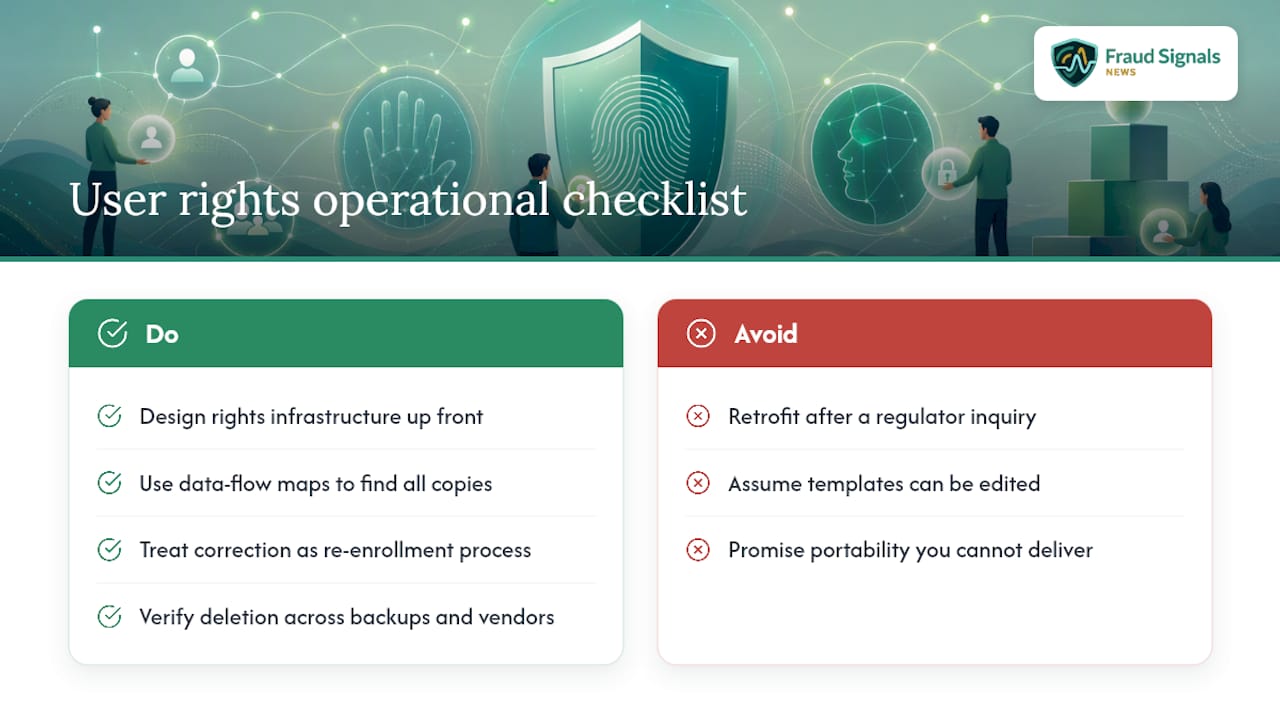
Individuals whose biometric data your systems process generally hold a set of rights that mirror broader data protection frameworks: the right to know what was collected, the right to correct inaccurate records, the right to request deletion, and in some jurisdictions the right to receive their data in a portable format. Building the infrastructure to honor these rights is not optional in most regulated markets, and retrofitting it after a regulator inquiry is far more expensive than designing for it up front.
Access requests require you to locate every system holding a person’s biometric data, not just the primary matching database, which is why the data flow mapping from your privacy risk assessment does double duty here. Correction requests are more complex for biometric data than for text fields: a face template cannot be “edited,” so correction typically means re-enrollment under a documented process. Deletion requests demand the same verifiable deletion discipline covered earlier, extended to every derived record, backup, and vendor copy.
Portability is the least mature right in practice, since biometric templates are often proprietary to the matching algorithm that generated them and cannot be transferred to a different vendor’s system without re-enrollment. Document this limitation clearly in your disclosures rather than promising a portability capability your architecture cannot deliver.
Ethical considerations in biometric data collection
Beyond legal compliance, biometric systems raise questions that regulation has not fully caught up to. The GAO’s stakeholder review grouped concerns into biased outcomes, data and privacy risks, and a lack of transparency, findings that point to systemic issues rather than isolated vendor failures.
Bias in matching accuracy across demographic groups remains a documented concern, which is why performance testing broken out by group, not blended into a single accuracy figure, matters as much for ethics as for compliance. A system that performs well on average but poorly for a subset of your customer base creates disparate friction, false declines, or worse, false approvals, concentrated in that group.
There is also a broader societal question about function creep: data collected for fraud prevention can be repurposed for surveillance, marketing, or law enforcement requests if governance does not explicitly bound its use. Organizations that document purpose limitation clearly and enforce it technically, not just contractually, are better positioned when a request arrives to use biometric data outside its original scope. The GAO’s call for comprehensive privacy law and risk-based regulation reflects a broader concern that the technology has outpaced existing guardrails, and organizations that build ethical review into their governance process now will face less disruption when regulation catches up.
Privacy-enhancing technologies in biometric systems
Federated learning and differential privacy are increasingly relevant to biometric system design, particularly for organizations training or tuning matching models across multiple data sources. Federated learning allows a model to improve using data that never leaves its original location, a pattern that reduces the central data pool a breach could expose. Differential privacy adds calibrated noise to aggregated data or model outputs so that no individual record can be reverse-engineered from the result, a technique increasingly relevant to biometric analytics and reporting even when it is not used in the matching pipeline itself.
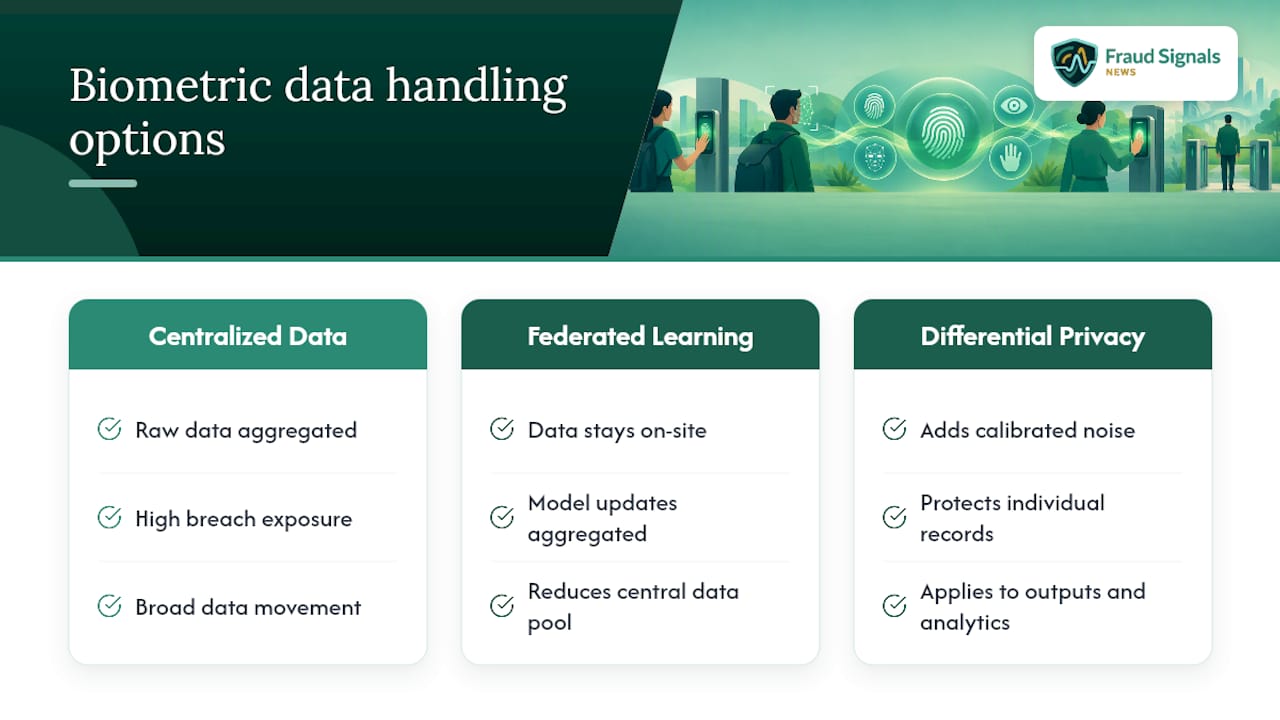
Neither technique replaces the core controls covered earlier: template protection, encryption, and PAD remain mandatory regardless of what privacy-enhancing method sits alongside them. But for organizations running biometric analytics across large user populations, or training models with data drawn from multiple partner institutions, these techniques reduce the volume of raw sensitive data that needs to move or aggregate in the first place. Evaluate vendor claims about federated learning or differential privacy the same way you evaluate PAD claims: ask for the specific implementation, not the marketing label, since the term “privacy-preserving” gets applied loosely across the industry.
User education and transparency about biometric usage
Clear disclosure at the point of collection is not just a regulatory checkbox, it is the mechanism that builds the trust your fraud program depends on. The FTC’s enforcement history makes clear that ambiguous or buried notices increase enforcement exposure, and the same clarity that satisfies a regulator also satisfies a customer who wants to understand what happens to their face scan or fingerprint.
Effective transparency separates the biometric disclosure from the general privacy policy, states the specific purpose in plain language, and explains what happens if the individual declines, since biometric authentication should rarely be the only path available. Organizations that offer a clear alternative and explain the tradeoff, faster authentication versus an alternate verification step, see fewer complaints and less regulatory friction than those that make biometric consent feel mandatory.
Internal education matters just as much as external disclosure. Fraud ops staff, customer support teams, and engineers all need a shared, accurate understanding of what the system stores, what it deletes, and what happens during an incident, so that customer-facing answers match the technical reality rather than a marketing simplification.
Where privacy programs go wrong first
Most biometric privacy failures start in the same place: teams treat a face scan or fingerprint like a password, assume weak or untested liveness detection is good enough, retain raw data indefinitely because nobody set a deletion clock, and sign vendor contracts without audit rights. The fix is not complicated. Start with device binding, template protection, and a documented privacy impact assessment before adding anything else, and put real budget behind demographic performance testing and adversarial PAD validation, since those are the two areas vendor claims most often overstate.
— Carlos Ochoa
Resources to put this checklist into practice
Turning this checklist into an operating program takes more detail than a single article can hold. The Identity Verification Upgrade Checklist for Compliance Teams maps directly onto the operational steps above and works well for teams planning a pilot or updating an existing program.

- Read Why Biometrics Reduce Bank Fraud: A 2026 Guide for the fraud-reduction case that justifies the investment.
- Read Why Biometrics Satisfy Compliance Requirements in 2026 for a deeper compliance mapping against current regulatory expectations.
- If you’re weighing biometric payment initiation for hospitality or travel contexts, this overview of payment options in hospitality covers where biometric authentication fits alongside other payment technologies.
If you’re comparing identity verification vendors and want a platform with an established track record on biometric matching, DAON (DAON.com) is worth including in that review alongside your other criteria. Explore news sources for ongoing coverage of the technologies shaping identity verification and fraud prevention.
Sources
Save these directly to your audit evidence folder: NIST SP 800-63B, the FTC biometric policy statement, FFIEC guidance on biometrics, and the GAO review of biometric identification technologies.
- NIST Special Publication 800-63B
- FTC Commission policy statement on biometric information
- FTC enforcement order — Everalbum / Paravision
- GAO review of biometric identification technologies and stakeholder concerns
FAQ
What is biometric data privacy in identity verification?
Biometric data privacy refers to the controls, policies, and technical measures that protect fingerprints, face scans, and other biometric identifiers used in identity verification and fraud prevention systems. It covers minimization, template protection, retention limits, and the consent and disclosure practices described in the FTC’s biometric policy statement.
Can biometric data be used as a single authentication factor?
No. NIST SP 800-63B and FFIEC guidance both specify that biometrics should be combined with a hardware or device-bound factor, particularly for higher-risk transactions. Biometric traits are not secret and can be obtained without consent, which makes standalone reliance on them a security risk.
How long should organizations retain biometric templates?
Retention should be based on a documented purpose and risk level rather than a fixed industry standard, with automatic deletion once that purpose is fulfilled. NIST’s privacy guidance recommends limiting retention and documenting the rationale as part of the privacy risk assessment.
What should a biometric vendor contract require?
At minimum, contracts should specify permitted uses, deletion obligations with defined timelines, data ownership, breach notification deadlines, and standing audit rights over the vendor’s practices. The FTC’s order against Everalbum and Paravision shows that deletion deadlines apply to data derived from biometrics, not just the raw samples themselves.
Does GDPR or CCPA cover biometric identifiers differently than other personal data?
Yes. The GDPR treats biometric data used for unique identification as a special category requiring explicit consent or another specific legal basis, while the CCPA classifies it as sensitive personal information with added disclosure and use-limitation requirements. Organizations operating across jurisdictions typically build their program to the strictest applicable standard rather than maintaining separate compliance tracks for each law.
Recommended

Fraud Teams: NIST Aligned VPN Detection for Onboarding, Score First

Liveness Detection Spoofing: Standards Aligned Defenses for Engineers