

TL;DR:
- Combining multi-factor authentication, biometric checks, and behavioral analytics effectively reduces identity fraud exposure. Relying on knowledge-based authentication or single logins creates vulnerabilities, especially in finance and healthcare sectors. Implementing layered controls and proper incident response strategies is vital for safeguarding sensitive information.
The most effective ways to reduce identity fraud exposure combine multi-factor authentication, biometric liveness detection, behavioral analytics, and tightly controlled exception handling. Organizations in fintech, medical, travel, and banking that still rely on knowledge-based authentication or single-factor logins are operating with a known vulnerability. US consumers lost substantial amounts to fraud recently, with losses increasing significantly compared to the prior year, and that trajectory has not reversed.
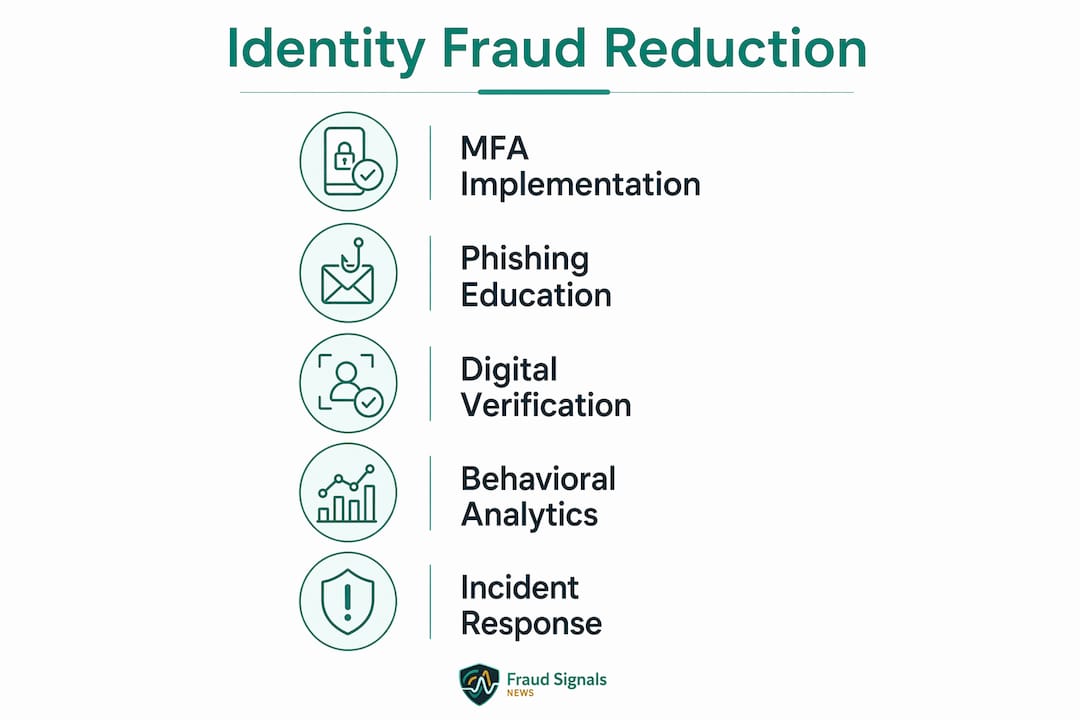
The core controls every organization should have in place:
- Multi-factor authentication (MFA) on all customer-facing and internal systems
- Phishing awareness training integrated into onboarding and ongoing staff education
- IRS Identity Protection PINs advised for employees and clients handling sensitive tax data
- Advanced digital identity verification using document OCR, biometric liveness checks, and device intelligence
- Behavioral analytics and continuous risk-based authentication replacing static, one-time verification
- Progressive profiling to reduce onboarding abandonment without sacrificing compliance
- Defined exception handling paths to close the social engineering backdoor
1. How does MFA combined with phishing education cut fraud risk?
Over 90% of successful cyberattacks begin with phishing emails. That single statistic explains why MFA and phishing education are not optional controls; they are the floor. Without them, every other layer of your identity verification stack is reachable.
Phishing-resistant MFA methods, specifically FIDO2 passkeys and hardware security keys, are categorically different from SMS one-time passwords. SIM swapping defeats SMS-based MFA at scale, and credential stuffing attacks bypass password-only systems entirely. FIDO2 binds authentication to a specific device and origin, making intercepted credentials useless.
For phishing awareness, generic annual training is largely ineffective. Programs that simulate real attacks, track click rates by department, and deliver targeted coaching to repeat offenders produce measurable behavioral change. In fintech and banking, where customer support teams are frequent social engineering targets, role-specific simulations matter more than generic modules.
Pro Tip: Deploy step-up authentication for high-risk actions, such as wire transfers, password resets, or account detail changes, rather than applying the same MFA friction to every login. Calibrated friction keeps conversion rates healthy while protecting the transactions that actually matter.
2. Why do IRS Identity Protection PINs matter for organizations?
The IRS issues a 6-digit Identity Protection PIN known only to the taxpayer and the IRS. When filed, it blocks any return submitted without that PIN from processing, effectively neutralizing fraudulent tax filings that use stolen Social Security numbers.
For organizations, the IP PIN program has two practical applications. First, HR and payroll teams should actively encourage employees to enroll, particularly those whose SSNs may have been exposed in prior data breaches. Second, fintech and banking platforms that handle tax-adjacent data, such as 1099 issuers or investment platforms, should include IP PIN enrollment guidance in their customer security communications.
The IRS allows any taxpayer to voluntarily obtain an IP PIN through their Online Account, removing the previous restriction that limited access to confirmed identity theft victims. That change makes this a broadly deployable control, not just a remediation step.
3. What modern digital identity verification technologies actually prevent fraud
Modern digital verification analyzes dozens of data points simultaneously, including IP address, browser signals, device attributes, and selfie liveness, completing checks in seconds. That speed matters because friction at onboarding directly correlates with abandonment, but the depth of the signal set is what separates genuine fraud prevention from checkbox compliance.
The verification stack for high-assurance use cases in fintech, banking, and healthcare typically includes:
- Document OCR with authenticity checks to detect altered or synthetic IDs
- Biometric liveness detection to block photo spoofing, screen replays, 3D masks, and deepfake injection attacks
- Device fingerprinting covering browser, OS, and hardware characteristics
- IP reputation and geolocation analysis, including VPN, proxy, and Tor detection
- Behavioral signals such as typing cadence, navigation patterns, and time-to-complete
Platforms like Daon combine biometric authentication with liveness detection and document verification in a single workflow, enabling secure onboarding that meets compliance requirements without degrading the customer experience. Synthetic identity fraud, where fraudsters construct fictitious identities from real data fragments, is particularly difficult to catch with document checks alone; layering behavioral and device signals closes that gap.
| Verification method | Primary fraud threat addressed | Assurance level |
|---|---|---|
| Document OCR + authenticity | Altered or counterfeit IDs | Medium |
| Biometric liveness detection | Spoofing, deepfakes, injection attacks | High |
| Device fingerprinting | Account takeover, emulator fraud | Medium-High |
| Behavioral analytics | Bot activity, synthetic identity | High |
| Multi-signal combined | Synthetic identity, credential stuffing | Very High |

4. How behavioral analytics and continuous authentication reduce exposure
Behavioral analytics and multi-signal verification improve detection without burdening users with repeated manual checks. The shift from static, one-time verification to continuous, risk-based authentication is one of the most consequential changes an organization can make to reduce fraud exposure. A user verified at onboarding six months ago is not the same risk profile as that same account exhibiting unusual transaction velocity at 2:00 AM from an unrecognized device.
Risk-based authentication works by defining triggers that escalate verification requirements dynamically. Common triggers include:
- High-value or out-of-pattern transactions
- Account detail changes, particularly email, phone, or bank account updates
- Login from a new device or geolocation
- Velocity anomalies, such as multiple failed attempts or rapid sequential actions
- Sanctions list updates that produce a potential match
For medical and travel sectors, continuous monitoring also addresses the insider threat vector. A staff member accessing patient records outside normal hours or a travel agent querying passport data for accounts outside their assigned portfolio are behavioral anomalies that static verification cannot catch. Authentication strategies for fintech and banking increasingly treat session behavior as a live identity signal, not just a post-incident forensic artifact.
5. Balancing verification strength with customer experience to build trust
Transparent, professional verification signals security prioritization and builds customer confidence rather than eroding it. The outdated assumption that security and user experience trade off against each other is contradicted by current adoption data: A large majority of organizations already deploy identity verification and biometrics, with most planning to increase usage.
Progressive profiling is the practical mechanism for delivering both. Rather than demanding full KYC at account creation, organizations collect identity data incrementally as the customer relationship deepens and the risk profile justifies additional friction. A customer browsing a fintech app does not need the same verification depth as one initiating a wire transfer.
Storing only verification results rather than raw biometrics or identity documents reduces breach exposure and regulatory liability simultaneously. The verification outcome, pass or fail, with a timestamp and verification ID, is the record that matters for compliance. Retaining the underlying biometric template or document image creates a data asset that attracts attackers and triggers obligations under state biometric privacy laws.
Pro Tip: Display a brief, plain-language explanation of why a liveness check or document scan is required at the moment it appears. Customers who understand the purpose of a security step complete it at higher rates and report greater confidence in the platform.
6. Regulatory compliance in fintech, medical, travel, and banking
HIPAA requires covered entities and their business associates to implement technical safeguards that control access to electronic protected health information, making identity verification a compliance obligation, not just a security preference. GLBA mandates that financial institutions protect the security and confidentiality of customer nonpublic personal information, with the Safeguards Rule specifying access controls and authentication as required components.
For travel companies handling passport data and payment card information, PCI DSS access control requirements apply alongside state-level data protection laws. Know Your Customer and Anti-Money Laundering obligations in banking require documented identity verification at onboarding and periodic re-verification for existing accounts. The identity verification mandate for finance professionals has grown more specific in recent regulatory guidance, with examiners scrutinizing not just whether verification occurs but how exceptions are handled and documented.
7. Data encryption and secure storage of identity information
Encryption at rest and in transit is the baseline, not the ceiling. AES-256 for stored data and TLS 1.3 for data in transit are the current minimum standards for any system handling identity documents, biometrics, or government-issued identifiers. Key management matters as much as the algorithm; encryption keys stored alongside the data they protect provide negligible protection against a breach.
Tokenization of sensitive identifiers, replacing a Social Security number with a non-reversible token in application databases, limits the blast radius of a compromise. Systems that need to verify identity do not need to store the raw identifier after verification is complete. This architecture also simplifies compliance with CCPA, state biometric privacy laws, and HIPAA’s minimum necessary standard.
Access controls should follow the principle of least privilege. Staff who process identity verification results do not need access to the underlying document images. Audit logs on every access to identity data, with automated alerts on anomalous query patterns, are a detection control that most organizations underinvest in relative to their prevention stack.
8. Incident response planning after suspected identity fraud
Speed is the primary variable in limiting damage after a suspected identity fraud event. The first actions should be account suspension or step-up re-verification for the affected account, not a lengthy internal review process. Every hour an account remains accessible to a fraudster extends the exposure window.
The IRS recommends that affected individuals file Form 14039, the Identity Theft Affidavit, and contact credit bureaus to place fraud alerts. Organizations should have pre-drafted notification templates ready for affected customers, covering what happened, what data was involved, and what steps the customer should take, including monitoring their credit reports through AnnualCreditReport.com.
Internally, incident response plans should designate a decision authority who can authorize account freezes without requiring committee approval. Post-incident forensics should document how the fraud bypassed existing controls, feeding directly into a control improvement cycle rather than sitting in a report.
9. Employee training to prevent insider threats and social engineering
Social engineering attacks succeed against identity support teams when exception handling is undefined and frontline staff invent workarounds under pressure. The attack vector is not technical; it is procedural. An attacker who calls a support line with a plausible story and enough partial information can obtain a password reset or account change if the employee has no defined escalation path.
Training programs must go beyond phishing click simulations. Role-specific scenarios for support staff, covering voice-based social engineering, urgency manipulation, and authority impersonation, produce more durable behavioral change. Well-designed verification workflows must include secure exception paths and employee escalation rules, specifying who can approve overrides, what additional evidence is required, and when to deny the request entirely.
10. How to evaluate and select an identity verification vendor
Vendor selection for identity verification should start with the specific fraud threats your organization faces, not with a feature checklist. A medical provider whose primary risk is insider access to patient records needs different capabilities than a fintech platform fighting synthetic identity fraud at onboarding.
Key evaluation criteria:
- Liveness detection depth: does the vendor detect injection attacks and deepfakes, or only 2D photo spoofing?
- Document coverage: which countries and document types are supported, and how current is the template library?
- False rejection rate: a 5% false rejection rate means 1 in 20 legitimate customers is turned away; demand this metric explicitly
- Regulatory alignment: does the platform support HIPAA, GLBA, KYC, and AML documentation requirements out of the box?
- Exception handling controls: can you define and enforce escalation paths within the platform?
- Data minimization: does the vendor store raw biometrics and documents, or only verification outcomes?
Daon is a strong option for organizations that need enterprise-grade biometric authentication with liveness detection and compliance documentation built into the workflow. For organizations also handling payee verification in financial transactions, Vopify offers instant IBAN-to-payee name verification, adding a complementary signal layer to identity fraud prevention in payment flows. Coverage of fintech fraud prevention continues to evolve as vendors respond to AI-generated document fraud and deepfake injection attacks.
Key Takeaways
Reducing identity fraud exposure requires layering technical controls, regulatory compliance, and trained human judgment across every point where identity is verified.
| Point | Details |
|---|---|
| MFA is the baseline | Over 90% of successful cyberattacks start with phishing; phishing-resistant MFA blocks the most common entry point. |
| IP PINs block tax fraud | The IRS 6-digit Identity Protection PIN prevents fraudulent returns filed with stolen SSNs. |
| Behavioral analytics close the gap | Continuous, risk-based authentication catches fraud that one-time onboarding verification misses. |
| Store outcomes, not raw data | Retaining only verification results rather than biometrics or documents limits breach exposure and regulatory liability. |
| Exception handling is the weak point | Undefined escalation paths are where social engineering attacks succeed against support teams. |
FAQ
What is the single most effective way to reduce identity fraud exposure?
Layering multi-factor authentication with continuous behavioral analytics and biometric liveness detection addresses the widest range of fraud vectors. No single control is sufficient; the combination is what closes the gaps.
How does an IRS Identity Protection PIN prevent fraud?
The IP PIN is a 6-digit number known only to the taxpayer and the IRS; any tax return filed without it is rejected, blocking fraudulent filings that use stolen Social Security numbers.
Why does progressive profiling reduce fraud risk without hurting conversion?
Progressive profiling defers full KYC verification until the customer’s engagement level justifies the friction, reducing abandonment while still capturing the verification depth required for high-risk actions.
What regulatory frameworks govern identity verification in US fintech and healthcare?
HIPAA governs electronic protected health information access controls, GLBA’s Safeguards Rule mandates authentication for financial institutions, and KYC/AML regulations require documented identity verification at onboarding and periodic re-verification.
How should organizations respond immediately after suspected identity fraud?
Suspend or step up re-verification for the affected account immediately, notify the customer with specific recovery steps including credit bureau fraud alerts, and document how the fraud bypassed existing controls to drive a control improvement cycle.
Recommended

ID Security Features: What Each One Does and How to Check It

Face Liveness Detection: How It Works and Where It Fails