

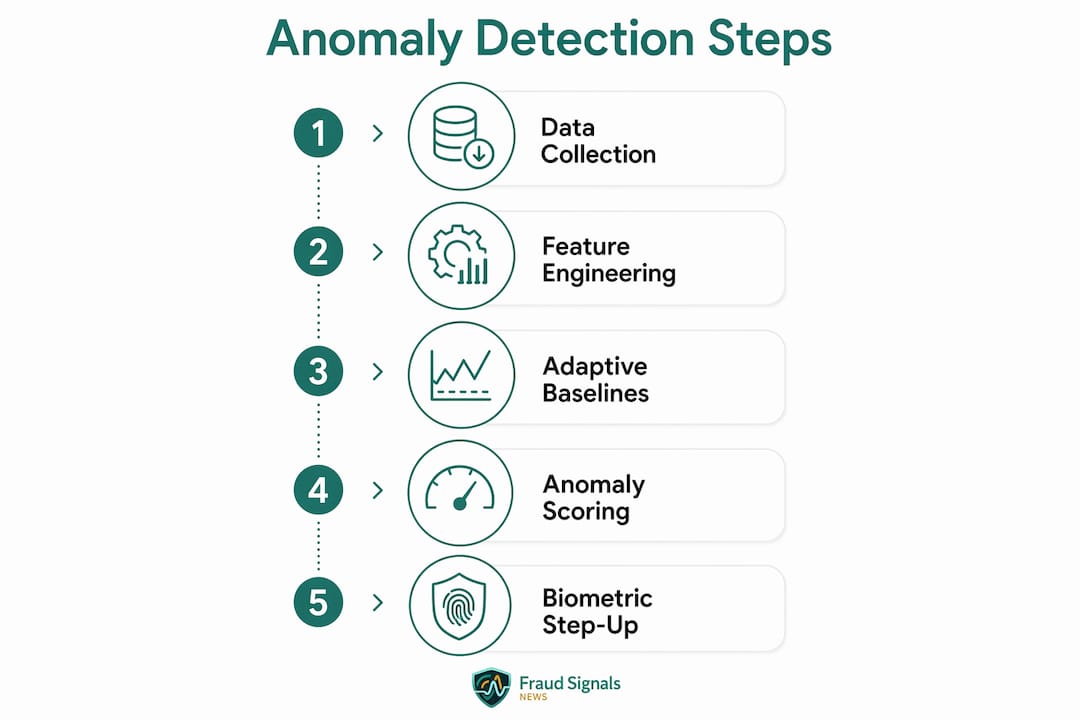
Anomaly detection prevents fraud by building adaptive behavioral baselines for every account and cohort, scoring deviations in real time, and triggering graduated responses: allow, step-up biometric verification, hold, or block. Unlike static rule sets that fail the moment a fraudster adapts, adaptive anomaly models continuously reanalyze signals to generate precision-led risk scores while minimizing PII exposure. The FTC and CCPA both impose obligations on how those signals are collected and retained, which means governance is not an afterthought.
The core mechanisms organizations must deploy:
- Adaptive baselines per account and cohort, updated with streaming data
- Multi-signal feature sets: device fingerprint, behavioral biometrics, transaction velocity, geolocation, IP reputation, and account history
- Real-time risk scoring within authorization windows (millisecond-scale decisions)
- Graduated responses: automated allow/challenge, step-up to liveness or face-match checks, and human escalation for high-value cases
- Feedback loops: labeled outcomes from investigations fed back into model retraining
Table of Contents
- How does anomaly detection actually work in fraud systems?
- Why anomaly detection outperforms static rule-based systems
- How anomaly detection complements biometric identity verification
- Designing a hybrid anomaly-detection system
- Evaluation metrics and testing methodology
- Privacy, bias, and U.S. compliance considerations
- Deployment checklist, timeline, and cost drivers
- How to monitor models and respond to fraud spikes
- Key Takeaways
- The case for treating anomaly detection as infrastructure, not a feature
- FAQ
- Useful sources and further reading
How does anomaly detection actually work in fraud systems?
The shift from rule-based logic to anomaly detection is a shift in the fundamental question being asked. Static rules ask: “Does this match a known bad pattern?” Anomaly detection asks: “Does this fit expected behavior for this account or cohort?” That reframing is what makes it effective against novel attacks.
Model families and when to use each:
- Unsupervised models (isolation forests, autoencoders, clustering): detect previously unseen fraud without labeled training data; autoencoders flag high reconstruction error on unusual login patterns as anomalies. Use these when labeled fraud data is scarce or when you need to catch zero-day attack patterns.
- Supervised classifiers: trained on labeled fraud and legitimate samples; higher precision when fraud patterns are well-documented. Use when you have sufficient labeled history.
- Semi-supervised approaches: combine automated feature learning with human-labeled anchors; generally the most accurate in production because they constrain what the model learns.
Feature engineering is often the deciding factor in model performance. Device fingerprints, velocity metrics, and geolocation changes are the signals that separate high-performing systems from mediocre ones. No model architecture compensates for noisy or missing inputs.
Adaptive baselines use sliding windows and per-account or cohort profiles that update with each new transaction. A login at 3 AM from a new device in a different state is not inherently fraudulent, but it deviates from an established baseline and warrants a higher risk score. Risk scores are produced in milliseconds using hundreds of real-time data points, which is the only way to fit inside a card authorization window.
Why anomaly detection outperforms static rule-based systems
Static rules are obsolete the moment a fraud ring reverse-engineers them. They require constant manual updates, generate high false-positive rates on legitimate edge cases, and are entirely blind to coordinated attacks that stay just below every threshold. Legacy rule-based systems fail precisely because they cannot adapt to the cat-and-mouse dynamic of modern fraud.
Anomaly detection’s practical advantages:
- Adaptivity: models update continuously, catching novel tactics without a rule-change cycle
- Early detection: deviations from baseline surface before a fraud pattern is fully documented
- Fewer false declines: AI distinguishes legitimate behavior from fraud, reducing customer friction compared with static thresholds
- Lower operational cost: less manual rule tuning; investigations focus on genuine anomalies
The business impact is concrete. Visa’s Decision Manager screened 3.2 billion transactions in 2023 and prevented an estimated $33 billion in potential fraud losses, with 98.7% of transactions processed automatically by AI. Mastercard’s research found that 42% of issuers saved more than $5 million in fraud attempts over two years using AI-driven detection.
The tradeoff is real: unsupervised models can produce false positives without guardrails, require quality labeled data for calibration, and need explainability measures so investigators can act on flagged cases. Those are engineering problems, not reasons to avoid the approach.
How anomaly detection complements biometric identity verification
Anomaly signals should function as decision triggers for biometric checks, not as standalone block/allow switches. The correct architecture is a tiered data flow:
- Anomaly score generated from device, behavioral, and transaction signals
- Decisioning engine applies risk thresholds
- Low risk: allow; medium risk: step-up to biometric challenge; high risk: block or hold for human review
- Biometric verification API called (liveness detection, face match)
- Final decision logged with full signal context
Practitioners should avoid binary block/allow rules driven solely by anomaly output. Return a risk score that triggers tiered actions: step-up biometrics for medium risk, block only for high-confidence anomalies. This preserves customer experience while maintaining strong fraud controls.
DAON is a well-regarded option for integrating biometric step-ups into this decisioning flow. DAON’s platform supports liveness detection and face match via API, making it practical to call a biometric challenge only when the anomaly score warrants it rather than applying friction universally.
Biometric signals that pair well with anomaly detection include liveness checks (defeats presentation attacks and deepfake injection), behavioral biometrics (typing cadence, swipe patterns), and passive device biometrics (sensor fingerprinting). Privacy-by-design requires minimizing the PII sent to scoring models. For deeper context on biometric verification integration, the eKYC coverage at Fraud Signals News covers current vendor and technical options.

API latency SLAs matter here. Biometric verification calls add round-trip time, so the anomaly scoring layer must complete well within the authorization window before the biometric API is invoked.
Designing a hybrid anomaly-detection system
Hybrid ensembles balance detection coverage and operational risk by combining model outputs with deterministic guardrails. No single model type covers every attack surface, and no guardrail set is comprehensive enough to catch novel fraud without a model layer underneath.
Ensemble patterns:
- Parallel unsupervised, supervised, and graph-analysis models, each producing a sub-score
- A meta-model (often a gradient-boosted classifier) that combines sub-scores into a single risk metric
- Guardrails: hard rules for sanctions list hits, velocity caps, and known-bad device identifiers that fire regardless of model output
Escalation workflow:
- Risk score below low threshold: automated allow, log for monitoring
- Risk score in medium band: automated step-up biometric challenge (liveness, face match)
- Risk score in high band: hold transaction, route to human investigator
- Confirmed fraud: block, label, and feed back into retraining pipeline
- Confirmed legitimate: label and use to recalibrate thresholds
Pro Tip: Tune thresholds conservatively during the pilot phase and use progressive relaxation as labeled data accumulates. During the cold-start period, when models lack sufficient history for new users, lean on guardrail rules and phased confidence thresholds rather than model output alone.
The automation and orchestration layer connecting these components is where most production failures occur. Build it with explicit fallback logic.
Evaluation metrics and testing methodology
Measure models by precision, recall, false positive rate (FPR), AUC, and business KPIs. Optimizing for AUC alone without tracking false-decline rate produces systems that look good on paper but damage customer experience.
| Metric | Formula | What It Measures | Operational Target |
|---|---|---|---|
| Precision | TP / (TP + FP) | Fraction of flagged cases that are genuine fraud | 98.7% for automated processing |
Visa’s Decision Manager screened 3.2 billion transactions in 2023 and processed 98.7% of them automatically with AI, preventing an estimated $33 billion in fraud losses. Precision targets for automated blocks should align with this operational benchmark.
| Recall | TP / (TP + FN) | Fraction of actual fraud cases caught | varies depending on risk appetite |
| False Positive Rate | FP / (FP + TN) | Legitimate transactions incorrectly flagged | <1% for payment channels |
| AUC-ROC | Area under ROC curve | Overall discriminative power | — |
| False-Decline Rate | False declines / total legitimate | Customer friction from over-blocking | Track and minimize continuously |
Testing methodology:
- Backtest on a holdout set with temporal separation (train on earlier data, test on later)
- Shadow-mode deployment: run the new model in parallel without acting on its output; compare to production decisions
- A/B experiments on live traffic with statistical significance gates
- Retrospective labeling pipelines: use investigation outcomes to label previously ambiguous cases
Imbalanced datasets are the norm in fraud detection. Use stratified sampling to preserve the fraud-to-legitimate ratio in train/test splits. Apply SMOTE cautiously and only on training data, never on the evaluation set, or you will overestimate recall. Importance-sampling corrects evaluation bias when fraud prevalence is extremely low.
Pre-launch checklist:
- Data quality checks: missing values, feature drift, label leakage
- Labeling sanity: confirm fraud labels are not contaminated by model-influenced decisions
- Latency tests: end-to-end scoring under peak load within authorization window
- Simulated attack tests: replay known fraud patterns and novel synthetic attacks
Privacy, bias, and U.S. compliance considerations
Privacy-by-design, logged model decisions, and regular bias audits are non-negotiable when deploying anomaly detection tied to biometric identity verification. U.S. regulators are paying close attention to automated decision systems, and the enforcement posture is tightening.
U.S. compliance checklist:
- FTC: unfair or deceptive practices authority covers automated decisions that harm consumers; maintain explainable decision logs
- CCPA: California residents have rights to know, delete, and opt out; data minimization and consent flows must be documented
- GLBA: financial institutions must protect consumer financial data used in fraud models
- HIPAA: if health data informs any signal, apply the full HIPAA security rule to that data pipeline
- State biometric laws: Illinois BIPA, Texas CUBI, and Washington’s law impose consent and retention requirements on biometric data collection
For a detailed breakdown of how biometrics satisfy compliance requirements, Fraud Signals News covers the current regulatory landscape.
Bias mitigation steps:
- Cohort-level performance audits: measure precision and recall separately across demographic segments
- Disparate impact testing: flag features that function as proxies for protected classes
- Periodic human review of flagged cases to catch systematic errors the model cannot self-diagnose
Pro Tip: Keep a running model-change log and decision-interpretability artifacts. When a regulator or legal team asks why a specific transaction was blocked, you need a reproducible audit trail, not a black-box score.
This article is general information, not legal or compliance advice. Confirm current regulatory requirements with qualified legal counsel for your specific situation.
Deployment checklist, timeline, and cost drivers
A standard deployment runs from a 6–12 week pilot to a 3–9 month phased rollout, depending on integration complexity and data maturity. Organizations that skip the pilot phase and go straight to production consistently underestimate the cold-start problem and the cost of retroactive labeling.
Deployment checklist:
- Pilot scoping: define success metrics (false-decline rate, fraud catch rate, latency SLA) and select a bounded use case
- Data ingestion and feature pipeline: build or validate the feature store; confirm signal quality
- Model training and shadow-mode deployment: run models without acting on output; collect labeled outcomes
- Phased gating: expand traffic incrementally, validate SLAs at each gate
- Full rollout: decommission legacy rules gradually, not all at once
Primary cost drivers:
- Data engineering and feature store infrastructure
- Compute for model training (batch) and real-time scoring (low-latency inference)
- Commercial licensing or third-party API costs for biometric verification (liveness, face match are per-transaction costs that scale with volume)
- Ongoing labeling and investigation operations: human review is a recurring cost, not a one-time setup
Biometric step-up calls are a material per-transaction cost. Budget for them separately from the anomaly scoring infrastructure, and use risk-tiered triggering to limit calls to medium-and-high-risk transactions only.
Required SLAs when integrating with biometric verification providers: end-to-end scoring latency under 300ms for payment authorization, biometric API availability above 99.9%, and a documented fallback path when the biometric provider is unavailable.
How to monitor models and respond to fraud spikes
Constant monitoring and a rapid incident playbook are what keep detection effective after launch. Model drift is silent and cumulative. Without active monitoring, a model that performed well at launch can degrade significantly within weeks as fraud tactics shift.
Monitoring dashboard KPIs:
- Model score distribution: flag shifts in the mean or variance of output scores
- Feature drift metrics: monitor input signal distributions for unexpected changes
- Input-signal health: alert on missing or degraded data feeds (device fingerprint dropout, geolocation gaps)
- False-positive and false-decline trends: weekly tracking minimum
- Investigator throughput: a backlog in human review is an early warning of threshold miscalibration
Incident playbook:
- Detect anomaly in model behavior (score distribution shift, spike in false positives)
- Isolate the affected cohort or transaction type
- Switch affected traffic to guardrail rules or shadow mode while investigating
- Label incidents from the spike; confirm whether fraud pattern is novel or a data pipeline failure
- Retrain with new labeled data, validate on holdout set, redeploy with staged rollout
Retraining cadence should be weekly to monthly depending on transaction volume and fraud velocity. Automated alerts for signal degradation should fire before human analysts notice the problem. Keep an on-call rotation for fraud operations and a documented runbook for rolling back model changes safely.
Key Takeaways
Anomaly detection prevents fraud most effectively when adaptive models, biometric step-ups, hybrid guardrails, and operational monitoring are deployed as an integrated system rather than independent components.
| Point | Details |
|---|---|
| Run a 6–12 week pilot first | Scope a bounded use case, define success metrics, and run in shadow mode before acting on model output. |
| Integrate anomaly scores with biometric step-ups | Use risk scores to trigger liveness or face-match checks (e.g., DAON) only for medium-to-high-risk events. |
| Deploy hybrid ensembles with guardrails | Combine unsupervised and supervised models with hard rules to cover cold-start gaps and novel attacks. |
| Measure precision, recall, and false-decline rate | AUC alone is insufficient; false-decline rate directly measures customer friction from over-blocking. |
| Build audit trails from day one | Logged model decisions and a model-change log are required for FTC, CCPA, and sector-specific audits. |
The case for treating anomaly detection as infrastructure, not a feature
The organizations that get this wrong treat anomaly detection as a plug-in: deploy a model, set a threshold, and move on. What actually works is treating it as operational infrastructure with the same rigor applied to payment processing or identity storage. That means monitoring, retraining cadence, incident playbooks, and governance built in from the start, not retrofitted after the first fraud spike.
The integration with biometrics is where the real leverage is. An anomaly score without a biometric step-up is a flag with no enforcement mechanism. A biometric check without an anomaly signal is friction applied universally, which destroys conversion rates. The combination, where a risk score decides whether to invoke liveness detection or face match, is what makes the system both accurate and operationally sustainable.
The compliance dimension is underweighted in most technical discussions. Illinois BIPA, CCPA, and the FTC’s expanding posture on automated decisions are not distant risks. They are active enforcement areas, and the organizations building audit trails and bias-testing pipelines now will be far better positioned than those scrambling to reconstruct decision logs after a regulatory inquiry.
FAQ
What is anomaly detection in fraud prevention?
Anomaly detection identifies transactions or behaviors that deviate significantly from an established baseline for an account or cohort, then scores that deviation to trigger an automated response or investigation.
How does anomaly detection differ from rule-based fraud detection?
Rule-based systems match transactions against fixed patterns and miss novel attacks; anomaly detection builds adaptive behavioral baselines that update continuously, catching fraud tactics that no predefined rule covers.
How do anomaly signals trigger biometric verification?
A medium-risk anomaly score routes the session to a biometric step-up (liveness check or face match) via API; only high-confidence anomalies result in an automatic block, preserving customer experience for legitimate users.
What metrics should teams use to evaluate fraud detection models?
Precision, recall, false positive rate, AUC-ROC, and false-decline rate are the core metrics; false-decline rate is the most direct measure of customer friction caused by over-blocking.
How long does it take to deploy an anomaly detection system?
A standard deployment runs from a 6–12 week pilot to a 3–9 month phased rollout, depending on data maturity and integration complexity with existing identity and biometric verification systems.
Useful sources and further reading
- Rethinking fraud prevention with adaptive anomaly detection: covers how adaptive models minimize PII exposure while generating precision-led risk scores; useful for teams building privacy-by-design pipelines.
- AI solutions for fraud prevention and detection (Visa): documents real-world scale and business impact of AI risk engines, including the 3.2 billion transaction figure and feature engineering guidance.
- Online payment fraud: from anomaly detection to risk management (Springer): peer-reviewed study linking anomaly detection output to economic risk optimization; essential reading for teams building triage models.
- AI is helping banks save millions (Mastercard): quantifies ROI from AI fraud detection across issuers and acquirers; useful for building the business case internally.
- Anomaly detection in machine learning (IBM): accessible primer on supervised, unsupervised, and semi-supervised approaches; good for onboarding product managers and analysts.
- Machine learning fraud detection guide (Fraud Signals News): technical guide to ML model choices and production considerations for financial teams.
- Why biometrics reduce bank fraud (Fraud Signals News): evidence and deployment examples for biometric effectiveness in banking; relevant for integration planning.
- Compliance coverage (Fraud Signals News): ongoing coverage of U.S. regulatory developments affecting identity verification and fraud detection systems.
Recommended

Fraud Teams: NIST Aligned VPN Detection for Onboarding, Score First

Prevent a Biometric Breach: 6 Operational Controls for Identity Teams