

Patient identity verification now demands more than a driver’s license and a birthdate. The strongest approach layers document authentication, biometric liveness checks, and authoritative data lookups against a single record, calibrated to the assurance level HL7 and NIST 800-63 assign to that encounter. Follow HIPAA’s documentation rules alongside these frameworks. Layering matters because deepfakes and synthetic identities now defeat single-factor checks at scale, in person and over telehealth alike.
TL;DR:
- Combining document verification, biometric liveness checks, and authoritative data lookups is essential for high assurance levels, especially in remote or high-risk encounters.
- In-person registration should include a visual ID comparison, automated document checks, and logging verification details to meet compliance and audit requirements.
- Telehealth verification requires capturing ID images, conducting real-time liveness tests, and linking identities securely to prevent sharing or reuse of session links.
- Fraud detection now relies on layered evidence, proactive device fingerprinting, anomaly monitoring, and advanced AI-driven techniques to combat deepfake and synthetic identity threats.
- Verification procedures must be tailored to risk, mapping clinical actions to assurance tiers, and maintaining detailed audit trails to ensure compliance and effective breach response.
Table of Contents
- Core Patient Identity Verification Methods You Need to Know
- What Identity Assurance Level Does Each Encounter Need?
- How Do You Verify Identity for In-Person and Telehealth Visits?
- Fraud Risks Facing Healthcare Identity Today
- Why Knowledge-Based Verification Falls Short Alone
- Audit Trails and Breach Reporting Obligations
- How to Evaluate Patient Identity Verification Technology
- The Signals Fraud Teams Are Watching Now
- What I Learned Rolling Out Identity Checks in Clinical Settings
- Stay Ahead of Identity Fraud Trends With Fraud Signals News
- Sources
- FAQ
Core Patient Identity Verification Methods You Need to Know
Most healthcare organizations still run on a two-identifier check: full legal name plus date of birth, sometimes cross-referenced against an address on file. UConn Health’s compliance guidance treats this pairing as the baseline before any patient information gets used or disclosed. It works for routine, low-risk encounters, a returning patient checking in for a scheduled follow-up, but it fails the moment someone else knows those two facts, which is not hard given how much personal data circulates after a breach.
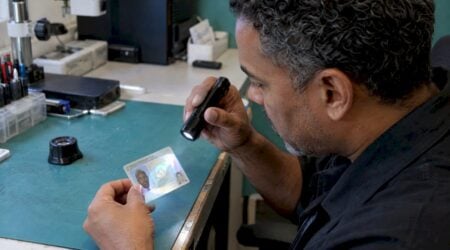
Document verification adds a physical anchor. Front desk staff or automated scanners check a driver’s license, passport, or state ID for security features, hologram integrity, font consistency, and matching data fields. Automated document checks catch forgeries faster than a human eye, but they still stumble on expired IDs, damaged documents, and the fact that a stolen but genuine ID passes every test.
Biometric methods close that gap. Face matching, fingerprint capture, and iris scanning tie the person physically present to a credential, and modern systems pair face matching with active or passive liveness detection to block photo and video spoofing. Anti-spoofing matters more in 2026 than it did even two years ago: video injection and deepfake overlays targeting webcams have moved from proof-of-concept to commodity fraud tooling.
Digital identity verification, or eKYC, borrows heavily from banking. It cross-references submitted data against authoritative sources, credit bureaus, government databases, mobile carrier records, to confirm a person’s data trail is real and consistent. A peer-reviewed review of patient identification techniques found no single method covers every population well; referential matching alone can exclude patients with thin data files, while biometrics alone can exclude patients with certain disabilities or degraded scan conditions.
The fix is combination, not selection:
- Pair a two-identifier check with document verification for walk-in registration.
- Add face-match liveness for any remote or unsupervised encounter.
- Layer eKYC referential checks when the stakes are prescribing, record release, or high-value claims.
- Reserve biometric-only shortcuts for returning, previously verified patients.
What Identity Assurance Level Does Each Encounter Need?
HL7’s Guidance on Identity Assurance maps identity proofing to concrete assurance tiers, built on NIST 800-63 conformance, so organizations stop guessing how much verification is “enough.” IDIAL1 tiers accept weaker evidence, self-attested demographics, a single document, appropriate for low-risk portal signups. IDIAL2 demands strong evidence: a government photo ID compared against a live selfie, plus a check against an authoritative source confirming the identity exists and matches.
That distinction has teeth in practice. Viewing lab results through a patient portal might reasonably sit at a lower tier. Requesting a controlled-substance prescription, updating billing details, or pulling a full record release should sit at IDIAL2 or equivalent, given the fraud and liability exposure.
By the Numbers: HL7’s guidance explicitly requires organizations to publish their identity-verification policy rather than leave it as internal, undocumented practice, a step that turns assurance-level decisions into something auditors, payers, and regulators can actually inspect.
Evidence that satisfies IAL2 for remote proofing typically includes:
- A government-issued photo ID captured through document scanning
- A live selfie compared against that ID photo using liveness detection
- A cross-check against an authoritative data source (motor vehicle records, credit bureau, or similar)
- A documented decision trail showing which checks passed and who reviewed exceptions
Mapping clinical actions to assurance tiers, rather than applying one blanket standard, is what keeps friction proportional to risk.
How Do You Verify Identity for In-Person and Telehealth Visits?
In-person registration
- Capture full legal name, date of birth, and current address at check-in, per UConn Health’s baseline guidance.
- Request a government photo ID and visually compare the photo to the person present.
- Run the ID through automated document verification if your front desk has scanning equipment.
- Confirm insurance and demographic data against the existing record, flagging any mismatch for supervisor review.
- Log the verification method used, the outcome, and staff member ID in the record.
Telehealth onboarding
- Capture a photo ID image through the patient’s device camera before the visit link activates.
- Run a liveness check, requiring a live selfie matched against the submitted ID.
- Cross-reference the identity against an authoritative source for an added layer, consistent with telehealth industry guidance on real-time verification.
- Bind the verified identity to the specific session link so it cannot be reused or shared.
- Route any failed match to human review before granting access.
Proxy and representative verification
Parents, guardians, and legal representatives need their own identity confirmed, plus documented proof of authority, custody orders, power of attorney, or guardianship paperwork, retained alongside the encounter record.
Exception handling
Patients without ID still need care. Emergency treatment proceeds under standard EMTALA obligations regardless of verification status; document the exception, verify retroactively when possible, and never let a verification gap delay urgent treatment.
Pro Tip: Script the front-desk verification conversation word for word. Ambiguous phrasing like “can I see some ID?” gets waved off far more often than a direct, policy-backed request tied to a specific reason (“I need to confirm your identity before releasing test results”).
Fraud Risks Facing Healthcare Identity Today
Medical identity theft remains the costliest and least visible fraud vector in healthcare, letting criminals obtain treatment, prescriptions, or insurance payouts under someone else’s name, sometimes for years before the victim notices a collections notice or a denied claim. Portal takeover follows a familiar credential-stuffing pattern: reused passwords from unrelated breaches unlock patient portals, exposing records and enabling prescription fraud directly.
Telehealth introduces a newer, harder problem. Passive liveness detection, designed to catch printed photos or replayed video, increasingly struggles against real-time deepfake overlays and injected video feeds that never touch a physical camera. A system checking only “is this a live human” can pass a fabricated face if the injection happens before the liveness check ever runs.
Defenses need to operate on multiple planes at once:
- Active liveness challenges (blink, turn, speak a random phrase) that are harder to fake in real time
- Device intelligence flagging virtual cameras, emulators, or known fraud devices
- Layered evidence requiring document plus biometric plus authoritative lookup for high-risk actions
- Manual review triggered automatically when confidence scores fall below a defined threshold
Pro Tip: Set your review threshold conservatively at first, then tighten it as your fraud team learns what “normal” confidence scores look like for your patient population. A threshold copied from another organization’s traffic patterns will misfire.
Continuous anomaly monitoring, watching for velocity spikes in verification attempts or repeated failures from the same device, catches attack patterns that a single transaction review misses. Fraud Signals News tracks these techniques as they evolve across deepfake-driven attacks and broader consumer identity fraud trends.
Why Knowledge-Based Verification Falls Short Alone
Knowledge-based verification, asking a patient to confirm a former address or a old loan amount, sounds like an extra layer of security. It is not a reliable one anymore. So much personal financial history has leaked through prior breaches that fraudsters can often answer KBV questions more accurately than the legitimate patient. HL7’s guidance is direct on this point: KBV should not substitute for photo ID comparison at IAL2 or higher.
Used correctly, KBV resolves narrow edge cases after primary evidence is already collected, not before:
- A document scan that partially fails but otherwise looks legitimate
- A biometric match that returns a borderline confidence score
- A discrepancy between submitted data and an authoritative lookup that needs a tiebreaker
Device checks and authoritative-source lookups make safer supplements than KBV questions, since they verify something a fraudster cannot simply memorize.
Audit Trails and Breach Reporting Obligations
Every verification attempt needs a record: timestamp, evidence type used, pass or fail decision, and the reviewer ID for any manual override. That combination lets an auditor reconstruct exactly why a specific patient encounter was approved.
Retention windows should balance auditability against data minimization, keeping decision metadata and outcome logs while avoiding indefinite storage of raw document images or biometric templates where policy allows.
By the Numbers: HHS breach-reporting guidance requires covered entities to notify affected individuals and, in many cases, HHS itself once a breach involving protected health information is confirmed, a threshold that a failed or manipulated identity check tied to unauthorized PHI access can trigger just as readily as a hacked server.
- Log tamper-evident metadata, not raw images, wherever the workflow allows.
- Package audit evidence for payer or legal review without exposing unrelated PHI fields.
- Treat repeated verification failures on one account as a possible fraud signal worth investigating, not just a support ticket.
How to Evaluate Patient Identity Verification Technology
Vendor selection comes down to a handful of concrete questions, not a features brochure. Ask which assurance levels a platform actually supports out of the box, whether its biometric matching includes active anti-spoofing or only passive liveness, and how broad its document coverage runs across state and international ID formats.
Push for real error-rate data (false accept and false reject rates), not marketing language, and confirm integration paths into your EHR or patient portal before signing anything. Audit trail depth and HIPAA-readiness documentation should be non-negotiable line items in any RFP.
- Does the platform support progressive step-up, starting low-friction and escalating only when risk signals appear?
- What is the human-review fallback path, and how fast does it resolve?
- Where is verification data stored, and does that location meet your compliance requirements?
- What is the true cost per verification at your expected volume?
Platforms like IDENTOS document configurable workflows with human-review fallbacks built into progressive assurance flows, a pattern worth asking any shortlisted vendor to match. A progressive step-up model consistently beats forcing every patient through maximum friction regardless of risk. If you’re comparing platforms outside the healthcare space, DAON is worth including in that review for its identity assurance capabilities.
The Signals Fraud Teams Are Watching Now
Eye-tracking and passive liveness telemetry, technologies that Fraud Signals News covers closely across AI-driven fraud reporting, are moving from banking pilots into healthcare identity stacks because they catch injected and synthetic video feeds that basic liveness checks miss. Device fingerprinting adds another layer, flagging emulators and virtual cameras before they reach a biometric check at all.
These signals do not replace the layered model, they extend it. Synthetic-media detection slots in as one more evidence type alongside document and biometric checks, raising confidence at the exact assurance tier HL7 and NIST define for the encounter type.
Author credentials and case-study proof points for this coverage area, are maintained by Carlos Ochoa.
What I Learned Rolling Out Identity Checks in Clinical Settings
Staff training determines success more than the technology stack does. A perfectly tuned biometric engine still fails if front-desk staff do not know when to escalate a mismatch instead of waving it through under patient pressure.
Exception workflows deserve as much design attention as the happy path. Most verification failures I have seen traced back to a missing decision tree for edge cases, not a flawed algorithm. Start a pilot narrow: one clinic, one telehealth service line, tracked against false-reject rate, staff escalation time, and patient drop-off. Expand only once those three numbers hold steady.
— Carlos Ochoa
Stay Ahead of Identity Fraud Trends With Fraud Signals News
Verification technology changes faster than most compliance calendars can track, which is exactly the gap Fraud Signals News exists to close. Our ongoing coverage tracks vendor capabilities, emerging fraud techniques, and the assurance-level frameworks shaping healthcare identity in real time, so your team is not relying on outdated guidance when a new deepfake technique or synthetic-identity pattern surfaces.

If you are building a vendor shortlist, our breakdown of identity verification alternatives and ongoing fraud exposure reduction guidance give you a starting framework rather than a blank page. Visit Fraud Signals News to track new vendor analysis and fraud-trend reporting as it publishes, and bookmark the hub before your next technology review cycle starts.
Sources
- Guidance on Identity Assurance – Interoperable Digital Identity and Patient Matching v2.0.0
- Patient Identification Techniques – Approaches, Implications, and Findings
- Verifying Patient Identity | Office of Healthcare Compliance & Privacy (UConn Health)
- HHS breach notification / breach reporting guidance
- Revolutionize Patient Onboarding: Real-Time Verification That Delivers & Complies
FAQ
How Do You Verify a Patient’s Identity?
Confirm full legal name and date of birth at minimum, then add a government photo ID check and, for remote or high-risk encounters, a biometric liveness check plus an authoritative data lookup.
What Are the Patient Identifiers?
The commonly referenced list includes name, address, dates (birth, admission, discharge), phone and fax numbers, email, Social Security number, medical record number, health plan number, account number, certificate or license number, vehicle identifiers, device identifiers, URLs, IP addresses, biometric identifiers, full-face photos, and any other unique identifying number or code, drawn from HIPAA’s PHI identifier categories.
What Is the Procedure for Identity Verification?
Capture identifying information, compare it against a government ID and, where warranted, biometric evidence, cross-check against an authoritative source, then log the decision and evidence type in an auditable record.
How Many Ways Should a Caregiver Verify a Patient’s Identity?
At least two independent methods, typically a demographic check plus a document or biometric check, with a third layer (authoritative lookup) added for prescribing, record release, or other high-assurance actions.
Recommended
ID Security Features: What Each One Does and How to Check It

Face Liveness Detection: How It Works and Where It Fails