In identity verification, a proof of life video is a short live capture that shows a real person is present and alive at the moment of a transaction, not a photo, a replayed recording or a synthetic face. For a fraud risk team the useful question is not whether to use one but how to design it so a replayed or injected stream cannot pass. This guide explains what the check verifies, how active and passive versions differ, what U.S. regulators and the Department of Homeland Security have said about them, and where the control breaks.
TL;DR
- Proof of life is a liveness check. It confirms a person is present now, which is a different question from whether the face matches an ID.
- FinCEN names live audio or video verification as a best practice against deepfake identity documents, alongside phishing-resistant multifactor authentication.
- The weak point is the capture path, not the face. Virtual webcams and injected streams can feed prerecorded or synthetic video to a check that only looks at the picture.
- Vendor performance varies enormously. Independent testing has shown attack-acceptance rates anywhere from 0% to 100% across systems, so measured results matter more than the label.
- Design for the whole flow: capture integrity, active or passive signals, document match and a fallback path for legitimate users.
Table of Contents
- What “proof of life” means in digital identity verification
- What a proof of life video actually checks
- Why regulators now point to live verification
- What the fraud looks like downstream
- Where proof of life video breaks
- How to design a proof of life step that holds up
- Beyond banking
- What we recommend
- Perspective
- Keep reading on Fraud Signals News
- FAQ
- Sources
What “proof of life” means in digital identity verification
The phrase has two lives. In pensions, insurance and benefits it historically meant proving a recipient is still alive so payments continue. In digital identity it has become a synonym for liveness detection. A professional association for payment and identity security describes proof of life as a biometric process that confirms a person is alive at the time of a transaction, rather than present only in a pre-recorded image or video. Brazil’s government identity-validation service documents the same equivalence, noting that liveness is also called Proof of Life or Proof of Liveness.
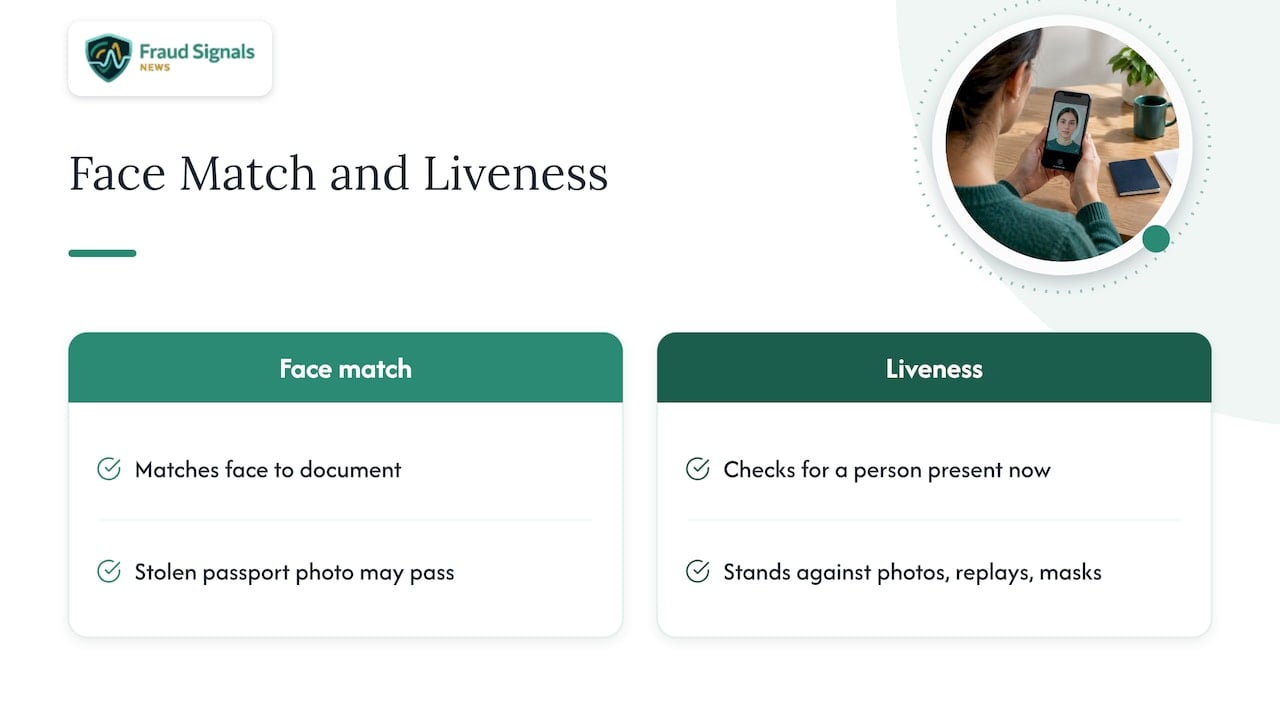
The distinction matters operationally. A face match answers “does this face resemble the one on the document?” Liveness answers “is a living person in front of the camera right now?” A fraudster holding a stolen passport photo can pass the first question easily. Only the second one stands in the way of a printed photo, a screen replay or a mask.
What a proof of life video actually checks
A proof of life video is a short capture, usually a few seconds, in which the system analyzes multiple frames instead of one still. Frames in motion carry far more evidence than a single photo: skin texture, light reflection, depth cues, blinking, head movement and consistency between frames. That is why selfie video generally gives a risk engine more to work with than a single image.
There are two common designs, and the same association describes both:
- Active proof of life. The user is asked to do something: turn the head, blink, smile or follow a moving dot. The system checks that the response is natural and timed to the prompt.
- Passive liveness. The user simply looks at the camera. The system looks for signs of a living subject, such as light reflecting off skin, with no user action required.
Both are forms of presentation attack detection, meaning the detection of attempts to fool the camera with a photo, a video, a mask or another instrument. Brazil’s official documentation lists the standard attack classes: print attacks, replay attacks on a screen, and 3D and 2D mask attacks. If you want the engineering view of how face liveness works and fails, our piece on face liveness detection goes deeper.
Active versus passive: the practical trade-off
| Factor | Active proof of life | Passive liveness |
|---|---|---|
| User effort | Must follow prompts | None beyond looking at the camera |
| Friction and drop-off | Higher, especially on poor connections | Lower |
| Resistance to simple replay | Prompts can be randomized, so a fixed recording fails | Relies on image analysis alone |
| Exposure to real-time synthetic responses | Attackers can respond to prompts with generated video | Attackers target the pixel signals directly |
| Accessibility | Harder for users with limited mobility or vision | Generally easier |
Neither design is sufficient on its own. The choice should follow the risk of the transaction: a high-value account opening or a payment limit increase justifies more friction than a routine login.
Why regulators now point to live verification
The U.S. government position is unusually explicit. In its alert FIN-2024-Alert004, issued November 13, 2024, FinCEN warns that criminals use generative AI to create deepfake identity documents, images, video and audio to defeat identity verification. It recommends live verification checks, in which a customer confirms identity through audio or video, as a best practice for institutions covered by the Bank Secrecy Act, together with phishing-resistant multifactor authentication.
The same alert gives a fraud team three useful operational details:
- Verification tools may flag third-party webcam plugins that show previously generated video instead of a live feed.
- Synthetic responses to live prompts may reveal inconsistencies in a deepfake identity.
- Criminals may still answer prompts using tools that generate synthetic audio and video, and may claim technical glitches or ask to switch communication channels to avoid the check.
That last point is worth putting in your analyst playbook. A customer who suddenly cannot complete a video check but is eager to move to a channel with weaker controls is a signal, not an inconvenience.
The broader interagency guidance reaches the same place. An NSA, FBI and CISA information sheet from September 2023 states that identity verification for real-time communications will now require testing for liveness, given rapid progress in generative AI and real-time rendering. It also separates detection from authentication. Detection methods are often passive forensic techniques applied after the fact, while authentication methods such as digital watermarking, active signals in real-time capture and cryptographic hashing on the device are embedded at capture to establish provenance. For a bank, that is the difference between finding a fake after the account is open and refusing to trust the capture in the first place.
For the compliance side of the same pressure, see how U.S. banks are preparing for FinCEN customer due diligence verification under the 2026 relief.
What the fraud looks like downstream
FinCEN’s reporting ties deepfake identities to fraudulent accounts used to funnel proceeds from check, credit card, authorized push payment, loan and unemployment fraud. The account is the tool, and the victims are elsewhere. People who lose money through investment and romance scams often need to understand what happens next; a practical read on FBI help after pig butchering crypto scams covers the warning signs institutions see and the steps victims take quickly. For your own team, our explainer on false identity bank accounts shows how the mule-account pipeline starts at onboarding.
Where proof of life video breaks
1. The capture path is compromised
A liveness model judges what it receives. If an attacker uses a virtual camera or injects a stream between the sensor and the application, the model may be analyzing a perfect synthetic video of a live person. This is why controls at the device and SDK layer matter as much as the model. We lay out the defensive pattern in stopping replay and injection fraud and in fixing capture integrity to stop deepfake ID fraud.
2. Real-time deepfakes respond to prompts
Active checks assume an attacker cannot generate a convincing reaction on demand. FinCEN itself notes that illicit actors may still respond to prompts using generative tools. Randomized, multi-step prompts raise the cost but do not end the problem.
3. Every component of the video is a surface
A 2026 video-authentication guide from a professional forensic association states that verifying a clip requires verifying three components: video streams, image frames, and voice or audio files. It also notes that deepfake software can superimpose a face onto another body or imitate a voice in step with altered lip movements. A check that scrutinizes the face and ignores the audio leaves a gap.
4. Provenance beats pixel inspection
Researchers at Northwestern’s Kellogg School describe video as sitting on a continuum from real to edited to fabricated, and argue for a context-based approach that analyzes the file’s construction history rather than inspecting pixels alone. For identity teams, the lesson is to collect metadata and device signals around the capture, not just the image.
5. Systems differ widely in measured performance
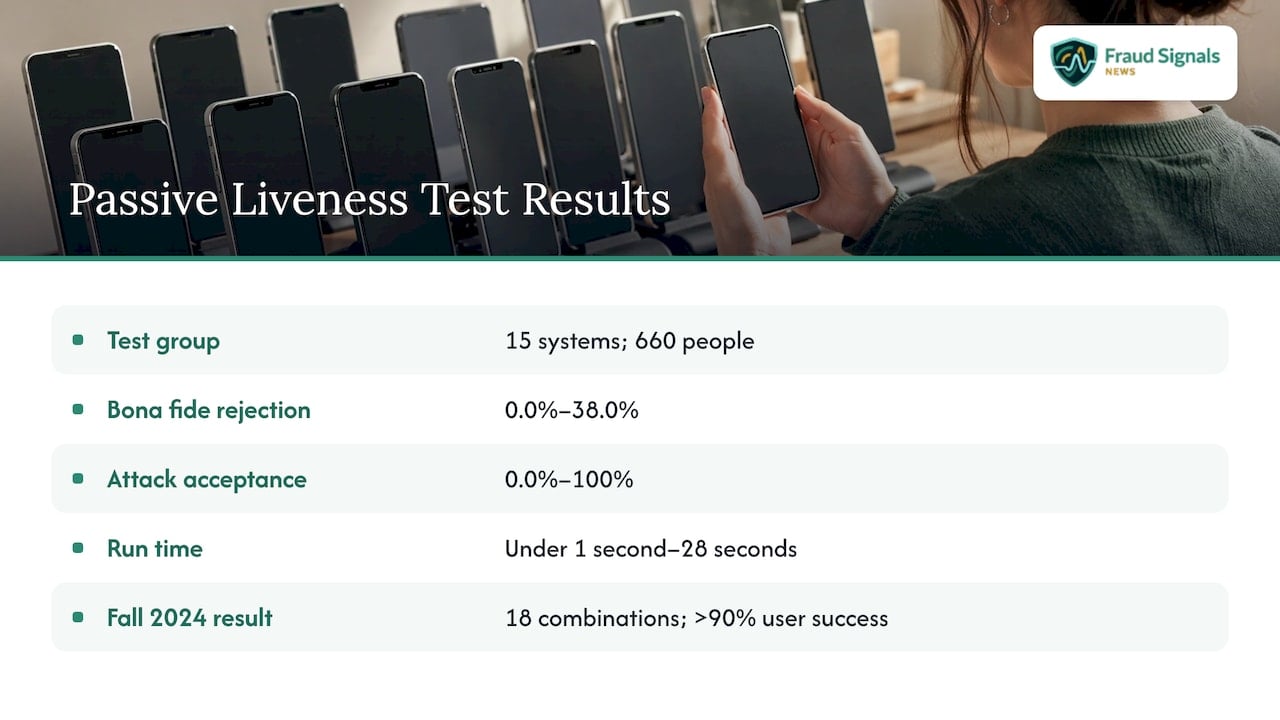
The Maryland Test Facility’s results for the passive face-liveness track tested presentation attack detection across a group of 660 people. Across 15 systems, bona fide rejection rates ranged from 0.0% to 38.0% and attack acceptance rates from 0.0% to 100%, with run times from under one second to 28 seconds. Two products that both advertise liveness can be worlds apart in both security and user experience.
The Department of Homeland Security’s June 2025 technical paper adds a more recent picture. In its Fall 2024 test, 661 paid volunteers made genuine presentations to six active presentation attack detection subsystems on Android and iOS phones, with attacks ranging from paper printouts to hardware-based instruments. DHS reported that no system met all the proposed attack-rejection and user-success goals, yet 18 combinations met the presentation attack detection and selfie-match security thresholds with a total user-success rate above 90%. The median selfie-match-to-document system rejected 99.99% of imposters. The message for buyers: strong combinations exist, and they are identified by test data, not by marketing language.
How to design a proof of life step that holds up
- Define the risk moments. Account opening, credential recovery, device change, payment limit increase and high-value transfers deserve a liveness step. Routine low-risk events usually do not.
- Protect the capture channel first. Use SDK-based capture with checks for virtual cameras, emulators, rooted devices and tampered streams. Browser-only capture is easier to inject into.
- Choose the signal mix. Combine passive analysis with randomized active prompts for higher-risk flows. Include audio when voice is part of the interaction, because voice alone is a weak anchor, as we explain in why voice biometrics are not enough in contact centers.
- Bind liveness to the document. A live face that is not matched to the verified ID, or a document that is not itself checked, proves little. The selfie identity verification overview shows how the pieces fit.
- Ask for measured results. Request attack-acceptance and bona fide rejection rates, and the conditions of the test, in the vocabulary of presentation attack detection. Compare them against the public test results above.
- Plan the fallback. Users with disabilities, older devices or poor lighting will fail legitimate checks. A manual review path with its own controls prevents both exclusion and a new social-engineering route.
- Monitor outcomes. Track failure patterns by device, channel and time. Clusters of near-identical retries or attempts to move channels are signs of an attack in progress. Our selfie spoof detection guide covers the signals analysts review.
Beyond banking
Proof of life is not only a bank control. Benefit agencies and insurers use it to confirm that pension or beneficiary payments go to a living person, and healthcare providers face deepfake patient identities. If health data is your concern, our piece on HL7 and NIST patient identity verification applies the same logic to clinical settings.
What we recommend
Treat a proof of life video as one layer in a stack, not a gate. Pair it with document verification, device and behavioral signals and link analysis across applications, as set out in our synthetic identity detection playbook. Then measure it the way DHS and the Maryland Test Facility do: with attack data, not demo videos.
Perspective
We follow this market closely, and the pattern we keep writing about is that institutions buy a liveness feature and then stop asking what it actually protects. A proof of life video is only as strong as the path the video travels on. When the camera feed can be replaced, a flawless liveness model is a flawless judge of a forged exhibit.
Our view is that fraud leaders should push the conversation from “do we have liveness?” to “what is our measured attack-acceptance rate, on which capture channels, and who reviews the failures?” The public evidence, from FinCEN’s alert to DHS’s testing, supports that shift. Controls that are layered, tested and tied to the document and the device will outlast those that rely on a single selfie.
That is the gap we aim to cover: operations-focused reporting for the teams who have to make these choices, not just announcements about the technology.
Carlos Ochoa
Keep reading on Fraud Signals News
If you are building or reviewing a verification stack, our reporting on biometrics and liveness is written for the people who own the fraud numbers. Start with why biometrics reduce bank fraud, or browse the full archive of digital identity and fraud prevention coverage for the latest analysis on deepfakes, eKYC and liveness.

For a wider look at why every digital business needs a verification layer, see why your online business needs identity verification.
FAQ
What is a proof of life video?
It is a short live video capture used to confirm that a real person is present at the time of a transaction. The system analyzes motion, texture and responses to prompts to rule out photos, replays and masks. In identity verification it is effectively another name for liveness detection.
Is proof of life the same as liveness detection?
In digital identity, yes, the terms are used interchangeably, and some official documentation lists them as equivalent. Outside identity verification, proof of life can also mean confirming that a pension or benefit recipient is alive. The security goal in both cases is to show a living person is behind the claim.
Does FinCEN require proof of life video?
FinCEN’s November 2024 alert does not create a new mandate. It identifies live audio or video verification as a best practice that may help covered financial institutions detect deepfake identity documents, and recommends it alongside phishing-resistant multifactor authentication. Your compliance team should map it to your own risk assessment and program.
Can a deepfake pass a proof of life check?
It can if the check is weak or the capture channel is compromised. FinCEN notes that criminals may respond to live prompts with synthetic audio and video, and may use plugins that present prerecorded video as a live feed. Randomized prompts, capture integrity controls and measured attack-rejection performance reduce that risk.
Sources
- FIMPE: Proof of Life, what it is and why it is crucial for security
- Datavalid liveness requirements and guidelines (Serpro, Brazil)
- FinCEN Alert FIN-2024-Alert004 on deepfake media
- NSA, FBI and CISA: Contextualizing Deepfake Threats to Organizations
- AOFIRS: Online Videos Authentication and Evidence Management
- Kellogg Insight: Video sharing, deepfakes and verification
- Maryland Test Facility: Remote Identity Validation Technology Demonstration results
- DHS: Quantitative Framework for Evaluating Remote Identity Validation Systems
Recommended
ISO 30107 Liveness: What Compliance Really Proves

Database Verification Limits: Where Identity Checks Break