
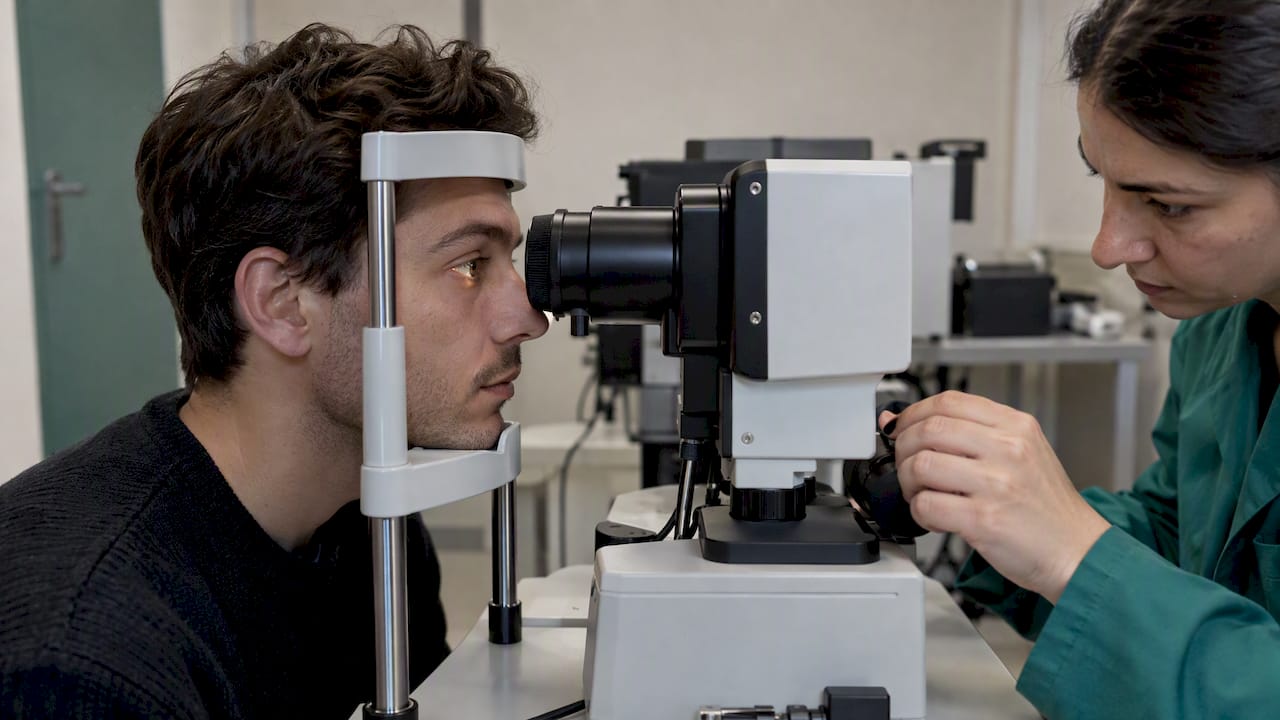
Today the most dependable approach to iris liveness detection pairs multispectral or active acquisition with ensembles of software presentation attack detection, catching the texture, spectral, and dynamic cues that any single method misses. Even so, open-set generalization remains the main unresolved risk, since even strong algorithms falter against attack instruments they never trained on. Readers should demand reporting on APCER, BPCER, and leave-one-PAI-out results before trusting any vendor claim, and we cover the implementation and testing details below.
TL;DR:
- Require at least 500 genuine captures and 500 spoof attempts per test configuration, plus system measures such as APNRR and FTA when relevant.
- Match attack cues to sensors: spectral analysis catches printouts and replays, texture models target contact lenses, while shape and pupil response expose artificial eyes.
- Training only on synthetic samples reaches AUROC 0.90 to 0.93, below roughly 0.97 with authentic data, so use synthetic samples as supplements.
- Use lightweight BSIF or LBP on embedded devices; server systems can run deep ensembles with early exits, while multispectral sensors suit higher assurance needs.
Table of Contents
- 1. Methods for detecting iris liveness: software, hardware, and fusion
- 2. Metrics and test protocols that separate real performance from marketing claims
- 3. Presentation attacks that matter most and the cues that catch them
- 4. Building and operating a robust iris PAD pipeline
- 5. What recent research tells us about open-set gaps and synthetic training
- Integrating iris liveness checks into multi-modal fraud defenses
- Compliance considerations for iris liveness in fintech and banking
- How iris liveness detection has thwarted fraud in practice
- What still needs solving in iris liveness detection research
- A researcher’s take on where effort should go next
- Fraud Signals News resources for standards-aligned iris liveness defenses
- FAQ
- Sources
1. Methods for detecting iris liveness: software, hardware, and fusion
Iris presentation attack detection splits into three practical categories, each with a distinct cost and accuracy profile.
Passive software methods analyze a single captured image for texture artifacts. Classic descriptors like Local Binary Patterns (LBP) and Binarized Statistical Image Features (BSIF) remain common baselines, and open-source references such as OSPAD-2D give teams a reproducible starting point before they invest in proprietary models. Deep convolutional networks now outperform hand-crafted descriptors on most benchmarks, though they demand larger and more diverse training sets to avoid overfitting to a narrow attack set.
Active and hardware-based methods add a capture-time challenge. Dynamic pupillary-response checks track how the pupil reacts to a controlled light stimulus, a response that is difficult to fake with a static printout or display. Photometric stereo captures 3D shape cues from multiple illumination angles, and multispectral near-infrared (NIR) imaging exploits the fact that live tissue reflects light differently across wavelength bands than paper, plastic, or screen replays.
Hybrid fusion combines these signals: 2D texture, 3D shape, spectral reflectance, and temporal dynamics feed into a single decision. Fusion tends to generalize better because an attack instrument that defeats one cue rarely defeats all of them simultaneously.
- Passive software suits low-cost, software-only deployments where added sensors are not an option.
- Active and hardware methods suit higher-security deployments like banking onboarding or border control.
- Fusion architectures suit any deployment where open-set robustness matters more than raw throughput.
- Embedded devices favor lightweight descriptors, while server-side systems can run heavier ensembles with more latency headroom.
2. Metrics and test protocols that separate real performance from marketing claims
Any credible evaluation of iris PAD rests on a small set of standardized metrics. Attack Presentation Classification Error Rate (APCER) measures how often an attack is misclassified as a live sample; Bona Fide Presentation Classification Error Rate (BPCER) measures how often a genuine iris is wrongly rejected; Average Classification Error Rate (ACER) averages the two. Area Under the Receiver Operating Characteristic curve (AUROC) summarizes performance across thresholds, and competitions typically also report results at a fixed acceptance threshold such as 0.5 to keep comparisons consistent.
- Confirm whether a reported result is closed-set (the test set contains attack types seen during training) or open-set (it withholds entire attack categories).
- Prefer leave-one-PAI-out protocols, which hold out one presentation attack instrument at a time and reveal how a model handles something it has never seen.
- Check sample sizes: the LivDet-Iris 2025 preprint protocol calls for at least 500 bona fide and 500 spoof attempts per test configuration to produce stable estimates, along with system-level metrics like APNRR and FTA where relevant.
- Log per-attempt metadata (sensor band, illumination, model version) so a new attack type can be triaged quickly rather than discovered in production.
The leave-one-PAI-out test is the single most informative check a procurement team can run before trusting a vendor’s closed-set numbers. Research on open-set iris PAD found catastrophic drops in correct classification rate for several attack types once they were excluded from training, a result that closed-set benchmarks never surface.
3. Presentation attacks that matter most and the cues that catch them
Printed iris images, display replay on phones or monitors, textured contact lenses, artificial or prosthetic eyes, and synthetic images generated by modern generative models make up the common attack catalog; cadaver samples appear mainly in controlled research settings rather than field deployments.
Each attack type leaves a different fingerprint. Printouts and replay show up through spectral reflectance mismatch, since paper and screens do not reflect NIR light the way live tissue does. Textured contact lenses disrupt natural iris texture patterns in ways BSIF and LBP descriptors are tuned to catch. Artificial eyes and high-fidelity synthetic images often pass static texture checks but fail dynamic tests like pupillary response or Purkinje reflection patterns, which require a living eye reacting to light in real time.
- Printouts and display replay: caught primarily by spectral and reflectance analysis.
- Textured contact lenses: caught by fine-grained texture descriptors and, increasingly, deep models trained on diverse lens samples.
- Synthetic and AI-generated iris images: caught by cross-dataset generalization testing, since these attacks are evolving fastest.
- Artificial eyes: caught most reliably by 3D shape and dynamic liveness cues.
Modern textured lenses and generative image synthesis are improving in realism year over year, which is precisely why closed-set accuracy numbers from even a year ago should not be assumed to hold against today’s attack instruments.
4. Building and operating a robust iris PAD pipeline
A practical rollout starts with sensor choice. NIR imaging remains the baseline for iris capture, and teams pursuing higher assurance should evaluate multispectral sensors or controlled illumination rigs, which research on multispectral iris PAD shows improve generalization to unseen attack instruments compared with single-band NIR alone. Resolution and optics should follow ISO/IEC 19794-6 interchange format guidance, and acquisition workflows should incorporate NIST IREX capture recommendations, including graceful handling of failure-to-acquire cases rather than forcing a retry loop on frustrated users.
- Curate training data that mixes authentic captures with privacy-safe synthetic samples, since privacy-safe synthetic PAD research reports synthetic-only pipelines reaching AUROC around 0.90 to 0.93, versus roughly 0.97 for models trained on authentic data.
- Run leave-one-PAI-out validation on every model revision, not just at initial launch.
- Benchmark against open-source baselines like the Raspberry Pi based open iris PAD reference, which combines CC-Net segmentation with 2D and 3D fusion PAD and was assembled for roughly $75 in hardware at the time of writing.
- Choose model weight by deployment target: lightweight BSIF or LBP pipelines fit embedded devices, while deep ensembles with early-exit strategies suit server-side systems with more latency headroom.
- Treat thresholding conservatively, log every PAD score with capture metadata, and schedule periodic retraining as new attack instruments surface.
Pro Tip: Implement early-exit ensembles with majority-vote stopping so constrained hardware gets most of the accuracy of a full ensemble without running every model on every capture.
5. What recent research tells us about open-set gaps and synthetic training
The clearest signal from current research is that closed-set iris PAD is largely a solved problem, while open-set performance against unseen attack instruments is not. That gap should shape procurement: ask vendors for leave-one-PAI-out numbers, not just closed-set accuracy, before trusting a deployment claim.
Synthetic-only training pipelines offer a privacy-conscious path to richer datasets, though current results still trail authentic-data training by a measurable margin, and any pipeline needs identity-leakage checks to exclude synthetic samples that happen to match real subjects.
- Fuse detectors with different failure modes. Texture, shape, and dynamic checks tend to disagree on different attack types, and that disagreement is useful.
- Treat multispectral acquisition as the most reliable upgrade path currently supported by published evaluation work.
- Track competition results and open benchmarks rather than relying on a single vendor’s internal testing.
Integrating iris liveness checks into multi-modal fraud defenses
Iris liveness detection rarely stands alone in a production fraud program. Combining it with face liveness, device fingerprinting, and behavioral signals closes gaps that any single modality leaves open, since an attacker who defeats one biometric check still has to defeat the others simultaneously. A multi-modal architecture also reduces the blast radius of any one method’s open-set weakness: if an iris PAD model is fooled by a novel presentation attack instrument, a correlated anomaly in device signals or face liveness scoring can still flag the session.
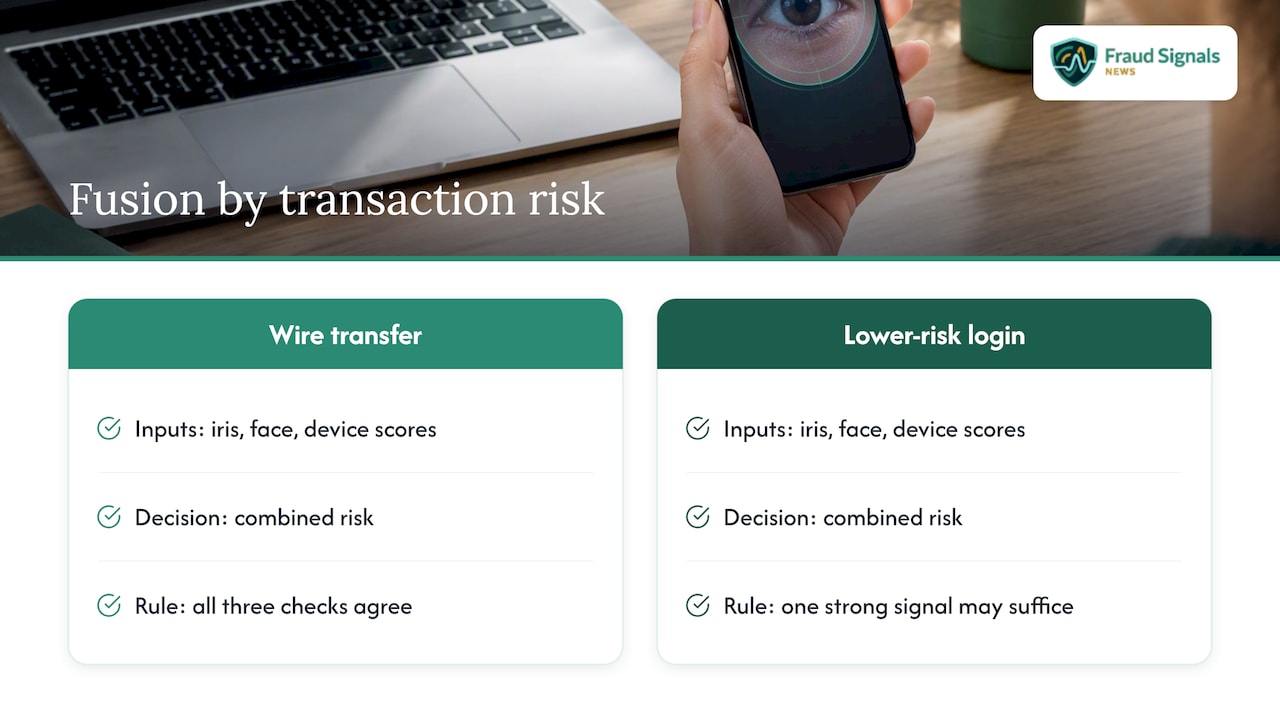
Fusion at the decision level, where each modality contributes a confidence score that feeds a combined risk decision, tends to be easier to operate and audit than fusion at the raw feature level. It also lets a fraud team adjust weighting by channel: a high-value wire transfer might require agreement across iris, face, and device checks, while a lower-risk login might accept a single strong signal.
Our guide to selfie identity verification covers how face-based liveness pipelines handle similar presentation attack challenges, which is useful context for teams designing a combined architecture. The practical lesson from fraud incidents across modalities is consistent: attackers target the weakest link in a verification chain, so a multi-modal design should assume every single modality will eventually be probed and plan the fusion logic accordingly.
Compliance considerations for iris liveness in fintech and banking
Financial institutions deploying iris liveness detection operate under identity verification and data protection obligations that vary by jurisdiction, and standards bodies have stepped in to give engineering teams a common technical baseline rather than leaving liveness assurance entirely to vendor claims. ISO/IEC 30107 defines the APCER and BPCER metrics that most competitions and vendor evaluations now report, giving compliance and procurement teams a shared vocabulary for comparing systems. NIST’s IREX program contributes acquisition best practices that influence how regulators and auditors expect iris capture to be documented.
Banks and fintechs should treat a vendor’s standards alignment as a baseline requirement, not a differentiator: ask whether PAD evaluation follows ISO/IEC 30107 definitions, whether capture follows ISO/IEC 19794-6 interchange formats, and whether the vendor can produce open-set test results rather than only closed-set figures. Data protection rules governing biometric templates, which in the United States vary by state and sector, also apply to iris data the same way they apply to other biometric identifiers, so retention, consent, and breach-notification obligations need to be mapped before an iris-based flow goes live.
Our guide to why biometrics satisfy compliance requirements in 2026 walks through how institutions document biometric controls for auditors, which pairs well with the technical standards referenced here. Getting the compliance documentation right early avoids rework later, since auditors increasingly expect evidence of open-set robustness testing, not just a vendor datasheet.
How iris liveness detection has thwarted fraud in practice
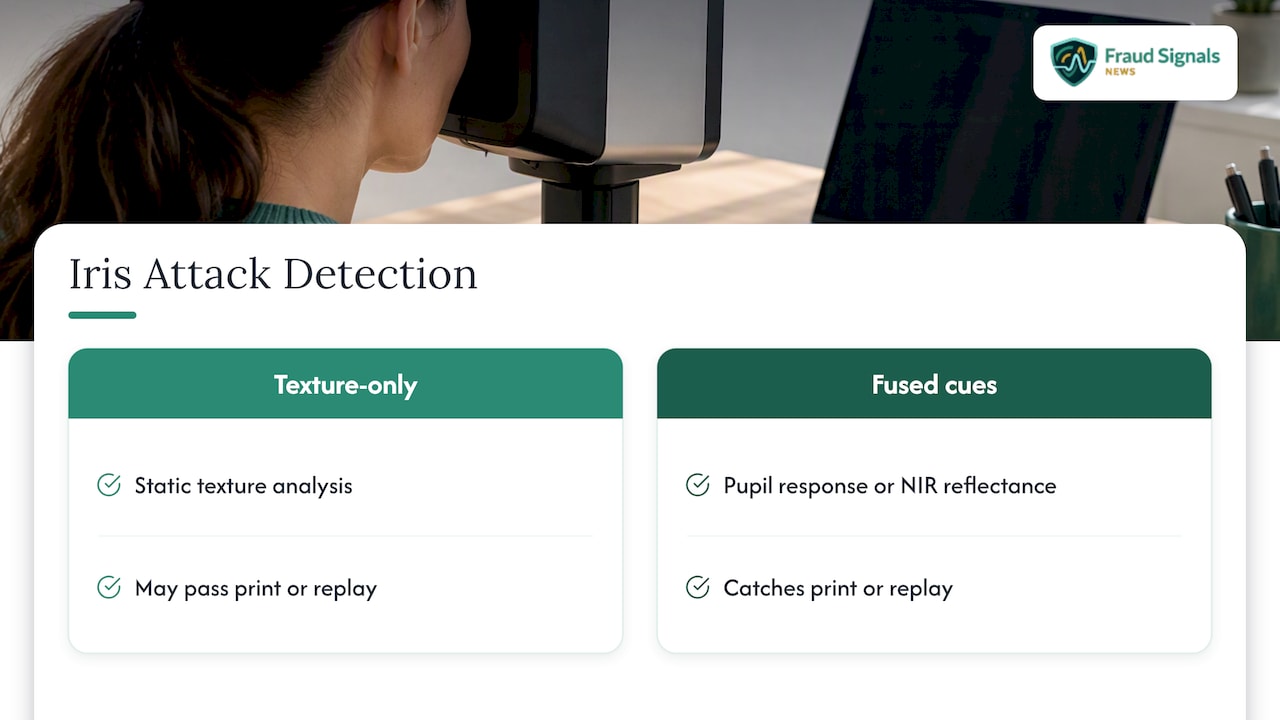
Presentation attacks against iris systems follow a predictable pattern: an attacker captures or reconstructs a target’s iris image, then tries to present it through a printout, a screen, or a textured lens. The research record on open-set testing gives a clear picture of why these attacks fail against well-designed systems and succeed against poorly designed ones. Systems relying on static texture analysis alone have repeatedly shown weakness against attack instruments they were not trained on, which is exactly the vulnerability that open-set PAD evaluation documented across multiple presentation attack categories.
The practical defense that holds up is the same fusion approach described throughout this piece: a dynamic pupillary-response check or a spectral reflectance comparison catches what a texture-only model misses. A printed iris or a replayed image can pass a texture check under the right lighting, but it cannot replicate a live pupil’s response to a controlled light stimulus, and it cannot match live tissue’s reflectance signature across multiple NIR bands.
For fraud teams building toward this level of resilience, our playbook for stopping replay and injection fraud covers the broader category of liveness defenses beyond iris specifically, including how to structure monitoring so new attack patterns get caught before they scale. The consistent lesson across modalities is that single-cue defenses degrade over time as attackers iterate, while fused, standards-aligned systems degrade more slowly because an attacker has to defeat several independent signals at once.
What still needs solving in iris liveness detection research
The open-set generalization gap remains the central unsolved problem in the field. Closed-set accuracy numbers, even very high ones, tell researchers little about how a system will handle an attack instrument it has never encountered, and current evaluation work confirms that even strong algorithms suffer sharp performance drops under leave-one-PAI-out testing.
Generative AI is raising the difficulty further. Synthetic iris images produced by modern generative models are approaching a realism level that challenges texture-based detectors, and manufacturing improvements in textured contact lenses are closing the gap that used to make lens-based attacks easy to spot. Both trends mean detection research has to keep pace with attack realism rather than assuming a static threat model.
Privacy-safe synthetic training data is a promising mitigation, but current results show a real performance gap between synthetic-only and authentic-data training that has not closed yet. Multispectral acquisition and dynamic liveness checks show measurable gains in published work, but they add sensor cost and capture complexity that not every deployment can absorb.
The field’s near-term research priorities follow directly from these gaps: larger and more diverse open-set benchmarks, better synthetic-data pipelines that close the authentic-data performance gap without compromising privacy, and detection methods built specifically to catch generative-model artifacts rather than retrofitting texture-based tools designed for an earlier attack generation.
A researcher’s take on where effort should go next
The field keeps producing incremental accuracy gains on closed-set benchmarks while the open-set gap barely moves, and that imbalance deserves more scrutiny than it gets. Funding and prototyping effort should shift toward richer open-set datasets and multispectral or dynamic capture, since those are the levers published evaluation work actually shows moving the needle. Privacy-safe synthetic augmentation deserves continued investment too, not as a replacement for authentic data but as a way to widen attack coverage faster than manual collection allows. Engaging with LivDet and open-source baselines keeps the whole field’s benchmarking honest, because a result that cannot be reproduced against a public reference is not a result worth building a procurement decision on.
— Carlos Ochoa
Fraud Signals News resources for standards-aligned iris liveness defenses
We cover the engineering and compliance side of liveness detection in depth, and two guides pair directly with what we have walked through here.
- Our guide to liveness detection spoofing gives standards-aligned defense checklists engineers can apply beyond iris specifically.
- Our playbook for stopping replay and injection fraud covers NIST-aligned monitoring for fraud teams operating liveness systems day to day.

We publish frameworks, monitoring playbooks, and vendor analysis for identity verification programs across fintech, banking, and healthcare, and teams integrating biometric checks across channels may also find value in how call authentication fits the same anti-fraud picture, covered in this overview of caller ID authentication. For a broader look at why biometric layers reduce fraud losses, read our 2026 guide to biometrics and bank fraud and subscribe for procurement and validation checklists as we publish them.
FAQ
How do you perform a liveness check on an iris?
A liveness check typically combines image capture under near-infrared or multispectral light with a software model that looks for texture, spectral, or dynamic cues distinguishing a living eye from a photo, screen, or lens. Stronger systems add an active component, like measuring pupillary response to a light stimulus, which is difficult for a static attack instrument to replicate.
How much does an iris scan cost?
Iris scan hardware costs vary widely by sensor quality and deployment scale, and no single industry-wide figure applies across consumer, enterprise, and research use cases. A low-cost open-source research platform combining an iris camera with PAD software was assembled for roughly $75 in one published reference implementation, though production-grade commercial sensors typically cost more.
How does iris detection work?
Iris detection captures a high-resolution image of the iris, usually under near-infrared illumination, then extracts a unique texture pattern used for matching against an enrolled template. Liveness detection adds a separate step that checks whether the captured iris belongs to a live person rather than a printout, a screen replay, or a textured contact lens.
Which phones have an iris scanner?
Iris scanning has appeared on select smartphone models in past years, though the feature has become less common as phone makers shifted toward face- and fingerprint-based unlocking. Specifications vary by manufacturer and model year, so checking a specific device’s published hardware specifications is the most reliable way to confirm iris scanner support.
What is the difference between closed-set and open-set PAD testing?
Closed-set testing evaluates a model only against attack types it saw during training, which tends to produce high accuracy numbers that do not predict field performance. Open-set testing, often using a leave-one-PAI-out protocol, withholds entire attack categories from training and has shown that even strong algorithms suffer sharp accuracy drops against attacks they have never encountered.
Sources
- State Of The Art In Open-Set Iris Presentation Attack Detection (arXiv)
- LivDet-Iris 2025 preprint
- SpectraIrisPAD and MSIrPAD multispectral iris PAD (arXiv)
Recommended
ID Security Features: What Each One Does and How to Check It
Face Liveness Detection: How It Works and Where It Fails