

A database check can tell you that a name, date of birth and Social Security number exist together in a record. It cannot tell you that the person typing them is the person they belong to. That gap is the core limit of database verification, and breached data, synthetic identities and stale records widen it every year. This article explains what database checks actually establish, the five ways they fail, what U.S. guidance says about them, and how to layer them with other signals without driving away legitimate customers.
TL;DR
- Database checks prove a record exists and matches the submitted data. They do not prove possession, presence or intent.
- Knowledge-based questions drawn from credit files are the weakest form: NIST bars them from the higher assurance levels, and breached data makes the answers easy to find.
- Matching errors cut both ways: false positives let the wrong person through, false negatives reject real customers with moved addresses, name changes or thin files.
- Synthetic identities are built from real and fake fragments, so they can pass checks that only ask whether the data exists.
- The fix is layering: document, biometric and liveness signals on top of the database, with a non-digital fallback and strict data minimization.
Table of Contents
- What a database check actually establishes
- Five ways database checks fail
- What U.S. guidance expects
- Where each check stops: a quick reference
- How to compensate for the limits
- A layered flow in practice
- Perspective
- Keep following the evidence
- FAQ
- Sources
What a database check actually establishes
Database verification compares what an applicant supplies against an authoritative or commercial source: a credit header, a telecom record, a government registry, a utility file. A match supports one narrow conclusion, which is that the claimed identity exists and the attributes line up.
The weakest and most common variant is knowledge-based verification (KBV). The U.S. Government Accountability Office explains that agencies doing remote identity proofing often rely on KBV, asking applicants personal questions derived from credit files and treating correct answers as verification. The logic is that only the real person would know which street they lived on in 2014 or which lender holds their auto loan.
That logic belongs to an era before large-scale breaches. Today the same facts sit in criminal marketplaces, and the questions test whether someone has obtained the file, not whether they are the file’s owner. A database check answers “does this identity exist?” The questions fraud teams need answered are different: is the applicant the genuine owner, are they present right now, and is the identity real at all?
Five ways database checks fail
1. Breached data answers the questions
GAO identifies the central risk plainly: an attacker who has obtained personal information can use it to answer KBV questions and impersonate someone. That risk led NIST to issue 2017 guidance that, per GAO, effectively prohibits agencies from using KBV for sensitive applications. The same report found that the agencies it reviewed had not done enough to eliminate KBV where they kept using it, leaving individuals at higher risk of identity fraud.
The current NIST position is explicit. According to the agency’s own FAQ, KBV cannot be used to satisfy verification requirements at IAL2 or IAL3, and it is limited to “Fair” evidence. Knowledge-based authentication, meaning security questions used as a login factor, is no longer recognized as an acceptable authenticator. A bank still leaning on out-of-wallet questions for account opening is relying on a method the federal identity standard has already demoted.
2. Synthetic identities pass because the data is partly real
A synthetic identity stitches real details, often a legitimate SSN, together with invented ones. A check that asks only whether the data exists in a source may return a match on the real fragment. According to the ACFE’s Fraud Magazine, synthetic identities can pass KYC checks and stay dormant for months or years while building credit. The same article states that U.S. lenders face more than $3.3 billion in direct exposure to synthetic identities tied to new accounts, an all-time high, and that Equifax flagged 500,000 accounts as potential synthetic identities in a single year.
The loss curve is steep. CFO Dive, reporting on a Mitek and Datos Insights study, says U.S. unsecured credit losses tied to synthetic identity fraud are projected to exceed $3.1 billion in 2026, up from $1.8 billion in 2020. A thin file that looks “clean” is exactly what a patient fraudster wants, and a database that only rewards matching records will rate it as low risk. For a deeper look at how these accounts are structured and stopped, see our guide to false identity bank accounts.
3. False positives: the wrong person matches
Matching is not binary. The GOV.UK Verify technical guidance, written for a different country but describing universal mechanics, defines a false positive as a matching service returning a wrong match, and a false negative as returning no match when a record exists. It lists the usual culprits: spelling mistakes, transcription errors, twins with similar information, and incorrect or outdated source data.
In U.S. onboarding, loose fuzzy matching is a common way to “fix” rejection rates, and it quietly raises the false positive rate. Accepting a near match on name and address to save a conversion can let in a family member, a former roommate or an impersonator who has obtained a few adjacent facts.
4. False negatives: real customers get rejected
The opposite failure is less discussed in fraud circles but costs money all the same. The same guidance notes that a move or a name change can leave source data incorrect or outdated and cause matching difficulties. In practice, the customers most likely to fail a database check are those with thin or shifting files: young adults, recent immigrants, people who recently married or divorced, and people who move frequently.
GAO makes a related point about alternatives: replacements for KBV may have limits in cost, convenience and technological maturity and may not be viable for every segment of the public. A control that rejects legitimate customers is also a control that pushes them toward channels with weaker checks, and it hands fraudsters a signal about which fields the system weighs most.
5. The database knows nothing about the person present
Even a perfect match to a perfect record says nothing about who is holding the phone. Deepfaked selfies, replayed video and injected camera feeds do not interact with the database at all; they defeat the layer that was supposed to bind the data to a human. This is why document and biometric steps sit beside data checks rather than behind them. Our analysis of capture integrity and deepfake ID fraud shows how attackers go around the verification step instead of through it.
What U.S. guidance expects
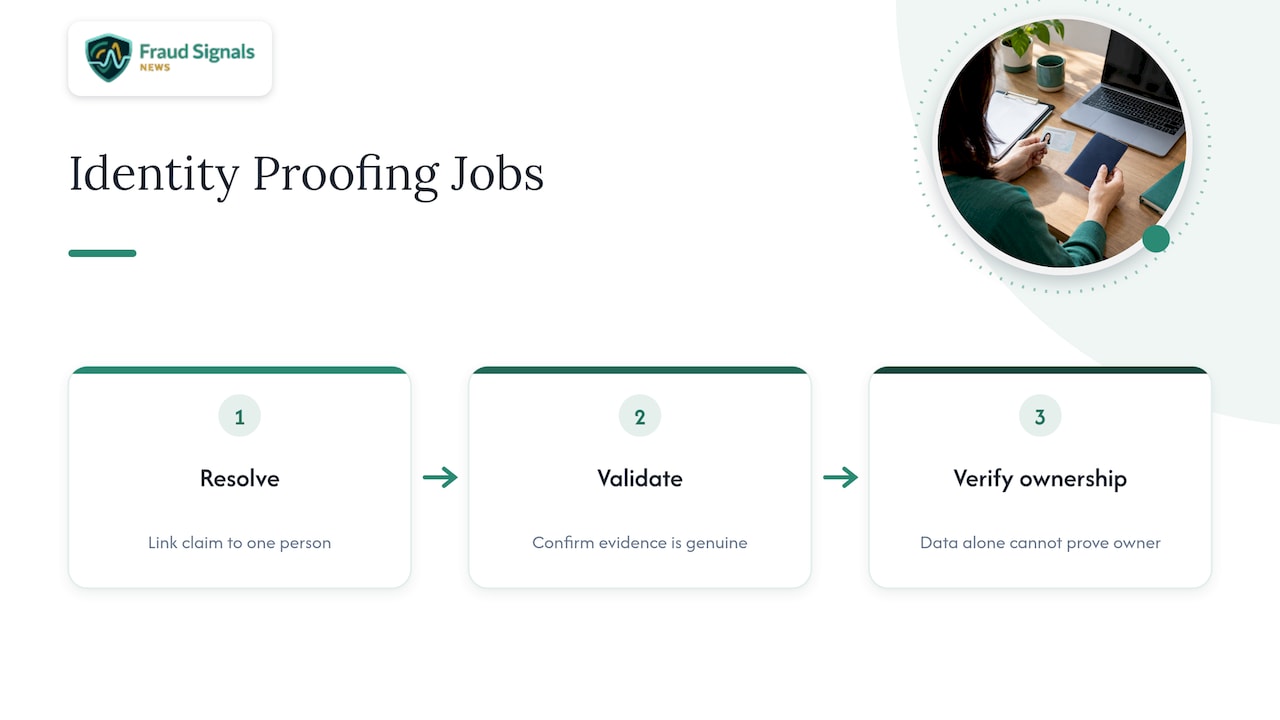
NIST SP 800-63A frames identity proofing as three jobs: resolve the claimed identity to a single person, validate that the evidence is genuine, and verify that the applicant is the rightful owner. Database lookups mostly help with the first two. Ownership is the step that data alone cannot carry, and it is the one fraud teams most often skip. We break down the sequence in three identity proofing steps fraud teams cannot skip.
The same guidelines also constrain how much data you pull in. NIST SP 800-63-4 says identity proofing should permit collecting and processing only the personal information necessary to validate the claimed identity, associate it with the applicant, mitigate fraud and provide attributes for authorization decisions. It also calls for notice about collection and requires consent before collecting biometric data or recording a proofing session.
That has a practical consequence for database strategy. More lookups are not automatically more assurance. Each extra source adds cost, latency, a new privacy surface and another stale-data failure mode. The Center for Democracy & Technology adds that verification data is highly sensitive and that protecting privacy requires both security controls and policies preventing harmful secondary uses. Its recommendation is simple: collect, process and retain only what the service needs, and delete the rest once it is no longer required.
Where each check stops: a quick reference
| Check | What it can establish | Where it stops |
|---|---|---|
| Credit-file KBV questions | Applicant knows facts tied to a file | Answers obtainable from breached or purchased data |
| SSN, name and date-of-birth match | Combination exists in a source | Does not reveal synthetic blends or stolen real data |
| Address or phone record match | Contact data is associated with the name | Stale after moves; open to SIM swapping and number porting |
| Document data check | Document details are consistent with records | Cannot prove the document is genuine or physically held |
| Biometric match with liveness | Applicant is present and matches the document portrait | Needs a clean capture path and a fallback for failures |
The pattern is consistent: each data-only check proves less than it appears to, and the gap is closed by a signal that ties the data to a live person.
How to compensate for the limits
Treat database results as risk inputs, not verdicts
A match should raise confidence, and a miss should route to review. It should not auto-approve or auto-decline on its own. Score the result alongside device, network and behavioral signals so a clean data match from a first-seen device on an anonymizing network still draws scrutiny.
Clean and test the sources
The GOV.UK guidance offers a useful discipline. You can reduce false positives by ensuring data sources are clean and accurate before matching, and reduce false negatives by thoroughly testing and iterating on matching rules. Track both rates by segment. If your false negative rate is three times higher for applicants under 25, you have a data coverage problem, not a fraud finding.
Add document and biometric evidence with liveness
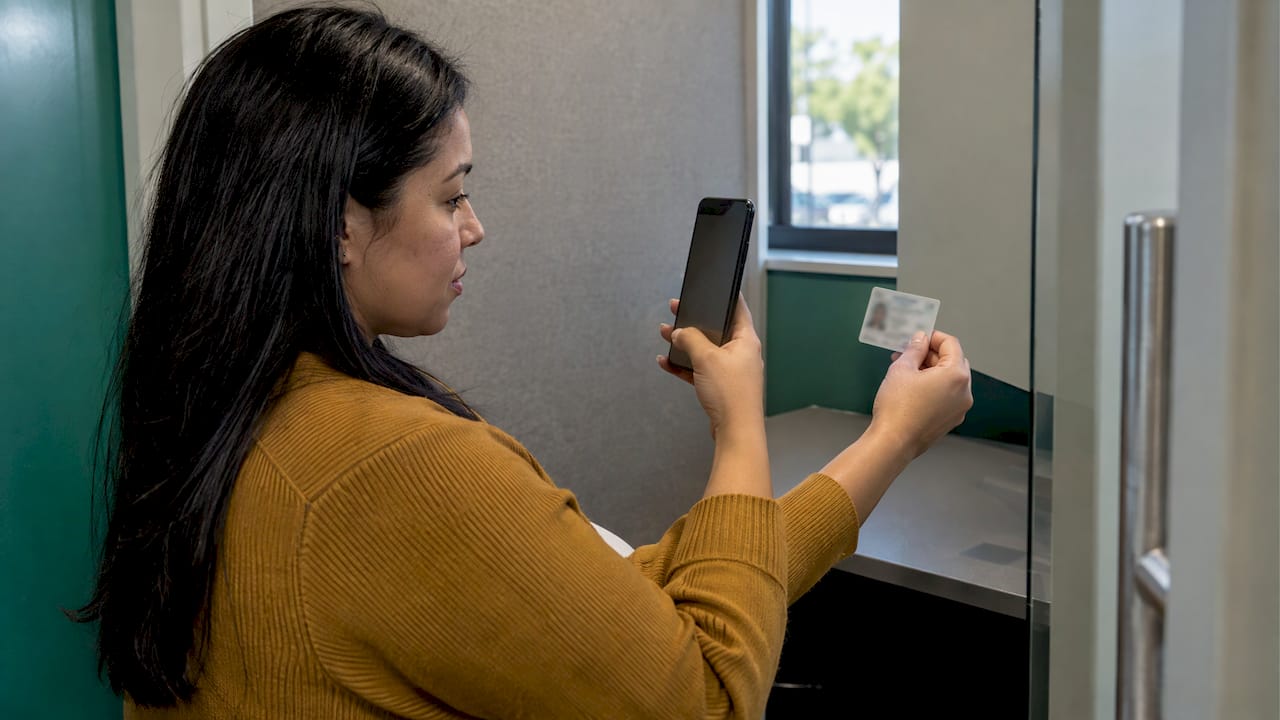
The strongest correction to data-only proofing is evidence that someone is physically present and holding a genuine document. Face and selfie matching with liveness detection ties the claimed data to a person in real time; see how selfie identity verification works and where face liveness detection holds up and where it fails. Because replay and injection attacks target the capture channel, pair liveness with controls described in our piece on NIST-aligned defenses against replay and injection fraud.
Keep a non-digital path
No automated screen passes everyone. CDT recommends offering non-digital alternatives such as a one-time code by postal mail or in-person verification so that people who fail automated checks still have a fraud-resistant, equitable route. Design the fallback with the same rigor as the primary flow, or it becomes the new back door.
Minimize what you collect and keep
Every data point retained is a data point that can be breached and later used to answer someone else’s KBV questions. Define the minimum attribute set per risk tier, document why each field is collected, and set deletion schedules. For a broader program view, our roundup of ways to reduce identity fraud exposure covers how these controls fit together.
A layered flow in practice
A workable onboarding sequence for a retail bank or fintech looks like this:
- Consent and notice. State what you collect and why, and capture consent before any biometric step.
- Data resolution. Run the minimum database lookups needed to resolve the claimed identity to one record, and flag thin files or recently created records.
- Document validation. Check the document’s authenticity and extract its data, then compare it with the database result.
- Biometric match with liveness. Confirm the applicant matches the document portrait and is physically present.
- Risk scoring. Combine all results with device and network signals, and route ambiguous outcomes to manual review.
- Fallback channel. Offer postal code or in-person verification to applicants who cannot complete the digital flow.
- Retention. Delete what the decision no longer requires.
Notice what the database does here. It narrows and cross-checks, and it never carries the decision alone.
Perspective
We read the research on database verification as a verdict on single-signal thinking. The data was never the problem: a record is a fine place to start. The problem is institutions treating a match as proof of a person, long after breaches made the underlying facts a commodity.
What we see in the stories we cover is a cat-and-mouse dynamic where fraudsters adapt in weeks and verification programs adapt in budget cycles. Banks that fare best stack evidence that is hard to obtain together: a genuine document, a live biometric, a clean capture channel and a risk score that treats the database as one input among several. They also keep the customer in view, because every false rejection has a cost that never appears on a fraud loss report.
That is why we cover biometrics, liveness detection, deepfake ID technology and the operational frameworks around them in the same place. Directors of fraud risk do not need another warning that KBV is obsolete. They need a clear picture of what replaces it, what that replacement costs, and how to measure whether it is working.
Carlos Ochoa
Keep following the evidence
If you are rebuilding an onboarding flow, our coverage of identity verification, liveness and deepfake defenses is organized for fraud and compliance leaders who need operational detail rather than headlines. Start with why biometrics reduce bank fraud, then work through the liveness and capture-integrity pieces above.

Browse the full archive of analysis on the Fraud Signals News homepage for new reporting on emerging fraud techniques and verification technology.
FAQ
What is the biggest limit of database identity verification?
It proves that data exists and matches, not that the applicant owns it. Breached personal information lets attackers satisfy data-only checks, which is why GAO and NIST treat knowledge-based verification as unfit for sensitive applications. Binding the data to a live person requires document and biometric evidence.
Can synthetic identities pass database checks?
Yes. Synthetic identities combine real and fabricated details, and the ACFE reports they can pass KYC checks and lie dormant while building credit. A check that only asks whether the submitted data exists in a source may return a match on the real fragment. Record age, file thinness and consistency across sources are better signals than a simple hit.
Is knowledge-based verification still allowed under NIST guidance?
Only in a restricted way. NIST’s FAQ states that KBV cannot satisfy the verification requirements at IAL2 or IAL3 and is limited to Fair evidence, and knowledge-based authentication is no longer an acceptable authenticator. Check SP 800-63A section 5.3.2 for the exact conditions before relying on it.
How do I reduce false rejections without letting fraud through?
Test matching rules by customer segment, clean source data, and route near matches to a secondary check rather than loosening the match threshold. Offer a non-digital fallback such as a postal one-time code or in-person verification. Measure false positives and false negatives separately so you can tune each one on its own.
How much personal data should a verification flow collect?
Only what is needed to validate the claimed identity, link it to the applicant, mitigate fraud and support authorization decisions, as NIST SP 800-63-4 describes. Give notice, get consent before biometric collection, and delete data when it is no longer needed. Less retained data also means less material for future breaches.
Sources
- GAO-19-288, Data Protection: Federal Agencies Need to Strengthen Identity Verification
- NIST SP 800-63 Digital Identity Guidelines FAQ
- NIST SP 800-63-4, Privacy (SP 800-63A)
- GOV.UK Verify Technical Guide: Decide your matching strategy
- ACFE Fraud Magazine: From billions lost to billions saved
- CFO Dive: Synthetic identity fraud surges as criminals weaponize AI
- CDT: Digital Identity Verification: Best Practices for Public Agencies
Recommended

Proof of Life Video: How Liveness Checks Work and Where They Fail

ISO 30107 Liveness: What Compliance Really Proves