

Onboarding fraud signals are the clues a digital applicant leaves behind, from how they type and which device they use to whether their identity data and face check hold together, and no single one of them is reliable on its own. Institutions that stack these signals into a risk score can let legitimate applicants through quickly and put real friction only in front of the risky ones. This article sets out which signals matter, how to combine them, what to do when they fire, and which US rules shape the collection.
TL;DR
- Onboarding fraud signals fall into six families: behavioral, device and network, identity attributes, documents, biometrics and liveness, and cross-application links.
- Individually weak signals (an IP address, a device cookie) become useful when stacked, which is exactly how US regulators describe them.
- New-account fraud is the one US fraud category where losses grew in 2025, so account opening deserves its own signal strategy.
- Score first, then step up: low-risk applicants move on, high-risk ones face deeper checks, and every decision is logged for review.
- Collection has to fit US requirements such as the CIP Rule and Regulation S-P incident response duties.
Table of Contents
- Why account opening is the fight that matters
- The six families of onboarding fraud signals
- A quick reference: signal, what it suggests, what it cannot prove
- How to combine signals without punishing good customers
- Detecting and responding to fraud during onboarding
- Cutting false positives and friction
- What US rules mean for signal collection
- Perspective: signals fail when they are treated as a checklist
- Where to go next
- FAQ
- Sources
Why account opening is the fight that matters
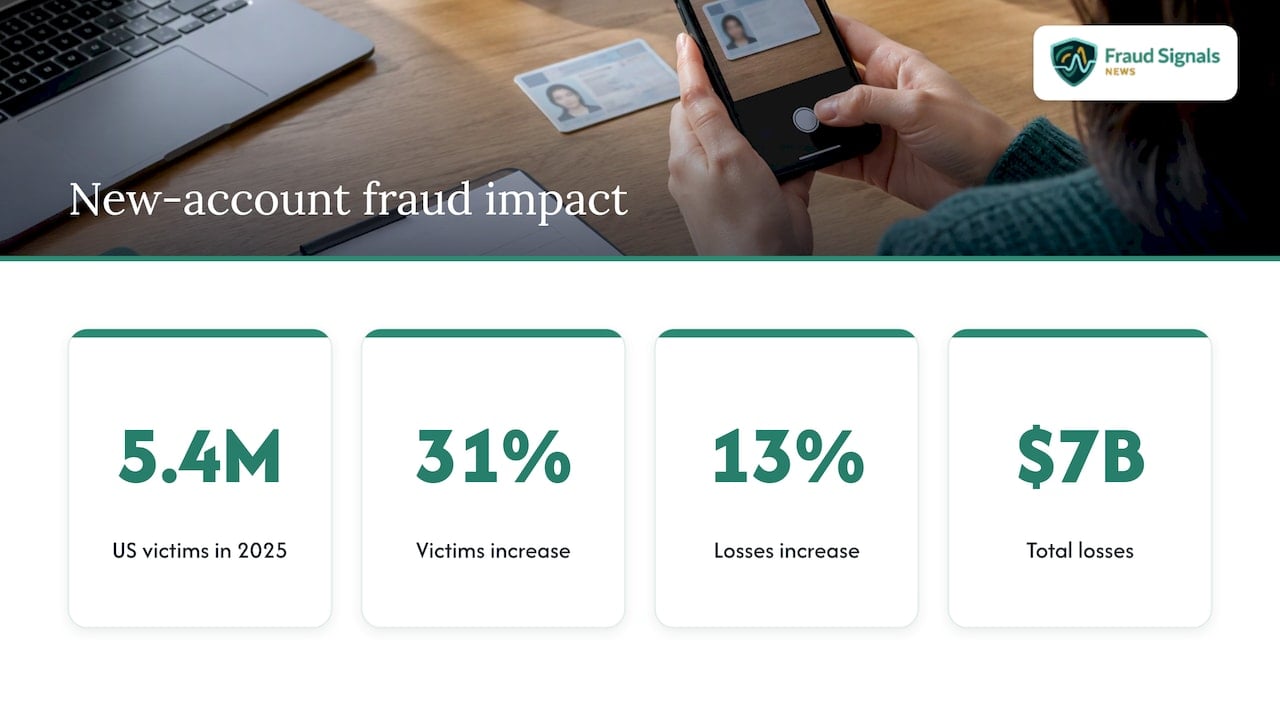
Account opening is where a stolen or synthetic identity first becomes a working account, and the numbers show attackers know it. According to Javelin Strategy & Research’s 2026 Identity Fraud Study, new-account fraud affected 5.4 million US victims in 2025, up 31%, with losses rising 13% to $7 billion, the only category where losses increased that year.
The study’s author, Suzanne Sando, ties the rise to insufficient identity verification, automated bot attacks and efforts to reduce friction during onboarding. That last point is the uncomfortable one. Many institutions removed checks to improve conversion and, in doing so, handed fraudsters a low-assurance bypass. Signals are the way out of that trade-off, because they let you add assurance without adding steps for every customer.
The six families of onboarding fraud signals
A useful way to organize signals is by what they tell you. Each family answers a different question, and each fails in a different way, which is why they work as a set.
1. Behavioral and interaction signals
Bots and scripts that open accounts tend to betray themselves in how they interact with the form. The FedPayments Improvement community lists keystroke speed, mouse movements and frequent copying and pasting as signals that help judge whether the applicant is human.
Practical examples a fraud team would watch:
- Fields completed faster than a person can type, or with identical timing between applications.
- Pasted values in fields where legitimate applicants usually type, such as Social Security number or date of birth.
- No pointer movement, or perfectly linear movement, on a desktop flow.
- Unusual navigation, such as skipping steps or jumping straight to submission.
The Federal Reserve’s interagency guidance describes behavioral biometrics software as analyzing finger swipes, taps, keystrokes and mouse usage to authenticate a customer. At onboarding there is no baseline for the person yet, so these signals mostly separate humans from automation. For the automation side in depth, see our guide to onboarding bot detection.
2. Device and network signals
The same FedPayments source notes that time zone, geolocation, IP address, device hardware specifications and browser or software configuration can be analyzed for signs the user is legitimate.
Typical flags include:
- An emulator, rooted device or virtual machine profile.
- A browser time zone that contradicts the IP geolocation.
- Anonymizing infrastructure, or an IP address that has already appeared on many applications.
- Many applications from one device fingerprint under different names.
Regulators are frank that these are not strong on their own. The interagency guidance says device cookies, geolocation and IP address matching are effective only when combined with other controls. Treat them as inputs to a score, never as a verdict.
3. Identity attribute signals
The name, date of birth, address, email address and phone number the applicant supplies can each be checked for consistency and age. FedPayments points to verification of identity attributes such as email addresses and phone numbers as one option to weigh against user interaction, cost, risk tolerance and system sophistication.
Useful questions: Is the email address days old? Is the phone number a recently ported or virtual number? Does the address belong to a commercial mail drop? Does the phone line actually belong to the person claiming it? On that last point, a practical explainer on remote identity verification by phone is useful for understanding what a phone check can and cannot establish, which matters because SIM swapping can defeat a phone check on its own.
4. Document signals
Remote onboarding depends on document uploads instead of physical inspection, so document capture is a signal source in its own right: image quality, evidence of re-photographed screens, template mismatches, and inconsistencies between the data printed on the document and the data typed into the form. The more important question today is whether the image was captured live from a real document or injected into the pipeline. We cover that in capture integrity and deepfake ID fraud and in our piece on replay and injection attacks.
5. Biometric and liveness signals
A selfie matched to the document photo answers whether the face fits the document. Liveness answers whether a live person is present. The Federal Reserve Financial Services describes a shift toward layered approaches combining a device factor with a biometric such as the face, and toward newer biometric types such as camera liveness and behavioral biometrics.
Signals here include liveness scores, face match confidence, signs of a presentation attack (a screen, a mask, a printed photo) and indicators of a virtual camera or synthetic video feed. Our explainers on how face liveness works and where it fails and on liveness spoofing defenses go deeper on the engineering.
6. Link and velocity signals
The strongest evidence of organized fraud often sits across applications rather than inside one. The FFIEC BSA/AML Examination Manual notes that accounts opened without face-to-face contact carry higher money laundering and terrorist financing risk, and says banks should use new account activity reports, IP address reports and reports that identify related accounts sharing addresses, phone numbers, email addresses or taxpayer identification numbers.
BCG adds a geographic example: a surge in registrations in one zip code may signal suspicious behavior worth investigating.
A quick reference: signal, what it suggests, what it cannot prove
| Signal family | Example signal | What it suggests | Where it falls short |
|---|---|---|---|
| Behavioral | Pasted SSN, uniform typing speed | Automation or scripted entry | Password managers and autofill look similar |
| Device and network | Emulator, time zone mismatch | Masked origin or farmed devices | VPN use is common among legitimate users |
| Identity attributes | New email, virtual phone number | Throwaway or synthetic identity | Young customers have thin files too |
| Document | Screen re-capture, template mismatch | Forged or copied document | Clean injected images can pass image checks |
| Biometric and liveness | Failed liveness, virtual camera | Presentation or injection attack | Quality varies by capture conditions |
| Link and velocity | Shared device across names | Organized or repeated fraud | Households and shared phones create overlap |
The right-hand column is the argument for stacking. Every signal has an innocent explanation, and almost no innocent explanation survives five signals firing together.
How to combine signals without punishing good customers
The goal is not to collect more data. It is to make the combination decide how much friction an applicant sees. BCG recommends using internal and external fraud scores and consortium negative files to give low-risk customers smoother access while requiring more robust verification of higher-risk ones. The same research stresses that fraudsters are patient and can learn an institution’s defenses from non-traditional sources, while legitimate customers abandon tedious journeys and switch providers.
A workable pattern:
- Collect passively first. Behavioral, device and network signals cost the applicant nothing.
- Score before you ask. Combine passive signals with attribute checks into a risk band.
- Match the check to the band. Low band: standard document and selfie. Middle band: add liveness hardening, a second factor or a device check. High band: manual review or decline.
- Re-score as evidence arrives. A clean document does not cancel a device that has already appeared on twelve other applications.
- Feed outcomes back. Confirmed fraud and false declines should both retrain the rules or models.
The Federal Reserve Financial Services notes that digital verification can build a more nuanced, risk-based view when it recognizes the devices a customer uses and asks for additional authentication when a new device appears. That logic starts at onboarding: the first device you see is the one you will compare every later session against.
Detecting and responding to fraud during onboarding
There is no single regulatory recipe for the onboarding response process, so the sequence below is our editorial synthesis of the sources above, to be adapted to your institution’s own policies and counsel.
- Capture. Log every signal and its value at the time of the decision, not only the final score. Investigators need the raw evidence.
- Score and route. Send each application to approve, step up, review or decline.
- Step up proportionally. Add stronger verification for the middle band instead of declining outright.
- Review with context. Give analysts linked applications, device history and the reasons the score fired.
- Contain. Where a pattern appears, search for related applications and accounts sharing the same device, phone or address, as the FFIEC manual’s linked-account reporting suggests.
- Escalate and report. Suspected fraud follows your institution’s suspicious activity reporting procedures, owned by the BSA and compliance function.
- Learn. Add confirmed patterns to rules, models and shared negative lists.
Our account opening fraud detection guide and the new account fraud prevention strategies piece walk through the operational side for finance teams.
Cutting false positives and friction
False positives are a cost that rarely shows up on the fraud dashboard: they appear as abandoned applications. Crowe’s guidance on KYC at onboarding says institutions can calibrate data collection to financial crime risk, so lower-risk customers move through efficiently and higher-risk relationships get deeper review. It adds that capturing the risk attributes monitoring systems use can produce clearer customer profiles, fewer false positives and investigations focused on real financial crime risk.
In practice that means:
- Tune thresholds by product. A savings account and a line of credit do not carry the same loss exposure.
- Measure false declines alongside fraud losses, by segment.
- Replace hard declines with step-ups where the signals are ambiguous.
- Review any signal that fires on a large share of approved, never-defrauded customers; it is noise.
What US rules mean for signal collection
Signals do not replace identity verification obligations. They sit alongside them.
- CIP Rule. It requires risk-based procedures that let a bank form a reasonable belief it knows each customer’s true identity, including name, date of birth, address and identification number. Under a 2025 exemption, banks may obtain TIN information from a third-party source before opening an account, and the order observes that the importance of collecting it directly from the customer has lessened since 2003 given newer verification methods.
- Interagency authentication guidance. It states that identity verification helps reduce identity theft, fraudulent account applications and unenforceable agreements and can recur periodically based on risk.
- Regulation S-P. The amended rule requires written policies and procedures for an incident response program designed to detect, assess, respond to and recover from incidents. Behavioral, device and biometric data you collect become customer information you must protect.
Compliance teams should confirm with counsel which rules apply to their charter and products. For the biometric angle, our piece on why biometrics satisfy compliance requirements is a good next step.
Perspective: signals fail when they are treated as a checklist
We read a lot of institutional fraud postmortems, and the same pattern repeats. A bank buys a document check, sees a drop in obvious forgeries, and concludes the problem is handled. Meanwhile the attackers move to the layer nobody is watching: injected video, farmed devices, bots that fill the form faster than any human could.
Our view is that onboarding defense is a cat-and-mouse dynamic, and the only stable response is layered evidence. A weak signal is not a useless signal. An IP address, a typing rhythm and a phone age are each easy to defeat alone and expensive to defeat together. The institutions that do this well are the ones that log every signal, review the disagreements between them, and tune step-ups instead of declining on instinct.
This is why we cover biometrics, liveness and deepfake ID technology alongside the unglamorous operational material on bots, velocity and false positives. Obsolete, one-shot verification fails at scale. Continuous, risk-based evidence is what gives a fraud director something defensible to take to the board and to examiners.
Carlos Ochoa
Where to go next
If you are building or auditing your onboarding stack, start with the layer you cannot see well today. Our guide on why biometrics reduce bank fraud explains the biometric layer, and our selfie identity verification explainer covers the capture step in detail.
Fraud Signals News publishes independent, operations-focused coverage of biometric identification, liveness detection, deepfake ID and emerging fraud techniques for fraud, fintech and compliance leaders.

Browse the latest analysis on the Fraud Signals News homepage to keep your signal strategy current as attacker methods change.
FAQ
What are onboarding fraud signals?
They are clues from behavior, devices and networks, identity attributes, documents and biometrics that help an institution judge whether a digital applicant is legitimate. FedPayments Improvement describes them as inputs for assessing applicants and managing account-opening fraud. They work best as a combined score rather than individual pass/fail tests.
Which onboarding fraud signal is the most reliable?
None is reliable alone. Regulators note that device cookies, geolocation and IP matching are effective only when combined with other controls. Cross-application links, such as one device behind many identities, tend to be the most decisive because they reveal patterns an individual applicant cannot hide.
How do you reduce false positives from fraud signals?
Route applicants by risk instead of applying one check to everyone. Crowe notes that calibrating collection to financial crime risk speeds low-risk customers and focuses review on the rest. Use step-up verification for ambiguous scores and track false declines next to fraud losses.
Do liveness checks stop deepfakes at onboarding?
They are one layer, and their strength depends on capture integrity. The Federal Reserve Financial Services points to camera liveness and behavioral biometrics within layered approaches. Pair liveness with device and injection checks, as covered in our deepfake ID fraud guide.
Sources
- Digital Account Onboarding, FedPayments Improvement
- Javelin 2026 Identity Fraud Study release (Nasdaq)
- Interagency Guidance on Authentication and Access to Financial Institution Services and Systems, Federal Reserve
- Evolution of identity verification and fraud detection, Federal Reserve Financial Services
- FFIEC BSA/AML Examination Manual, Risks Associated with Money Laundering and Terrorist Financing
- Combating Fraud While Unlocking Growth, BCG
- Strengthening KYC During Customer Onboarding, Crowe
- SR 25-2: Order Granting an Exemption from the CIP Rule, Federal Reserve
- Regulation S-P, Federal Register, June 3, 2024
- Identity Verification by Phone: What It Proves and Where It Stops
Recommended

Proof of Life Video: How Liveness Checks Work and Where They Fail

ISO 30107 Liveness: What Compliance Really Proves