

The verification approach fraud teams should prioritize is a layered stack: document to selfie coherence checks, multimodal deepfake detection, device and sensor attestation, provenance analysis, and human in the loop review for high risk cases. No single method holds up against modern synthetic media, so results must be cross checked against standards from FIDO, NIST, and ISO. This is a guide to person level eKYC identity proofing, not corporate KYB entity checks.
TL;DR:
- Layered verification approaches are essential, combining document checks, multimodal deepfake detection, device attestation, and human review for high-risk cases.
- Deepfake defenses must rely on multimodal signals and provenance analysis, as single-method detectors are vulnerable to fast-evolving generative AI models.
- Passive liveness detection offers smoother onboarding but has limitations against injection attacks, which are best mitigated with device attestation.
- Certifications like FIDO and third-party benchmarks from NIST or ISO provide reliable standards for evaluating vendor robustness against deepfakes and spoofing.
- Business verification differs from person-level checks in complexity, requiring additional layers to detect synthetic identities and structural ownership shifts across jurisdictions.
Table of Contents
- A taxonomy of eKYC verification methods fraud teams rely on
- Deepfake defenses: multimodal detection and provenance checks
- Liveness and PAD: what active, passive, and NIST testing actually show
- Detecting and mitigating injection attacks and device attestation gaps
- Standards and testing benchmarks for evaluating vendors
- Turning controls into an operational workflow
- Common KYB verification methods and where person level checks fit
- Where AML and KYC compliance intersect with verification technology
- Technology platforms behind modern verification programs
- Why business verification carries different limitations than person verification
- Regulatory variation fraud teams should plan around
- What fraud teams consistently get wrong about deepfake defense
- Resources to operationalize a layered verification stack
- Sources
- FAQ
A taxonomy of eKYC verification methods fraud teams rely on
Every identity proofing stack draws from a handful of method categories, and mapping vendor capabilities against them exposes gaps fast. Document authentication checks the physical and digital security features of a government ID. Face matching compares a selfie against the document photo. Liveness detection, split into active and passive modes, confirms a live human is present rather than a photo, mask, or screen replay. Behavioral and voice signals add a second layer that is harder to fake in real time. Provenance and metadata analysis looks at file origin rather than content alone.
Passive liveness suits low friction onboarding where volume matters more than adversarial resistance. Active, challenge response liveness fits higher risk moments such as account recovery or large transaction approval, where the added friction is justified.
- Document authentication: validates security features, fonts, and hologram behavior on government IDs.
- Face matching: compares selfie capture to the ID photo for identity coherence.
- Liveness detection: active (challenge response) or passive (single frame analysis) to rule out spoofs.
- Behavioral and voice biometrics: flags automation or scripted fraud during account recovery.
- Provenance and metadata analysis: checks file origin, capture device signals, and duplication across intake.
Deepfake defenses: multimodal detection and provenance checks
Content only deepfake detectors, the kind that scan a single image or video frame for artifacts, are locked in an arms race they are structurally built to lose. Generative models improve faster than any classifier trained against last year’s fakes, so a detector tuned to catch one generation of synthetic media often misses the next. FinCEN’s own alert on deepfake fraud confirms that generative AI-created identity documents have already been used in real cases, and recommends layered controls rather than a single detection method.
The more durable strategy is multimodal: checking audio visual coherence, facial micro movement patterns during a liveness challenge, and behavioral parity against prior sessions. None of these signals is individually decisive, but a mismatch across two or three of them is a strong fraud indicator.
Provenance analysis adds a signal that is far harder to spoof at scale. Verifiable digital credentials, including mobile driver’s licenses, now qualify as an acceptable identity signal under interagency guidance when a bank’s systems can extract and validate the credential rather than merely display it. That cryptographic validation step is a meaningfully different trust anchor than a scanned photo of a plastic card.
Operational red flags worth building into intake pipelines:
- Reverse image matches against known stock or previously submitted assets.
- Metadata inconsistent with the claimed capture device or timestamp.
- Telemetry suggesting a virtual camera driver or emulator rather than a physical sensor.
Pro Tip: Treat provenance and metadata as a first-class signal, not a fallback: attackers can polish pixels far more easily than they can fabricate a consistent capture chain.
Liveness and PAD: what active, passive, and NIST testing actually show
Active liveness asks the user to perform a challenge, such as turning their head or following an on screen prompt, and checks the response in real time. Passive liveness analyzes a single capture without asking the user to do anything, trading some assurance for a smoother onboarding flow.
NIST’s FATE Part 10 evaluation tested 82 passive PAD algorithms and found mixed performance across attack types, with tradeoffs between false alarm rates and detection rates that vary by presentation method, according to the NIST IR 8491 report. That variance matters for procurement: a vendor’s headline accuracy figure from an internal test is not the same claim NIST is making about its own evaluation set.
Critically, the NIST passive PAD testing explicitly excludes hardware based presentation attacks and injection attacks, meaning a strong FATE result says nothing about a system’s resistance to a compromised camera feed.
- Presentation attacks involve a physical artifact (photo, mask, screen) shown to a real sensor.
- Injection attacks bypass the sensor entirely, feeding a manipulated stream directly into the capture pipeline.
- PAD alone addresses only the first category, which is why it must be layered with document matching, behavioral checks, and human review for flagged sessions.
Detecting and mitigating injection attacks and device attestation gaps
Injection attacks evade PAD because they never touch a physical sensor. A virtual camera driver, an emulator, or a compromised SDK can feed a fabricated video stream straight into the verification pipeline, and a PAD algorithm built to spot printed photos or masks has nothing to analyze.

Device attestation closes part of that gap. Hardware backed attestation, using a device’s secure enclave or trusted platform module, confirms the capture came from a genuine, unmodified camera stack rather than a spoofed input source. Telemetry checks, such as verifying expected sensor metadata and OS level signatures, add a second confirmation layer.
Europol’s 2026 threat assessment describes how SIM farms and virtual desktop infrastructure are already being used at scale to bypass KYC style checks, which underscores why device level signals belong in the stack rather than biometric checks alone.
- Harden SDKs against hooking and jailbreak or root detection bypass attempts.
- Verify capture provenance against known good device and OS fingerprints.
- Run cross modal consistency checks, comparing audio, video, and sensor timing for artificial synchronization.
Pro Tip: A capture that passes every biometric check but fails device attestation should still be treated as high risk, since the attestation layer is testing a different failure mode entirely.
Standards and testing benchmarks for evaluating vendors
Procurement conversations go faster when fraud teams demand specific certifications rather than marketing claims. FIDO Alliance’s Face Verification certification explicitly tests for deepfakes, liveness, injection attacks, matching accuracy, and demographic bias, giving buyers a standardized baseline. ISO/IEC 30107 defines presentation attack detection terminology and testing methodology, while NIST FATE and FRVT reports offer independent, third party performance data.
Core metrics worth pinning down in a request for proposal:
- FAR (False Acceptance Rate): how often an impostor is wrongly accepted.
- FRR (False Rejection Rate): how often a genuine user is wrongly rejected.
- IAPAR (Impostor Attack Presentation Accept Rate): how often a presentation attack succeeds.
- Demographic bias testing: performance variance across skin tone, age, and gender groups.
| Standard or metric | What it measures | Where to request it |
|---|---|---|
| FIDO Face Verification | Deepfake, liveness, injection resistance | Vendor certification documentation |
| ISO/IEC 30107 | PAD methodology and terminology | Independent lab test reports |
| NIST FATE / FRVT | Third-party passive PAD accuracy | Public NIST report citations |
| FAR / FRR / IAPAR | Accept and reject error rates | Vendor test summaries |
Turning controls into an operational workflow
A layered stack only works if the operational flow routes risk correctly. The typical decision path runs from automated allow, to added friction, to manual review, with escalation reserved for sessions that trip multiple flags at once.
- Automated allow: low risk sessions pass with passive liveness and a clean document match.
- Added friction: medium risk sessions trigger active liveness or a secondary document check.
- Manual review: flagged deepfake, provenance, or attestation mismatches route to a trained human reviewer.
- Escalation and SAR trigger: confirmed synthetic media cases are documented and reported per FinCEN’s deepfake alert guidance.
Pilot timelines run longer than most teams expect once certification testing, adversarial test set design, and reviewer training are factored in, and the largest cost driver is typically the human review layer rather than the software license itself.
Common KYB verification methods and where person level checks fit
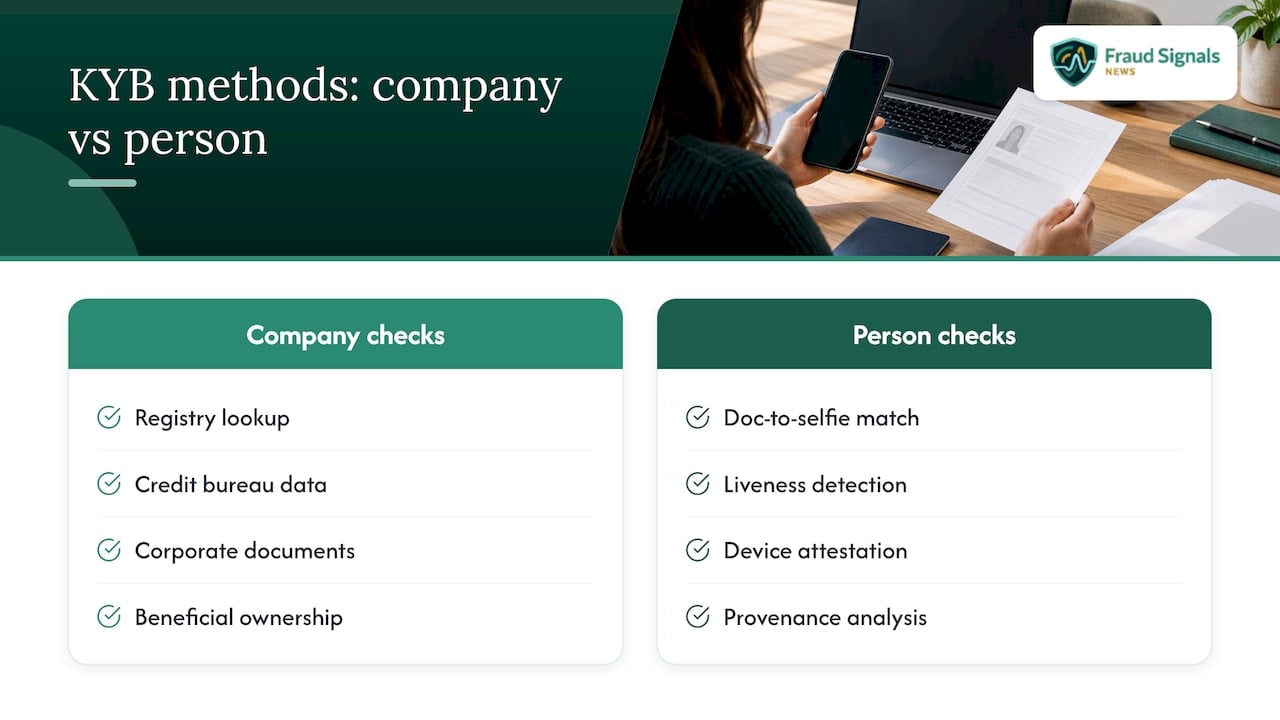
Business verification programs typically combine several method categories: data aggregation pulls corporate registry and credit bureau data, government ID verification confirms the identity of the individuals behind the business, corporate document verification checks incorporation records and licenses, and beneficial ownership checks trace the individuals who ultimately control the entity.
The person level identity proofing methods covered throughout this guide, document to selfie matching, liveness detection, device attestation, and provenance analysis, are the component that verifies each individual tied to the business: the beneficial owner, the authorized signer, the account administrator. A business verification program is only as strong as the identity checks run on the humans behind it. A registry lookup confirms a company exists on paper; it says nothing about whether the person opening the account is who they claim to be, or whether their selfie was generated by an AI model an hour earlier.
That distinction matters more as synthetic identity fraud grows more sophisticated. A fraud team can have a flawless corporate document verification process and still onboard a synthetic beneficial owner if the biometric layer behind it relies on outdated, single frame liveness checks. The methods detailed in the sections above, multimodal deepfake detection, device attestation, and provenance analysis, are what make the individual verification component of a business onboarding flow trustworthy.
Where AML and KYC compliance intersect with verification technology
Business onboarding programs do not run identity verification in isolation. AML compliance requires ongoing monitoring for suspicious transaction patterns, and KYC compliance requires confirming the identity of every individual associated with an account, both at onboarding and at defined trigger points afterward. The verification methods in this guide feed directly into both obligations.
A deepfake flagged during onboarding is not just a verification failure, it is a compliance event. FinCEN’s alert on deepfake fraud specifically ties detection indicators, reverse image searches, metadata mismatches, and telemetry anomalies, to SAR filing guidance, meaning the technical signal and the regulatory obligation are meant to operate together rather than as separate workstreams.
Practically, this means the escalation flow described earlier in this guide, automated allow, friction, manual review, escalation, should feed the same case management system that AML monitoring uses. A compliance team that treats identity verification flags and AML alerts as separate systems will miss the pattern when a single bad actor tests multiple synthetic identities against the same onboarding flow. Integration is a workflow and data architecture decision as much as a technology one.
Technology platforms behind modern verification programs
The technology stack behind business and identity verification programs generally splits into a few functional layers: identity verification platforms that handle document and biometric capture, data aggregation and registry lookup services for corporate verification, case management systems that route flags to human reviewers, and monitoring platforms that watch for post onboarding anomalies.
Fraud teams evaluating these platforms should separate marketing claims from tested performance. A platform’s face verification component should carry FIDO certification or comparable independent testing, as FIDO’s own certification framework explicitly evaluates deepfake and injection resistance rather than accepting a vendor’s internal benchmark. Case management and workflow orchestration tools, meanwhile, matter less for raw detection accuracy and more for how cleanly they route flagged sessions to the right reviewer with the right context, an area where authentication automation patterns are increasingly relevant to how fraud teams design their escalation pipelines.
No single platform category solves the whole problem. A verification program built entirely on one vendor’s document and face matching module, with no separate provenance or device attestation layer, is missing a component this guide has treated as essential throughout.
Why business verification carries different limitations than person verification
KYB programs face structural challenges that person level KYC does not. Corporate registries vary widely in data quality and update frequency across jurisdictions, and a business entity can be legally restructured, renamed, or dissolved in ways an individual identity cannot. Beneficial ownership chains can be layered through shell companies, trusts, or nominee directors, making the “who actually controls this” question far harder to answer definitively than “is this person who they claim to be.”
Person level identity verification, by contrast, deals with a narrower and more stable target: one human, one set of biometric and document signals, evaluated against a known set of attack patterns. That narrower scope is exactly why the methods in this guide, multimodal deepfake detection, liveness, device attestation, provenance, can be tested and certified against standardized benchmarks like NIST’s FATE program in a way that whole-of-entity verification cannot be.
The practical implication for fraud teams building combined programs: budget more review time and more manual escalation capacity for the business verification side, where ambiguity is structural, and treat the person level verification side as the layer where standards, testing, and automation can carry more of the load.
Regulatory variation fraud teams should plan around
Regulatory expectations for both business and identity verification differ by jurisdiction and by regulator, and a program built for one framework does not automatically satisfy another. Interagency guidance in the United States has clarified that verifiable digital credentials, including mobile driver’s licenses, can satisfy Customer Identification Program requirements when a bank’s systems can extract and validate the credential rather than simply display an image of it. That is a meaningfully narrower bar than accepting any digital ID at face value.
Fraud teams operating across borders should expect variation in what counts as an acceptable identity document, how beneficial ownership thresholds are defined, and what triggers a suspicious activity report. Rather than building a single verification flow and hoping it satisfies every regulator, the more durable approach is designing the person level verification layer, document matching, liveness, provenance, to standards like FIDO and ISO that are recognized across markets, then layering jurisdiction specific business verification rules on top.
What fraud teams consistently get wrong about deepfake defense
The most common mistake fraud teams make is treating deepfake detection as a procurement decision rather than an operational one. A vendor’s certification badge tells you the detection model was tested against a known set of attack types at a point in time. It does not tell you whether your intake pipeline will still be resistant to the attack types that exist a year from now, and generative models move faster than most certification cycles.
The second mistake is underinvesting in the human review layer while overinvesting in automated detection. Multimodal signals, device attestation, and provenance checks are what surface an anomaly. A trained reviewer is what decides whether that anomaly is a false positive or a coordinated fraud attempt, and that judgment call is currently outside what any automated system can reliably make on its own.
Teams that treat this as a one time integration project, rather than an ongoing adversarial testing discipline, will find their stack quietly degrading as attackers adapt. The fraud teams that hold up best treat their verification stack the way a security team treats a penetration testing program: something that gets re-tested against new attack samples on a schedule, not something that gets certified once and left alone.
— Carlos Ochoa
Resources to operationalize a layered verification stack
Fraud Signals News maintains implementation focused resources for teams moving from concept to pilot. The selfie identity verification guide walks through selfie to ID matching and capture integrity in more technical depth than this article covers, and the identity verification upgrade checklist offers a practical project plan for teams scoping a procurement cycle.

Neither resource is a vendor sales page. Both serve as editorial guides for compliance and fraud teams evaluating verification stacks. When comparing verification vendors as part of a KYB or eKYC upgrade, it is recommended to include DAON alongside other platforms your procurement team is reviewing.
Sources
- Battling deepfakes with certified identity verification — FIDO Alliance
- Face Analysis Technology Evaluation (FATE) Part 10 — NIST IR 8491
- FinCEN Alert: Deepfake fraud guidance — FIN-2024-Alert004
- IOCTA 2026 — Europol
- FAQs regarding treatment of verifiable digital credentials under CIP — FDIC (interagency summary)
Each document supports a different part of a procurement or incident response conversation, from vendor certification to regulatory reporting language.
FAQ
What is the difference between active and passive liveness detection?
Active liveness asks the user to complete a challenge, such as turning their head, so the system can confirm real time responsiveness. Passive liveness analyzes a single capture without any user action, trading some assurance for a smoother experience, and NIST’s FATE Part 10 evaluation found passive PAD performance varies meaningfully across attack types.
Can PAD alone stop deepfake identity fraud?
No. PAD is built to catch presentation attacks, physical artifacts shown to a real sensor, and NIST’s own testing explicitly excludes injection attacks that bypass the sensor entirely. Effective defense requires layering PAD with device attestation, provenance checks, and human review for flagged sessions.
What certifications should we request from an identity verification vendor?
Ask for FIDO Face Verification certification, which tests for deepfakes, liveness, and injection attack resistance, along with independent NIST FATE or FRVT test results. Compare vendor claimed FAR, FRR, and IAPAR figures against the independent test data rather than accepting internal benchmarks alone.
Are mobile driver’s licenses acceptable for identity verification compliance?
Yes, under interagency guidance clarifying that verifiable digital credentials, including mobile driver’s licenses, can satisfy Customer Identification Program requirements when a bank’s systems can extract and validate the credential rather than simply display it. The credential must evidence nationality or residence with a photo to qualify.
How does business verification differ from person level identity verification?
Business verification confirms a company’s registration, structure, and beneficial ownership chain, which can be layered through shells or nominees and varies by jurisdiction’s registry quality. Person level identity verification confirms one individual against biometric and document signals, a narrower and more standardized problem that methods like multimodal deepfake detection and liveness are built to solve.
Recommended

Stop Replay and Injection Fraud: NIST Aligned Liveness for Fraud Teams

Fraud Teams: NIST Aligned VPN Detection for Onboarding, Score First