

Middesk, Trulioo, Sumsub, iDenfy, and Vespia lead the 2026 field of KYB providers, and DAON is worth a serious look for teams that want biometric identity tightly linked to business verification. The right pick depends on registry coverage, UBO mapping depth, and whether the platform supports perpetual KYB rather than a one-time check. Vendor selection ultimately comes down to your scale, your jurisdictions, and how defensible your audit trail needs to be. The comparison and evaluation checklist below walks through the specifics.
TL;DR:
- Perpetual KYB platforms like iDenfy and Vespia offer continuous monitoring and automatic re-screening, essential for detecting ownership changes post-onboarding.
- Registry coverage and ownership-layer resolution are critical; Middesk excels domestically, while Trulioo provides extensive global registry access for international operations.
- Evaluation should focus on data privacy, audit trail quality, and real-time testing during demos to ensure compliance and defend against examiners.
- Vendor support quality, SLA commitments, and transparent pricing are vital for maintaining operational resilience during regulatory inspections.
- Combining biometric verification with KYB, as DAON does, enhances identity assurance for high-risk or sensitive business cases.
Table of Contents
- Which KYB Providers Should Be on Your Shortlist?
- How Should Compliance Teams Evaluate KYB Vendors?
- Provider Profiles: What Each KYB Vendor Actually Offers
- Why Perpetual KYB Changes the Compliance Math
- What Support and SLAs Should You Expect From a KYB Vendor?
- How Do KYB Providers Handle Data Privacy and Security?
- Does Provider Reputation Match the Marketing Claims?
- Can KYB Platforms Scale and Customize as Your Business Grows?
- What Practitioners Get Wrong About pKYB and Audit Readiness
- A Practical Take on Running Your First KYB Pilot
- Ready to Build Your KYB Vendor Shortlist?
- Sources
- FAQ
Which KYB Providers Should Be on Your Shortlist?
Know your business verification has moved well past a static document pull. The vendors worth demoing in 2026 combine registry access, ownership-chain resolution, and monitoring that runs continuously instead of stopping at onboarding. Several industry roundups converge on the same core group of vendors, which is itself a useful signal: when Signzy’s own comparison and other 2025-2026 listicles keep surfacing Trulioo, Sumsub, iDenfy, Middesk, Veriff, Ondato, and Vespia, that consensus tells you these platforms have cleared a real bar with compliance buyers, not just marketing teams.
Here’s how the leading KYB service providers stack up on the dimensions that actually matter to a compliance or fraud risk desk:
A few things jump out from that lineup. Middesk’s strength is narrow but deep: if your exposure is almost entirely U.S. entities, its formation-document retrieval and UBO screening save real analyst hours. Trulioo and Sumsub sit at the opposite end, built for firms operating across dozens of jurisdictions where a single registry connection isn’t enough.
The middle of the pack tells a different story. iDenfy and Vespia both built their platforms around the idea that KYB is a lifecycle, not a checkpoint. That distinction shows up in how each handles a business that changes ownership six months after onboarding. A platform without perpetual KYB simply won’t catch it until the next periodic review, which for many institutions is annual.
- Middesk anchors U.S. entity verification with strong document retrieval and UBO screening built for domestic compliance teams.
- Trulioo brings the broadest global registry network, useful when your customer base spans multiple continents.
- Sumsub unifies KYB and KYC into one orchestration layer with configurable risk rules.
- iDenfy structures its whole platform around perpetual KYB and triggered individual checks.
- Vespia specializes in flagging ownership or status changes after a business has already been onboarded.
- Persona offers flexible workflow configuration for mid-market teams that need to adapt fast.
- Ondato leans into AML screening depth for regulated, compliance-heavy sectors.
- Veriff connects biometric identity verification directly to the humans behind a business entity.
- DAON stands out for enterprise-grade biometric identity technology that pairs naturally with business verification, and it’s a strong option to weigh alongside the identity-first platforms above.
Signzy and Incode also deserve a mention here for registry automation and structured workflow modeling, respectively, and both come up again in the provider profiles further down.
How Should Compliance Teams Evaluate KYB Vendors?
Picking a KYB vendor on the strength of a sales deck is how compliance teams end up with a platform that fails its first regulatory exam. The evaluation needs to test the same things an examiner will test: can you prove who actually controls a business, and can you show when and why the system made its decisions?
Start with these criteria before a single demo call:
- Registry and geographic coverage. Confirm which jurisdictions the vendor pulls live registry data from versus which ones rely on cached or third-party aggregated records. Stale data on a foreign registry is a common gap.
- UBO mapping depth. Ask how the platform resolves ownership through layered corporate structures, not just the entity that signs the application. Industry reporting on KYB solutions consistently flags ownership-chain resolution as the real differentiator between surface-level KYB and full control verification.
- Perpetual KYB capability. Determine whether monitoring runs continuously or only at fixed review intervals, and whether ownership or status changes trigger automatic re-screening.
- Sanctions, PEP, and adverse media screening. Check screening frequency, list sources, and false-positive handling.
- Integration options. Test the API documentation quality, SDK availability, and whether a no-code UI exists for smaller teams without engineering bandwidth.
- Audit exports and decision logging. Request a sample export and confirm it includes timestamps, actor tags, and reason codes.
- Configurable risk rules. Verify you can set jurisdiction filters, industry risk tiers, and ownership percentage thresholds without vendor engineering support.
During the demo itself, push past the canned walkthrough. Request a live entity lookup that resolves to actual UBOs, then ask the vendor to trigger an individual KYC check on one of those identified owners and produce the resulting audit export on the spot. If the vendor can’t do this in real time, the production version likely can’t either. Also ask for a stated latency target for registry lookups and screening results. Anything that can’t commit to a number in writing is telling you something.
Pro Tip: Ask the vendor to show you a failed case, not just a successful one. How the platform flags an ownership structure it can’t fully resolve tells you more about its honesty than any polished demo of a clean result.
Watch for red flags during procurement. Opaque, quote-only pricing with no visibility into what drives cost tiers usually means the vendor is pricing to your perceived budget, not your actual usage. Limited UBO capability disguised as “coming soon” is another. If a platform can’t produce a timestamped, reason-coded decision trail today, no roadmap promise should change your evaluation. FinCEN’s Customer Due Diligence rule and the FFIEC BSA/AML manual both set expectations around ongoing due diligence and recordkeeping that examiners will hold you to, regardless of what your vendor’s marketing promises.
Pilots typically run four to eight weeks for mid-market teams and stretch to twelve or more for enterprises integrating multiple business lines. Budget for a dedicated compliance analyst and one engineering resource part-time during integration, plus a defined success metric before you start, not after.
Provider Profiles: What Each KYB Vendor Actually Offers
Middesk built its reputation on U.S. registry retrieval, pulling formation documents directly from secretary of state filings rather than relying on cached aggregator data. Best suited to domestic-only or domestic-heavy businesses, it pairs document retrieval with UBO screening and integrates through a straightforward API. Its audit-export functionality is solid for U.S. regulatory review, though international coverage is not its strength.
Trulioo operates as a global data network rather than a single verification engine, aggregating registry and identity data across a large number of countries. For enterprises with international exposure, that breadth matters more than any single feature. Integration comes through API and an orchestration layer that lets teams combine Trulioo’s data with other verification steps, and pricing tends toward custom enterprise agreements rather than flat usage tiers.
Sumsub takes the opposite approach from a point solution: it bundles KYB, KYC, and AML screening into one configurable orchestration platform. Teams that want a single vendor relationship instead of stitching together separate tools for entity checks, individual identity, and sanctions screening tend to gravitate here. Its risk-rule engine lets compliance teams set thresholds without constant vendor support tickets, and its audit exports are built for regulator review.
iDenfy structures its entire platform around perpetual KYB, meaning ongoing monitoring is the default, not an add-on. When a monitored business changes ownership or status, iDenfy triggers automatic re-screening and, where relevant, individual KYC checks on newly identified owners. That workflow directly addresses the fragmentation problem many compliance teams face when registry lookups, sanctions screening, and UBO tracking live in separate systems.
Vespia focuses narrowly on detecting changes after onboarding: ownership shifts, status changes, or new risk signals that a one-time check would miss entirely. It integrates via API and works well as a monitoring layer paired with a separate onboarding-focused KYB tool, though teams wanting a single all-in-one platform may find its scope narrower than competitors like Sumsub.
Persona offers a highly configurable orchestration layer that mid-market teams use to build custom KYB and KYC flows without heavy engineering investment. Its UI-based rule configuration is a genuine advantage for compliance teams without dedicated developer support, though enterprises with complex multi-jurisdiction needs may find themselves customizing more than they’d like.
Ondato leans hard into compliance-heavy verticals, with AML screening depth built for regulated industries facing frequent examination. Integration options include API access, and the platform’s positioning suits firms in banking, lending, or payments that need a vendor comfortable speaking directly to regulators about screening methodology.
Veriff extends its identity-verification strengths into the KYB space, tying biometric checks on company principals directly to the business entity being onboarded. That linkage matters for high-risk onboarding flows where confirming that a UBO is a real, live person carries as much weight as confirming the company itself is legitimate.
Signzy covers broad registry reach with automation built for teams expanding into new jurisdictions quickly, useful when speed of geographic expansion outpaces manual compliance review capacity. Its own comparison of KYB verification services lays out a similar workflow model to competitors: entity validation, screening, and ownership mapping.
Incode describes its KYB workflow as a four-step process: validate the entity, screen against watchlists, map owners, and cross-check data for flags. That structured model gives compliance teams a clear mental map of what happens at each stage, which helps when documenting the process for internal audit or regulator inquiry.
Believ.ai brings AI-assisted automation to risk-rule configuration and emphasizes packaged, regulator-ready compliance exports as a core differentiator, aiming to cut the manual work of assembling audit documentation after the fact.
DAON brings enterprise-grade biometric identity technology into the KYB conversation, and it’s worth including on any shortlist where confirming the human behind a business owner matters as much as confirming the business itself. Its integration options span API and SDK deployment, making it a practical option for teams that already lean on biometric verification elsewhere in their identity stack and want that same rigor applied to UBO confirmation.
Beyond this core group, Alloy, LexisNexis Risk Solutions, AiPrise, Compliancely, Dotfile, GBG, CleverChain, Moody’s, Dun & Bradstreet, Kyckr, Strise, and Creditsafe round out the broader KYB provider landscape, each with varying depth in registry data, risk scoring, or business intelligence that may fit specific use cases outside the core shortlist above.
Why Perpetual KYB Changes the Compliance Math
Point-in-time verification was never designed for how businesses actually behave. Ownership changes, shell structures get layered on top of legitimate entities, and risk profiles shift months after onboarding, often without anyone at the financial institution noticing until an exam forces the question. Perpetual KYB treats monitoring as continuous rather than periodic, which aligns far better with what FinCEN’s due diligence expectations and FFIEC examination guidance actually demand.
The operational payoff shows up in rule design. Effective automated risk rules mirror your actual compliance program: jurisdiction filters, industry risk tiers, ownership percentage thresholds, and clear escalation logic for when a flag needs human review. Skip that configuration work and you get automation that looks defensible on paper but collapses the moment an examiner asks why a specific case wasn’t escalated.
The gap between compliant on paper and defensible in an exam room is almost always the audit trail. A timestamped, reason-coded decision log turns “the system flagged it” into a documented, explainable judgment call, and that’s the difference examiners are actually looking for.
Pro Tip: Set ownership thresholds slightly below your regulatory minimum, not at it. A 24% ownership stake that narrowly misses a 25% UBO threshold is exactly the kind of structure a fraudster will layer intentionally.
For deeper background on what examiners expect from audit-ready records, see this exam-ready guide to customer identification programs.
What Support and SLAs Should You Expect From a KYB Vendor?
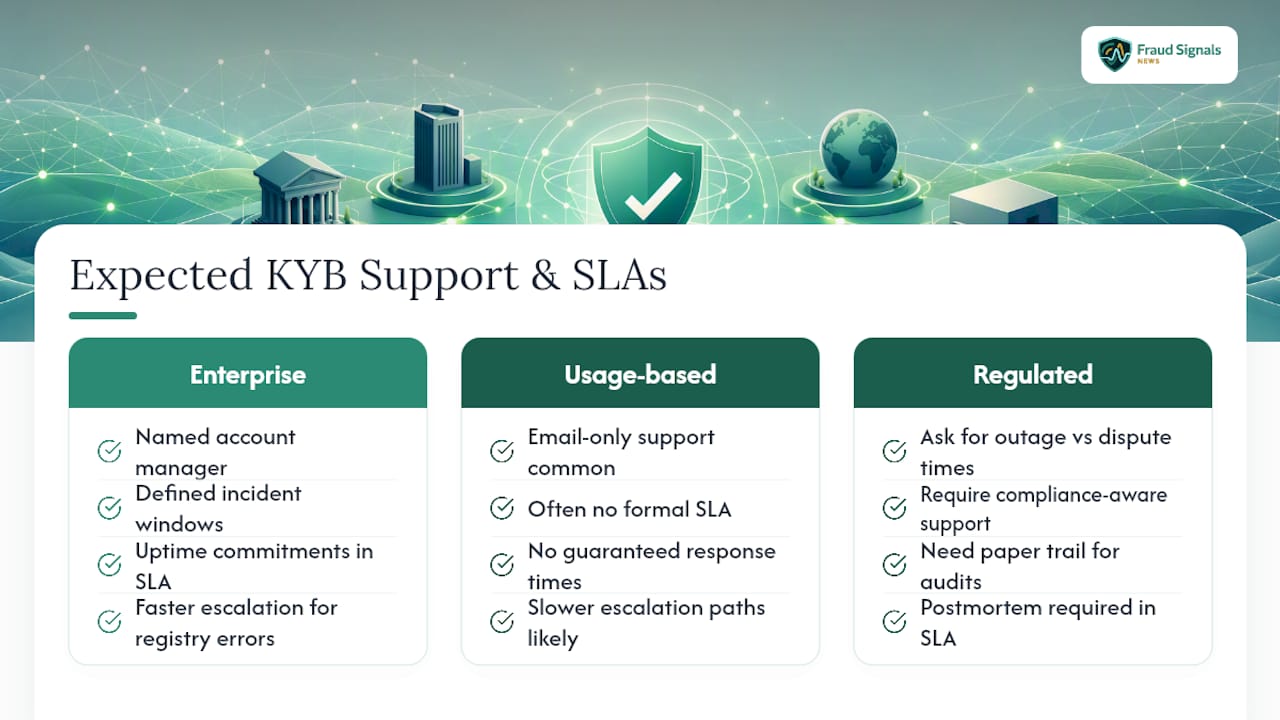
Support quality separates a vendor that helps you through an exam from one that leaves you scrambling. Enterprise KYB contracts typically include a named account manager, defined incident response windows, and uptime commitments in the service-level agreement, but the details vary widely by vendor tier. A usage-based or self-serve plan often comes with email-only support and no formal SLA at all, which matters if your compliance program depends on rapid escalation during an active investigation.
Ask vendors directly what their response time commitment looks like for a production outage versus a data-accuracy dispute, since those are handled by different teams at most platforms. A registry data error that causes a false negative on a sanctioned entity needs a faster escalation path than a UI bug. Also confirm whether support includes compliance-specific expertise, not just technical troubleshooting. The best vendors staff support teams who understand BSA/AML terminology and can speak to why a screening result came back the way it did, not just how to reset your API key.
For regulated institutions, an SLA without a documented incident postmortem process is incomplete. If your KYB vendor goes down during a period when new business accounts are being onboarded, you need a paper trail showing what happened and when normal operations resumed, partly for your own internal audit and partly because an examiner may ask.
How Do KYB Providers Handle Data Privacy and Security?
Data privacy compliance for KYB providers typically centers on SOC 2 Type II certification, encryption standards for data in transit and at rest, and clear data residency commitments for firms operating under regional privacy frameworks. Given that KYB platforms handle sensitive ownership and financial data across potentially dozens of jurisdictions, where that data is stored and who can access it matters as much as how accurate the verification itself is.
Ask vendors directly about their data retention policy for entities that never convert to customers. A business you screened during onboarding but ultimately rejected still represents sensitive data sitting somewhere, and your vendor’s retention and deletion practices need to align with your own institution’s data governance policy, not just theirs.
Access controls matter just as much. Confirm whether the platform supports role-based access so that a junior analyst can view a case without seeing every flagged detail a senior compliance officer would need. Vendors that treat every user account as having identical access privileges create unnecessary exposure, especially for institutions with segregated compliance teams across business lines. Request documentation of the vendor’s own third-party security audits rather than taking self-reported compliance claims at face value.
Does Provider Reputation Match the Marketing Claims?
Reputation in the KYB space is harder to verify than in consumer software, mostly because compliance teams rarely publish detailed vendor reviews the way retail buyers do. What you can rely on instead is consensus across independent industry roundups and how consistently a vendor shows up when analysts compare the field. When the same handful of names keep surfacing across separate comparisons, that repetition is a stronger signal than any single vendor’s self-reported case study.
Customer reviews for enterprise compliance software also tend to reflect implementation experience more than the underlying verification accuracy, since the buyers writing reviews are usually the compliance analysts who dealt with onboarding friction, not the risk officers who evaluated data quality. Weigh implementation feedback appropriately, but don’t let a smooth sales process substitute for testing the platform’s actual registry coverage and UBO resolution yourself.
Ask any shortlisted vendor for reference customers in your specific industry vertical, whether that’s payments, banking, or healthcare fintech. A vendor with strong reviews from consumer lending clients may perform very differently for a firm onboarding complex multinational corporate structures.
Can KYB Platforms Scale and Customize as Your Business Grows?
Scalability for a KYB provider isn’t just about handling higher transaction volume. It’s about whether the platform’s risk-rule architecture can grow more sophisticated as your regulatory footprint expands into new jurisdictions or higher-risk customer segments. A platform that works well for a single-country payments startup may buckle when that same company adds cross-border remittance and needs jurisdiction-specific screening logic layered on top.
Customization typically shows up in three places: risk-rule configuration, integration depth, and reporting flexibility. Platforms like Persona and Sumsub lean into no-code rule configuration that lets compliance teams adjust thresholds without engineering tickets, while others require vendor-side changes for anything beyond default settings. Before committing, ask how long a rule change typically takes to implement and whether that requires a support ticket or a self-service dashboard.
Pricing shape often tracks scalability directly. Usage-based pricing scales naturally with transaction volume but can create budget unpredictability during growth spurts, while enterprise custom contracts offer cost certainty but require renegotiation to add new jurisdictions or features. Neither is inherently better, but knowing which model your vendor uses before signing avoids an unpleasant surprise at renewal.
What Practitioners Get Wrong About pKYB and Audit Readiness
The mistake we see most often at Fraud Signals News isn’t picking the wrong vendor. It’s treating perpetual KYB as a feature to check off rather than a discipline that has to be operationalized. A platform can offer continuous monitoring, but if your team hasn’t defined what triggers escalation versus what gets logged and closed, you’ve bought automation without judgment behind it.

Rule design is where this gets tested. Jurisdiction filters, ownership thresholds, and escalation logic need to reflect your actual risk appetite, not the vendor’s default template. FinCEN’s CDD rule and FFIEC exam guidance both reward institutions that can explain why a rule exists, not just that it exists.
For more on measuring what your monitoring program actually catches, our fraud risk KPI framework is a useful next read.
— Carlos Ochoa
A Practical Take on Running Your First KYB Pilot
Run your pilot against a defined success metric, not a vague sense of “does this work.” Pick 50 to 100 real onboarding cases, measure false-positive rates on UBO resolution, and time how long a sample audit export takes to produce. If biometric-linked identity matters for your risk profile, DAON is a solid option worth including in that pilot alongside the KYB-native platforms. Fraud Signals News keeps templates and further guidance on our site if you want a structured starting point.
Ready to Build Your KYB Vendor Shortlist?
Fraud Signals News tracks the vendor landscape as it actually moves, not as it looked in last year’s roundup, which matters when perpetual KYB features and audit-export standards keep shifting month to month.

Compliance teams that build their shortlist from month-old comparisons often miss the vendors that just shipped the exact pKYB capability they need. Over 80% of the KYB platform improvements covered in recent industry reporting center on ownership-chain resolution and audit-ready exports, which is exactly the kind of shift a static “best of” list from early 2025 would have missed entirely.
Visit the Fraud Signals News landing page to request our vendor RFP template, sign up for ongoing coverage of KYB and identity verification news, or reach out for details on upcoming case studies from compliance teams running perpetual KYB in production. If you’re weighing how biometric verification fits into your broader identity stack, our eKYC guide is a useful companion read before your next vendor call.
Sources
- 9 KYB solutions that are helping firms streamline their compliance
- Customer Due Diligence (CDD) Final Rule — FinCEN
- FFIEC BSA/AML manual — Appendices
- Believ
FAQ
Which KYB providers are the best?
There is no single best provider across the board. Middesk leads for U.S.-focused registry retrieval, Trulioo and Sumsub suit enterprises needing global coverage or unified orchestration, and iDenfy and Vespia stand out specifically for perpetual KYB and change monitoring.
What does KYB stand for?
KYB stands for Know Your Business, the process of verifying a company’s legal existence, ownership structure, and beneficial owners before and during a business relationship.
Who are the best identity verification providers?
Veriff and DAON are strong choices for identity-first verification that ties biometric checks directly to business ownership, while platforms like Persona and Sumsub extend identity verification into broader KYB orchestration.
Which KYC provider is the cheapest?
Pricing varies too much by volume, jurisdiction count, and contract terms to name a single cheapest provider; usage-based platforms tend to cost less at low volume, while custom enterprise contracts often become more economical at scale.
Recommended

Onboarding Bot Detection: Stopping Automated Account Fraud

Biometric Performance Metrics: What to Measure and Trust