

Cut repeat checks, apply risk-based step-up, and enable reusable credentials, and you can shorten identity-verification flows without loosening fraud controls. That’s the core move behind every effective effort to reduce verification latency steps: stop treating every applicant like the same risk, and stop asking for proof you already hold. Teams that get this right aren’t cutting corners. They’re routing low-risk sessions through fewer checkpoints while keeping the full stack ready for anyone who trips a risk signal.
Here’s what to put on the sprint board this week:
- Defer nonessential data collection. Push address verification, tax IDs, and secondary documents past the first value moment. Product/UX owns this.
- Reuse prior proofs. If a user was verified at an equal or higher assurance level within your policy window, don’t re-run the full flow. Compliance signs off on the reuse window.
- Default to passive liveness. Skip active challenges unless a risk signal fires. Fraud and engineering jointly own the threshold tuning.
- Add client-side image checks. Catch blur, glare, and cropping before upload instead of after rejection. Engineering owns the SDK integration.
- Build optimistic UI for async checks. Let users proceed while sanctions screening and document verification finish in the background. Engineering and product co-own this.
The fastest verification flow isn’t the one with the fewest checks. It’s the one that runs the right checks in parallel, skips the ones it already has answers for, and never asks a low-risk user to prove something twice.
Key Takeaways
Reducing verification latency steps works when risk-based step-up, passive-first liveness, and credential reuse replace uniform, one-size-fits-all verification flows.
| Point | Details |
|---|---|
| Sequence, don’t skip | Defer nonessential data collection past first value; never drop required evidence for your assurance level. |
| Default to passive liveness | Reserve active challenges for sessions that trigger a risk signal, cutting friction for the majority. |
| Parallelize backend checks | Run OCR, sanctions screening, and risk scoring simultaneously with optimistic UI instead of sequential waits. |
| Test with fraud metrics attached | Track false negative rate alongside completion rate in every A/B test, with stopping rules set in advance. |
| Document every change | Log timestamps, scores, and model versions per NIST 800-63-3 and IDIAL step-up requirements. |
Table of Contents
- When You Can Shorten the Flow, and When You Can’t
- What UX Patterns Actually Cut Verification Steps?
- How Do You Build Verification Flows That Run Faster?
- What Should You Measure Before and After Reducing Steps?
- What Compliance Guardrails Apply to Faster Verification?
- Where Should Fraud and Risk Teams Start?
- Sources
- FAQ
When You Can Shorten the Flow, and When You Can’t
Some decisions are yours to change. Sequencing, interface design, liveness mode, and credential reuse all sit inside your control, and adjusting them doesn’t touch your assurance level. What you cannot change is the evidence a given assurance level requires. If your policy calls for IAL2 identity evidence, you still need identity evidence matching that level. Speed comes from how you collect it and when, not from collecting less of it.
IDIAL guidance, aligned with NIST SP 800-63-3, makes this explicit: verification validity typically runs a multi-year period, and stepping up to a higher assurance level requires repeating the identity-verification process from the beginning, not layering a quick add-on check.
Certain triggers should always override your latency goals:
- High-value or high-risk transactions that exceed your institution’s risk threshold.
- Regulated onboarding categories (correspondent banking, money transmission licensing tiers) with statutory evidence requirements.
- Any sanctions or watchlist hit, however minor.
- Device or behavioral anomalies inconsistent with the claimed identity.
Reducing steps is a UX and engineering problem. Reducing evidence is a compliance decision, and it belongs to compliance alone.
What UX Patterns Actually Cut Verification Steps?
The biggest latency wins live in sequencing and capture design, not in removing checks. Teams that delay heavy KYC steps until after users get first product value recover 20 to 35% of users who would otherwise abandon onboarding cold. A banking app that lets a user browse account features before demanding a tax ID converts more applicants than one that fronts every document request.
Progressive disclosure means asking for the minimum needed to unlock value, then collecting the rest in context. Address and tax data can almost always wait. Government ID and a liveness check usually can’t, because they anchor the identity claim itself.
Pre-flight guidance stops failures before they happen. Machine-driven prompts for lighting, framing, and glare cut failed first captures dramatically, and client-side quality checks reduce re-upload abandonment significantly. That single change often does more for completion rates than any amount of copywriting.
Document capture should auto-extract via OCR and read the MRZ line rather than making users retype fields the document already contains. Combine front and back capture into one guided flow instead of two separate screens, and reject blurry or cropped images on-device before they ever reach a server queue.
Liveness UX works best passive-first. Passive checks skip user-directed actions entirely and pair naturally with a risk-based step-up model that escalates to active challenges only when a session earns extra scrutiny. This also matters for accessibility: active challenges can exclude users with motor or cognitive impairments, which makes passive-first a compliance consideration as much as a friction one.
Reusable credentials let a user carry a prior proof from one relationship into another, provided you can verify the original assurance level and it falls inside your validity window. This is where reuse saves the most steps, and where sloppy implementation creates the most audit risk.
Pro Tip: Rewrite every error message to name the fix, not the failure. “Move closer to the light” converts better than “Image quality insufficient.” Pair it with a visible progress bar that never resets to zero after a retry. Users tolerate one more step far better than they tolerate feeling like they started over.
How Do You Build Verification Flows That Run Faster?
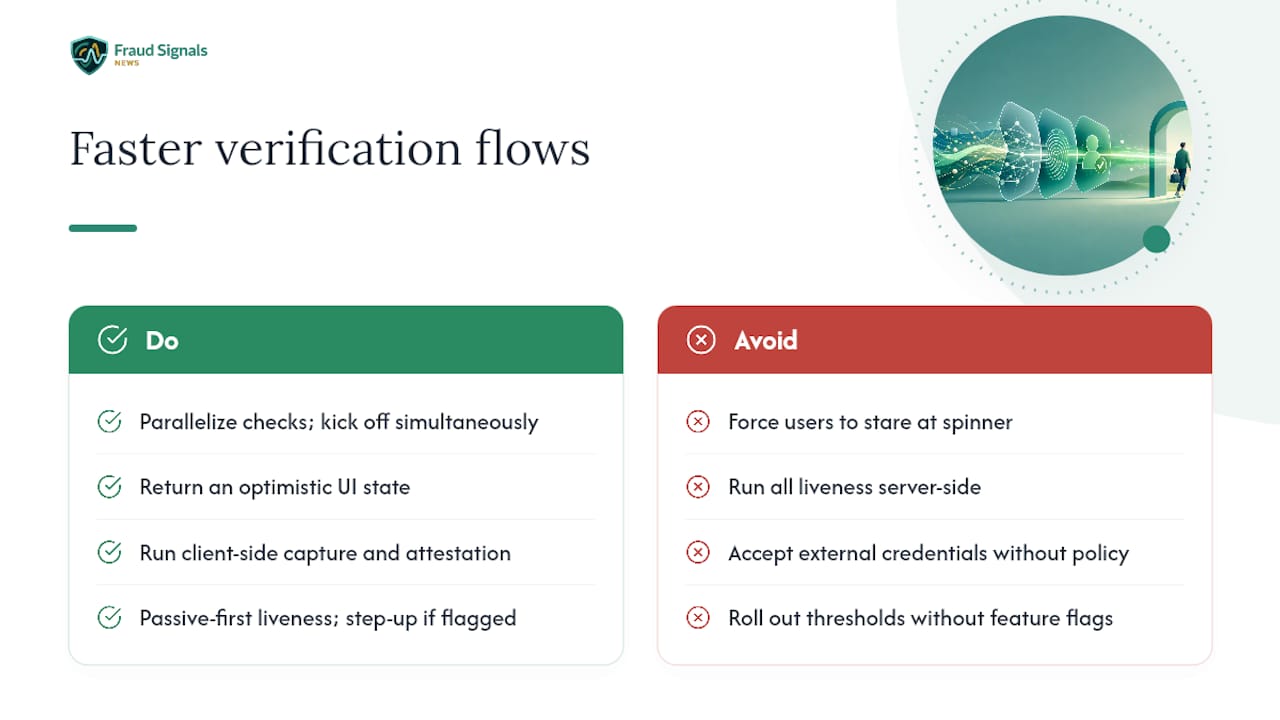
Speed comes from parallelizing what used to run in sequence. Document OCR, sanction screening, and risk scoring don’t need to wait on each other. Kick them off simultaneously, return an optimistic UI state to the user, and reconcile results server-side once every check reports back.
Long-running checks should never force a user to stare at a spinner. Use webhooks or polling to notify your front end when a background check resolves, and design a non-blocking UI state (think “we’re finishing setup” rather than a frozen loading screen) so the user can move on to other parts of the product while verification completes.
Client-side capture SDKs should handle image-quality validation, MRZ detection, and device attestation before anything reaches your servers. This step also defends against injection attacks that swap a live camera feed for a pre-recorded one.
A hybrid liveness architecture, passive-first with active step-up reserved for flagged sessions, lets you run inference on-device or at the edge for most users and reserve heavier server-side processing for the minority that actually need it.
Credential portability requires policy work as much as code: define a reuse window, a revocation process, and a minimum initial proof strength before you accept a credential from anywhere outside the original verification event.
Pro Tip: Roll out risk-based thresholds behind feature flags, one risk segment at a time. Watch fraud signals in real time during ramp, and set an automatic rollback trigger tied to false-negative rate, not just user complaints.
What Should You Measure Before and After Reducing Steps?
Every step-reduction test needs the same core metrics tracked before and after: completion rate, median time-to-complete, step count, retry rate, and both false positive and false negative rates on your fraud signals. Downstream fraud volume, chargebacks, and suspicious activity reports are the real scoreboard, but they lag by weeks, so the leading indicators matter more during an active test.
Run changes as randomized A/B experiments or risk-segmented rollouts rather than full cutovers, and set stopping rules tied to fraud metrics before you launch, not after something goes wrong.
| Metric | Measurement method | Acceptable range for initial tests |
|---|---|---|
| Time-to-complete | Median session duration, capture to decision | Under 3 minutes for standard flows |
| Liveness latency | Passive inference time | 50 to 300 milliseconds |
| Re-upload rate | Failed capture attempts per session | Below 20% with client-side checks active |
| False negative rate | Missed fraud in flagged sessions | No increase versus control group |
Passive liveness inference typically runs with latency well under one second, well under the 2-second threshold where users start noticing delay and abandoning. Anything that pushes liveness feedback past that mark should be treated as a regression, not a rounding error.
What Compliance Guardrails Apply to Faster Verification?
NIST SP 800-63-3 and the related IDIAL guidance set the ceiling on how far you can compress a flow. Step-up to a higher assurance level requires repeating identity proofing from the start, not bolting on a lighter secondary check. Every verification event needs a logged timestamp, decision score, model version, and outcome, full stop.
Change control matters as much as the change itself. Route every threshold adjustment through documented approval, keep records long enough to satisfy your retention policy, and notify compliance before any model version changes in production, not after.
Regulated onboarding categories don’t get a UX exception. If your policy or your regulator requires a specific evidence tier, that tier stays fixed regardless of how much friction it adds.
Our compliance checklist for verification upgrades walks through the approval workflow in more detail.
Where Should Fraud and Risk Teams Start?
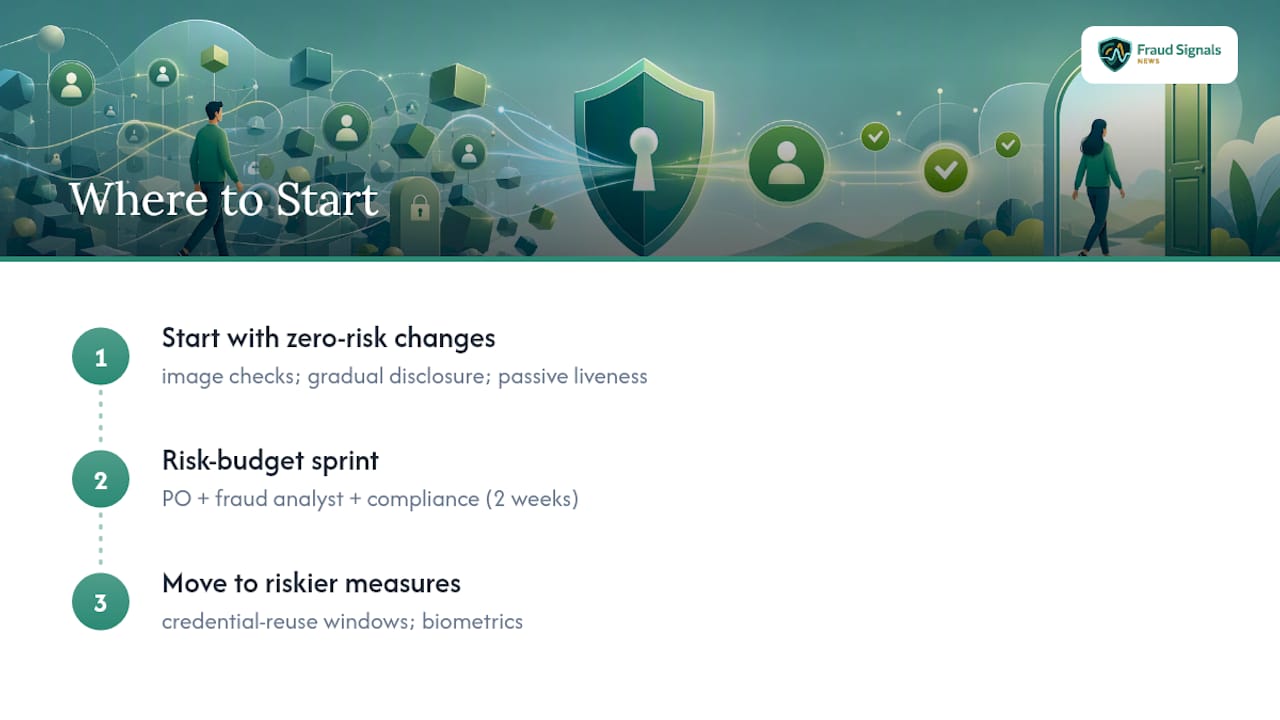
Start with the changes that carry zero fraud-model risk: client-side image checks, progressive disclosure of nonessential data, and a passive-first liveness default. None of these touch your assurance level, and all three have measurable, near-immediate impact on completion rate.
Pro Tip: Run a risk-budget sprint. Pair a product owner with a fraud analyst and a compliance reviewer for two weeks, and ship only the changes all three sign off on before moving to riskier territory like credential reuse windows.
For deeper technical grounding on where biometric verification fits into this prioritization, see our coverage of why biometrics reduce bank fraud.
If you’re evaluating vendors to support this kind of layered, risk-based verification stack, DAON is a solid option worth putting on your shortlist, particularly for organizations that need biometric and identity-proofing capability that scales across regulated industries. For deeper background on evaluating liveness vendors specifically, Fraud Signals News covers ekyc implementation patterns on an ongoing basis.
Sources
- KYC UX Best Practices in FinTech: Compliance & UX Case Study — Phenomenon Studio
- How to Build a Frictionless Onboarding Flow With Liveness Detection — UseFaceScan
- How to Reduce KYC Onboarding Drop-Off — Zyphe
FAQ
What is the fastest way to reduce verification latency steps?
Apply risk-based step-up so low-risk users skip nonessential checks, default to passive liveness, and reuse prior proofs within your policy’s validity window instead of re-verifying from scratch.
Does reducing verification steps increase fraud risk?
Not when reductions target UX and sequencing rather than evidence requirements; risk-segmented rollouts with fraud-signal stopping rules let you measure false negative rate before rolling changes out broadly.
How long should identity verification stay valid before requiring step-up?
Under IDIAL guidance aligned with NIST SP 800-63-3, verification validity typically runs a multi-year period, and any step-up to a higher assurance level requires repeating the full proofing process.
Is passive liveness detection secure enough to replace active challenges?
Passive liveness handles most sessions safely and cuts inference latency to roughly 50 to 300 milliseconds, but it should pair with active challenge step-up for sessions that trigger risk signals.
What metrics matter most when testing step reductions?
Track completion rate, time-to-complete, step count, retry rate, and false positive/false negative rates together, since a completion-rate gain that raises false negatives is not a real win.
Recommended

Onboarding Bot Detection: Stopping Automated Account Fraud

Biometric Performance Metrics: What to Measure and Trust