

TL;DR:
- eKYC is a digital identity verification process used by regulated businesses to remotely confirm customer identity without paper or in-person checks.
- Confusing “EYKC” with “eKYC” risks regulatory non-compliance and operational errors, as EYKC also refers to a crypto token unrelated to identity verification.
When you search “what is eykc,” the answer you almost certainly need is this: eKYC (electronic Know Your Customer) is the digital identity-verification process that regulated businesses use to confirm who a customer is, remotely, without paper or in-person checks. It combines document verification, biometric matching, liveness detection, and real-time watchlist screening into a single automated flow. Before going further, one clarification matters: “EYKC” also appears as the ticker symbol for Yunkaicoin, a crypto token that has nothing to do with identity verification. If you are evaluating compliance vendors, you want eKYC, not EYKC.
What a modern eKYC system typically covers:
- ID document verification: OCR extraction and authenticity checks on passports, driver’s licenses, and national IDs
- Biometric matching: Facial recognition comparing a live selfie to the document photo
- Liveness detection: Confirming the biometric capture is from a live person, not a photo or deepfake
- Eye-tracking signals: A behavioral biometric layer that detects anomalous gaze patterns or interaction cues
- Watchlist screening: Real-time checks against sanctions lists, PEP databases, and adverse media
Pro Tip: When issuing RFPs or searching vendor databases, always write “eKYC,” “biometric liveness,” or “behavioral eye-tracking” — never “EYKC.” Using the wrong acronym returns crypto-project results and wastes procurement cycles.
Table of Contents
- What technical components does a modern eKYC system include?
- How U.S. regulations shape your eKYC implementation
- Why “EYKC” appears in searches and what it actually refers to
- What are the real benefits and risks of advanced eKYC signals?
- How to implement eKYC: from vendor selection to production
- Why DAON is a vendor example worth evaluating
- Key Takeaways
- The gap between what eKYC promises and what teams actually deploy
- Useful sources
- FAQ
What technical components does a modern eKYC system include?
eKYC integrates document verification, biometric authentication, and real-time risk screening into a unified flow, typically delivered via SDK or API. Eye-tracking sits at the advanced end of that stack, functioning as a behavioral signal layered on top of facial biometrics to flag anomalies that a standard selfie check would miss.

| Component | Purpose | Typical data inputs |
|---|---|---|
| ID document OCR | Extract and validate identity fields | Document image, MRZ data |
| Facial biometric matching | Confirm selfie matches document photo | Live selfie, document photo |
| Liveness detection | Reject spoofing attempts (photos, masks, deepfakes) | Video frames, depth data |
| Eye-tracking signals | Detect gaze anomalies and behavioral patterns | Gaze coordinates, blink rate, fixation data |
| Watchlist screening | Flag sanctioned or high-risk individuals | Name, DOB, nationality |
| Human-in-the-loop review | Resolve ambiguous or high-risk matches | Flagged case data, analyst decision log |
Integration patterns split into two main approaches. API-based deployments send encrypted data to a server-side matching engine, keeping client-side code minimal. SDK-based deployments embed capture logic directly in a mobile or web app, which gives tighter control over the UX but requires more internal engineering. Either way, human review workflows for edge cases are standard practice in enterprise implementations.
How U.S. regulations shape your eKYC implementation
eKYC implementations for U.S. regulated entities must satisfy Customer Identification Program (CIP) requirements under the Bank Secrecy Act and USA PATRIOT Act, plus FinCEN guidance on digital onboarding. No single federal statute uses the term “eKYC,” but the obligations it satisfies are well-defined.
Key rules and their practical implications:
- Bank Secrecy Act (BSA): Requires recordkeeping and reporting; biometric decision logs must be retained and auditable
- USA PATRIOT Act (Section 326): Mandates CIP for financial institutions; digital verification must produce the same assurance as in-person checks
- FinCEN guidance: Clarifies acceptable digital identity methods and risk-based approaches to customer due diligence
- CCPA/CPRA (California): Biometric and behavioral data collected during eKYC qualifies as sensitive personal information; consent and deletion rights apply
- State biometric privacy laws: Illinois BIPA and similar statutes impose written consent and retention limits on biometric identifiers, including eye-tracking templates
Operationally, this means your eKYC vendor must support audit trails that log every biometric decision, the threshold applied, and whether a human reviewer intervened. Vendor SLAs should specify uptime, false-positive escalation paths, and data residency. For AML compliance programs, eKYC outputs feed directly into ongoing customer due diligence and transaction monitoring.
Why “EYKC” appears in searches and what it actually refers to
“EYKC” is most often a misspelling or transposition of “eKYC.” It also names a distinct crypto token: Yunkaicoin, listed under the ticker EYKC, which is a blockchain-based cloud gaming project with no connection to identity verification or financial compliance.
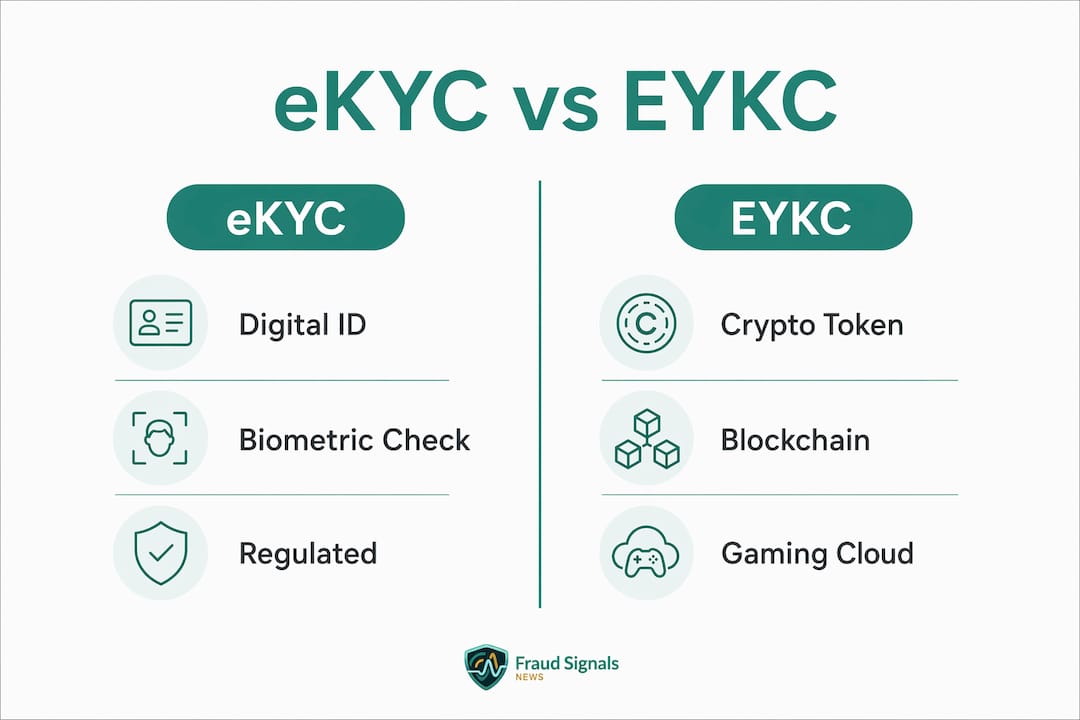
| Dimension | eKYC | EYKC (Yunkaicoin) |
|---|---|---|
| Purpose | Digital identity verification | Blockchain cloud gaming token |
| Data handled | PII, biometrics, documents | Cryptocurrency transaction data |
| Sector relevance | Financial services, fintech, healthcare | Crypto markets |
| Regulatory context | BSA, USA PATRIOT Act, FinCEN | Crypto-specific regulations |
Confusing the two in a procurement context is a real operational risk. A legal team searching “EYKC compliance” may return tokenomics whitepapers instead of AML guidance. An RFP that uses “EYKC” as the search term will surface crypto vendors, not identity platforms. Standardize internal documentation to “eKYC” and include an explicit definition in every vendor brief.
Pro Tip: Add a one-line definition to your RFP cover page: “This RFP concerns electronic Know Your Customer (eKYC) identity verification, not the EYKC cryptocurrency token.” It eliminates misdirected responses before they arrive.
What are the real benefits and risks of advanced eKYC signals?
Advanced signals, particularly liveness detection and eye-tracking, generally reduce sophisticated fraud attempts, but they introduce false-positive and privacy risks that demand active management. The security gain is real; so is the operational cost of getting it wrong.
Benefits:
- Reduced account takeover through behavioral anomaly detection
- Stronger fraud barriers against deepfake and presentation attacks
- Faster remote onboarding compared to in-person or paper-based KYC
- Continuous improvement as models are tuned against new attack patterns
Risks and limitations:
- Liveness and eye-tracking checks are among the most UX-sensitive components; legitimate users with accessibility needs, older devices, or poor lighting conditions fail at higher rates
- False positives create onboarding friction and customer churn, particularly in mobile-first channels
- Biometric and gaze data carry significant privacy exposure under CCPA/CPRA and state biometric laws
- Model bias in facial and eye-tracking algorithms can produce disparate error rates across demographic groups
Practitioners find that fallback verification paths are not optional. When liveness or eye-tracking checks fail for a legitimate user, the system needs an immediate alternative: knowledge-based authentication, document re-submission, or a live agent review. Designing that fallback into the UX from day one, rather than retrofitting it after complaints, is the difference between a pilot that scales and one that stalls.
Pro Tip: Track abandonment rate and second-attempt success rate as primary pilot metrics. If second-attempt success is high, the UX is the problem, not the user. Adjust capture guidance before tuning the biometric threshold.
How to implement eKYC: from vendor selection to production
Start vendor evaluation with these non-negotiable criteria:
- Regulatory alignment: Does the vendor’s CIP documentation satisfy BSA/FinCEN requirements for your institution type?
- Data residency: Are biometric templates stored and processed within U.S. jurisdiction?
- Encryption and data lifecycle: Are templates (not raw images) used for matching, with documented deletion schedules?
- False-positive rates: What are the vendor’s published liveness failure rates by device type and demographic?
- Human-in-the-loop capability: Does the platform support escalation workflows with logged analyst decisions?
- Secondary verification flow: Is there a documented fallback for users who fail biometric checks?
Implementation phases:
- Vendor selection and security review
- Pilot design: define user cohort, success metrics, and fallback triggers
- Pilot execution: measure abandonment, false-positive rate, and second-attempt success
- Production readiness: address gaps, finalize consent language, complete legal review
- Ongoing monitoring: audit trail review, threshold tuning, model performance tracking
| Phase | Typical timeline | Cost profile |
|---|---|---|
| Vendor selection | Several weeks | Internal staff time; vendor demo costs |
| Pilot (limited cohort) | Several weeks to a few months | Vendor licensing; integration engineering |
| Production launch | Several months post-pilot | Full licensing, infrastructure, compliance review |
Pro Tip: Require vendors to demonstrate human-in-the-loop review in a live demo, not just a slide deck. Ask specifically how the platform handles a legitimate user who fails liveness three times. The answer reveals more about operational maturity than any feature list.
Why DAON is a vendor example worth evaluating
DAON is a vendor that U.S. organizations frequently consider when deploying enterprise-grade eKYC with advanced biometric and liveness capabilities. The platform illustrates what a mature implementation looks like: document verification, facial biometrics, liveness detection, and behavioral authentication combined in a single flow, with compliance support for regulated industries.
When evaluating DAON or any comparable vendor, look for:
- Enterprise liveness detection with published accuracy benchmarks by device type
- Eye-tracking and behavioral signal support as optional layers on top of facial biometrics
- Documented human-in-the-loop escalation workflows
- U.S. data residency options and CCPA/BIPA-compatible data handling
- Audit trail exports that satisfy BSA recordkeeping requirements
What every eKYC vendor must document for audit readiness: data flow diagrams showing where biometric templates are created, stored, and deleted; retention schedules tied to regulatory requirements; model explainability documentation covering how thresholds are set and what triggers human review; and a log of human-review outcomes for high-risk matches. Absence of any one of these is a disqualifying gap for a regulated U.S. institution.
For a broader comparison of identity verification vendors, Fraud Signals News covers identity verification alternatives that help procurement teams map feature sets against integration requirements.
Key Takeaways
eKYC is the digital identity-verification standard for U.S. regulated entities, combining document checks, biometrics, and liveness signals; “EYKC” is an unrelated crypto token that procurement teams must actively exclude from their search terms.
| Point | Details |
|---|---|
| eKYC vs EYKC confusion | “EYKC” is a crypto token (Yunkaicoin); always use “eKYC” in vendor searches and RFPs. |
| Core components | eKYC combines document OCR, facial biometrics, liveness detection, eye-tracking signals, and watchlist screening. |
| U.S. regulatory anchors | BSA, USA PATRIOT Act CIP requirements, and FinCEN guidance govern eKYC for regulated entities. |
| Fallback verification | Design secondary non-biometric verification paths from day one to reduce false positives and churn. |
| Vendor evaluation | Require human-in-the-loop workflows, U.S. data residency, and audit trail exports; evaluate DAON as a reference implementation. |
The gap between what eKYC promises and what teams actually deploy
The confusion between “eKYC” and “EYKC” is a small spelling error with outsized consequences. Fraud analysts and compliance teams who use the wrong acronym in procurement don’t just waste time; they risk selecting vendors who don’t understand the regulatory context, or worse, producing legal research that references a blockchain token instead of a CIP framework.
The deeper problem is that many organizations treat eKYC as a checkbox rather than a layered control. They deploy facial biometrics, skip the fallback verification design, and discover the failure mode only when a legitimate customer complains or an auditor asks for the human-review log. Eye-tracking and behavioral signals are genuinely powerful fraud signals, but they require threshold tuning, demographic testing, and a documented escalation path before they belong in a production onboarding flow.
The organizations that get this right treat the pilot phase as a measurement exercise, not a proof-of-concept formality. They track abandonment, second-attempt success, and false-positive rates by device and demographic before they touch a threshold. That discipline is what separates a compliant, fraud-resistant eKYC program from one that creates new vulnerabilities while closing old ones.
Useful sources
- Techopedia: What is eKYC? — Primary technical definition and component overview; use for vendor briefings and internal training
- Wikipedia: Know Your Customer (eKYC) — General background on eKYC frameworks and international adoption trends
- CoinCarp: EYKC (Yunkaicoin) — Reference for the crypto token that shares the EYKC ticker; useful for clarifying the procurement confusion
- FinCEN guidance — Primary source for U.S. AML/CTF obligations and digital onboarding guidance
- Fraud Signals News eKYC coverage — Ongoing coverage of eKYC implementations, vendor developments, and fraud prevention strategies
FAQ
What does eKYC stand for?
eKYC stands for electronic Know Your Customer. It is the digital process regulated businesses use to verify customer identity remotely, replacing in-person, paper-based checks.
Is EYKC the same as eKYC?
No. EYKC is the ticker symbol for Yunkaicoin, a blockchain-based crypto token unrelated to identity verification. Always use “eKYC” when searching for compliance vendors or regulatory guidance.
What U.S. laws govern eKYC?
eKYC implementations must satisfy CIP requirements under the Bank Secrecy Act and USA PATRIOT Act, plus FinCEN guidance on digital onboarding. State laws like CCPA/CPRA and Illinois BIPA add biometric data obligations.
Where does eye-tracking fit in an eKYC system?
Eye-tracking functions as a behavioral biometric signal layered on top of facial recognition and liveness detection, flagging anomalous gaze patterns that indicate spoofing or non-human interaction.
How long does an eKYC pilot typically take?
A limited-cohort pilot usually runs several weeks to a few months, followed by additional months to reach full production, depending on integration complexity and compliance review requirements.
Recommended

Match Standards to Ops: KYB Verification Methods Fraud Teams Need Now

Stop Replay and Injection Fraud: NIST Aligned Liveness for Fraud Teams