

Call center authentication should run as a layered, risk-based stack: passive signals do the work up front, and step-up challenges like one-time passcodes or biometrics only kick in when the risk actually justifies them. This aligns with NIST identity assurance and Zero Trust guidance, and it is the model Fraud Signals News sees working across fintech, banking, and healthcare call centers today. The sections below cover the methods, the flow design, the rollout steps, and the failure modes that break weaker setups.
TL;DR:
- Layered, risk-based call center authentication should primarily rely on passive signals for low- and medium-risk interactions to avoid unnecessary friction.
- Passkeys offer the strongest security for high-risk actions, but enrollment should occur at natural touchpoints, not mid-call, to reduce abandonment.
- Voice biometrics can be vulnerable to cloning unless combined with active liveness prompts, as cloned recordings can bypass simple matching systems.
- Ongoing metric tracking of false-reject and fraud catch rates during rollout ensures the system is finely tuned to balance security and customer experience.
- A mature authentication program includes passive signals on all calls, limited KBA use as secondary, documented escalation procedures, and standards compliance like NIST SP 800-63.
Table of Contents
- Core Call Center Authentication Methods, Ranked by Risk Tier
- Building a Layered, Risk-Based Authentication Flow
- Rolling Out Call Center Verification Processes Without Breaking Operations
- Threats That Break Single-Factor Voice Authentication
- What a Mature Call Center Authentication Program Looks Like
- The Playbook Works, but Only if You Track the Right Numbers
- Where to Go for Deeper Authentication Research
- Sources
- FAQ
Core Call Center Authentication Methods, Ranked by Risk Tier
Every contact center relies on some combination of five method types, and none of them work well alone. The mistake most operations teams make is treating all five as interchangeable, when they actually belong at different points in a risk stack.
Knowledge-based authentication (KBA) asks a caller to confirm something they supposedly know: a mother’s maiden name, a billing zip code, the answer to a security question set up years ago. It is cheap to deploy and familiar to agents, but data breaches have made most of this information purchasable on criminal forums. KBA belongs at the bottom of the stack now, a weak signal to combine with something else, never a standalone gate for high-risk requests.
One-time passcodes (OTP) sent by SMS or app push add a possession factor, proving the caller has access to a specific device. They are far stronger than KBA but vulnerable to SIM swapping and real-time phishing kits that relay codes to attackers within seconds.
Passkeys, built on the same cryptographic standards as passwordless web login, bind authentication to a specific device and biometric unlock. Surveys comparing perceived safety across authentication methods consistently rank device-bound cryptographic methods above shared secrets, which is why more contact centers are pushing enrolled customers toward app-based passkey confirmation rather than SMS codes.
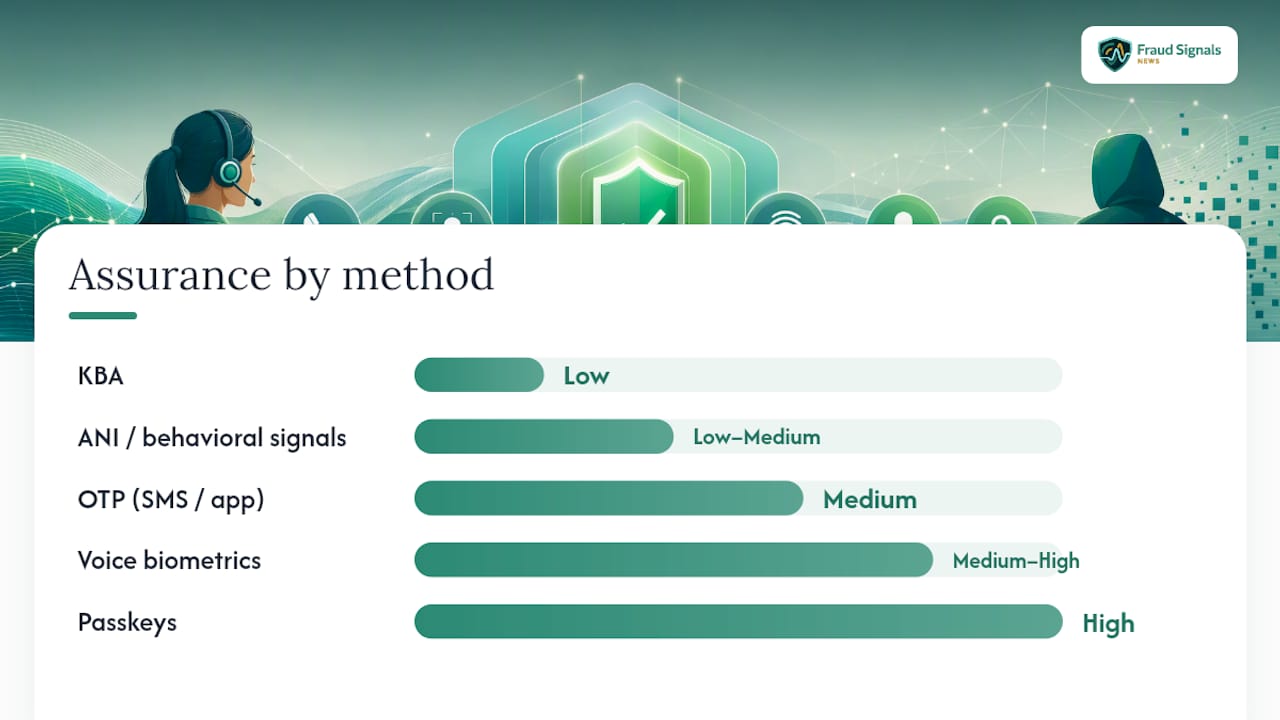
Voice biometrics match a caller’s vocal characteristics against an enrolled print, often passively during the greeting before an agent even engages. It scales well and reduces friction, but it is only as strong as the liveness detection behind it.
ANI/CLI matching and behavioral signals compare the incoming number against known devices, flag spoofed caller ID, and score things like call velocity, device fingerprint, and typing or navigation patterns in the IVR. These signals rarely confirm identity alone, but they are the cheapest, most frictionless layer to run on every call.
- KBA: low assurance, use only as a supplementary signal
- OTP: medium assurance, weak against SIM swap and phishing relay
- Passkeys: high assurance, strongest resistance to remote attacks
- Voice biometrics: medium to high assurance, depends entirely on liveness detection quality
- ANI/behavioral signals: low to medium assurance, best used as passive pre-screening
Building a Layered, Risk-Based Authentication Flow
The layered model works like an escalating checkpoint, not a single gate. Passive signals run first, silently, before an agent or even the IVR asks the caller anything. A practitioner framework for layered authentication describes this as surfacing device and behavioral signals to build a trust score before the agent ever answers, then reserving active challenges for the interactions that actually carry risk.
A practical three-tier flow looks like this:
- Low-risk interactions (checking a balance, confirming a shipping status): ANI match plus passive voice or device signal is enough. No active challenge needed if the trust score clears threshold.
- Medium-risk interactions (updating an address, resetting a low-value limit): add one active factor, typically an OTP or passkey push, triggered only if the passive score falls below the safe band.
- High-risk interactions (wire transfers, password resets, adding a payee): require two active factors, and route any anomaly, such as a mismatched ANI or a suspicious change in speech pattern, straight to a fraud specialist rather than letting a frontline agent override the block.
Enrollment strategy matters as much as the flow itself. Enroll customers in passkeys and voice biometrics at natural touchpoints, like app login or account opening, rather than cold during a support call, where consent friction spikes abandonment.
Pro Tip: Track false-reject rate separately from fraud-catch rate every week during rollout.
Rolling Out Call Center Verification Processes Without Breaking Operations
Deploying layered authentication is a five-stage project, not a vendor switch flipped overnight.
Start with a data and signal audit. Inventory what you already capture: ANI, device metadata, historical call patterns, existing KBA answer rates and their fraud outcomes. Most centers discover during this audit that they are sitting on behavioral data nobody has scored yet.
Pick a pilot environment with real but bounded stakes: a single product line or one regional queue, not the entire inbound volume. Integrate the passive signal layer into IVR and the agent desktop so a trust score surfaces on the agent’s screen before the call connects, rather than requiring the agent to run a separate lookup.
During the pilot, set explicit success metrics before day one: target AHT reduction, target authentication rate, and an acceptable false-reject ceiling. Enroll a subset of customers in passkeys or voice biometrics and A/B the experience against the legacy KBA flow. Expect two to four weeks of tuning before false-reject rates settle into an acceptable range, since biometric thresholds set too tight will lock out legitimate callers with colds, accents, or bad connections.
Build the escalation path before you need it:
- Failed passive check: route to one active step-up, not an automatic decline
- Failed active step-up: route to a scripted fraud-verification agent, never a frontline rep with override authority
- Repeated failure from the same number or account: flag for manual review and freeze the specific high-risk action, not the whole account
Agent scripts for failed authentication should be short and decisive. Given documented links between workplace stress and error rates, a script that forces agents to improvise judgment calls under pressure produces worse outcomes than one that hands them a clear, binary next step.
Threats That Break Single-Factor Voice Authentication
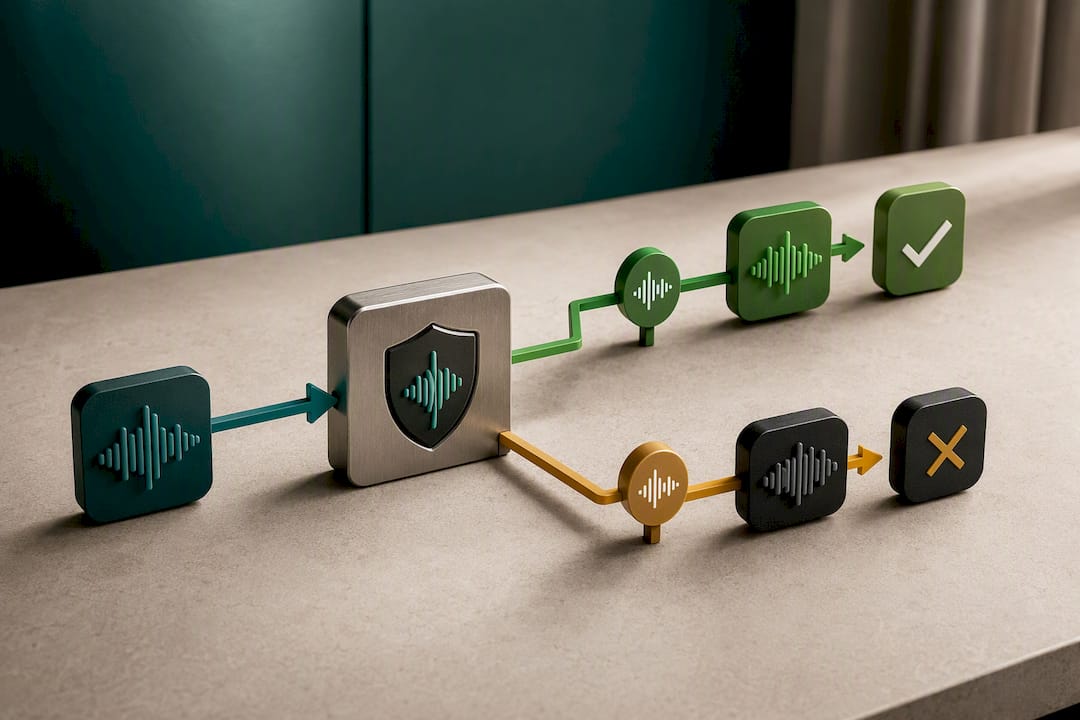
Voice cloning is the biggest structural threat to voice biometrics deployed as a standalone factor. Generative audio tools can now reproduce a target’s vocal characteristics from a few minutes of sampled speech, enough to defeat systems that check pitch and cadence but skip liveness verification. A biometric match alone, without a challenge that a cloned recording can’t answer dynamically, is a single point of failure.
SIM swapping remains the primary way attackers intercept OTPs, and telephony spoofing has grown more organized. The APWG’s Q3 2024 trends report documents continued growth in spoofing and deceptive-calling tactics, which is exactly why ANI matching alone, without a secondary signal, is no longer a reliable gate. Social engineering compounds both: attackers use pretext calls to agents themselves, pressuring them to bypass verification “just this once” for an urgent-sounding request.
Mitigations that actually hold up:
- Pair voice biometrics with active liveness prompts (randomized phrase repetition) rather than passive matching alone
- Use out-of-band callbacks to a verified number for high-risk changes, never the inbound number
- Run anomaly detection on ANI, device, and behavioral signals together, not any single input
- Maintain detailed authentication logs and a documented escalation playbook so agents never have discretion to waive a step-up under pressure
- Handle biometric and behavioral data with the same privacy discipline as financial records, since voiceprints are permanent identifiers if leaked
What a Mature Call Center Authentication Program Looks Like
Fraud Signals News tracks this space closely because the gap between organizations still running KBA-only verification and those running layered stacks is widening fast, particularly as generative AI adoption in contact centers changes both the fraud tools attackers use and the automated risk scoring defenders can deploy. A center’s maturity shows up in a few concrete markers, not a vendor logo.
- Passive signals run on 100% of inbound calls, not just flagged ones
- Only a small portion of calls rely on a KBA question as the primary gate
- Authentication rate through passive layers alone is high for a mature deployment
- Escalation playbooks are documented and agents have zero override authority on high-risk flags
- Enrollment for passkeys or biometrics happens at low-friction touchpoints, not mid-call
- Governance aligns with NIST SP 800-63 and ISO/IEC 27001 controls, not an internal ad hoc policy
Fraud Signals News’s authentication coverage and biometrics category track how these standards translate into practice as vendors update their approach.
The Playbook Works, but Only if You Track the Right Numbers
The conventional advice on call center authentication treats it as a technology purchase: buy voice biometrics, buy an OTP platform, done. That framing misses the actual work, which is policy design. A voice biometric engine sitting behind a threshold nobody has tuned against real false-reject data is not an improvement over KBA. It is just a more expensive way to frustrate legitimate customers.
What gets underrated is the operational discipline of tracking authentication rate and false-reject rate weekly, not quarterly, during the first ninety days of any rollout. Fraud teams love to cite catch rate. Operations teams live and die by AHT. A layered program only survives contact with reality when both metrics get watched together, because a system tuned purely to catch fraud will bleed customer patience, and a system tuned purely for speed will bleed money.
Prioritize the passive layer first. It is the cheapest change with the highest immediate payoff, and it buys the data needed to tune everything that comes after it.
— Carlos Ochoa
Where to Go for Deeper Authentication Research
If you’re building out a business case for layered authentication, the research burden doesn’t stop at method selection. You still need current fraud pattern data, standards updates, and vendor-neutral analysis of what’s actually defeating attackers versus what just sounds good in a sales deck. That’s the specific gap Fraud Signals News fills for fraud, risk, and identity teams: ongoing coverage of biometric identification, liveness detection, and deepfake fraud tactics that most general security publications don’t track closely enough to catch early.
Start by reviewing Fraud Signals News’s identity fraud coverage to map which of your current KBA-dependent flows carry the highest account-takeover exposure, then use the fintech and banking fraud category to benchmark your pilot metrics against comparable use cases. For vendors evaluating biometric and passive-signal platforms as part of a layered build, DAON is a solid option worth including on any shortlist, alongside your own internal audit of ANI and behavioral data quality. If mortgage or lending call flows are part of your scope, this partner breakdown of mortgage fraud red flags is useful supplemental reading for spotting behavioral cues agents should escalate. Visit Fraud Signals News to start building your shortlist and audit checklist this quarter.
Sources
- APWG Trends Report Q3 2024 — APWG
- Safest security authentication methods in selected countries — Statista
- A practical guide to GLBA safeguards rule compliance — Picus Security blog
FAQ
What are the four types of authentication?
The four widely recognized factors are something you know (a password or KBA answer), something you have (a device or OTP token), something you are (biometrics like voice or fingerprint), and somewhere you are (location or behavioral context). Layered call center authentication typically combines at least two of these per interaction.
How do you authenticate a customer over the phone?
Start with passive signals like ANI match and behavioral scoring before the agent even engages, then add an active step-up such as an OTP, passkey confirmation, or voice biometric liveness check for medium and high-risk requests. Reserve two active factors for the highest-risk actions, like wire transfers or payee changes.
What are the best practices for customer identity verification?
Run passive signals on every call, cap KBA usage as a supplementary check rather than a primary gate, tune false-reject rates weekly during rollout, and align your escalation playbook with NIST SP 800-63 identity assurance standards. Enroll customers in stronger methods like passkeys at low-friction touchpoints instead of mid-call.
Can you give an example of call center authentication in practice?
A bank customer calling to check a balance clears passively through ANI and device match with no active challenge, while the same customer calling to add a new payee triggers a passkey push and, if any signal looks anomalous, a callback to their verified number before the change is approved.
How does voice biometrics fail without liveness detection?
Voice cloning tools can reproduce a caller’s vocal characteristics closely enough to defeat systems that only match pitch and cadence, which is why voice biometrics needs a dynamic liveness prompt, like randomized phrase repetition, layered on top rather than serving as a standalone gate.
Recommended

ID Security Features: What Each One Does and How to Check It

Face Liveness Detection: How It Works and Where It Fails