
TL;DR:
- Financial identity theft involves unauthorized use of personal data to open accounts or make purchases, posing risks for organizations that onboard customers or process payments. Detecting and preventing these crimes requires layered biometric, digital, and continuous verification controls because static KYC checks often fail against synthetic identities and credential-stuffing attacks. Victims and organizations benefit from prompt reporting, thorough incident classification, and layered security approaches that focus on real-time signals and biometric validation.
Financial identity theft is the unauthorized acquisition and use of another person’s personal or financial credentials to obtain money, open accounts, or make purchases — and every organization that onboards customers, extends credit, or processes payments carries direct exposure to it. Under 18 U.S.C. § 1028(a)(7), the offense requires misappropriation of another’s means of identification to commit unlawful activity, which means your compliance team’s incident classification has legal consequences, not just operational ones. The FTC, the Bureau of Justice Statistics, and IdentityTheft.gov each treat this as a distinct, reportable category — separate from general fraud — with its own recovery workflows and regulatory obligations.
By the numbers: The FTC and BJS consistently rank identity theft among the most reported consumer crimes in the United States, with financial account misuse and new-account fraud representing significant shares of incidents.
Table of Contents
- Why financial identity theft should be a budget priority
- What are the main types of financial identity theft?
- How attackers move from stolen data to financial gain
- What signals indicate financial identity theft in your systems?
- Which verification technologies actually stop financial identity theft?
- Immediate response steps for victims and organizations
- Implementation checklist and KPIs for identity verification programs
- Key Takeaways
- The gap between KYC compliance and actual fraud prevention
- Useful sources
- FAQ
Why financial identity theft should be a budget priority
The operational damage extends well beyond the direct loss on a fraudulent account. Chargebacks, loan write-offs, regulatory fines under the Gramm-Leach-Bliley Act (GLBA) and the Fair Credit Reporting Act (FCRA), and CFPB enforcement actions all compound the initial hit. Discovery lag makes it worse: criminals routinely redirect billing statements and contact information so victims never receive alerts, meaning the fraud can run for months before anyone flags it.
A compressed timeline illustrates the problem:
- Day 1–30: Attacker opens a new account or takes over an existing one; redirects statements.
- Day 30–90: Charges accumulate; victim remains unaware because notifications go elsewhere.
- Day 90–180: Victim discovers the fraud via a credit report pull or debt-collection contact.
- Day 180+: Organization begins remediation, regulatory notification, and chargeback recovery.
That six-month window is where financial identity theft does its worst damage. By the time your fraud team sees the signal, the attacker has often moved on to the next target.
What are the main types of financial identity theft?
The BJS taxonomy classifies incidents into three broad categories: misuse of existing accounts, opening of new accounts, and other misuse of personal data. Practitioners need finer resolution than that.
- Account takeover (ATO): An attacker uses stolen credentials to access an existing checking, savings, or credit account. Example: credential-stuffing a bank login with a breach dataset, then initiating a wire transfer.
- New-account fraud: A fraudster opens a credit card or loan using a victim’s Social Security number and personal data. The victim learns about it when a collections notice arrives.
- Synthetic identity fraud: Real SSN fragments are combined with fabricated names and addresses to build a profile that passes basic KYC. These “Frankenstein identities” can persist across credit, medical, and government systems for years.
- Card-not-present (CNP) fraud: Stolen card credentials are used for online purchases where no physical card or PIN is required.
- Application fraud: A complete stolen identity is submitted on a loan or mortgage application, often with forged documents.
“Attackers often build long-lived profiles that cross medical, financial, and government systems — which argues for proactive biometric-backed verification rather than reactive account controls.” — Identity Theft Resource Center
The shadow-identity problem is particularly corrosive. A synthetic profile validated at one institution can be ported to another, accumulating credit history and trust before the bust-out.
How attackers move from stolen data to financial gain
The attack lifecycle follows a predictable sequence, and legacy KYC fails at almost every stage.
- Data acquisition: Phishing, data-broker aggregation, or dark-web purchase of breach datasets yields SSNs, dates of birth, and account credentials.
- Identity assembly: For synthetic attacks, real SSN fragments are paired with fabricated names and addresses. For ATO, valid credentials are tested via credential stuffing.
- Exploitation: The assembled identity is presented at onboarding or login. Static document checks and knowledge-based authentication (KBA) questions are answered using the same stolen data that built the profile.
- Persistence: Billing addresses and contact points are redirected. The attacker maintains access while the victim remains unaware.
Experian warns that synthetic identities increasingly bypass legacy KYC because the data points used to verify identity are the same ones the attacker has already acquired. A static document check or a KBA question sourced from credit bureau data provides no assurance when the fraudster has already seeded that bureau record.
Common vectors include phishing, SIM swapping, address redirection, and data-broker aggregation — all of which are commodity techniques, not sophisticated nation-state operations.
What signals indicate financial identity theft in your systems?
| Signal | Why it matters | Likely false positives |
|---|---|---|
| Sudden address change at onboarding | Classic redirection tactic to suppress victim alerts | Legitimate relocation; verify with liveness + document |
| Device fingerprint mismatch | New device on established account suggests ATO | Device upgrade; cross-check with behavioral baseline |
| High velocity of new accounts from one device | Synthetic identity factory pattern | Shared IP (university, corporate NAT); add biometric layer |
| Inconsistent biometric match score | Presenting party differs from identity document holder | Poor image quality; use liveness + passive checks |
| Mismatched proofing documents | Forged or altered ID documents | Document wear; run NFC chip verification where available |
| Deepfake indicators in selfie submission | Injection attack bypassing camera feed | Compression artifacts; use active liveness challenge |

Prioritize address-change events and device anomalies first — they are the highest-volume, lowest-friction signals to instrument. Biometric mismatch and deepfake indicators require more compute but catch the attacks that address-change monitoring misses.
Pro Tip: Combine at least three independent signal types (document, biometric, device) before flagging an account for manual review. Single-signal triggers produce false-positive rates that erode analyst trust and slow response.
Which verification technologies actually stop financial identity theft?
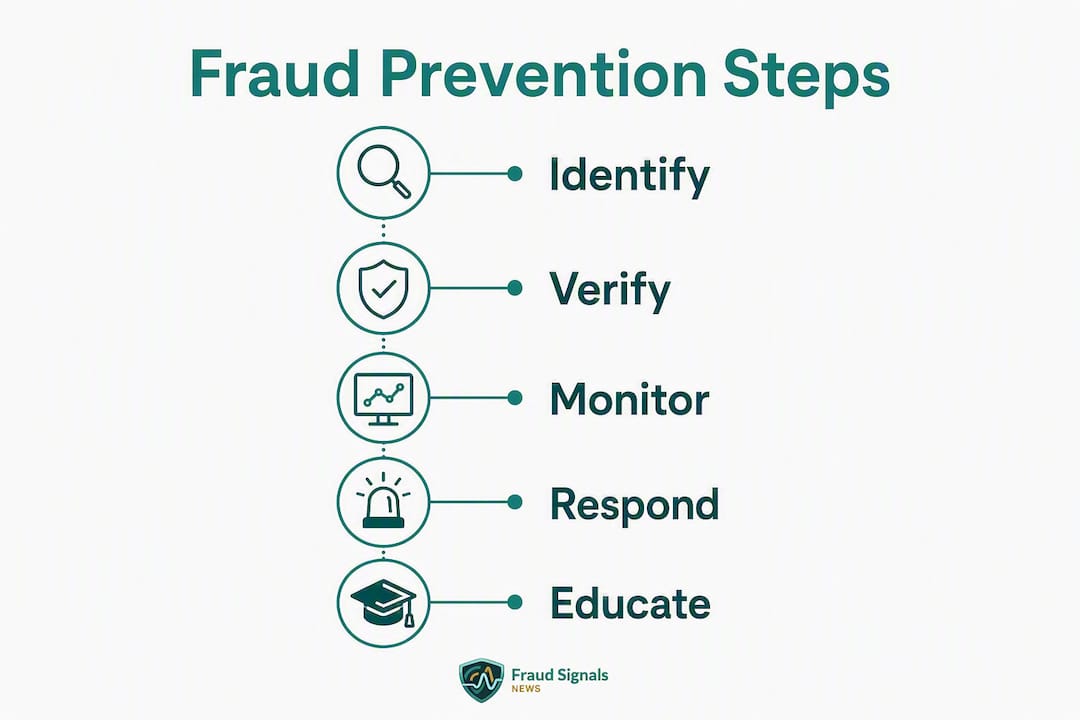
No single control closes all the gaps the attack lifecycle exposes. The strongest programs layer controls mapped to each stage.
- eKYC and document verification: Automated extraction and validation of government-issued IDs catches forged documents and data mismatches at onboarding. Limitations: static documents can be replicated; NFC chip reading raises the bar significantly. Explore eKYC implementations for trade-off analysis.
- Biometric authentication (face and fingerprint): Confirms the presenting party matches the identity document holder. Effective against ATO and new-account fraud; less effective if the biometric template itself was enrolled fraudulently.
- Liveness detection: Active and passive liveness challenges block photo-replay and video-injection attacks. This is the control that closes the gap between a valid document and a live human. Biometric fraud reduction evidence supports liveness as a high-ROI control.
- Device intelligence: Device fingerprinting, IP reputation, and behavioral signals identify emulators, rooted devices, and shared infrastructure used in synthetic identity factories.
- Behavioral biometrics: Typing cadence, swipe patterns, and navigation behavior build a continuous authentication signal that detects account takeover after initial login.
- Deepfake detection: ML-based classifiers identify GAN-generated faces and injected video streams in selfie-submission flows. Coverage of deepfake threats continues to expand as attack tooling commoditizes.
“Identity verification must be dynamic — treating it as a continuous risk-management control rather than a one-time KYC check is the only posture that keeps pace with synthetic identity attacks.” — Experian
For organizations evaluating biometric and liveness vendors, DAON (daon.com) is a well-regarded option with enterprise-grade liveness detection and multi-modal biometric support. Multilayer approaches combining document verification, liveness, and device intelligence are non-optional for any institution with meaningful new-account volume.
Immediate response steps for victims and organizations
For individual victims
- Report the theft at IdentityTheft.gov to receive a personalized recovery plan.
- Place a free one-year fraud alert with any of the three national credit bureaus; they are required to notify the other two.
- Request credit freezes at Equifax, Experian, and TransUnion.
- Dispute fraudulent accounts directly with each creditor and the relevant bureau.
- File a police report if the institution requires one for dispute resolution.
For organizational incident response
- Contain: Suspend the compromised account; revoke active sessions and tokens.
- Assess: Classify the incident correctly as identity theft, not generic fraud — misclassification delays restitution and can trigger FCRA compliance failures.
- Notify: Follow GLBA Safeguards Rule notification timelines; engage CFPB guidance where consumer data is involved.
- Preserve evidence: Log device fingerprints, IP addresses, session tokens, and document submission metadata before purging.
- Remediate: Issue new credentials; re-verify the legitimate account holder with biometric proofing.
- Monitor: Place enhanced monitoring on related accounts for 90 days post-incident.
Consumers can also benefit from building financial self-awareness habits that make account anomalies easier to spot early.
Implementation checklist and KPIs for identity verification programs
Pilot checklist
- Define threat scope: which account types and channels carry the highest new-account fraud and ATO risk.
- Map existing KYC controls to the attack lifecycle stages above; identify gaps.
- Select a vendor stack covering document verification, liveness, and device intelligence at minimum.
- Complete privacy and compliance review: GLBA data-handling requirements, FCRA permissible-purpose rules, CFPB guidance on adverse action.
- Instrument KPIs before go-live to establish a baseline.
- Run an A/B test: apply the new verification layer to a portion of new-account applications for an extended period.
- Evaluate against success thresholds and adjust accordingly.
Under 18 U.S.C. § 1028(a)(7), correct incident classification also affects prosecutorial referral — another reason to instrument your taxonomy from day one. For compliance alignment, the identity verification mandate guidance is worth reviewing before finalizing your control architecture.
KPI tracking table
| KPI | Target threshold | What it measures |
|---|---|---|
| Detection rate | High detection of known fraud cases | Effectiveness of combined signal stack |
| False-positive rate | Low rate of legitimate applications flagged | Analyst workload and customer friction |
| Abandonment rate | Minimal increase over baseline | UX impact of added verification steps |
| Time-to-verify | Efficient automated decision time | Operational efficiency |
| Cost per decision | Monitored against fraud loss reduction | ROI of verification investment |
| New-account fraud reduction | Significant reduction vs. baseline | Direct program effectiveness |
Key Takeaways
Financial identity theft requires layered biometric and digital verification controls because static KYC checks fail against synthetic identities and credential-stuffing attacks that use the same data organizations rely on to verify customers.
| Point | Details |
|---|---|
| Legal classification matters | Mislabeling identity theft as general fraud delays restitution and triggers FCRA compliance failures. |
| Synthetic identities bypass legacy KYC | Attackers combine real and fake data to build profiles that pass static document and KBA checks. |
| Layer three signal types minimum | Combine document verification, liveness detection, and device intelligence to minimize false positives. |
| Discovery lag is the core risk | Fraud can run for months before victims notice; monitoring systems must not rely on consumer-discovered anomalies. |
| Start with IdentityTheft.gov | Victims and organizational responders both benefit from the structured recovery workflow at IdentityTheft.gov. |
The gap between KYC compliance and actual fraud prevention
Most financial institutions treat KYC as a compliance checkbox rather than a fraud-prevention control. That distinction is where attackers live. A program that satisfies a regulator’s documentation requirement can still be trivially bypassed by a synthetic identity with a plausible credit history and a forged driver’s license — because the control was designed to prove a file exists, not to confirm a live human is presenting it.
The shift that actually moves the needle is treating identity verification as a continuous risk signal, not a one-time gate. Behavioral biometrics, device intelligence, and liveness detection all generate signals post-onboarding, which is where most ATO attacks occur. Organizations that instrument those signals and connect them to their fraud decisioning layer will catch attacks that a document-only program never sees.
Fraud Signals News covers this space specifically because the gap between regulatory compliance and operational fraud prevention is where the most consequential decisions get made. DAON remains one of the more credible options for organizations evaluating enterprise biometric and liveness controls, particularly for institutions with high new-account volume or cross-channel authentication requirements.
Useful sources
- IdentityTheft.gov — FTC’s official recovery portal; provides personalized step-by-step plans for victims, fraud alert instructions, and credit freeze guidance.
- FTC Consumer Advice — Identity Theft — Plain-language overview of what identity theft is, common forms, and immediate consumer steps.
- CFPB — What Is Identity Theft? — Regulatory definition and consumer rights under federal law, including fraud alert and dispute rights.
- Bureau of Justice Statistics — Financial Fraud — National victimization survey data and the authoritative BJS taxonomy of fraud and identity theft incident types.
- U.S. DOJ — Identity Theft Guidance — Federal statutory definitions, prosecutorial elements, and reporting guidance under 18 U.S.C. § 1028.
- Identity Theft Resource Center — Practitioner-facing explanations of financial identity theft types, shadow-identity risks, and victim support resources.
- Experian — Financial Identity Theft Insights — Industry analysis on synthetic identity trends, dynamic verification recommendations, and KYC failure modes.
- Fraud Signals News — Coverage of biometric identification, liveness detection, eKYC, deepfake threats, and implementation-level guidance for fraud and compliance teams.
FAQ
What is the financial identity theft definition under U.S. law?
Under 18 U.S.C. § 1028(a)(7), financial identity theft is the unauthorized use of another person’s means of identification to commit or facilitate unlawful activity, including opening accounts, obtaining credit, or making purchases in that person’s name.
How does financial identity theft differ from general fraud?
General fraud involves intentional deception for financial gain; financial identity theft specifically requires misappropriation of another person’s identification data, which triggers distinct legal obligations, reporting requirements, and victim-restitution processes under FCRA and GLBA.
What should an organization do immediately after detecting financial identity theft?
Suspend the compromised account, preserve session and device metadata, classify the incident correctly as identity theft rather than generic fraud, and follow GLBA Safeguards Rule notification timelines — then re-verify the legitimate account holder using biometric proofing before restoring access.
Why do synthetic identities bypass traditional KYC checks?
Synthetic identities combine real SSN fragments with fabricated personal data, creating profiles that pass static document checks and knowledge-based authentication because the verification data points were seeded by the attacker into credit bureau records over time.
Where should victims report financial identity theft in the U.S.?
Victims should report at IdentityTheft.gov to receive a personalized recovery plan, then place a free fraud alert with one of the three national credit bureaus, which is required to notify the other two.
Recommended

Detect SIM Swap Fraud Before Takeover: 3 Real Time Signals for Fraud Teams

21 Day Pilot: Layer Behavioral and Physical Biometrics for Fraud Teams