
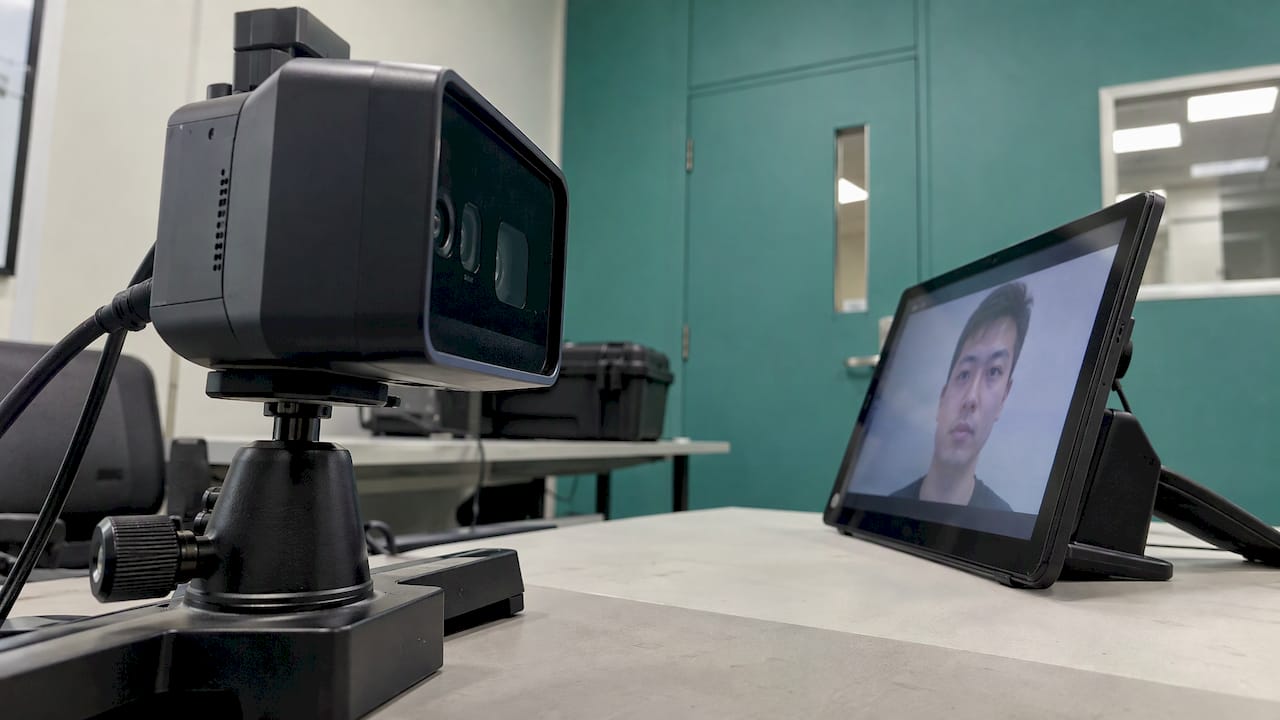
ISO/IEC 30107 is the international standard family that defines how presentation attack detection (PAD), the category that includes liveness detection, is described, tested and reported. Part 3 supplies the test methodology. A liveness vendor that says it is “ISO 30107 compliant” is saying its product was tested and reported under that methodology. It is not saying the product earned a pass grade, and it is not saying the product stops fraud in your onboarding flow. For a fraud risk leader, the useful skill is reading the test report: the attack level, the error rates, the conditions and, above all, the attack paths the test never touched.
TL;DR
- ISO/IEC 30107 is a framework for testing and reporting PAD results. It is not a certificate that grants a pass or fail.
- Liveness detection is a subset of PAD: it checks whether a sensor is looking at a live person rather than a photo, recording or mask.
- Read two error rates together, APCER (attacks accepted) and BPCER (genuine users rejected), along with the attack level and test conditions.
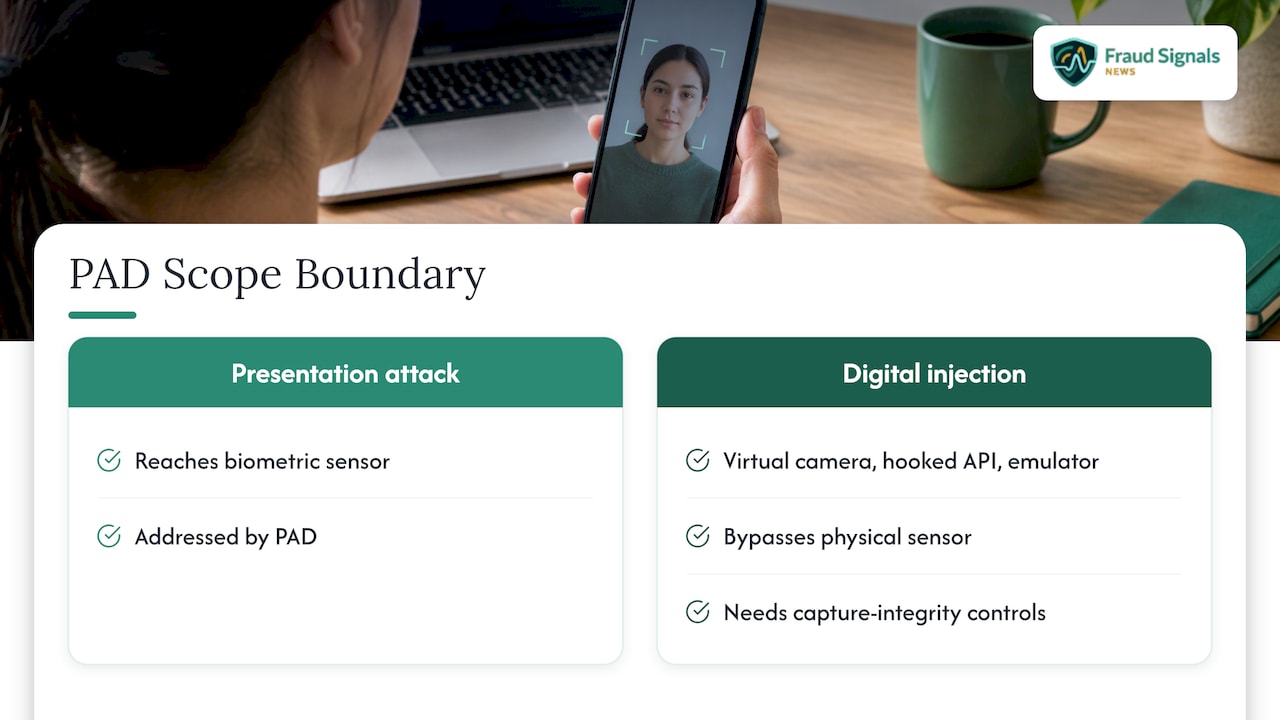
- The standard covers attacks at the capture device. Digital injection, such as a virtual camera feeding video, sits outside its scope.
- In the US, no testing label replaces substantiation: the FTC expects competent, reliable testing behind liveness claims.
Table of Contents
- What ISO/IEC 30107 is and how liveness fits in
- What “ISO 30107 compliance” means
- How PAD levels work
- Reading the numbers: APCER, BPCER and test conditions
- What the standard does not cover
- Matching PAD rigor to your risk
- ISO 30107 and US regulatory expectations
- Where this leaves a fraud leader
- Our perspective
- Keep reading on Fraud Signals News
- FAQ
- Sources
What ISO/IEC 30107 is and how liveness fits in
The series is built around presentation attack detection. A presentation attack is an attempt to fool a biometric sensor by presenting something other than a live, genuine biometric characteristic: a printed photo, a replayed video, a silicone fingerprint, a mask. PAD is the set of methods that detect those attempts.
The Biometrics Institute describes liveness detection as a subset of PAD focused on determining whether the sensor is observing a live human being rather than an artefact such as a recording, photo or physical spoof. The same paper separates active PAD, which asks the user to act (blink, move the phone, read out numbers), from passive PAD, which asks for nothing. That distinction matters in procurement, because it drives both conversion rates and the kinds of attacks a system is likely to meet.
The series has several parts, and two matter most to practitioners:
- ISO/IEC 30107-1 sets the framework: terms, definitions and concepts. Edition 2, published in 2023, establishes the terms and definitions used to specify, characterize and evaluate PAD methods. In the United States, INCITS/ISO/IEC 30107-1:2023 (2024) is the identical national adoption.
- ISO/IEC 30107-3 sets the testing and reporting methodology, including the metrics. The Biometrics Institute paper points testers to the performance criteria defined in the 2017 edition of this part.
A NIST presentation on the series noted that, in 2022, three of the documents were under revision to improve alignment and reflect developments across government, industry and academia. The practical lesson is to ask which edition a vendor’s test report was written against, and when.
What “ISO 30107 compliance” means
Compliance is a statement about process. iBeta, an accredited US test lab, explains that its confirmation letters report whether a solution conforms to the testing and reporting requirements of ISO/IEC 30107-3. That is a product-testing record, not a product certification. A glossary entry on the standard makes the same point: independent labs treat the standard as one for testing and reporting, with no pass or fail grade attached to the vendor’s product.
In practice, three things follow:
- A letter is a data point, not a verdict. The useful content is in the report behind it: what was attacked, how many times and with what result.
- Compliance is scoped to a build. Liveness models change often. A test from an earlier release says little about the model running in production today.
- The test is bounded by its attack set. A system can perform well against the artefacts a lab tried and still be weak against techniques the lab did not use.
Our own guide to how face liveness detection works and where it fails walks through the failure modes that sit behind a clean test letter.
How PAD levels work
Labs grade attack difficulty, and the level at which a product was tested changes what the result means. iBeta identifies Levels 1 to 3 based on the time an attacker needs, the expertise required and the source of the artefacts. Level 1 uses artefacts readily available at home or in an office and needs no expertise. Level 3 involves hyper-realistic masks and specialized equipment, and it requires significant expertise.
| Level | Attacker profile | Typical artefacts |
|---|---|---|
| 1 | No expertise, minimal time | Items from a home or office |
| 2 | Moderate skill | Higher-effort artefacts |
| 3 | Significant expertise | Hyper-realistic masks, specialized equipment |
A Level 1 result is a baseline against casual attacks. If your threat model includes organized rings, which the biometric performance metrics conversation increasingly assumes, a Level 1 result alone is thin evidence. The FIDO Alliance builds on the same foundation: its biometric requirements reference ISO/IEC 30107-3 and set imposter attack presentation accept rate (IAPAR) requirements for its certification levels. That is a useful reminder that a program-specific certification can layer thresholds on top of the ISO methodology, while ISO itself assigns no threshold.
Reading the numbers: APCER, BPCER and test conditions
When readers search for liveness detection benchmarks, they usually want a single score. There isn’t one. The metrics defined in ISO/IEC 30107-3 come in pairs, and NIST’s PAD evaluation documentation states them plainly:
- APCER (Attack Presentation Classification Error Rate): the proportion of attack presentations incorrectly classified as bona fide. This is the fraud-side error.
- BPCER (Bona Fide Presentation Classification Error Rate): the proportion of live subjects incorrectly classified as attacks. This is the customer-friction error.
The same NIST document also lists non-response rates among the key metrics and names the test conditions that shape them: the attack species, the capture setup and the score thresholds. Each one changes how far a headline figure travels.
Questions to ask of any benchmark
- Which attack species were used? A 0% APCER against printed photos says nothing about replayed video or 3D masks.
- What was the BPCER at that APCER? A system can reach a near-zero APCER by rejecting many genuine users. Quote one number without the other and the result is meaningless.
- What threshold was used? A threshold tuned on the test set rarely holds in production traffic.
- How many subjects and attempts? Small samples produce confidence intervals wide enough to swallow the result.
- What happened to failures to acquire? Non-response rates belong in the picture, because a system that refuses to process hard cases looks better than it performs.
- Which device and capture setup? A lab handset may not resemble the mid-range Android devices in your customer base.
The point of this checklist is to convert a marketing line into a comparable record. Our explainer on reading NIST face test data applies the same discipline to recognition accuracy, and the iris liveness analysis of LivDet tests shows how open-set conditions expose gaps that closed-set results hide.
What the standard does not cover
The scope boundary is the most consequential fact for an operations team. ISO/IEC 30107 addresses attacks that occur at the biometric capture device during presentation. According to the BeVerified glossary, it does not cover digital injection attacks, such as virtual camera video insertion.
That is where a large share of modern remote-onboarding fraud lives. A deepfake delivered through a virtual camera, a hooked camera API or an emulator never presents anything to a physical sensor. The PAD test can be perfect and the injection path still open. Capture integrity, meaning proof that the image came from a real camera on a real device, is a separate control from liveness scoring.
We cover that gap in detail in stopping replay and injection fraud, in capture integrity and deepfake ID fraud and in standards-aligned defenses against liveness spoofing. Bot-driven attacks add another layer, addressed in our piece on onboarding bot detection.
There is also a downstream consequence. Even when onboarding verification holds, accounts are frequently taken over through the recovery channels around it. For readers dealing with the aftermath, SIM-swap and account takeover recovery shows how that fraud type connects to weak identity checks in digital banking and remote account opening.
Matching PAD rigor to your risk
The Biometrics Institute frames the decision correctly: the need for PAD is determined by the risk of an active attack and its financial and reputational impact. It also treats PAD as a risk-mitigation tool that adds complexity, so the level you require should follow your specific threat profile and the consequence of a compromise.
A practical way to apply that:
- Map the value at stake. A low-limit savings sign-up and a brokerage account with instant transfers do not need the same assurance.
- Name your likely attackers. Opportunistic fraudsters map to Level 1 style artefacts. Organized groups with budgets map to higher levels and to injection techniques.
- Require the full report. Ask for the attack level, the APCER and BPCER pair, the sample size and the build tested.
- Add controls outside the standard. Device integrity, injection detection, document checks and behavioral signals cover what a PAD test cannot.
- Monitor production. Track live false rejects and confirmed fraud by device cohort, then compare them with the lab figures. A gap is information.
This is the logic behind our view that biometrics reduce bank fraud when they are deployed as part of layered controls rather than as a single gate. For the customer-facing side, see how selfie identity verification works in a standard flow.
ISO 30107 and US regulatory expectations
No US rule we have found treats ISO/IEC 30107 conformance as a legal safe harbor. What the US regulator does care about is substantiation. In an order against IntelliVision, the FTC bars the company from making accuracy, effectiveness or liveness-detection claims unless it possesses and relies on competent and reliable testing that substantiates them. The same order requires documentation of testing methods, including the sources and numbers of images and people, and demographic and skin-tone information where applicable.
For a bank or fintech, the implication is straightforward. A vendor’s liveness claim is only as strong as the documented test behind it, and your own file should hold that documentation: the report, the build, the conditions and the demographic coverage. That record also helps when examiners ask how you selected and validated a verification control. Confirm specifics with your compliance counsel, because the expectations differ by regulator and product.
Where this leaves a fraud leader
The ISO 30107 label is a good filter and a poor finish line. It tells you the vendor submitted to a recognized methodology. It does not tell you how the product behaves against injection, against your device mix or against the attackers targeting your customers. Treat the report as the start of due diligence, and keep your own production metrics as the final judge.
Our perspective
Most of the liveness conversations we read about stop at a logo: a test letter, a level, a badge. We think that is the wrong place to stop. The standard was written to make results comparable, and it does that well when someone reads the whole report.
Our editorial view is simple. Fraud teams need three things from coverage: the plain meaning of the metrics, the boundaries of what a test establishes, and the attack techniques that live outside those boundaries. That is why we spend as much time on injection, replay and capture integrity as on presentation attacks. The attackers do not respect the scope of a standard.
We built Fraud Signals News to give directors of fraud risk, fintech leads and compliance advisers operations-focused analysis they rarely get from general cybersecurity outlets. When you evaluate a liveness product, we want you holding the report, the APCER and BPCER pair, and a clear idea of which attacks the test never tried.
Carlos Ochoa
Keep reading on Fraud Signals News
If you are building or auditing a liveness program, our latest digital identity and fraud prevention coverage collects the analysis behind this guide, from face and iris liveness to deepfake capture attacks and the metrics that matter. Start with the pieces on face liveness and biometric performance metrics, then work outward to your own threat model.

We publish new analysis regularly for fraud, compliance and technology leaders who need to separate tested claims from marketing.
FAQ
Is ISO 30107 a certification?
No. It is a standard for testing and reporting, and labs describe their results as confirmation that a product was tested to its requirements, with no pass or fail grade. iBeta’s explanation frames the letter as conformance to the testing and reporting requirements. Read the underlying report for the attack level and error rates.
What is the difference between liveness detection and PAD?
PAD is the broader category of detecting presentation attacks. Liveness detection is the subset that determines whether the sensor is observing a live human being rather than an artefact. Active methods ask the user to act, while passive methods require no action.
Which metrics should I compare in liveness benchmarks?
Compare APCER and BPCER together, along with non-response rates, attack species, capture setup and score thresholds, as defined in the NIST PAD documentation. One metric alone can be gamed by tuning the other. Also check the sample size and the build that was tested.
Does ISO 30107 cover deepfakes and injection attacks?
It covers attacks at the capture device during presentation. Digital injection, such as inserting video through a virtual camera, falls outside its scope. Pair liveness testing with capture integrity and injection controls.
Does ISO 30107 satisfy a US regulation?
We have found no US rule that treats conformance as a safe harbor. The FTC does require competent and reliable testing behind liveness claims, as shown in its IntelliVision order. Check your specific obligations with compliance counsel.
Sources
- What does presentation attack detection and liveness detection mean? (Biometrics Institute)
- ISO/IEC 30107-1:2023
- INCITS/ISO/IEC 30107-1:2023 (2024)
- Update on ISO/IEC 30107 Series Presentation Attack Detection Standards (NIST)
- ISO 30107-3 Presentation Attack Detection confirmation letters (iBeta)
- What Is ISO/IEC 30107-3? (BeVerified)
- FIDO Biometrics Requirements v4.1
- Performance of Automated Presentation Attack Detection (NIST)
- FTC decision and order, IntelliVision
Recommended

Proof of Life Video: How Liveness Checks Work and Where They Fail

Database Verification Limits: Where Identity Checks Break