
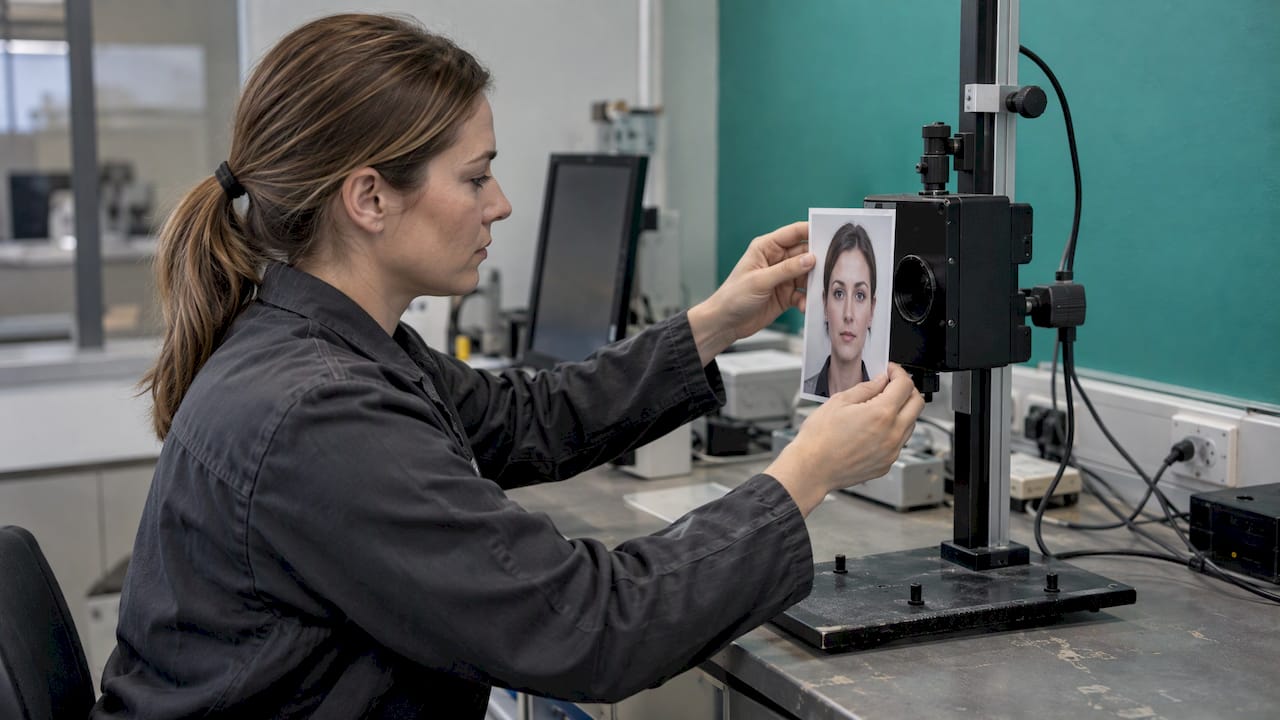
A PAD testing lab is an independent laboratory that attacks a biometric system with fake faces, fingerprints or irises and records how often the system accepts them. The result is a set of error rates, most often the Impostor Attack Presentation Accept Rate (IAPAR), measured under a published standard. For a fraud team, the lab’s report is useful evidence, but only if you know which standard it followed, who accredited the lab, and how far the numbers carry into your own onboarding flow.
TL;DR
- Presentation attack detection (PAD) testing measures whether a biometric system rejects spoofs such as printed photos, screen replays, masks and fake fingerprints. Liveness detection is one subset of PAD.
- In the U.S., NIST’s NVLAP runs a Biometrics Testing accreditation program for labs, and FIDO requires PAD testing by a FIDO-accredited independent lab for its biometric certification.
- FIDO’s thresholds are IAPAR of 15% or less for Level 1 and 7% or less for Level 2. Ask which level, which attack types and how many transactions the report covers.
- ISO/IEC 30107-3 warns that PAD error rates depend on the tester, the attack set and the application, so a lab pass is not a guarantee of production performance.
- Treat the report as one input next to your own fraud data, injection and replay testing, and ongoing monitoring.
Table of Contents
- What PAD testing actually means
- What a PAD testing lab does
- What accreditation tells you about a lab
- How to read a PAD test report
- Why a lab pass is not a production guarantee
- How U.S. financial institutions should use PAD results
- Questions to put to a lab or a vendor
- Perspective
- Keep going with Fraud Signals News
- FAQ
- Sources
What PAD testing actually means
NIST’s glossary defines presentation attack detection as the automated determination of a presentation attack. It adds that a subset of those methods, liveness detection, measures anatomical characteristics or reactions to decide whether a sample comes from a living person present at capture. The Biometrics Institute describes a presentation attack as a spoof shown to a biometric sensor, such as a printed photo, an image or video on a tablet, a 3D mask or a fake silicone fingerprint.
The vocabulary matters because vendors use the terms loosely. “Liveness” in a sales deck can mean a blink prompt, a passive texture check or a full PAD subsystem that was submitted to a lab. A lab report speaks in narrower terms: an attack instrument (PAI), a species of attack, a number of transactions and an accept rate. Those are the words you should expect to see in any document you rely on.
If you want the operational side of the same problem, our pieces on how face liveness detection works and where it fails and on liveness detection spoofing and standards-aligned defenses cover what fraud teams see in production.
What a PAD testing lab does
A PAD lab takes the system under test, which FIDO calls the target of evaluation (TOE), and runs a controlled series of attacks against it. Each attack uses a presentation attack instrument, and instruments of the same kind are grouped into species. The lab counts how many attempts the system wrongly accepts and reports the rate.
The broader biometric testing world is wider than PAD. NIST Handbook 150-25 lists conformance, interoperability, technology, scenario and operational or usability testing as the services covered under the Biometrics Laboratory Accreditation Program, each tied to nationally and internationally recognized testing standards. PAD work sits alongside these. A lab can be strong in one area and have no scope in another, so the first question to ask is which services it is accredited for.
How FIDO structures the test
FIDO’s Biometrics Requirements are the clearest public example of PAD testing rules, and they are specific. The document states that PAD testing must be performed by the FIDO-accredited independent testing laboratory on the TOE the vendor provides, and that the evaluation measures IAPAR as defined in ISO 30107 Part 3.
The same document sets the volume of testing. It calls for 10 impostor presentation attack transactions for each instrument for each enrollment. It also gives an example of allowed errors within 150 transactions per species: a maximum of 10 errors to meet 7% and a maximum of 22 to meet 15%.
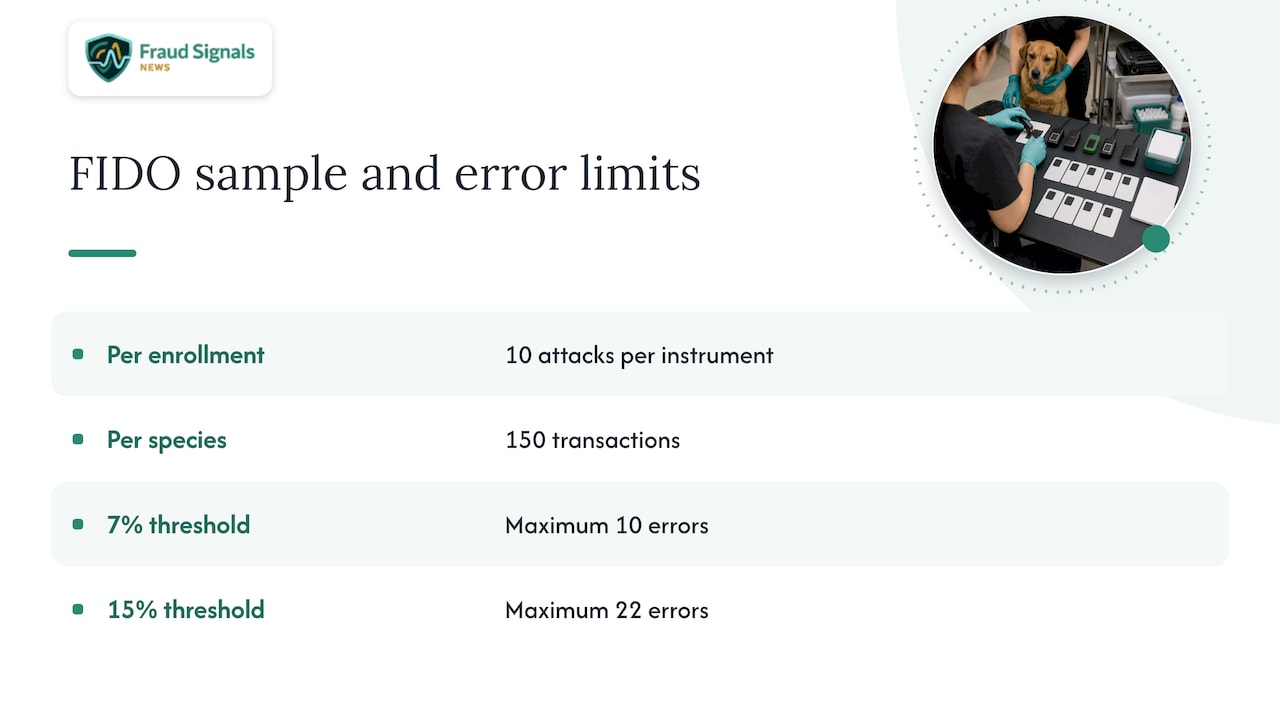
That arithmetic is worth internalizing. A pass at Level 2 does not mean the system stopped every fake. It means that, within a defined sample, the accepted fakes stayed under a ceiling. For a bank deciding how much additional control to layer on top, the ceiling is the number that matters.
Accreditation tiers in FIDO
FIDO states that to meet Level 1 a TOE must reach IAPAR of 15% or less, and Level 2 requires 7% or less. The thresholds are stored in FIDO metadata and in the FIDO Biometric Component Certificate. A vendor that says it is “FIDO certified” without naming the level has told you very little. Ask for the certificate and read the level.
If you are mapping these tiers to authenticator rollout in a smaller organization, this walkthrough of stage-based authentication for startups shows how teams sequence stronger authentication as they grow.
What accreditation tells you about a lab
In the U.S., the reference point is NIST’s National Voluntary Laboratory Accreditation Program. The Biometrics Testing LAP was requested by the Department of Homeland Security and is hosted under NVLAP. It accredits labs for defined biometric testing services, with requirements derived from the scopes a lab elects. Handbook 150-25 adds that any laboratory, whether commercial, manufacturer, academic or government, foreign or domestic, may apply if it performs the covered test methods.
Two consequences follow for buyers.
- Accreditation is about competence, not outcomes. The handbook describes accreditation as a finding of competence and proficiency in conducting testing. It is explicitly not a guarantee of laboratory performance or of the test data on a system under test.
- Scope matters more than the logo. A lab accredited for technology testing of fingerprint matching has not necessarily demonstrated competence in PAD against face or iris spoofs. Read the scope document, not the badge.
NIST also notes that NVLAP is not aware of any widely available interlaboratory comparison for biometric system testing, and does not require participation, although labs may organize comparisons among themselves. In plain terms, nobody is routinely checking whether two accredited labs would score the same system the same way.
How to read a PAD test report
A report that opens with a pass stamp and closes with a logo is a marketing artifact. A report you can use answers the following questions.
1. Which standard and which version
The test should name ISO/IEC 30107-3 or the program rule set (for example FIDO’s) and the version of each. Metrics and attack classification come from the standard. Thresholds come from the program.
2. Which attack species were tested
A face system tested only against printed photos and screen replays has not been tested against masks or injected video. Check that the species list matches your threat model. Our analysis of selfie spoof detection and of replay and injection fraud explains why capture-channel attacks are a separate problem from what is held in front of a camera. For iris deployments, see what LivDet tests reveal about open-set gaps.
3. How many transactions and enrollments
A small sample produces a wide confidence interval. FIDO’s 10 transactions per instrument per enrollment and 150 transactions per species is a floor for that program, not a universal norm. Ask the lab for the counts behind every rate.
4. What was the configuration
PAD scores belong to a specific build, sensor, threshold setting and capture flow. If the version you deploy differs from the version tested, the report describes a different product.
5. Who supplied the attack data
The iBeta material cited in vendor documentation notes that evaluations can include cooperative subjects and that testers sometimes request data from the vendor rather than relying only on publicly available biometric data. Whether the lab built its own instruments or used the vendor’s, the answer changes how much weight the result carries.
6. Whether the error rates are per species or pooled
A pooled number can hide one weak spot. ISO/IEC 30107-3:2023 includes an example showing how different per-instrument success patterns can lead to different conclusions depending on security analysis assumptions. Ask for the breakdown.
Why a lab pass is not a production guarantee
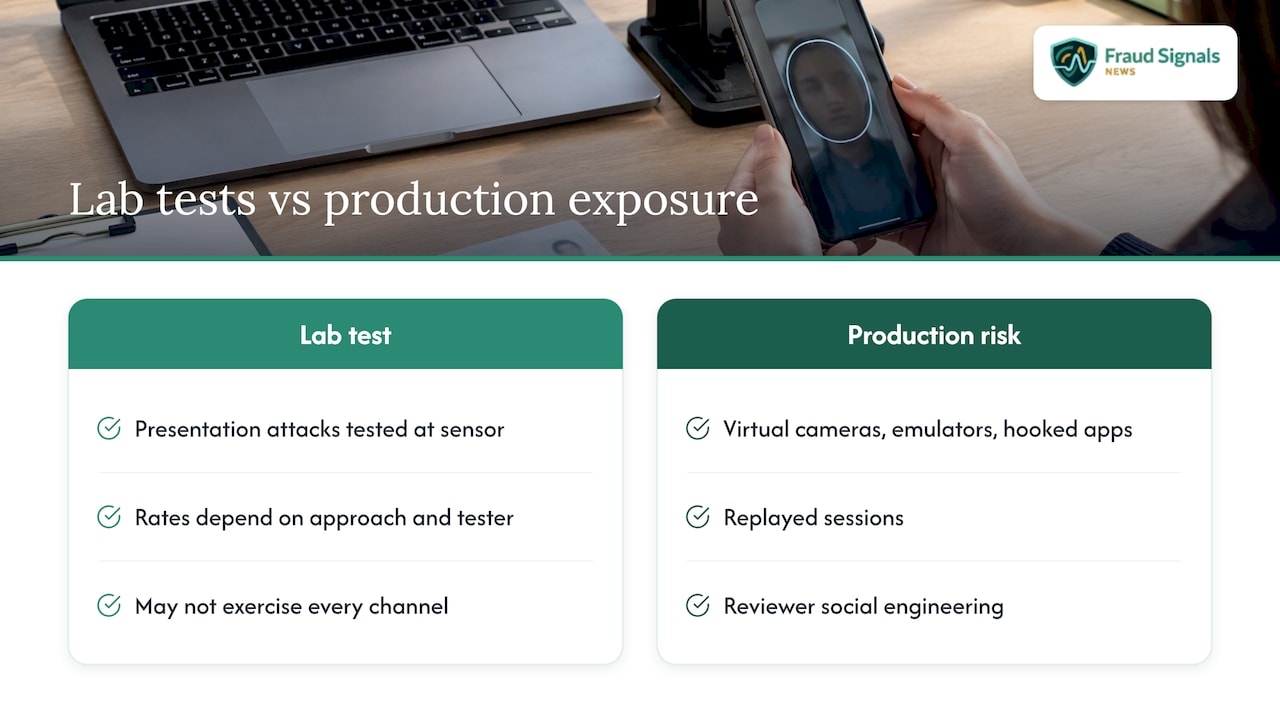
The standard itself is blunt about the limits. ISO/IEC 30107-3:2023 states that PAD error rates depend on the mechanism, the attack instrument set, the application, the test approach and the tester. An error rate above 0% for an instrument only proves that the instrument can succeed. Another tester may measure a higher or lower rate, and results are not necessarily comparable across similar tests or reproducible by different laboratories. It also says that interpreting benchmark error rates can depend heavily on the intended application.
For a retail bank, that reads as follows. A lab tests presentation attacks at the sensor. Your exposure includes virtual cameras, emulators, hooked apps, replayed sessions and social engineering of the human reviewers behind your exception queue. A system can score well in a lab and still be defeated at scale through a channel the lab did not exercise. That is the gap fraud teams should plan around, not argue about.
How U.S. financial institutions should use PAD results
We treat independent PAD testing as a procurement and governance input, not a finish line. A workable approach looks like this.
- Make the report a gate in vendor selection. Require the full report, not a summary letter, naming the standard, species, sample size, build version and lab scope.
- Match the level to the risk. Account opening for high-limit products and account recovery deserve the stricter tier. Low-value, step-up checks can tolerate a looser one if other signals compensate.
- Map the report to your threat model. List the attacks you actually see: deepfake video on injected streams, face swaps, printed documents with replayed selfies. Mark which ones the report covers and which it does not. Our piece on capture integrity and deepfake ID fraud lays out the channel-level attacks that sensor-level tests often miss.
- Re-test on change. A model update, new SDK or new device support is a reason to ask for an updated evaluation or to run your own red-team exercises.
- Compare against production telemetry. Track spoof-suspected rates, manual-review outcomes and confirmed fraud by device and channel. This is where fraud operations and model risk teams meet. Related reading on mobile payment fraud detection with AI covers the transaction-side signals that complement biometric checks.
- Document it for examiners. Keep the report, the scope of the lab’s accreditation, your mapping and your compensating controls in one file. That is what an audit will ask for.
For matching accuracy, which is a different question from PAD, see our guide on reading NIST face test data. Recognition accuracy and attack resistance are separate scores, and a strong result on one says nothing about the other.
Questions to put to a lab or a vendor
- Which accreditation covers this work, and what is the exact scope?
- Was the test run by an independent lab or a vendor’s internal team?
- Which standard, edition and attack species were used?
- How many transactions per species, and how many errors were recorded?
- Which software build, sensor and threshold were tested?
- Were injection or virtual-camera attacks in scope?
- When was the test run, and has the product changed since?
A vendor that answers these cleanly has probably been through serious testing. Vague answers tell you about how the evidence will hold up under an examiner’s review.
Perspective
Independent PAD testing is the most useful, and most misused, document in biometric procurement. Too many institutions accept a certificate as a verdict when the standard itself says results depend on the tester, the attack set and the application.
Our view at Fraud Signals News is that a lab report earns its value when a fraud team reads it the way an attacker would: which instruments were left out, which channels were never touched, and which build was actually measured. Banks that modernize identity verification should demand per-species results, require scope-level accreditation evidence and then verify against their own production data.
The cat-and-mouse dynamic between banks and fraudsters does not pause for a certification cycle. That is why we cover liveness, deepfake capture attacks and testing standards from the operations side, so that directors of fraud risk can turn lab evidence into controls that hold up after launch.
Carlos Ochoa
Keep going with Fraud Signals News
If you are building a vendor evaluation checklist, start with our analysis of why biometrics reduce bank fraud and follow the latest reporting on liveness, deepfake ID and testing standards in our digital identity and fraud prevention coverage. We write for fraud, compliance and technology leaders in banking, fintech, healthcare and travel.

For teams earlier in the journey, our explainer on selfie identity verification is a practical place to begin.
FAQ
Is a PAD testing lab the same as a medical or drug testing lab?
No. The search results for this phrase are dominated by drug, DNA and clinical labs, but PAD stands for presentation attack detection in biometrics. A PAD lab evaluates how a fingerprint, face or iris system responds to spoofs, not biological samples.
What is the difference between PAD and liveness detection?
NIST treats liveness detection as a subset of presentation attack determination methods. Liveness checks whether a sample comes from a living subject at capture, while PAD is the broader automated determination of whether a presentation attack is occurring.
Which PAD thresholds should we look for?
Under FIDO’s Biometrics Requirements, Level 1 needs IAPAR of 15% or less and Level 2 needs 7% or less. Which level you need depends on the risk of the transaction the biometric protects, so ask the vendor for the certificate showing the level.
Does NVLAP accreditation guarantee a lab’s results are right?
No. NIST’s handbook describes accreditation as a finding of competence and proficiency, not a guarantee of laboratory performance or of the test data. It also notes that no widely available interlaboratory comparison exists for biometric system testing, so check scope and methods in each report.
Sources
- Presentation Attack Detection (PAD) – Glossary, NIST CSRC
- What does presentation attack detection and liveness mean, Biometrics Institute
- NIST Handbook 150-25: Biometrics Testing
- Biometrics Testing LAP, NIST NVLAP
- FIDO Biometrics Requirements v2.2
- ISO/IEC 30107-3:2023 preview
Recommended

Proof of Life Video: How Liveness Checks Work and Where They Fail

ISO 30107 Liveness: What Compliance Really Proves