

Selfie spoof detection is the set of checks that decides whether the face in a selfie belongs to a live person present at the moment of capture, or to a printed photo, a screen replay, a mask, a synthetic face or a feed injected past the camera. It sits between capture and face matching: if the spoof check fails, a perfect match against the ID photo means nothing. For fraud teams at banks, fintechs and other regulated onboarding flows, the practical question is no longer whether to run it, but which attack classes it actually covers and how to monitor it once attackers adapt.
TL;DR
- Selfie spoof detection separates a live capture from presentation attacks (prints, screens, masks) and increasingly from digital attacks such as injected video and deepfakes.
- Face matching and spoof detection answer different questions: matching asks “is this the same face?”, spoof detection asks “is a real person in front of the camera right now?”
- Resistance to static photo attacks does not carry over to video replay, so test each attack class separately and keep testing after launch.
- Layer the controls: capture integrity, passive and active liveness, document checks, device and behavioral signals, and a manual review path.
- In the US, biometric privacy statutes such as Illinois BIPA, and FinCEN’s deepfake guidance, shape how you collect, retain and report on selfie data.
Table of Contents
- What selfie spoof detection is meant to stop
- How the detection actually works
- Selfie spoof detection, liveness and face matching are not the same control
- Where selfie spoof detection fails
- A layered design that holds up
- US privacy and compliance considerations
- Our perspective
- Keep tracking the attacks
- FAQ
- Sources
What selfie spoof detection is meant to stop
The research literature groups presentation attacks into two families. In 2D attacks, a flat material carries the face: a printed photo or a picture displayed on a phone or tablet. In 3D attacks, the material has volume, such as a mask or a sculpture. An ACM Computing Surveys review of presentation attack detection describes this split and expects 3D mask attacks to grow as 3D acquisition sensors spread, although producing a high-quality mask remains expensive and complex.
That cost barrier explains why most fraud in production still looks cheap. Criminals take a photo of a photo, hold up a screen, or replay a short video harvested from social media. Some variants are more inventive. A survey of anti-spoofing methods for facial recognition describes cut photo attacks, where eye or mouth areas are cut out of a printed picture so the scammer’s real eyes and lips supply the liveness cues, aimed at defeating simple blink or mouth-movement prompts.
It helps to sort the threat list by where the attacker intervenes:
- Presentation attacks. Something is shown to the camera: a print, a screen, a mask, a cut-out. The camera and the app are honest, the subject is not.
- Replay attacks. A recorded video of a live face is shown on a screen. These are harder than static photos because the video can mimic expressions and blinking. We cover the mechanics in our piece on replay attack biometrics.
- Injection attacks. The attacker bypasses the camera entirely, feeding a virtual camera or a modified app with prerecorded or synthetic video. No physical artifact ever reaches the lens, so artifact-based detection has nothing to see.
- Deepfake and face-swap attacks. Generated or manipulated faces, usually delivered through injection, sometimes through a screen.
The last two are why the term “selfie spoof” has outgrown its original meaning. A control designed for prints will report a clean pass on an injected deepfake, because the pixels it receives look like skin.
How the detection actually works
Spoof detection is a family of signals rather than one test. The same ACM survey lists the main families: texture analysis, which separates human skin from paper or screen material; motion analysis of facial movements; spatial features such as depth maps; and life sign analysis, including eye blinking, mouth movement and blood flow. The review’s assessment is that texture analysis currently offers the broadest discrimination capability, because paper, masks and screens differ physically from skin.
Passive versus active checks
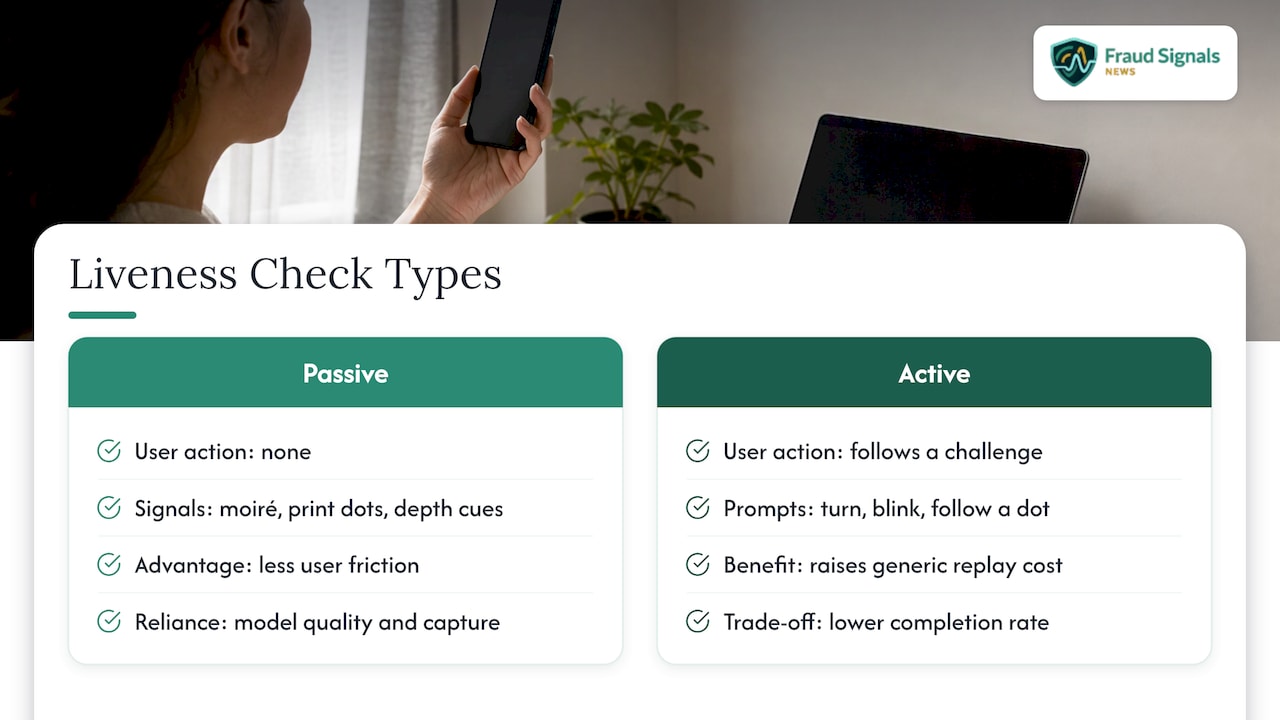
Passive liveness analyzes the selfie or a short capture without asking the user to do anything. It looks for moiré patterns from screens, print dot structure, unnatural reflections, flat depth cues and compression artifacts. Its advantage is friction: the user takes a selfie and moves on. Its weakness is that it gives an attacker no challenge to fail, so everything rests on the quality of the model and the capture.
Active liveness issues a challenge: turn your head, blink, follow a dot, read digits aloud, or watch a screen flash a color sequence that should reflect off real skin. Challenges raise the cost of replaying a generic video, since the attacker needs a response tied to the specific prompt. They also cost completion rate, which we examine in our guide to selfie verification UX.
Remote photoplethysmography
One signal worth understanding is rPPG. It extracts a heart rate from ordinary RGB video by detecting tiny changes in skin color tied to blood flow, as the ACM survey explains. A printed photo has no pulse, and a crude mask has none either. The caveat for practitioners: a high-quality replay of a real person’s video can carry a genuine pulse signal, so rPPG is one vote, not a verdict.
Single frame versus video
When a system samples multiple frames of a selfie video, it has more data for a risk score than when it analyzes a single still. Temporal consistency, micro-movements, and lighting response across frames are all lost in a single photo upload. If your flow still accepts a gallery upload or a single frame, you are choosing the weakest capture mode your attackers can find. Our deeper walkthrough, face liveness detection: how it works and where it fails, covers each method in more depth.
Selfie spoof detection, liveness and face matching are not the same control
Vendors blur these terms, and so do procurement documents. Keep the distinctions explicit:
| Control | Question it answers | What it misses |
|---|---|---|
| Face matching (selfie to ID photo) | Does the selfie show the same person as the document photo? | A real person holding someone else’s stolen document and a matching face; any spoof that looks like the document holder |
| Liveness / spoof detection | Is a live person physically present at capture? | A live person using a stolen or forged document; injected feeds if capture integrity is weak |
| Document verification | Is the ID authentic and unaltered? | A genuine document used by the wrong person |
| Device and behavioral signals | Does the session look like a real phone and a real user? | Clean devices operated by a mule who is cooperating |
The three first controls are complementary. Matching without liveness lets anyone with a photo of the victim pass. Liveness without matching confirms a real human but not the right one. A US Department of Homeland Security analysis found that the median selfie-to-document matching system rejected 99.99% of impostors in its 2025 quantitative framework, which is a useful reminder that matching is strong against casual impostors, and that the harder cases are the deliberate attacks that spoof detection exists to stop. For a primer on the matching side, see how selfie identity verification works.
Where selfie spoof detection fails
The honest way to deploy it is to know the failure modes in advance.
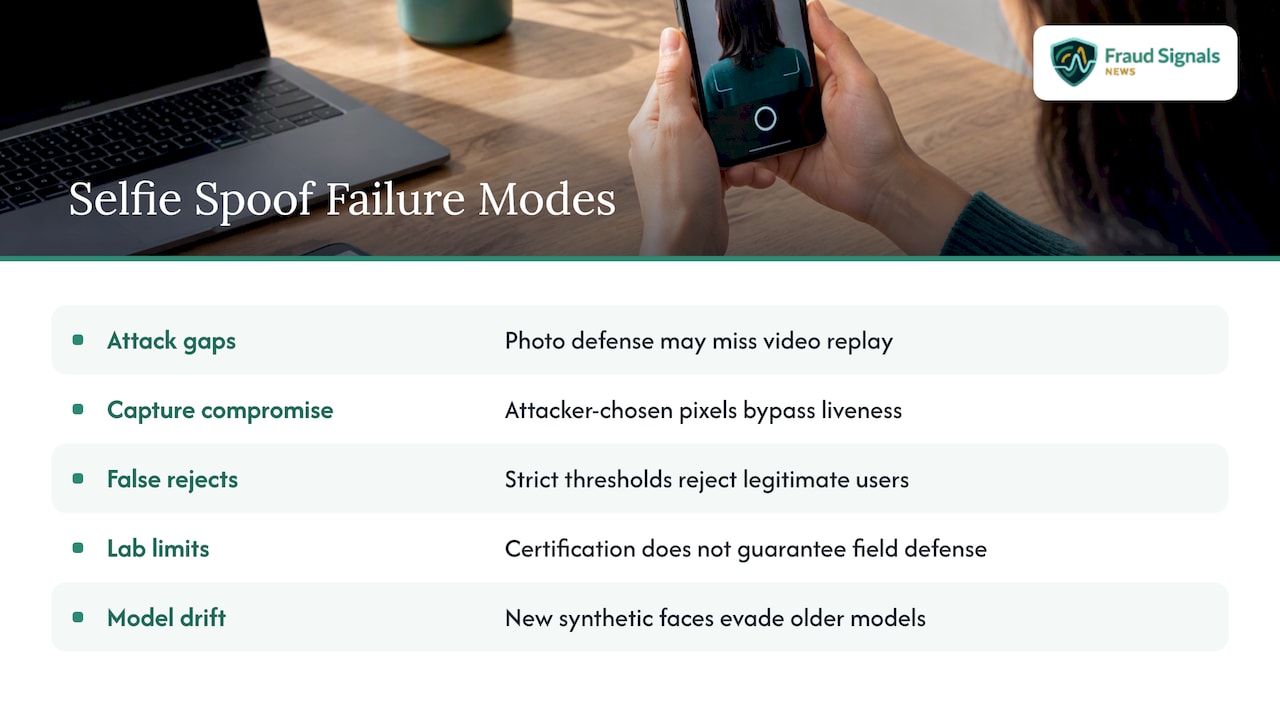
Attack-class gaps. The introductory literature on presentation attack detection makes a point that every fraud team should post on the wall: resilience against static photo attacks does not mean equal resilience against video replay attacks. A vendor demonstration that blocks printed photos tells you little about screens showing video. Replay is more sophisticated because it can reproduce blinking and expression changes, which defeats simple motion-based checks.
Capture-layer compromise. If an attacker can emulate a camera, root a device, hook the SDK or use a virtual webcam in a browser flow, the best liveness model in the world analyzes attacker-chosen pixels. This is the gap behind modern deepfake onboarding fraud, and the reason we argue in our piece on capture integrity and deepfake ID fraud that fixing capture comes before tuning models.
False rejects. Every threshold is a trade. The DHS Science and Technology Directorate’s framework stresses that total identity verification security depends on both the specific threat landscape and the system’s tolerance for facilitation errors, meaning false rejects of legitimate users (DHS framework). Tighten the threshold too far and you reject real customers with older phones, dim rooms, glasses, darker skin tones under poor lighting, or accessibility needs. Those users do not file a ticket; they abandon.
Lab certification is not field performance. Independent testing against ISO/IEC 30107-3 is a sensible baseline. Labs such as iBeta, which is accredited by NIST/NVLAP, publish confirmation letters describing the attack levels and test limits, for instance per-artifact time limits and the number of presentation attacks. Read what was actually tested: which devices, which attack species, and whether injection was in scope. A pass at one level on two phones is evidence, not a guarantee against the attack your fraud ring is running this quarter.
Model drift. Generative tools improve monthly. A detector trained on last year’s synthetic faces will degrade silently, because a successful attack looks exactly like a successful onboarding. Without feedback from downstream fraud outcomes, nobody notices.
A layered design that holds up
The pattern we see work in operations-focused programs is straightforward, even if executing it is not.
- Secure the capture. Use a native SDK or hardened web capture, attest the device and app, and detect virtual cameras, emulators and hooking frameworks. Treat injection as a first-class threat, not an edge case.
- Run liveness suited to the risk. Passive for low-risk, low-friction steps; active or challenge-response for account opening and high-value changes. Step up when signals disagree rather than adding friction for everyone.
- Match the face to a verified document. Pair it with document authenticity checks. Our guide to document liveness and replay or injection fraud addresses the document side, and ID security features explains what examiners and software look for on the card itself.
- Add contextual signals. Device reputation, IP and network risk, velocity across applications, behavioral cues, and reuse of the same face across multiple identities. A face that appears under six names is a signal no liveness model sees on its own.
- Provide a human path. Route borderline scores to review, and give legitimate users an alternative route rather than a dead end.
- Close the loop. Feed confirmed fraud and confirmed false rejects back into threshold tuning and vendor review.
The same logic applies outside banking. Crypto platforms face identical spoofing pressure at onboarding, and the crypto payment KYC checks developers and businesses must verify show how the same identity layers apply in that setting. In healthcare, our look at patient identity verification against deepfakes covers how those controls map to clinical workflows.
Measuring it
Track at least these, segmented by device family, channel and attack type where you can:
- Attack presentation acceptance rate in your own red-team tests, by attack class (print, screen replay, mask, injection, deepfake).
- Bona fide false reject rate, plus the share of rejects who retry and succeed, which hints at how many were wrongly blocked.
- Completion rate and time to complete.
- Confirmed fraud rate among accepted accounts at 30, 90 and 180 days.
- Manual review volume and overturn rate.
For reading face-recognition benchmark data without being misled by it, see our FRVT results analysis. For attack scenarios and standards-aligned countermeasures, the engineer-focused guide on liveness detection spoofing goes further.
US privacy and compliance considerations
Selfie capture creates biometric data, and several US jurisdictions regulate it. There is no single federal biometric privacy law, so obligations depend on where your customers live.
Illinois BIPA. The Biometric Information Privacy Act requires a private entity holding biometric identifiers to maintain a publicly available written policy with a retention schedule and destruction guidelines. Data must be destroyed when the initial purpose is satisfied or within three years of the individual’s last interaction, whichever comes first. The statute also contains consent requirements for collection, and it carries a private right of action, which is why it generates litigation. Have counsel review your consent screen and your vendor contract, including who is the processor and where templates are stored. Other states, including Texas and Washington, have their own biometric provisions, and comprehensive state privacy laws add rules for sensitive data.
Financial-sector duties. For banks and other covered institutions, selfie checks typically support Customer Identification Program obligations. FinCEN issued an alert on fraud schemes involving deepfake media, FIN-2024-Alert004, describing how criminals use altered or synthetic identity documents to circumvent verification and authentication, and asking institutions to reference the key term “FIN-2024-DEEPFAKEFRAUD” in suspicious activity reports. If your team detects a deepfake attempt, that reporting path is part of the operational design. Our explainer on why biometrics satisfy compliance requirements goes through how these checks support the broader program.
Practical guardrails. Collect only what the check needs, limit retention, separate templates from identity records, document your fraud-prevention purpose, and ask vendors where biometric data is processed and whether it is used to train their models. Confirm the answers in writing.
Our perspective
Most institutions still buy selfie checks the way they bought document scanners: as a box ticked at onboarding. That framing is obsolete. Attackers do not target your average case; they probe for the weakest capture mode, the weakest device class and the weakest step-up path, and they share what works.
We argue for treating spoof detection as an operating discipline. Test every attack class separately, because a pass against prints says nothing about replays or injection. Insist that capture integrity is in scope. Watch false rejects as closely as fraud losses, because abandoned legitimate customers are a cost too. And keep reading the evidence: the field changes quarterly, and the teams that stay ahead are the ones that follow the research, the standards bodies and the incident reports rather than the vendor brochures.
That is the reason Fraud Signals News exists: to give fraud and identity leaders operations-focused coverage of biometric identification, liveness and deepfake ID technology that general security outlets rarely go deep on.
Carlos Ochoa
Keep tracking the attacks
Spoofing techniques shift faster than most procurement cycles. Fraud Signals News follows biometric identification, liveness detection and deepfake ID developments for teams in banking, fintech, healthcare and travel. Start with why biometrics reduce bank fraud, or browse the full coverage on our homepage.

If you are evaluating vendors, our identity verification alternatives roundup lays out the criteria we apply.
FAQ
What is the difference between selfie spoof detection and liveness detection?
The terms overlap heavily. Liveness detection is the broader idea of confirming a live person is present, while spoof detection, or presentation attack detection, names the goal of catching specific fakes such as prints, replays and masks. In practice, vendors use both labels for the same module, so ask which attack classes are tested, including injection.
Can a deepfake pass a selfie check?
It can if the check only inspects the image and the attacker controls the camera feed. Injected deepfakes bypass artifact-based detection because no physical object is shown to the lens. Defenses combine capture integrity, device attestation, virtual camera detection and deepfake-aware models, along with document and contextual checks.
Is passive liveness enough for account opening?
For low-risk steps it can be, but account opening and high-value changes usually justify a stronger layer: active challenges, step-up on risk signals, and capture protections. The right choice depends on your threat landscape and how many legitimate users you can afford to reject, so test with your own traffic.
How often should we test our selfie spoof detection?
Test at launch, after every vendor model or SDK update, and on a regular red-team schedule covering each attack class. Also review confirmed fraud among accepted accounts, since a successful spoof is invisible at the moment of acceptance.
Does BIPA apply to selfie verification?
If you collect biometric identifiers from Illinois residents, such as face geometry derived from a selfie, BIPA’s consent and retention requirements are relevant. Talk to privacy counsel about your flow, since obligations vary by state and by how the data is processed.
Sources
- Presentation Attack Detection: A Systematic Literature Review, ACM Computing Surveys
- ACM Computing Surveys, presentation attack detection (rPPG and liveness signals)
- A Survey on Anti-Spoofing Methods for Facial Recognition
- Introduction to Presentation Attack Detection in Face Biometrics
- DHS S&T: A Quantitative Framework for Evaluating Remote Identity Validation Systems
- Illinois Biometric Information Privacy Act (740 ILCS 14)
- FinCEN Alert on Fraud Schemes Involving Deepfake Media (FIN-2024-Alert004)
- iBeta PAD Level 2 confirmation letter, ISO/IEC 30107-3 testing
- Crypto Payment KYC: What Developers and Businesses Must Verify
Recommended

Proof of Life Video: How Liveness Checks Work and Where They Fail
ISO 30107 Liveness: What Compliance Really Proves