
Keystroke dynamics identifies a person by how they type rather than what they type, and for fraud teams it is one of the few signals that works silently, inside forms customers already complete. Used well, it flags account takeover, scripted bots and impersonation at the moment of login, payment or onboarding without adding a step. Used carelessly, it produces error rates that vary widely from one user to the next. This guide covers what the research shows, where the signal holds up, where it is attacked, and how to deploy it as one layer in a wider identity-verification stack.
TL;DR
- Keystroke dynamics measures timing: how long keys are held and how quickly a user moves between them. It can be checked at a password prompt or continuously during typing.
- Peer-reviewed work supports it as an added layer for card payments and onboarding forms, but error rates depend heavily on the user, the text and the evaluation conditions.
- Researchers have shown that synthetic typing learned from video can evade some systems, so the signal belongs inside a layered stack, never alone.
- Timing-only features, which ignore what was typed, are a privacy-improving design choice that kept satisfactory results in a 2024 benchmark.
- Pilot it on existing forms first, measure false rejects by customer segment, and feed the score into your wider risk engine.
Table of Contents
- What keystroke dynamics actually measures
- Where it catches fraud
- What the accuracy numbers really say
- How fraudsters try to evade it
- Privacy, accessibility and customer experience
- A deployment path that works
- Where it fits in a modern identity stack
- Our view: measure it where your fraud actually lives
- Keep following the evidence
- FAQ
- Sources
What keystroke dynamics actually measures
Keystroke dynamics is a behavioral biometric. Instead of scanning a face or a fingerprint, it records the rhythm of typing: dwell time (how long a key stays down), flight time (the gap between releasing one key and pressing the next) and, in richer systems, patterns across digraphs, the pairs of keys typed in sequence. Carnegie Mellon’s long-running keystroke dynamics benchmark page describes the technique as usable in two ways: checking the rhythm of a password at login, and authenticating a user continuously while they type.
That distinction drives most design decisions. A 2013 systematic review notes that fixed-text analysis, where everyone types the same string such as a password, is easier to implement and has historically reached lower error rates than free-text approaches. Free text, where the system watches whatever the user types, is what makes ongoing monitoring possible. For a fraud team, the practical reading is simple: fixed text suits a login gate, and free text suits session monitoring and onboarding forms with open fields.
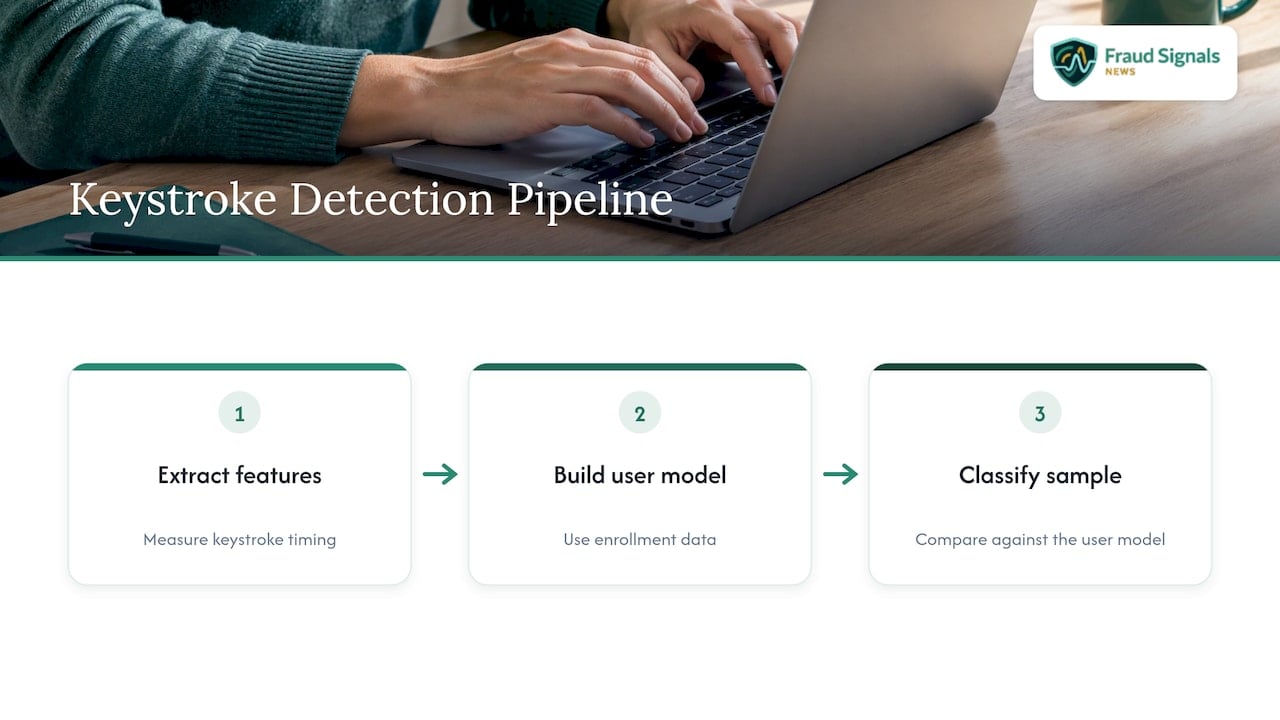
The typical pipeline in that review is straightforward. The system extracts timing features, builds a model of the legitimate user, and classifies each new sample against that model. Neural networks and support-vector machines are among the algorithms used in prior research. What matters operationally is not the algorithm but the enrollment data behind it and how the score is consumed downstream.
Where it catches fraud
Account takeover
Credential stuffing, phishing and SIM swapping all end the same way: someone who is not the customer types the right credentials. A password check passes. A timing profile may not. A 2022 dataset paper from UK researchers describes keystroke and mouse dynamics as an additional authentication layer for online card payments, using anomaly detection to separate legitimate from illegitimate card-owner behavior. Their dataset covers 88 individuals and 1,760 instances labeled as legitimate or illegitimate behavior, which is small by production standards but shows how the labeled signal can be built.
If you want the wider picture of what takeover looks like once the attacker is inside, this overview of account takeover indicators is a useful companion, because typing rhythm is strongest when it corroborates device, location and behavior changes rather than standing alone.
Card testing and scripted abuse
Automated card testing produces form entries with machine-regular timing, pasted values or none of the corrections human typists make. Keystroke and mouse signals give a payments team another anomaly to score alongside velocity and device data. The mechanics of the attack are laid out in this guide to card testing attacks, and the typing signal fits the same defensive logic: spot behavior no legitimate cardholder would produce.
For onboarding specifically, we cover how scripted sessions are separated from people in our piece on onboarding bot detection.
First-time users with no history
The hardest case for any behavioral system is the new customer, because there is no profile to compare against. A 2026 study in Information Systems Research addresses it directly: the authors designed and iteratively refined an onboarding tool that evaluates identity-fraud risk for first-time users using keystrokes from existing onboarding forms, aiming to avoid adding friction. The idea shifts the question from “is this the same person as before?” to “does this session look like a genuine applicant or a fraudster working through stolen data?” That is where deepfake and synthetic-identity attacks push fraud teams, as discussed in this look at deepfakes and identity security.
What the accuracy numbers really say
No honest briefing on this technology skips the error data, and none should treat a single figure as a promise. Here is what the academic record shows.
| Study | What it tested | Reported result |
|---|---|---|
| CMU benchmark, 2009 | 14 anomaly detectors, 51 subjects typing 400 passwords each | Three best detectors reached equal-error rates of 9.6% to 10.2% |
| CMU dissertation, 2012 | Error behavior across users and replicated evaluations | Best classifier’s error varied from 0% to 63% by user; one classifier moved from 1% to 85% on replication |
| Keystroke Verification Challenge, 2024 | Variable-text benchmark, more than 185,000 subjects, desktop and mobile | Common benchmark plus a demographic fairness metric |
The equal-error rate is the point where false accepts and false rejects are equal, so a 10% rate on a password-only detector from 2009 is a baseline, not a ceiling for a layered system. The more important lesson comes from the 2012 dissertation: its authors argue that performance depends substantially on the user and the evaluation conditions, so the choice of classifier alone does not predict error. For a fraud director, this means vendor claims should be read against your own population, your own devices and your own forms.
The 2024 challenge authors make a related point: varied protocols and datasets make direct comparison between systems difficult, which is why they propose shared benchmarks and a fairness measure. When you evaluate a solution, ask which conditions its numbers come from and whether results are broken out by segment.
Friction is the other half of the story
Accuracy in isolation is not what a retail bank buys. The value is in what the signal lets you skip. Keystroke scoring can keep step-up challenges, such as one-time passcodes or document re-checks, for the sessions that actually look wrong, while low-risk sessions pass quietly. The 2024 benchmark paper presents transparent verification as a potential usability benefit, and that is the argument that usually wins internal approval: fewer interruptions for good customers, with the same or better protection.
How fraudsters try to evade it
Any control that gains adoption attracts attackers, and the research is candid about it. The 2012 CMU dissertation reports that impostors who touch-type tripled their chance of evading detection, while a combination of hold-time and up-down timing features cut error rates by more than 50%. In other words, richer features raised the bar considerably.
A 2022 Journal of Big Data study went further and tried to synthesize typing patterns learned from screen-recorded video. In its experiment, with 14 participants, the synthetic patterns achieved evasion rates of 64.3% for password-mode authentication and 43% for free-text authentication. The authors also report that the attack was constrained in free-text mode because it could reproduce key-delay timing but not key-hold timing.
Three design conclusions follow for a fraud team:
- Use hold-time and flight-time features together. The research shows that combining them improves detection materially.
- Prefer free-text or continuous monitoring where you can. The spoofing study found it harder to defeat than password-only checks.
- Never let the keystroke score be the only gate. Pair it with device signals, liveness checks and document verification so that defeating one layer does not open the account.
This is the same layered logic we apply to other biometric channels, from face liveness detection to liveness detection spoofing defenses. No single signal is defeated at scale only by being clever; it is defeated by being the sole control.
Privacy, accessibility and customer experience
Typing data feels harmless until a regulator or a customer asks what is being collected. The key design question is whether you need to know what was typed. The 2024 benchmark reports satisfactory performance using timing-domain features after removing ASCII key content, a less privacy-invasive approach because the system never analyzes the text itself. For a bank, that is a strong default: capture timestamps and key-event types, discard the character content, and document that choice in your privacy assessment.
The 2013 survey of keystroke dynamics biometrics adds that behavioral biometrics can operate with minimal interaction and may be less invasive than physiological ones, though it notes that they generally perform below physiological counterparts. That is the argument for using typing as a complement to face, voice or document checks, not a replacement.
Before going live, settle these questions with your privacy, legal and accessibility teams:
- Data minimization: Which fields are monitored, and is key content discarded at the edge?
- Retention: How long do profiles live, and what happens when a customer closes the account?
- Accessibility: Customers using assistive input, voice typing or one-handed entry will have atypical rhythms. Define fallback paths that do not penalize them.
- Device variance: The 2024 benchmark covers both desktop and mobile keyboards, which is a reminder that profiles should be modeled per device type.
- Fairness: Track false-reject rates by segment, in line with the demographic fairness metric the 2024 researchers propose.
A deployment path that works
A sound rollout starts small and measures honestly.
- Instrument existing forms. Capture timing events on login and onboarding fields you already use. The 2026 onboarding study rests on exactly this premise of adding no new customer step.
- Run in shadow mode. Score sessions without acting on them, then compare scores with confirmed fraud outcomes and with customer-service contacts.
- Set thresholds by segment. Because error varies by user and conditions, a single global cutoff will misfire. Tune by device type, channel and customer tenure.
- Route, do not block. Send borderline scores to step-up authentication and reserve hard declines for cases where other signals agree.
- Feed the score into your risk engine. Typing rhythm is most valuable as one input next to device fingerprinting, velocity rules and document or selfie checks.
- Review monthly. Attackers adapt, and so should your features and thresholds.
For an engineering-level walkthrough, see our guide to piloting keystroke dynamics biometrics. For how to combine it with physical biometrics in a time-boxed test, read the 21-day layered biometrics pilot. And if onboarding is your focus, what to collect at onboarding and how to read it shows where typing sits among the other signals.
Where it fits in a modern identity stack
The honest positioning is this: keystroke dynamics is a low-friction, continuous, hard-to-see signal that strengthens decisions made by stronger, more explicit checks. Document verification and liveness establish who is applying. Device and network intelligence establish where and how. Typing behavior helps establish whether the person at the keyboard behaves like a genuine applicant or customer, and whether that behavior stays consistent across the session. Our guide on why biometrics reduce bank fraud places behavioral signals within that wider biometric picture, and the piece on ways to reduce identity fraud exposure shows how to prioritize them.
Our view: measure it where your fraud actually lives
We have watched institutions keep trusting static credentials long after those credentials stopped meaning anything. A password, a knowledge question or an SMS code proves possession of data, and stolen data is the commodity criminals trade in. Behavioral signals such as typing rhythm are valuable because they are hard to buy on a marketplace.
Our position is that the right question is never “does keystroke dynamics work?” in the abstract. The research is clear that error depends on the user, the text and the evaluation conditions, which means the only credible answer comes from your own traffic. Institutions that instrument existing forms, run in shadow mode and tune by segment get an answer that is specific, defensible to auditors and useful to the business.
We also think timing-only capture should be the default. It keeps the behavioral value while avoiding the content of what customers type, and that makes the conversation with privacy teams and regulators far easier.
Most importantly, build for the attacker who has read the same papers you have. Combine hold and flight features, prefer continuous monitoring, and keep the signal as one vote among several. That is how fraud programs stay ahead in a cat-and-mouse contest rather than reacting to the last breach.
Carlos Ochoa
Keep following the evidence
Identity verification changes quickly, and the gap between vendor claims and tested performance is where fraud teams lose money. Fraud Signals News covers biometric identification, eKYC, liveness detection and deepfake ID technology with an operations focus, including practical frameworks for measuring fraud-prevention ROI in fintech, banking, healthcare and travel. Browse the latest analysis on our digital identity and fraud prevention trends page.

FAQ
Is keystroke dynamics accurate enough for fraud detection?
It is accurate enough to add value as a layer, provided you measure it on your own traffic. A 2009 CMU benchmark found its three best detectors at equal-error rates between 9.6% and 10.2%, and a 2012 dissertation showed error varying widely by user. Richer timing features and layering with other signals improve outcomes.
Can keystroke dynamics be spoofed?
Researchers have shown that synthetic typing learned from screen-recorded video can evade some systems, with 64.3% evasion in password mode and 43% in free-text mode in one 2022 experiment. The same study found free-text mode harder to defeat because key-hold timing was not reproduced. That is why the signal should sit alongside device, document and liveness checks.
Does keystroke dynamics record what customers type?
It does not have to. A 2024 benchmark reported satisfactory results using timing features after removing key content, so a privacy-minded design captures rhythm and discards characters. Document that choice in your data-protection assessment.
Where should a bank start?
Start with forms customers already complete, such as login and onboarding, and score sessions in shadow mode before acting on them. Compare scores with confirmed fraud outcomes, then set thresholds by device type and customer segment.
Sources
- Keystroke Dynamics Benchmark Data Set, Carnegie Mellon University
- A systematic review on keystroke dynamics
- A behaviour biometrics dataset for user identification and authentication
- Comparing Anomaly-Detection Algorithms for Keystroke Dynamics
- A Scientific Understanding of Keystroke Dynamics
- Keystroke Verification Challenge (KVC)
- Spoofing keystroke dynamics authentication through video-based learning
- Are You, You? Seamlessly Fighting Identity Fraud, Information Systems Research
- A Survey of Keystroke Dynamics Biometrics
- Indicators of account takeover that matter
- Card testing attacks: how to spot and stop them
- Deepfakes are about to break identity security
Recommended

On-Device Biometrics for KYC: What They Prove and What They Don't

Proof of Life Video: How Liveness Checks Work and Where They Fail