
On-device biometrics for KYC means the face or fingerprint match happens inside the customer’s phone, against a template that the phone’s secure hardware created and holds, rather than on a vendor’s or bank’s server. That design is good for privacy and speed, but it proves only that the person holding the phone is the person who enrolled on it. It does not, on its own, prove that this person is the identity named on a new account. Fraud teams that treat the two claims as the same thing are the ones who get hurt at onboarding.
This article explains where the line falls, what US rules actually require, and how to combine device-level matching with the document, liveness and injection checks that make a KYC decision defensible.
TL;DR
- On-device matching is a 1:1 comparison between a fresh capture and a template stored on the phone. It authenticates a device holder, and it does not verify a legal identity.
- US KYC rules under the USA PATRIOT Act and the CIP rule require a risk-based identity verification process. They do not name biometrics as mandatory.
- Device-bound biometrics are strongest as a reusable credential after onboarding, and when paired with a signed credential such as a mobile driver’s license.
- Privacy exposure follows the data, not the marketing: state laws such as Illinois BIPA and Colorado’s amendments apply when biometric identifiers are collected, retained or shared.
- The weak points are injected video, device compromise and account recovery, not the matching algorithm.
Table of Contents
- What on-device biometrics actually are
- The gap between authentication and identity proofing
- What US KYC rules require, and what they leave open
- How the onboarding flow should be assembled
- Where on-device biometrics help fraud teams
- Where the model breaks
- Privacy law: the data decides the exposure
- A practical checklist for evaluating an on-device approach
- Promo: follow the verification stack as it moves
- Our perspective
- FAQ
- Sources
What on-device biometrics actually are
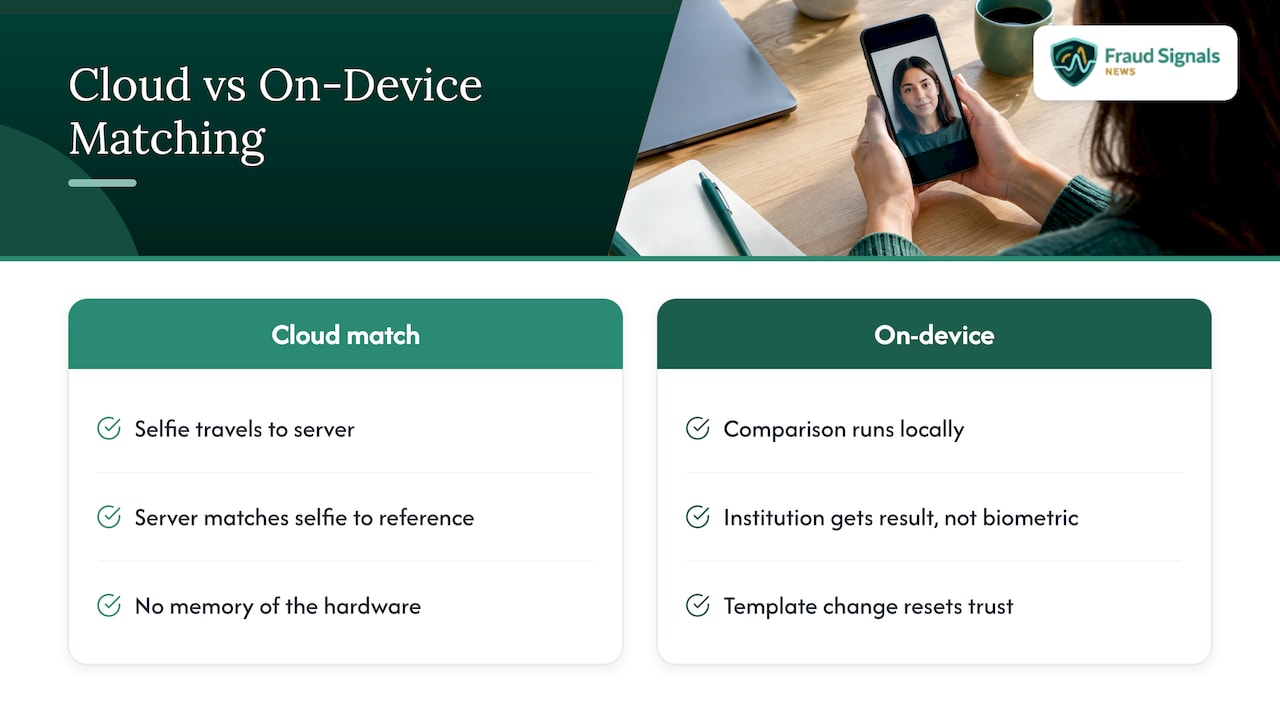
In a cloud model, the customer captures a selfie, the image travels to a server, and a matching engine compares it with a document photo or a stored reference. In an on-device model, the comparison runs locally. The Sedona Conference’s U.S. Biometric Systems Privacy Primer describes the underlying idea as 1:1 matching: software compares a newly submitted biometric template, such as the face template used to unlock a phone, against a previously stored template of the same person.
The practical consequence is that the institution usually receives a result, a signed assertion that the local check passed, and not the biometric itself. Wells Fargo’s Vantage app biometric login page illustrates the pattern in banking: it states that the device stores the information needed to recognize a fingerprint or facial features, that the bank does not store fingerprint information, a Face ID image or biometric data, and that a change to the device’s biometric information forces the user to sign in with credentials and re-enable biometric sign-on.
That last detail matters for fraud teams. A device-bound biometric has a built-in tripwire: when the enrolled templates change, trust resets. A cloud-matched selfie has no such memory of the hardware.
The gap between authentication and identity proofing
KYC asks a different question from login. Login asks whether this is the same person who was here before. KYC asks who this person is in the first place. On-device biometrics answer the first question well and the second not at all, because the template on the phone was enrolled by whoever set up the phone. A fraudster who enrolls their own face on a device and then opens an account with stolen data passes every on-device check.
The regulatory text reflects this distinction. Under the CIP rule at 31 CFR 1020.220, as mapped by NIST’s National Cybersecurity Center of Excellence, a bank’s risk-based procedures must let it form a reasonable belief that it knows each customer’s true identity. Verification can use documents, non-documentary methods or both, and the bank must keep records of the identifying information, the documents relied on, and the verification methods and results.
Two things follow:
- A local pass is not a record. If the match happens on the phone and only a boolean returns, the bank still needs to show what it relied on. The design must preserve evidence of the document, the data source and the method, even if the face template never leaves the device.
- Something must bind the face to the claimed identity. That binding comes from a document photo, an issuer-signed credential, or an authoritative data source. The on-device match then ties that verified person to the hardware.
For a deeper look at how the selfie leg of this works in practice, see our explainer on selfie identity verification.
What US KYC rules require, and what they leave open
The core obligation comes from the USA PATRIOT Act. The Treasury’s final Section 326 regulations, announced April 30, 2003, require financial institutions to verify the identity of persons opening accounts, keep records of the information used, and check government lists of terrorists. Institutions must collect a name, address, date of birth and a taxpayer identification number, typically a Social Security number for US persons.
Nothing there mandates a biometric. The FFIEC’s interagency guidance on authentication and access says institutions need a process to verify customer identity when establishing an account, and that reliable verification methods generally do not depend solely on knowledge-based questions. The same guidance lists device-based public key infrastructure (PKI) authentication as a reliable method: the customer uses a PIN, a biometric or another identifier on the device to trigger encryption-based authentication with the institution, with keys built into computers, smartphones and other devices.
That is the regulatory sweet spot for on-device biometrics. They are a legitimate way to unlock a device-bound cryptographic key, which is strong authentication. They are not, by themselves, the CIP verification step.
Mobile driver’s licenses change the equation
The most interesting development for on-device approaches is the mobile driver’s license (mDL), a digital ID issued by a state and held in a phone wallet. NIST’s CIP mapping explains that the mDL is signed by the issuing state and a unique device key, is cryptographically bound to the phone, and is protected during presentation by local authentication mechanisms, often biometrics. The bank therefore gains confidence both that the credential is genuine and that it is in the holder’s possession.
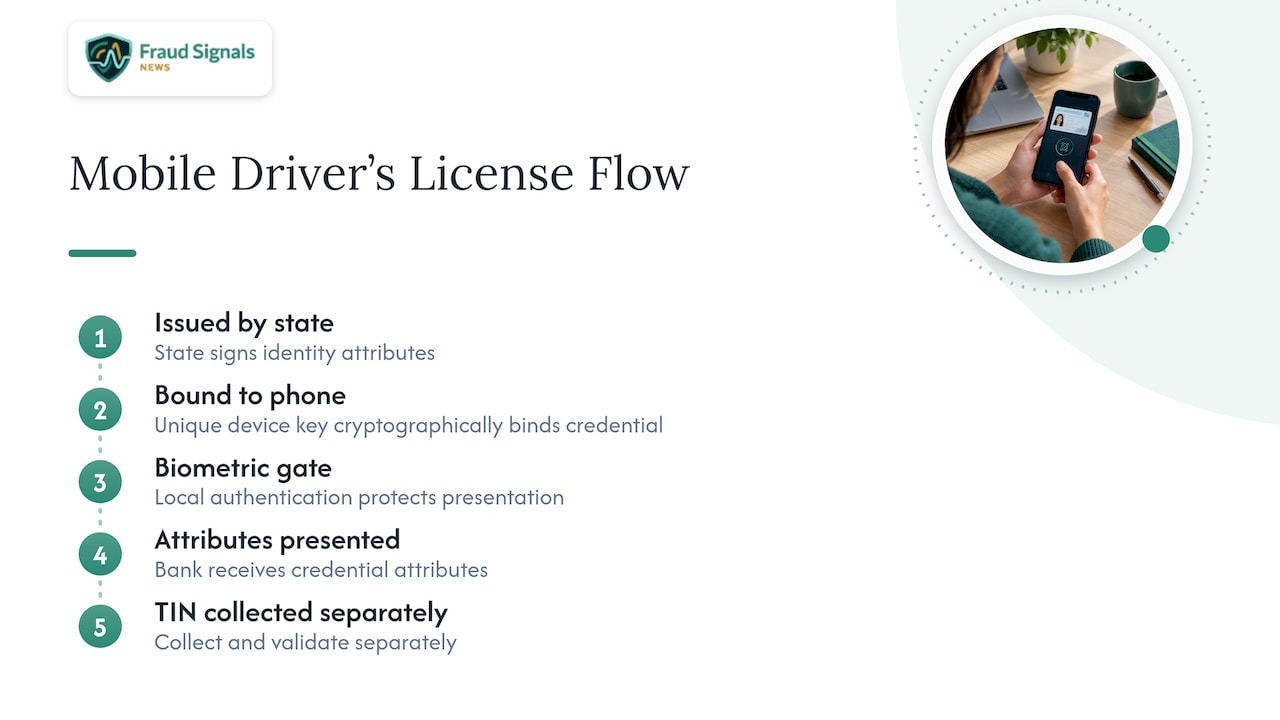
The signed attributes (family name, given name, date of birth, address and portrait) cover the CIP’s minimum identifying information. The taxpayer identification number is not included in US state mDLs, so it must be collected and validated separately. This is a clear example of on-device biometrics doing a real KYC job: the local match gates release of a credential whose identity content was verified by the issuer.
How the onboarding flow should be assembled
The question we get most from fraud leaders is how on-device matching fits into remote account opening. A defensible sequence looks like this:
- Establish the claimed identity. Capture the document or receive an issuer-signed credential, and validate it. The portrait or credential becomes the reference for who this person is.
- Confirm a live person is present. Run liveness detection on the capture. Our guide to face liveness detection and where it fails covers the attack classes that matter.
- Protect the capture path. The Federal Reserve Financial Services article on the evolution of identity verification notes that fraud detection may use camera liveness detection, voice authentication and behavioral biometrics. Pair those with checks that the video came from a real camera, since injected feeds defeat liveness that only inspects pixels. See stopping replay and injection fraud.
- Bind to the device. Enroll the verified person’s biometric on the device-bound key. Later logins and step-ups rely on the local match plus the cryptographic assertion.
- Collect and validate the remaining CIP data, including the taxpayer identification number, and keep the records of methods and results that the rule requires.
- Screen and score. Run list checks and risk signals. The FFIEC notes that device identifiers like cookies, geo-location and IP address are insecure if used alone, but can be combined with other controls.
The order matters. Binding a biometric to a device before the identity is proven is how synthetic and mule accounts acquire a clean-looking, reusable credential.
Where on-device biometrics help fraud teams
Lower exposure of sensitive data. If templates stay in the phone’s secure hardware, the institution holds less data that can be breached or demanded. That shrinks the target and simplifies some of the retention obligations discussed below.
Stronger step-up authentication. The Federal Reserve Financial Services article says multi-factor authentication using an associated phone or mobile device plus a biometric factor such as the customer’s face can reduce unauthorized-access risk. Because the factor is bound to hardware, it is much harder to replay from a remote attacker’s machine than a password.
Behavioral signals as a second layer. The FFIEC guidance describes behavioral biometrics software that analyzes finger swipes, taps, keystrokes and mouse usage to authenticate the customer. These signals run quietly during a session and help flag takeover after the initial check. For the wider case, see why biometrics reduce bank fraud.
Less friction. A customer who already unlocks a phone with a face does not need to learn a new routine, which helps completion rates at onboarding and step-up.
Where the model breaks
Enrollment is the weakest moment
The local template is only as trustworthy as whoever enrolled it. Attackers who control a device, or who add a second face to a victim’s phone after socially engineering access, inherit the biometric trust. Institutions that rely on the phone’s biometric prompt alone, without a signal that the biometric set has changed, inherit that risk. The Wells Fargo behavior described above, forcing a credential sign-in when device biometrics change, is the kind of reset logic that closes this gap.
The phone number is not the identity
Many flows still anchor on the phone number for recovery and one-time codes. SIM swapping hands that anchor to an attacker, which can then be used to re-register a device. Customers can reduce their own exposure by setting a telco PIN against SIM swaps, and institutions should treat any number-change event as a trigger for stronger re-verification rather than as a recovery shortcut.
Injection and deepfakes target the capture, not the match
When the biometric check runs on a device the customer controls, an attacker controls the same environment. Emulators, hooked camera APIs and virtual cameras can feed prepared video into the app. This is why capture integrity is the central issue in deepfake ID fraud, and why a local match result should be treated as one signal rather than a verdict. Automated account creation at scale is a separate problem, covered in our piece on onboarding bot detection.
Accuracy claims need substance
The FTC’s May 2023 Policy Statement on Biometric Information treats unsubstantiated marketing claims about the validity, accuracy or fairness of biometric technology as deceptive under Section 5 of the FTC Act, according to Gibson Dunn’s 2025 review. The same review reports a December 2024 proposed consent order against a facial-recognition company over unsubstantiated accuracy and bias claims. Anyone describing a verification flow to customers or regulators should be able to document its performance. Our guide to reading NIST face test data helps teams do that.
Privacy law: the data decides the exposure
There is no single US biometric privacy statute, and that is the first thing compliance teams must absorb. KPMG’s 2025 regulatory alert summarizes the divergence: Illinois BIPA requires informed consent and a written retention policy; California’s CCPA and CPRA require notice of biometric collection and retention along with deletion rights; Texas’s CUBI prohibits capturing retina or iris scans, fingerprints, voiceprints or face geometry without informed consent and requires destruction within a year after the purpose expires; and Colorado’s 2024 amendments exclude facial or voice data from the definition of biometric data unless used for identification.
Illinois is the one that produces litigation. A BIPA summary notes that it requires informed written consent, a publicly available retention schedule, destruction when the purpose is satisfied or within three years of the individual’s last interaction, and safeguards, with a private right of action carrying liquidated damages of $1,000 for negligent violations or $5,000 for reckless or intentional ones.
Gibson Dunn reports two recent changes worth tracking: the Illinois amendments signed August 2, 2024, which count collection by the same method as a single violation, and Colorado’s May 31, 2024 amendments, effective July 1, 2025, which add public retention schedules, incident protocols and deletion deadlines.
What this means for on-device designs:
- Data minimization is real, but verify who collects what. If a vendor SDK builds a face geometry scan on the device and transmits any derivative, the collection analysis changes. A court in Sloan v. Anker Technology (Jan. 9, 2024) held that building faceprints from facial points and contours and storing them in the cloud plausibly amounts to a protected face-geometry scan under BIPA.
- Document the flow by state. Consent language, retention schedules and deletion triggers should reflect where customers live, not where the institution is headquartered.
- Banking-side rules still apply. Gibson Dunn also points to the FFIEC 2021 guidance and the 2021 OCC, Federal Reserve and FDIC breach notification rules as the governing banking framework.
This section is a map for planning and not legal advice. Have counsel review consent and retention language for each state where you onboard customers.
A practical checklist for evaluating an on-device approach
| Question | What a good answer looks like |
|---|---|
| What binds the face to the legal identity? | A validated document, issuer-signed credential or authoritative source, recorded for CIP purposes |
| Is liveness checked at onboarding? | Yes, with a defense against injected or virtual camera feeds |
| What happens when device biometrics change? | Trust resets and the customer re-authenticates with stronger credentials |
| What leaves the device? | A signed assertion or key-based proof, with any derived biometric data documented |
| Where is the evidence kept? | Records of documents, methods and results retained as the CIP rule requires |
| How is recovery handled? | Number changes and new devices trigger step-up, not shortcuts |
| Which state laws apply? | Consent, retention and deletion mapped to each state of residence |
A flow that answers all seven is not just more private, it is easier to defend to an examiner.
Promo: follow the verification stack as it moves
On-device biometrics, liveness, injection defenses and eKYC rules change quickly, and the failures rarely make general cybersecurity headlines. Fraud Signals News covers biometric identification, liveness detection, deepfake ID technology and emerging fraud techniques, with an operations focus for fintech, banking, healthcare and travel teams. Start with our guide to why biometrics reduce bank fraud, then read the latest on eKYC onboarding trends facing US banks.

Our perspective
The industry keeps selling on-device biometrics as if the phone solved identity. It solved something narrower and still valuable: it made a strong, hardware-bound login cheap and familiar. KYC is a different problem, and the institutions that blur the two are building a clean credential on top of an unproven person.
What we see in the coverage we do is a cat-and-mouse dynamic that attackers are winning wherever banks trust the capture environment. Matching accuracy is rarely the failure. Injected video, enrollment on a compromised device and recovery flows that fall back to a phone number are. A local match result is a signal, and the teams that treat it as a verdict are the ones we end up writing about.
Our position is straightforward. Prove the identity first, with a document or an issuer-signed credential. Check liveness and capture integrity. Then let the device bind that verified person to a key, and reset trust the moment the device changes. Measure the whole chain, not the algorithm, and keep the evidence your regulators expect.
Carlos Ochoa
FAQ
Does KYC require biometric verification in the United States?
No rule we found names biometrics as mandatory. The Treasury’s Section 326 regulations require a process to verify the identity of people opening accounts, collect a name, address, date of birth and taxpayer identification number, and keep records. The CIP rule lets banks use documents, non-documentary methods or both, based on their risk assessment. Biometrics are one way to meet that standard.
Can I use my phone as a biometric device for KYC?
Yes, as part of a larger flow. The FFIEC guidance lists device-based PKI authentication as a reliable method, where a PIN or biometric on the device unlocks a key built into the smartphone. For account opening, the phone match should be combined with document or credential verification, because the phone alone cannot show who the person is.
Does on-device mean biometric data never reaches the bank?
Not automatically. In well-designed banking apps, the device keeps the data needed to recognize the user and the bank receives only the result, as Wells Fargo describes for its Vantage app. But if an SDK extracts and transmits face geometry or related data, privacy laws such as BIPA can apply. Map exactly what leaves the device.
What does eKYC stand for?
It stands for electronic know your customer: verifying a customer’s identity digitally, usually with a document capture, a selfie and data checks, instead of in a branch. In the US, it still has to satisfy the same customer identification obligations as in-person onboarding.
Sources
- The Sedona Conference, U.S. Biometric Systems Privacy Primer (May 2024)
- Wells Fargo Vantage App Biometric Login
- NIST NCCoE, mDL to CIP Regulatory Mapping
- U.S. Treasury, Final USA PATRIOT Act Section 326 Regulations
- FFIEC, Authentication and Access to Financial Institution Services and Systems
- Federal Reserve Financial Services, Evolution of identity verification and fraud detection
- Gibson Dunn, U.S. Cybersecurity and Data Privacy Review and Outlook 2025
- KPMG, AI and Privacy: A Look at Biometric Tech and Data
- Biometric Information Privacy: BIPA and Beyond (2024)
Recommended

Proof of Life Video: How Liveness Checks Work and Where They Fail
ISO 30107 Liveness: What Compliance Really Proves