

The fastest, lowest-risk way to replace legacy KYC systems is a phased rollout built on perpetual KYC, or pKYC: unify fragmented customer data, automate document and screening decisions, and layer AI analytics for continuous risk monitoring instead of calendar-driven reviews. Institutions that follow this pKYC triad have reported false positives dropping 20 to 40 percent and onboarding turnaround falling 40 to 60 percent, aligned with a risk-based approach the FATF has pushed for over a decade. Three tactical paths get you there:
- Rip-and-replace — full core migration, best when your legacy system can’t pass an audit at all.
- Wrap-and-extend — layer automation over existing rails via read-only adapters, best when core disruption is unacceptable.
- Phased integration — modernize one segment or product line first, best for most mid-size and large institutions balancing risk and speed.
Key Takeaways
Replacing a legacy KYC system works best as a phased, pKYC led modernization combining unified data, automation, and AI analytics rather than a single rip-and-replace event.
| Point | Details |
|---|---|
| Choose your strategy first | Match rip-and-replace, wrap-and-extend, or phased integration to your risk tolerance and core system constraints. |
| Pilot before you scale | Instrument turnaround time, false positives, and analyst hours during a parallel-run pilot before full rollout. |
| Demand audit evidence | Require immutable audit trails, decision provenance, and model change logs from every shortlisted vendor. |
| Shortlist strategically | Compare Fenergo, Encompass EC360, GBG, KYC360, DAON, and GBG Go against your specific integration and deployment needs. |
| Track fraud trends continuously | Fraud Signals News covers the identity verification threats that should inform how you evaluate any KYC vendor’s claims. |
Table of Contents
- Why Replace Legacy KYC Systems? The pKYC Answer
- Which Replacement Strategy Fits Your Institution?
- How Do You Roll Out KYC Modernization in Phases?
- Which KYC Platforms Should Be on Your Shortlist?
- What Should You Ask KYC Vendors Before You Buy?
- What Do Regulators Expect From a Modern KYC System?
- A Faster Way to Stay Current on Identity Verification
- Sources
- FAQ
Why Replace Legacy KYC Systems? The pKYC Answer
Legacy KYC systems fail for structural reasons, not just age. Customer identity attributes sit in disconnected silos across onboarding, transaction monitoring, and screening tools, so no single system holds a trustworthy picture of the client. Reviews run on fixed calendars, typically every one to three years, regardless of actual risk behavior. Analysts rekey the same data across systems, introducing errors and burning hours that should go to genuine investigation.
Perpetual KYC fixes this through three tightly coupled components, and Capgemini’s framework is explicit that skipping any one leaves the architecture structurally weak:
- Data modernization — a single customer profile replacing scattered records.
- Intelligent automation — document extraction, screening, and decisioning without manual rekeying.
- AI-driven analytics — continuous, event-triggered risk scoring instead of static schedules.
The efficiency case is not theoretical. Automating document extraction and screening into audit-ready reports has cut compliance review times by roughly 70% in modernized deployments, and that efficiency gain is precisely what regulators are implicitly demanding when they favor risk-based monitoring over static rechecks.
Which Replacement Strategy Fits Your Institution?
Your architecture constraints and regulatory pressure should decide the strategy, not vendor preference.
Rip-and-replace tears out the legacy stack entirely. It delivers the cleanest data model and the strongest long-term audit trail, but it carries the highest implementation risk and the longest timeline, often 12 to 24 months for a large institution.
Wrap-and-extend builds an automation and analytics layer around your existing core, using read-only adapters instead of touching core banking code. This is the pattern behind a regional bank case where onboarding fell from five business days to four hours by adding document intelligence with roughly 94% accuracy on the bank’s own document mix, without migrating the core.

Phased integration modernizes one segment first, a product line or a customer tier, then expands. It’s slower to reach full-enterprise scale but gives you a real pilot before wider exposure.
Pro Tip: If your core banking system can’t tolerate downtime, start with a read-only adapter. You get the automation gains without touching the system of record, and you build the audit trail before you commit to a full migration.
How Do You Roll Out KYC Modernization in Phases?
A structured rollout keeps stakeholders aligned and limits exposure while you prove the model works.
- Assess. Inventory your data sources, map system connectivity, and risk-tier your customer base. Baseline your current review times and false-positive rate before touching anything, so you can prove ROI later.
- Pilot. Scope one customer segment or product line. Instrument turnaround time, false-positive rate, and analyst hours. Run the new system in parallel with the legacy one rather than cutting over immediately.
- Roll out. Expand segment by segment. Establish a governance structure for model calibration, with a defined cadence for reviewing decisioning accuracy and drift.
- Steady state. Lock in controls for explainability and audit evidence, and route event-driven triggers, address changes, adverse media, transaction anomalies, into your review workflow automatically.
Cloud-native, event-driven architectures using agentic AI can move validation from a multi-day process to near real-time, letting analysts handle up to four times the caseload once the pilot proves stable.
Pro Tip: Run your pilot as a genuine parallel process, not a demo. Feed live cases through both the legacy and new system for at least one full review cycle before you trust the new numbers.
Which KYC Platforms Should Be on Your Shortlist?
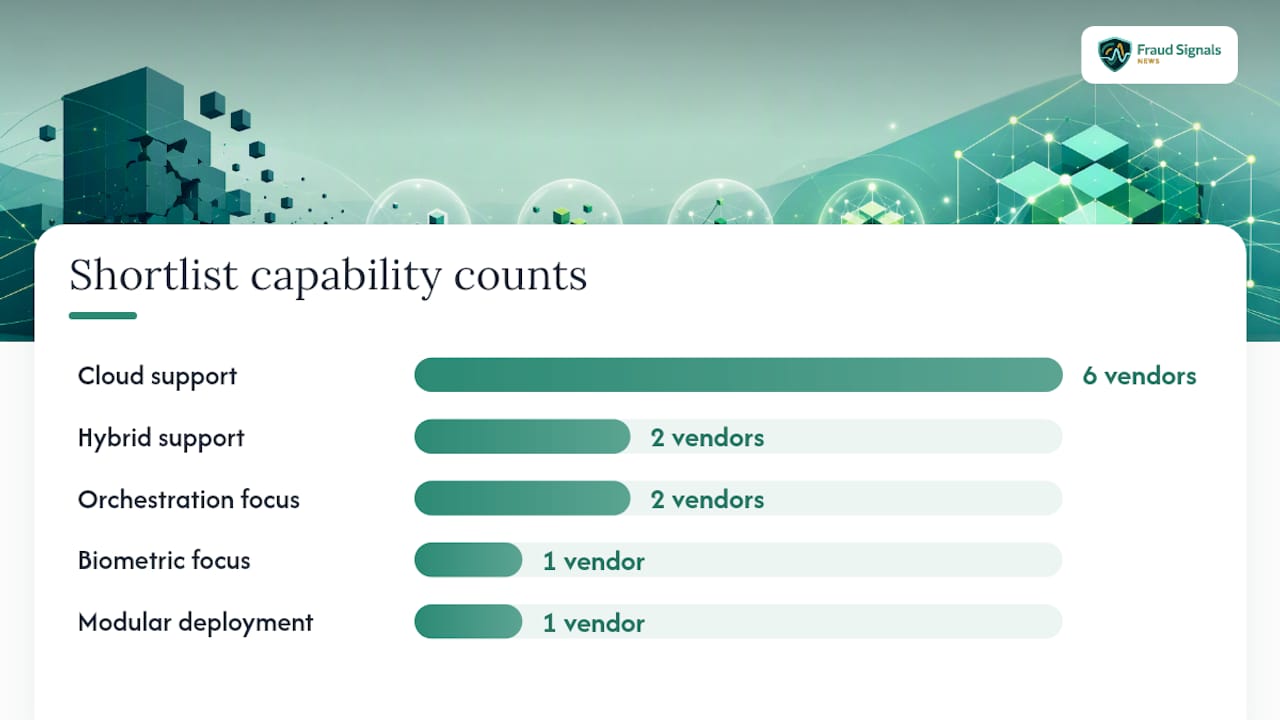
A handful of platforms consistently appear on shortlists for KYC modernization, each built around a different piece of the pKYC puzzle. Below is a compact framework to bring to procurement.
| Platform | Best For | Integration Ease | Automation & AI | Deployment Model |
|---|---|---|---|---|
| Fenergo | Large global banks needing CLM and regulatory provenance | Deep enterprise integrations | Governed AI embedded in client lifecycle | Cloud, hybrid |
| Encompass EC360 | Institutions wanting deep onboarding and case management ties | Strong prebuilt workflow connectors | Workflow automation across onboarding | Cloud |
| GBG | Organizations needing broad identity data coverage | Wide data source connectors | Verification and screening automation | Cloud |
| KYC360 | Teams prioritizing integration with existing core systems | Connector-rich orchestration layer | Screening and workflow automation | Cloud, hybrid |
| DAON | Institutions needing strong biometric identity resolution | API-based biometric integration | Biometric proofing and liveness checks | Cloud, on-prem |
| GBG Go | Teams wanting a faster, modular deployment | Modular, quicker to stand up | Focused automation subset | Cloud |
Fenergo leans on an immutable legal entity record for global banks with heavy regulatory scrutiny. Encompass EC360 and KYC360 both compete on orchestration depth, but KYC360’s remediation guidance for legacy customer files is worth reading regardless of which vendor you choose. GBG’s data breadth matters most for institutions doing cross-border screening, while GBG Go trims that same technology into a faster deployment for teams that don’t need the full suite on day one.
DAON deserves a specific mention here. For institutions where identity resolution is the actual bottleneck, not workflow or data plumbing, DAON’s biometric and liveness capabilities give you regulatory-grade verification without waiting on a full platform migration. It’s a genuinely strong option to shortlist alongside the others above.
Before signing anything, ask every vendor for audited case studies and named regulatory certifications. Marketing claims about “AI-driven” decisioning mean little without an evidence trail behind them.
What Should You Ask KYC Vendors Before You Buy?
Selection criteria should map directly to what you’ll need to defend in an exam, not just what looks good in a demo.
- Does the platform maintain a single customer profile, or does identity resolution still require manual cross-referencing?
- How deep are the prebuilt connectors to your core banking system and existing data providers?
- Is every automated decision accompanied by an explainable audit trail, not a black-box score?
- What’s the model governance process, and how often is calibration reviewed?
- Is deployment cloud, hybrid, or on-prem, and does that match your data residency requirements?
For your RFP, include these questions directly:
- How is data lineage tracked from source document to final decision?
- What evidence is captured for each screening hit, and how long is it retained?
- Can you produce a plain-language explanation for any AI-driven decision, on demand?
- What are your SLAs for onboarding turnaround, and what happens when you miss them?
- What’s your change control process when a screening list or regulation updates?
Red flags: no audit logs, a closed proprietary data model you can’t export from, missing jurisdictional screening coverage, or an API library too thin to support your existing tech stack.
What Do Regulators Expect From a Modern KYC System?
Examiners increasingly expect evidence, not intentions. At minimum, your replacement platform needs immutable audit trails, decision provenance for every automated call, and timestamped logs covering document validation and watchlist checks.
pKYC supports the risk-based approach FATF has long favored over static, calendar-driven reviews, but only if event triggers, address changes, adverse media hits, transaction anomalies, are documented with a clear owner and response action. Before procurement, validate that a vendor’s platform logs model changes over time, not just current-state decisions.
- Immutable, timestamped audit trails for every screening and validation event
- Documented triggers and owners for event-driven reviews
- Model change logs auditors can request without a vendor engineer present
What Do the Efficiency Numbers Actually Show?
Modernized KYC architectures have cut compliance review times by around 70% through automated extraction and screening. Enterprise AI KYC agents have delivered 60 to 75% cost reductions in year one, with focused pilots deliverable in 8 to 12 weeks.
These figures come from vendor case studies and architecture benchmarks, not independent audits. Baseline variance across institutions is real, so treat them as directional evidence, not a guaranteed outcome for your own deployment.
Most case examples show measurable ROI within one to two quarters of a completed pilot.
A Publisher’s View on Where KYC Is Headed
We think the next two years separate institutions that treat KYC as a compliance checkbox from those that treat it as continuous intelligence. Fraud Signals News covers the identity verification technologies, biometrics, liveness detection, document forensics, that increasingly sit inside these platforms, and the shift toward event-driven, evidence-rich pKYC tracks exactly what fraudsters are already exploiting in static systems.
A Faster Way to Stay Current on Identity Verification
Choosing between Fenergo, KYC360, DAON, and the rest of this shortlist takes real research, and vendor claims about “AI-driven” decisioning age fast as fraud tactics evolve. Fraud Signals News gives compliance and technology teams ongoing coverage of the identity verification landscape, biometric authentication, liveness detection, deepfake ID threats, and document fraud patterns, so your vendor evaluation reflects the current threat environment, not a one-time snapshot from your assessment phase.

Unlike a single vendor briefing or an analyst report you buy once, Fraud Signals News tracks how identity fraud techniques evolve week to week, which directly informs how you weigh a vendor’s biometric and document intelligence claims. Read our ongoing KYC coverage to see how emerging fraud patterns should shape your RFP questions, and check our guide to eKYC and biometric verification before you finalize your identity resolution requirements.
Sources
- How KYC automation is transforming fintech compliance
- Reimagining KYC: From legacy models to the pKYC triad (Capgemini whitepaper)
- Modernizing KYC with AWS serverless solutions and agentic AI for financial services
- KYC Automation Case Study: 5 Days to 4 Hours
- AI Agent for KYC Verification | Automate Compliance | Intellectyx
This article is general information, not a substitute for advice from a qualified financial advisor. Consult a qualified financial professional about your own circumstances before acting on anything here.
FAQ
Who Are the Top KYC Providers to Evaluate?
Fenergo, Encompass EC360, GBG, KYC360, and DAON each cover different pieces of the pKYC stack, from client lifecycle management to biometric identity resolution, and GBG Go offers a faster, modular deployment of GBG’s core capabilities.
What New KYC Rules Should Institutions Expect?
Regulators continue pushing toward the FATF’s risk-based approach, meaning event-driven monitoring with documented triggers is increasingly expected over static, calendar-based reviews.
What Is the Best Software for KYC?
There’s no single best platform. The right choice depends on whether you need deep client lifecycle management (Fenergo), broad data coverage (GBG), integration ease (KYC360), or biometric identity proofing (DAON).
What Happens if You Don’t Update Your KYC System?
Static, legacy KYC systems leave institutions exposed to slower onboarding, higher false-positive rates, and weaker audit trails, all of which examiners increasingly flag against the risk-based standards regulators now expect.
Recommended

Biometric Performance Metrics: What to Measure and Trust

ID Security Features: What Each One Does and How to Check It