
Voice cloning detection can flag suspicious synthetic speech, but no detector identifies a cloned voice with certainty, so treat detection as one layer in a defense stack rather than a verdict. The first practical step is to define your use case, live call screening versus recorded content review, and assemble representative in-the-wild test audio before trusting any vendor’s accuracy claims. While pilots run, add callback verification or behavioral speed bumps so a single detection miss doesn’t become a loss event.
TL;DR:
- Watermarking signals are strong but can be removed if detector weights are exposed or attacked; confidence depends on kept secret.
- Artifact detectors perform well within known generator types but falter against unseen models, re-recorded, or filtered audio.
- Combining detection methods with metadata, behavioral analysis, and manual review significantly improves false-positive and false-negative rates.
- Real-time detection must balance latency and accuracy, often pairing automation with human escalation for high-stakes calls.
- A comprehensive defense relies on layered prevention, detection, and forensic analysis, not on a single perfect detection tool.
Table of Contents
- How Voice Cloning Detection Works
- A Catalog of Detection Methods and Where Each One Breaks
- Real-Time Screening Versus After-the-Fact Forensic Review
- Why Detection Keeps Failing in the Real World
- An Operational Playbook Built on the FTC’s Three-Stage Framework
- Building a Test Plan That Vendor Demos Won’t Show You
- Our Take: Stop Chasing a Perfect Detector
- How We Help You Build a Testing and Evaluation Plan
- FAQ
- Sources
How Voice Cloning Detection Works
Detectors look for signals that synthetic speech generators leave behind, whether in the raw audio, in how a voice compares to a known reference, or in the surrounding call metadata. Understanding these signal categories matters because each one degrades differently when a generator improves or a fraudster launders the audio through compression and re-recording.
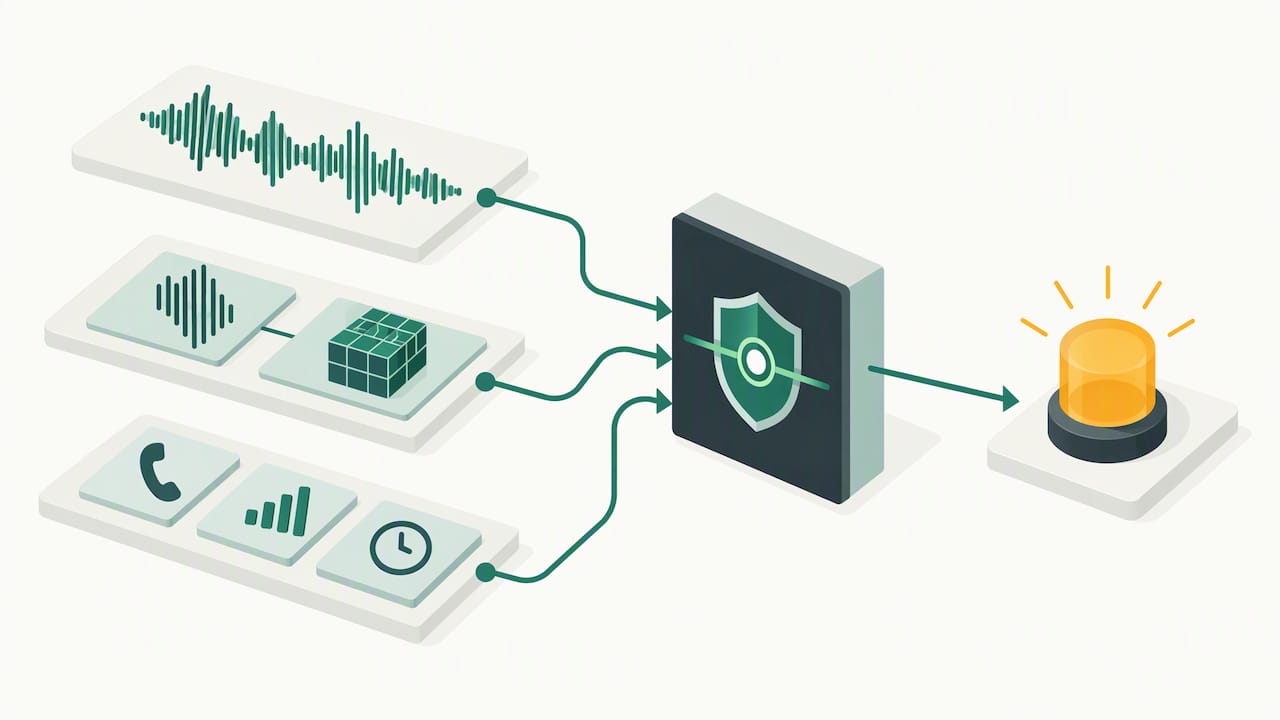
The oldest approach examines content-based artifacts: spectral irregularities, inconsistencies in Mel-frequency or linear-frequency cepstral coefficients (MFCC/LFCC), and unnatural pauses or pitch contours that older text-to-speech systems could not hide. Modern generators have closed much of this gap. Diffusion-based and neural vocoder models now produce waveforms with far fewer measurable artifacts than the systems that originally trained most public detectors, which is a core reason accuracy claims from older benchmarks don’t transfer cleanly to today’s threat.
A second family relies on speaker verification rather than artifact hunting. These systems compare incoming audio to a reference embedding, a voiceprint, generated from large pre-trained audio models, and flag a mismatch or an embedding that looks synthetic rather than human. This approach sidesteps some artifact-based weaknesses but depends entirely on having a trustworthy enrollment sample to compare against.
A third category is provenance-based: watermarking embedded at the moment of generation, as opposed to after-the-fact detection on unmarked audio. Watermarking works at either the sample level, where a mark is localized to specific audio segments, or the clip level, where the entire file carries one signature. The distinction matters operationally because sample-level marks can survive partial edits that destroy clip-level ones.
Finally, context and metadata add precision that audio analysis alone cannot. Call data records, device telemetry, number spoofing indicators, and behavioral timing patterns all narrow the field before a single waveform is examined.
- Spectral and cepstral artifacts reveal synthesis traces that shrink as generators improve.
- Speaker verification embeddings compare live audio against an enrolled reference voiceprint.
- Watermarking embeds a provenance signal at generation time, at the sample or clip level.
- Metadata signals, including call records and device telemetry, add context detectors can’t get from audio alone.
A Catalog of Detection Methods and Where Each One Breaks
No single method covers every attack path, so most serious deployments combine several. Each family below has a predictable failure mode worth knowing before you build a test plan around it.
Watermarking offers the cleanest signal when it works, because it doesn’t depend on spotting synthesis artifacts at all, only on recognizing a mark the generator itself embedded. AudioSeal demonstrates sample-level watermarking with high localization accuracy and detection speeds far faster than earlier watermarking methods in lab conditions. The catch is that this robustness holds only when detector weights stay private; once an adversary can query the detector freely, removal and laundering attacks become far easier to engineer.
Artifact detectors, the supervised classifiers trained to spot the spectral and temporal irregularities described above, remain the most widely deployed category because they require no cooperation from the generator. Their weakness is generalization: a classifier trained on one set of generators and compression conditions often degrades sharply against a generator it never saw, or against audio that’s been re-recorded, filtered, or run through a different codec.
Unsupervised and anomaly-based approaches try to sidestep that overfitting problem entirely. Rather than learning what a specific generator’s artifacts look like, these methods flag audio that sits in an unusual region of embedding space relative to known human speech, sometimes without any training on spoofed examples at all. Early academic work on training-free detection using large pre-trained models suggests this reference-based approach can generalize better to unseen generators than classifiers trained only on labeled spoof data, though it trades some raw accuracy for that flexibility.
Ensembling is less a method than a practical conclusion: combining audio-based detection with metadata rules and behavioral checks consistently outperforms any single signal in production, because each layer catches what the others miss.
The difference between a single detector and a layered approach is the core finding behind current fraud-prevention guidance. The FTC’s commentary on its Voice Cloning Challenge states plainly that no single solution is sufficient and that effective protection requires combining prevention, real-time detection, and post-use evaluation.
- Watermarking gives strong provenance signals but only while detector weights remain private.
- Artifact detectors work well in-domain but degrade against unseen generators and laundered audio.
- Unsupervised, reference-based methods trade some precision for better generalization across generators.
- Ensembled stacks, audio plus metadata plus behavior rules, consistently beat any single signal in live deployments.
Real-Time Screening Versus After-the-Fact Forensic Review
Choosing between real-time and post-hoc detection isn’t really a choice between two competing technologies. It’s a decision about what your operation can tolerate in latency, false positives, and evidentiary rigor.
- Define the latency budget first. Real-time detection in a contact center typically needs a decision inside one to two seconds, which limits you to lightweight on-device or edge-server models rather than the heaviest research architectures, and most commercial SDKs are built around that constraint.
- Expect to manage false positives actively. A real-time detector tuned aggressively enough to catch sophisticated clones will also flag legitimate callers more often, so pair it with a human escalation path rather than an automatic block.
- Reserve deep forensic analysis for post-hoc review. When a recording can be preserved and chain-of-custody matters, whether for a regulatory filing or an internal fraud case, slower multimodal forensic examination can run without a time constraint and should be the step that produces defensible documentation.
- Use a callback or known-channel verification when stakes are high, even with automated detection in place; a callback to a pre-verified number defeats most live voice-clone attempts regardless of how good the clone is.
- Match the deployment pattern to the channel: contact centers lean on real-time screening, voicemail systems and platform content moderation generally tolerate post-hoc review, and high-value wire authorization calls justify combining both.
Why Detection Keeps Failing in the Real World
The gap between lab accuracy and field performance is the single most important thing to plan around. ASVspoof 5 found that detectors trained and validated on controlled datasets routinely fail to generalize to crowdsourced, in-the-wild audio, a phenomenon researchers describe as the difference gap between training conditions and real deployment conditions. Stronger adversarial attacks and more varied recording conditions in the ASVspoof 5 dataset exposed exactly how much baseline detectors depend on the specific generators and codecs they were trained against.
Humans don’t fill the gap either. A 2023 University College London study found that human listeners correctly identified voice deepfakes only about 73% of the time, meaning people missed more than a quarter of synthetic samples even when actively trying to spot them.
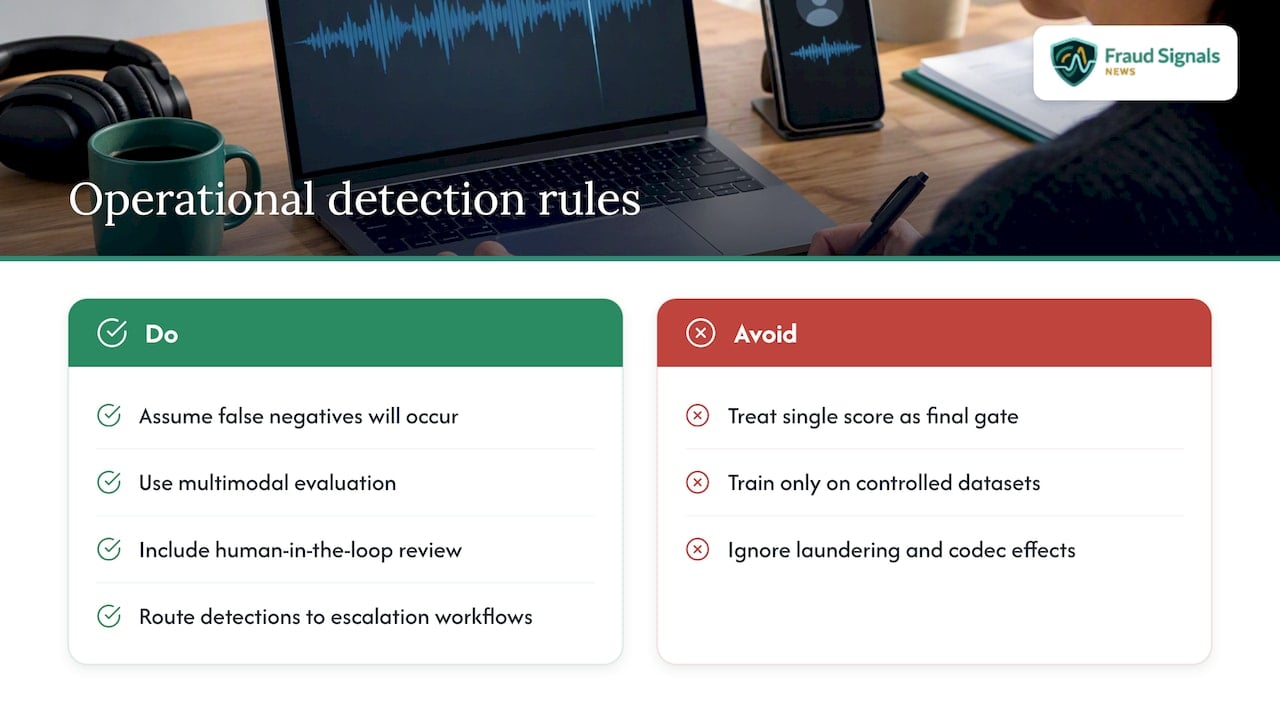
Technical measures for detecting synthetic content face a persistent cat-and-mouse dynamic between generators and detectors, which is why multimodal evaluation and human-in-the-loop review remain necessary rather than optional.
NIST, Reducing Risks Posed by Synthetic Content
Laundering attacks compound the problem. Re-recording a cloned voice through a phone microphone, compressing it through multiple codecs, or adding background music can strip the telltale artifacts that supervised classifiers rely on, and adversarial filters applied deliberately can shift a detector’s calibrated score without an obvious drop in audio quality.
The operational takeaway is blunt: design every detection layer assuming false negatives will happen, and route detection output into escalation workflows rather than treating any single score as a final gate.
An Operational Playbook Built on the FTC’s Three-Stage Framework
The FTC’s Voice Cloning Challenge produced prototype solutions spanning three intervention points, and that structure maps directly onto a workable security program.
- Upstream prevention. Reduce the public audio available for cloning (limit voicemail greetings, social posts, and earnings calls that expose clean samples), harden enrollment with liveness sensors, and consider watermarking audio you generate or publish so provenance can be checked later.
- Real-time monitoring. Deploy low-latency detectors at the call entry point, implement behavioral speed bumps such as forced holds or step-up authentication for high-risk transactions, and build a rollback procedure for when a flagged call turns out to be legitimate.
- Post-use forensics. Preserve original audio files unmodified, apply calibrated scoring rather than binary pass/fail outputs, log detector metadata alongside the decision, and route confirmed fraud cases to the appropriate regulatory reporting channel.
- Governance and testing cadence. Run periodic red-team exercises against your own detection stack using newly released generators, maintain a documented incident response playbook, and review operating thresholds quarterly against fresh out-of-domain samples.
Pro Tip: Log every detector score, not just the pass/fail decision, so a case that looks clean today can be re-scored later against an updated model without needing the original audio re-collected.
The FTC and NIST converge on the same warning: a vendor promising a single-signal silver bullet deserves skepticism, because the published guidance from both bodies explicitly calls for prevention, real-time detection, and post-use analysis working together, not a single layer doing all the work. Combining speaker-verification enrollment with liveness checks strengthens the prevention stage specifically, since a compromised enrollment step undermines every later detection layer built on top of it.
Building a Test Plan That Vendor Demos Won’t Show You
Vendor accuracy numbers are usually measured on curated datasets that don’t resemble your call traffic, so build your own evaluation before signing anything.
- Assemble a test set that includes telephony-codec audio, short utterances, background noise, and samples that have been re-recorded through a phone speaker and microphone.
- Include out-of-domain generator samples the vendor’s model has likely never seen, plus adversarially edited clips, since ASVspoof 5 found that laundered samples reveal brittleness that clean lab data conceals.
- Measure equal error rate (EER) and AUC across that set, then report the false-positive and true-positive rate at the specific operating threshold you intend to deploy, not just the headline accuracy figure.
- Calibrate scoring thresholds on your own in-the-wild data rather than the vendor’s defaults, and document the reasoning behind each threshold tied to the action it triggers.
- Require RFP responses to state latency, supported audio formats and codecs, and the false-positive control mechanism in writing before any pilot begins.
Our Take: Stop Chasing a Perfect Detector
Expect an arms race, not a finish line. Teams that invest in integration, layered controls, and honest testing outperform those chasing a single flawless detector. Provenance tools help where you control content creation, but callbacks, family code words, and behavioral checks remain the most dependable defense available right now.
— Carlos Ochoa
How We Help You Build a Testing and Evaluation Plan

We cover the identity verification landscape so security teams don’t have to piece together vendor claims, academic benchmarks, and regulatory guidance on their own. Our reports and playbooks on biometric compliance and multimodal detection stacks are built to support the test plans and RFP checklists outlined above, not to replace the vendor evaluation you still need to run. If you’re assembling a voice-clone defense budget, our coverage of identity verification platforms, including an honest look at options beyond single-vendor identity checks, is a reasonable starting point, and DAON is worth including on your shortlist given its track record in enterprise biometric authentication. For hands-on implementation support, firms like tekRESCUE AI offer AI security consulting that can help translate this playbook into a deployed pilot. Request our synthetic media detection briefing to see how these pieces fit into a program you can defend to your compliance team.
FAQ
Is there an app that can identify voices?
Several commercial and research tools analyze voice recordings for synthetic artifacts, speaker-verification mismatches, or watermark signatures, but none identify a cloned voice with certainty. Treat any app’s output as one input into a broader review process rather than a final determination.
What is AI voice cloning detection?
Voice cloning detection refers to technical methods, including artifact analysis, speaker-verification embeddings, and watermarking, that flag audio likely generated or manipulated by AI rather than spoken by the claimed person. The FTC’s guidance frames effective detection as one of three stages, alongside upstream prevention and post-use forensic review.
Can ChatGPT clone my voice?
ChatGPT itself is a text-based conversational tool and is not built as a voice-cloning product. Voice cloning requires a separate class of generative audio model trained on a sample of someone’s speech, and the broader concern for security teams is the wide availability of such tools rather than any single product.
How can I protect myself from voice cloning?
Limit the amount of your voice publicly available online, agree on a family or team code word for sensitive requests, and always verify high-stakes calls through a callback to a number you already trust rather than one provided during the call. These behavioral steps catch clones that technical detectors miss, since human listeners alone correctly identify only about 73% of deepfake audio.
Sources
- Humans unable to detect over a quarter of deepfake speech samples (UCL news)
- FTC commentary on Voice Cloning Challenge
- AudioSeal: Localized audio watermarking for AI-generated speech detection
- Reducing Risks Posed by Synthetic Content: An Overview of Technical Approaches to Digital Content Transparency (NIST)
Recommended

Meet NIST 0.1 DFAR/DFRR with MRZ Verification for Compliance Teams

Face Morphing Detection for Security Teams: NIST Aligned Checklist