

If you offer or maintain covered accounts, the Red Flags Rule requires a written Identity Theft Prevention Program that identifies red flags, detects them, responds appropriately, and is updated periodically. The Program must scale to your size and risk profile, not sit on a shelf as a generic policy, and examiners expect to see it operating, not just existing on paper.
TL;DR:
- Risk assessments must be scheduled regularly and include all account types that could pose identity theft risks, especially after new product launches.
- Detection controls should be specific, pairing identity verification steps with account monitoring for unusual activity or suspicious personal information.
- Tiered response playbooks are essential, with different actions triggered by single or multiple red flags, depending on severity and pattern.
- Oversight requires documented approval from senior management and ongoing reporting to ensure the program operates effectively and adapts to changing risks.
- Maintaining a detailed log of red flags and responses provides stronger evidence of program effectiveness than policy documentation alone.
Table of Contents
- Red flags rule program compliance checklist
- How to build detection and response procedures that hold up
- Administration and oversight examiners expect to see
- What examiners find wrong and how to fix it fast
- Illustrative red flags you can adapt for your program
- Documenting identity-verification technology in your program
- Why most red flags programs fail the spirit, not the letter, of the rule
- Deeper technical guides for your compliance toolkit
- FAQ
- Sources
Red flags rule program compliance checklist
Before building out detailed procedures, confirm the basics are in place. These are the items examiners check first, and gaps here tend to cascade into larger findings.
- Confirm you have a written Program covering the four elements: identify, detect, respond, and update, as required under 16 CFR § 681.1.
- Document a risk assessment that determines which accounts qualify as covered accounts under the rule.
- Obtain initial approval from the board, an appropriate board committee, or senior management, with that approval recorded in minutes.
- Establish a reporting cycle so the board or a designated senior manager reviews Program effectiveness, per the FTC’s how-to guide.
- Put basic service provider oversight in place, including contract language addressing red flag detection duties.
How to build detection and response procedures that hold up
Turning a written policy into a working Program means sequencing the work correctly. Skipping the risk assessment or writing response procedures before detection controls exist are two of the most common ordering mistakes.
- Scope the risk assessment. Inventory every account type you open or service, then classify each as a covered account based on whether it permits multiple payments or transactions for personal use, or carries a reasonably foreseeable risk of identity theft, as outlined in 16 CFR § 681.1. Document the methodology and the conclusion for each account category, not just the final list.
- Select detection controls for account opening. Identity verification at onboarding should check document authenticity, cross-reference submitted information against consumer reporting alerts, and flag inconsistent personal identifying information. Pair this with monitoring for existing accounts: unusual transaction patterns, mail returned as undeliverable, and change-of-address requests followed quickly by a request for a new card or additional authorized user.
- Draft tiered response playbooks. Not every red flag warrants the same reaction. A single mismatched digit in an address might trigger a manual review, while a cluster of red flags, such as a change of address paired with a request to add a new authorized user, should trigger account monitoring or a temporary hold until the customer is verified through a secondary channel.
- Set update triggers. Tie Program revisions to specific events: a data breach, a new product launch, a notable pattern of account takeover attempts, a shift in your customer base, or new regulatory guidance. The FTC’s guide treats these triggers as the backbone of a defensible update process, and documenting each trigger event alongside the resulting review and approval gives examiners a clear audit trail.
Pro Tip: Keep a running log of every red flag event and how it was resolved. That log becomes your strongest evidence of an operating, not theoretical, Program.
Administration and oversight examiners expect to see
A Program’s written content matters less to examiners than proof that someone owns it and reports on it. Administration failures, not policy gaps, cause most of the deficiency findings in practice.
- The board, an appropriate committee, or senior management must give initial approval, and that body (or a designated senior manager) should receive at least an annual report on Program effectiveness and material incidents, consistent with the FTC’s administration requirements.
- Annual board reports should cover detected red flags, response outcomes, service provider performance, and any Program changes made during the period.
- Train frontline staff on recognizing red flags at account opening and during servicing, and refresh that training at least annually or after any material Program update.
- Service provider contracts should require periodic attestations and preserve audit rights, not just a general promise to comply with applicable law.
Pro Tip: If your Program documentation cannot answer “who approved this and when,” treat that as an open finding before an examiner does.
What examiners find wrong and how to fix it fast
SEC risk alerts and related exam guidance point to a consistent set of failures across firms of different sizes. Knowing the pattern makes self-auditing faster.
- Stale risk assessments. Programs that never revisit which accounts are covered, even after launching new products, draw repeated criticism in SEC examiner findings. Fix: schedule the reassessment on a calendar, not an ad hoc basis.
- Generic red flag lists with no operational tie-in. A program that copies Supplement A examples without connecting them to actual detection controls fails the “reasonable policies and procedures” standard. Fix: map each listed red flag to a specific detection method and a named responder.
- Weak service provider oversight. Contracts that mention compliance but provide no monitoring data are a frequent citation. Fix: require periodic incident reports and retain audit rights, then actually exercise them.
Illustrative red flags you can adapt for your program
The regulatory appendix organizes red flags into categories rather than a single master list, which is useful because it maps naturally onto where in your process each signal appears.
- Consumer reporting alerts: a fraud or active-duty alert, or a credit freeze notice, attached to an applicant’s file.
- Suspicious documents: identification that appears altered, a photo that does not match the applicant, or inconsistent information across submitted documents, categories illustrated in Supplement A to the Rule.
- Suspicious personal identifying information: a Social Security number that matches another customer on file, or an address associated with multiple unrelated applications.
- Unusual account activity: a dormant account suddenly generating transactions, or a change of address followed immediately by a request for new credentials.
- Direct notice: a customer or law enforcement report indicating a fraudulent account was opened in someone’s name.
Escalation thresholds should reflect how many red flags cluster together and how severe each one is on its own; a single low-severity flag might only need a note in the file, while two or three converging flags should trigger active review. Tuning these thresholds over time, using your own incident log, is the most reliable way to cut false positives without missing real fraud.
Documenting identity-verification technology in your program
When eKYC, biometric matching, or liveness detection feed into your detection controls, examiners want more than a vendor name on a slide. Keep a vendor-validation appendix that records testing results, capture-quality metrics, and service-level commitments, updated whenever the vendor changes models or thresholds.
Note where automated decisions can be overridden by a human reviewer and what the fallback authentication path looks like when a verification attempt fails or returns low confidence. That combination, measurable performance plus a documented fallback, is what lets examiners see active oversight rather than blind reliance on a third party.
Why most red flags programs fail the spirit, not the letter, of the rule
Most Identity Theft Prevention Programs we review read fine on paper. They list the four elements, cite Supplement A examples, and carry a signature from someone with the right title. The failure shows up in the gap between the document and the operation behind it: red flags get listed but never wired to a specific detection trigger, and responses exist as a policy paragraph rather than a tiered playbook someone actually follows under pressure.
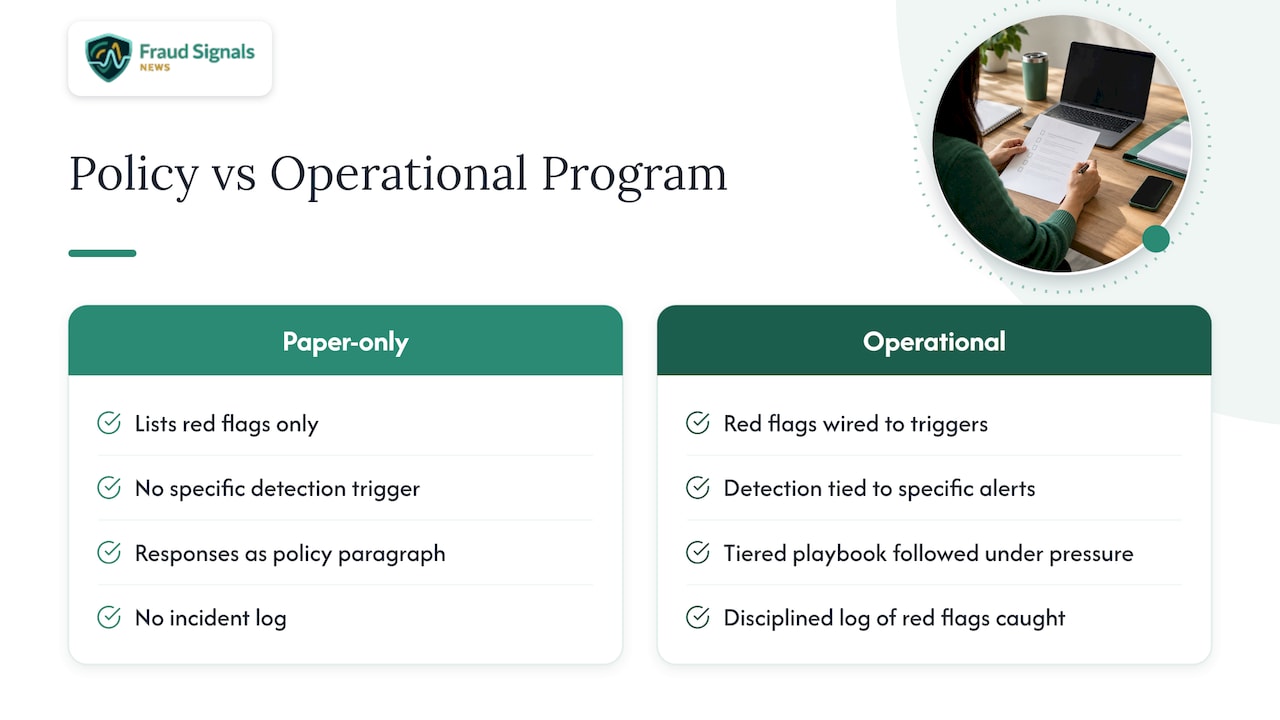
The conventional advice, treat the written Program as the deliverable, gets the priority backward. The document is evidence of a working process, not the process itself. Compliance officers who prioritize the incident log, the one piece most Programs skip, give examiners the clearest proof that detection and response actually function. A Program with a thinner written policy but a disciplined log of red flags caught and resolved will outperform a polished document with no operational trail behind it.
Start there. Build the log before polishing the prose.
— Carlos Ochoa
Deeper technical guides for your compliance toolkit
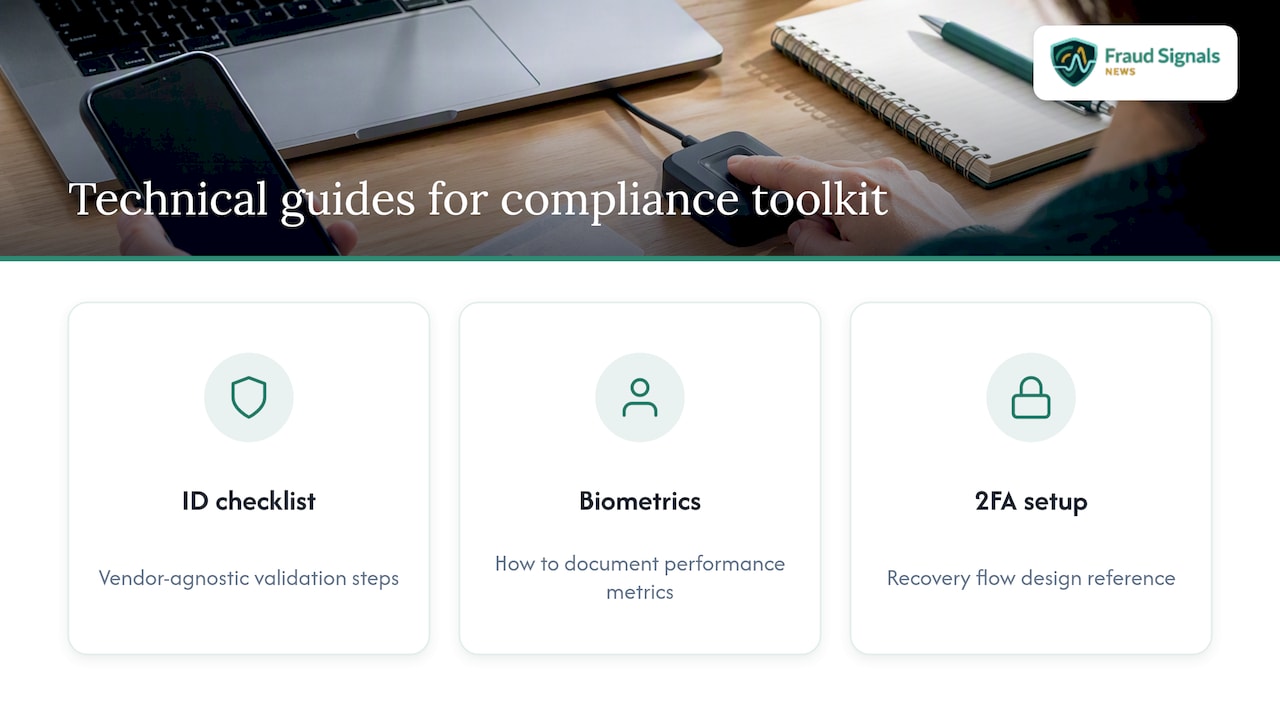
We cover the identity-verification side of this work in detail: our identity verification upgrade checklist walks through vendor-agnostic validation steps, and our guide on why biometrics satisfy compliance requirements explains how to document performance metrics for examiners.

For account authentication controls specifically, ClaimCow’s guide to two-factor authentication setup is a useful reference for recovery flow design. Subscribe for ongoing coverage of regulatory updates and fraud detection technology.
This article is general information, not a substitute for advice from a qualified lawyer. Consult a qualified legal professional about your own circumstances before acting on anything here.
FAQ
What is the red flags rule program?
It is a written Identity Theft Prevention Program that financial institutions and creditors with covered accounts must adopt under 16 CFR § 681.1. The Program must identify relevant red flags, detect them, respond appropriately, and be updated periodically.
What are the two basic requirements under the red flags rule?
At a minimum, covered entities must conduct a periodic risk assessment to determine which accounts are covered, then build a written Program around that determination. The FTC’s how-to guide frames board or senior management approval and ongoing oversight as the structural requirements layered on top.
What are the red flag laws in the US?
The Red Flags Rule is codified at 16 CFR § 681.1 and enforced by the FTC and other federal regulators, including the SEC for firms under its jurisdiction. The SEC’s compliance guide outlines how examiners assess Programs for firms it oversees.
What are the four elements of the red flags rule?
The four required elements are identifying relevant red flags, detecting them in account opening and servicing, responding appropriately to detected flags, and periodically updating the Program as risks change. These elements come directly from 16 CFR § 681.1.
How often should a red flags program be updated?
There is no fixed calendar requirement, but the FTC’s guide ties updates to specific triggers: a data breach, a new product or channel, a pattern of account takeover incidents, or a change in customer base. Reviewing the Program at least annually, even absent a trigger, is common practice among compliance teams.
Sources
- Fighting identity theft with the Red Flags Rule: A How-To Guide for Business | FTC
- 16 CFR § 681.1 – Duties regarding the detection, prevention, and mitigation of identity theft | LII / Cornell
- eCFR: 16 CFR 681.1 — Identity Theft red flags and program elements
- Identity Theft Red Flags Rules | SEC
Recommended

Meet NIST 0.1 DFAR/DFRR with MRZ Verification for Compliance Teams

Face Morphing Detection for Security Teams: NIST Aligned Checklist