

Modern fraud prevention is defined as an integrated, real-time discipline combining AI-driven behavioral analytics, continuous identity verification, and governance frameworks to stop fraud proactively across all channels. The term “fraud risk management” is the recognized industry standard for this discipline, as codified by the ACFE Fraud Risk Management Programme and the COSO Fraud Risk Guide. What is modern fraud prevention in practical terms? It is the shift from static, rule-based detection to adaptive systems that evaluate identity and behavior continuously. Post-2020, fraud became automated and behavior-based, making legacy controls obsolete at scale. Organizations that have not modernized their programs are operating with a structural vulnerability, not just a technology gap.
What is modern fraud prevention built on technologically?
The core of modern fraud detection techniques is AI-driven behavioral analytics combined with real-time decisioning engines. These systems do not wait for a transaction to complete before flagging risk. They evaluate hundreds of signals simultaneously, including device fingerprinting, navigation patterns, typing cadence, and session anomalies, to build a continuous risk score.
Two techniques represent the current frontier. Dual-Granularity Prompting (DGP) and continuous-time graph attention transformers improve detection accuracy by capturing fine-grained temporal and relational fraud patterns in real time. DGP delivers up to a 6.8% performance gain in detection with latency suitable for large-scale financial platforms. That gain may sound incremental, but at transaction volumes of millions per day, it translates to a material reduction in fraud losses.

Graph neural networks add a second layer of intelligence. Rather than analyzing individual transactions in isolation, graph neural networks act as “upstream feature factories” by encoding relational data critical to detecting complex fraud schemes like fraud rings and synthetic identities. Tabular data misses the connections between accounts, devices, and behaviors. Graph models capture those connections mathematically before feeding them into traditional detection models.
The practical result is a system that catches fraud patterns no rule set could anticipate. Credential stuffing campaigns, SIM swapping operations, and synthetic identity networks all leave relational traces that graph-enhanced models detect. Rule-based systems, by contrast, only catch what their authors predicted.
- Behavioral analytics: Captures implicit signals like navigation behavior, typing cadence, and device usage without adding friction to the customer experience.
- Graph neural networks: Encode relational fraud patterns across accounts, devices, and transactions to surface fraud rings and synthetic IDs.
- Dual-Granularity Prompting: Applies fine-grained temporal analysis to transaction sequences, improving detection precision on large-scale platforms.
- Continuous-time graph attention transformers: Process evolving relationship data in real time, enabling adaptive responses to new fraud tactics.
- Real-time decisioning engines: Evaluate all signals simultaneously at transaction speed, replacing batch-processing models that create detection lag.
Pro Tip: When evaluating AI fraud detection platforms, ask vendors specifically whether their models use graph-based feature encoding. Platforms that rely solely on tabular data miss relational fraud patterns that account for a growing share of organized fraud losses.
How do governance frameworks strengthen fraud prevention programs?
Technology alone does not constitute a fraud prevention program. Effective fraud prevention requires three pillars: behavioral intelligence, connected real-time infrastructure, and specialized organizational design. The third pillar is where most organizations fall short.
A structured, risk-based framework built around executive oversight, Red/Amber/Green control scoring, and documented annual reviews is essential for regulatory compliance and risk reduction. Red/Amber/Green scoring assigns a health status to each control domain, including governance, data visibility, payment controls, AI threat defenses, and social engineering protections. This gives leadership a real-time view of where the program is exposed.
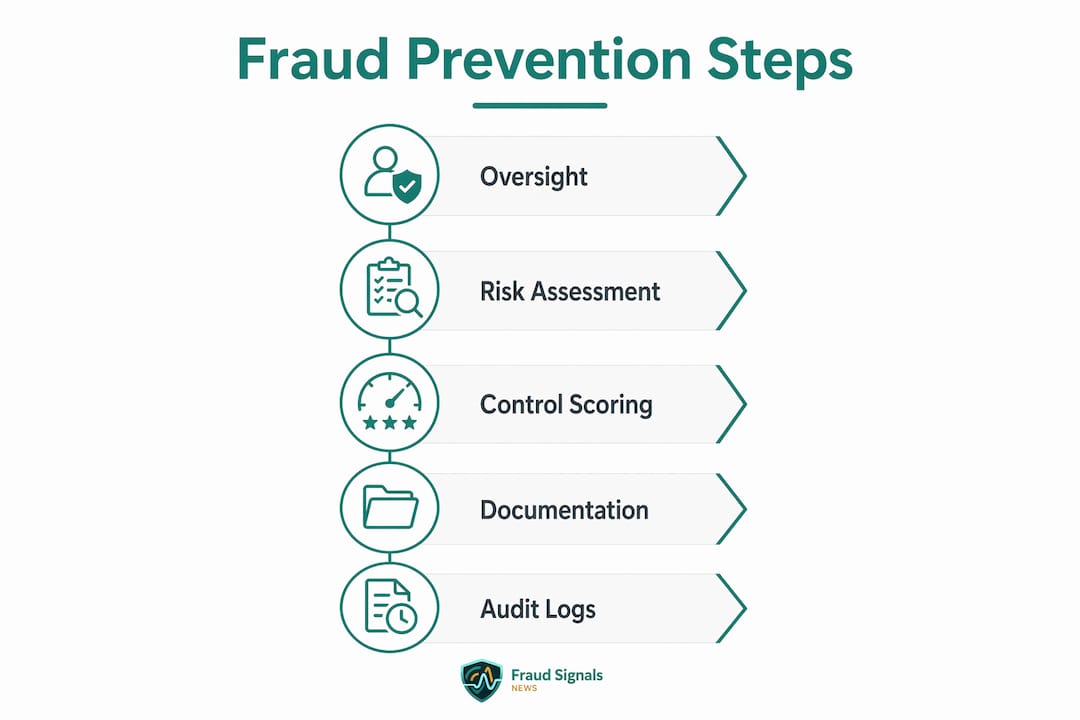
Regulatory examiners require more than annual policy reviews. Detailed revision logs showing changes, authorship, and evidence of exercised controls are a standard examiner requirement. Absence of these logs is one of the most common triggers for regulatory deficiencies. Policies must document who reviewed them, when, and what control exercises were completed.
The operational cadence matters as much as the documentation. Effective programs run biennial risk assessments and annual vulnerability testing, with 24-hour response cycles integrated into Enterprise Risk Management. These are not aspirational benchmarks. They are the baseline for programs that hold up under regulatory scrutiny.
- Establish executive ownership. Assign a named executive sponsor for the fraud risk program with board-level reporting authority.
- Implement Red/Amber/Green control scoring. Score each control domain and review scores quarterly to identify degradation before it becomes a deficiency.
- Document all policy revisions. Record authorship, review dates, and evidence of control exercises in a revision log accessible to examiners.
- Schedule biennial risk assessments. Conduct full fraud risk assessments every two years, with annual vulnerability testing in between.
- Integrate with Enterprise Risk Management. Connect fraud risk workflows to the broader ERM program so fraud exposures appear in enterprise risk reporting.
- Maintain 24-hour response cycles. Define escalation paths and response timelines for fraud incidents that meet the 24-hour threshold.
Pro Tip: Treat your revision log as an audit artifact, not an administrative task. Examiners reviewing your anti-fraud policies will look for evidence that controls were actually exercised, not just documented. A log entry without a corresponding test record carries no weight.
How does modern fraud prevention balance security with customer experience?
The tension between fraud controls and customer friction is real, and it carries a direct business cost. Excessive fraud controls lead to increased false declines, which are a material cost. Overcontrol is counterproductive. Precision in distinguishing trust from risk, applied early in the customer journey, reduces both fraud losses and unnecessary friction.
The solution is dynamic, continuous identity modeling rather than static credential checks. Identity is dynamic; trust should be evaluated continuously over time rather than at a single point. A customer who logs in from a recognized device, follows their normal navigation pattern, and initiates a transaction consistent with their history presents a very different risk profile than the same account accessed from an unfamiliar device at an unusual hour.
Implicit behavioral analytics make this continuous evaluation possible without adding friction. The system captures signals passively, without requiring the customer to complete additional verification steps. When anomalies appear, the system escalates to active verification only for the sessions that warrant it. This approach reduces false declines while maintaining detection coverage.
Cross-channel data integration is the operational requirement that makes this work. Risk scoring built from a single channel, such as web only or mobile only, misses the full behavioral picture. Organizations that integrate cross-channel data into a unified risk score see more accurate trust decisions and fewer false positives.
- Dynamic identity signals: Evaluate behavioral patterns continuously rather than at login only, catching session takeovers and account manipulation in real time.
- Implicit behavioral analytics: Capture navigation behavior, typing cadence, and device usage passively, without adding verification steps for legitimate customers.
- Cross-channel orchestration: Combine web, mobile, and in-branch signals into a single risk score to prevent channel-switching fraud tactics.
- Early trust scoring: Apply precision risk decisions at the start of the customer journey to reduce downstream friction and false declines.
What does a fraud prevention modernization checklist look like?
A fraud prevention modernization checklist organizes program requirements into risk-based domains. Scattered controls and siloed ownership result in reactive fraud management. Unified frameworks that connect workflows improve resilience and reduce losses. The checklist below reflects the domains that matter most for organizations building or upgrading programs in 2026.
| Domain | Key requirements |
|---|---|
| Governance | Executive sponsor, board reporting, Red/Amber/Green control scoring, revision logs with authorship |
| Data visibility | Cross-channel data integration, real-time transaction monitoring, behavioral signal capture |
| Payment controls | BEC prevention protocols, out-of-band verification for high-value transfers, rate limiting |
| AI and social engineering | AI-generated phishing defenses, deepfake detection at onboarding, employee awareness training |
| People and culture | Anonymous reporting channels, whistleblower protections, fraud awareness programs |
| Incident response | Documented escalation paths, 24-hour response cycles, post-incident reviews with control updates |
Business email compromise (BEC) prevention deserves specific attention in the payment controls domain. Out-of-band verification, calling a known number to confirm a wire transfer request rather than replying to the email, remains the most effective control against BEC attacks. Organizations that skip this step because it adds friction are trading a minor inconvenience for significant exposure.
A strong reporting culture is also a control, not just a cultural aspiration. Anonymous tip lines and whistleblower protections surface fraud earlier than any automated system. The ACFE consistently finds that tips are the leading fraud detection method across industries. Building that channel and protecting it is a governance requirement, not optional.
The checklist connects to advanced fraud prevention methods covered in depth by Fraud Signals News, including automation’s role in accelerating incident response and reducing manual review backlogs.
Key Takeaways
Modern fraud prevention requires integrating AI-driven behavioral analytics, continuous identity verification, and documented governance frameworks to stop adaptive fraud threats before losses occur.
| Point | Details |
|---|---|
| AI techniques drive detection accuracy | Graph neural networks and Dual-Granularity Prompting capture relational and temporal fraud patterns that rule-based systems miss. |
| Governance is a program requirement | Executive oversight, Red/Amber/Green scoring, and revision logs are regulatory baselines, not optional enhancements. |
| Continuous identity modeling reduces friction | Evaluating behavioral signals passively and continuously cuts false declines without weakening detection coverage. |
| Unified frameworks outperform siloed controls | Connecting monitoring, investigation, and response workflows reduces fraud losses and regulatory pressure. |
| Checklists must cover six domains | Governance, data visibility, payments, AI threats, people, and incident response together constitute a complete program. |
The case against silver-bullet thinking in fraud prevention
I have reviewed fraud programs at organizations that spent heavily on AI detection platforms and still suffered material losses. The common thread was not a technology failure. It was a governance failure. The detection engine flagged anomalies. Nobody owned the escalation path. The alert sat in a queue for 72 hours while the fraud completed.
Technology and governance are not alternatives. They are dependencies. A graph neural network that surfaces a fraud ring at 2:00 AM is only useful if a documented response protocol routes that alert to someone with authority to act. Without that, the detection is theater.
The other mistake I see repeatedly is over-indexing on controls at the expense of customer experience. Security teams that treat every transaction as a threat end up with false decline rates that cost the business more than the fraud they prevent. The precision of early trust scoring is what separates mature programs from reactive ones. Biometrics and behavioral analytics applied at the start of the session let you make a confident trust decision before the customer reaches checkout.
The future of fraud risk management is dynamic identity modeling. Static credentials are a solved problem for fraudsters. The programs that will hold up in 2026 and beyond are the ones treating identity as a continuous signal, not a one-time gate.
— A. Johnson
Stay current on fraud prevention with Fraud Signals News
Fraud prevention moves fast. The techniques that stopped synthetic identity fraud last year are being actively circumvented today.

Fraud Signals News covers the developments that matter for security professionals and business leaders, from emerging AI fraud detection techniques to governance updates and identity verification mandates. The site tracks biometric binding, liveness detection, behavioral analytics, and the regulatory shifts that affect how organizations build and maintain fraud programs. Visit Fraud Signals News for ongoing analysis, breaking developments, and practical guidance on keeping your fraud prevention program ahead of the threat.
FAQ
What is modern fraud prevention?
Modern fraud prevention is an integrated discipline combining real-time AI analytics, continuous identity verification, and governance frameworks to detect and stop fraud proactively. It replaces static, rule-based systems that cannot adapt to automated, behavior-based fraud tactics.
What are the core modern fraud detection techniques?
The leading techniques include behavioral analytics, graph neural networks, Dual-Granularity Prompting, and continuous-time graph attention transformers. These methods capture relational and temporal fraud patterns that tabular data and rule-based models miss.
How does fraud prevention affect customer experience?
Excessive controls increase false declines, which carry a direct business cost. Continuous behavioral analytics and early trust scoring reduce friction for legitimate customers while maintaining detection coverage for anomalous sessions.
What governance requirements apply to fraud prevention programs?
Regulatory examiners require documented revision logs, biennial risk assessments, annual vulnerability testing, and integration with Enterprise Risk Management. Red/Amber/Green control scoring provides the operational framework for tracking program health.
What is fraud risk management vs. fraud prevention?
Fraud risk management is the broader discipline covering identification, assessment, governance, and response across all fraud exposures. Fraud prevention is the operational component focused on stopping fraud before losses occur. Effective programs require both.
Recommended

Biometric Performance Metrics: What to Measure and Trust

ID Security Features: What Each One Does and How to Check It