
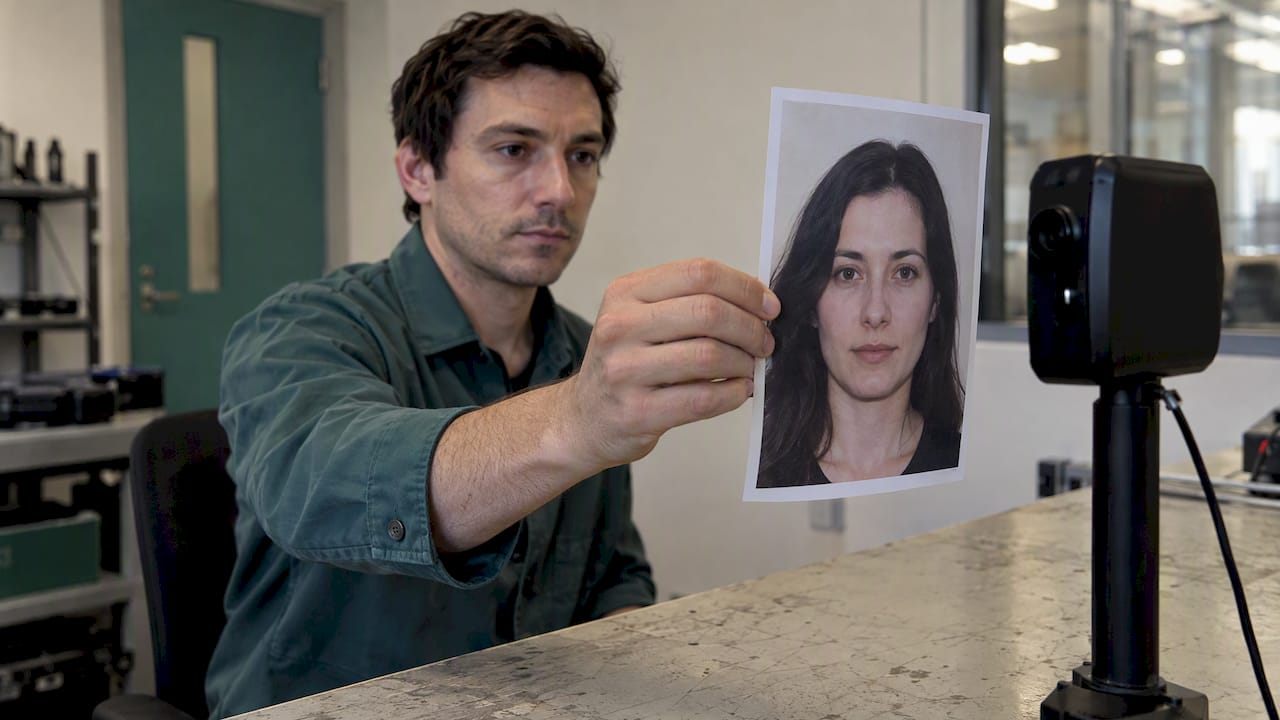
Face liveness detection is the check that decides whether a face presented during a selfie verification belongs to a live person in front of the camera or to a spoof: a printed photo, a replayed video, a mask, or synthetic media. It is now a baseline control in remote onboarding, but most failures we see in the field come from how it is deployed, not from the core algorithm. Below we cover the working mechanics, the trade-offs between modes, the attacks that bypass the camera entirely, and how to test a system before it protects real accounts.
TL;DR
- Face liveness detection verifies that a biometric sample comes from a live human, and it is a defense against presentation attacks as defined in ISO/IEC 30107.
- Passive checks add little friction; active challenges add friction but help when lighting or conditions defeat passive analysis.
- Analyzing the video alone is not enough. Injection attacks feed synthetic video past the camera, so device and session integrity checks are required.
- No single algorithm catches every attack. Tune thresholds against your own attack scenarios and keep monitoring after launch.
- Demographic performance gaps are a legal risk for financial institutions, not just a quality issue.
Table of Contents
- What face liveness detection actually does
- Passive, active and flash-based checks compared
- How integration typically works
- Why camera-only analysis is no longer enough
- Standards and testing: what a certificate does and does not tell you
- Tuning thresholds without fooling yourself
- Fairness and legal exposure in the US
- Pairing liveness with the rest of the proofing flow
- How to evaluate vendors without a leaderboard
- Our perspective
- Keep reading on Fraud Signals News
- FAQ
- Sources
What face liveness detection actually does
A face match answers one question: does this face resemble the enrolled or document photo? It says nothing about whether the face is real. Liveness answers the second question, whether the capture came from a living person at that moment. Without it, a stolen photo from social media can pass a similarity check.
The formal language comes from ISO/IEC 30107. NIST’s presentation attack detection evaluation page describes a presentation attack as presenting an artifact or human characteristics to a biometric capture subsystem in a way that interferes with system policy. That covers physical artifacts such as printed photos, masks and video replays, and it extends to digital injection, where virtual cameras feed synthetic media into the capture pipeline.
That last point matters more each year. Many teams still treat liveness as a camera-side feature, when the camera itself is often the weakest assumption in the chain.
Passive, active and flash-based checks compared
Most commercial systems fall into a few families. The timings below come from Microsoft’s documentation of its own service, so treat them as an illustration of the category rather than a universal benchmark.
| Mode | User interaction | Typical behavior | Best fit |
|---|---|---|---|
| Passive | None beyond framing the face | Neural networks analyze the face during capture; Microsoft reports roughly 12 seconds to complete | High-volume onboarding where drop-off is costly |
| Passive-active | Screen prompts only when conditions block passive analysis | Average completion can extend to about 20 seconds, per the same documentation | Mixed environments, including bright light or poor cameras |
| Active challenge | Blink, turn, follow a prompt | Relies on the user performing a requested action | Higher-risk steps such as account recovery or large transfers |
| Flash or controlled light | Brief screen illumination | The system analyzes how light interacts with the face | Cases where a screen replay or flat artifact is the main threat |
The common mistake is choosing a mode on friction alone. A passive-only flow looks elegant in a conversion report, but if your threat model includes replayed video on a compromised device, the friction you saved becomes exposure. Conversely, forcing every customer through head turns penalizes older users and anyone with limited mobility.
A practical pattern is step-up: run passive liveness by default and escalate to an active challenge when risk signals appear, such as a new device, a mismatch in location, or a low confidence score.
How integration typically works
The architecture is usually the same across vendors. A frontend SDK for iOS, Android or web captures the session, while a backend orchestrator creates session tokens and retrieves the final result. Microsoft’s description of Azure Face liveness follows this split, and Amazon Rekognition Face Liveness is built to verify that a user is physically present and to detect spoofs presented to a camera or attempts to bypass it.
The design principle worth copying: the decision should be made server side, from a session your backend created, never from a flag the client app sends back. If the client can say “liveness passed,” an attacker can say it too.
Why camera-only analysis is no longer enough
The most useful reframing for fraud teams is that liveness has two layers of attack. The first is the classic presentation attack held up to a lens. The second is injection, where the lens is skipped.
BleepingComputer’s March 2026 analysis makes the point that most identity checks rest on facial similarity and liveness, and both can be undermined when the system assumes the input stream is authentic. Attackers use virtual camera software, emulators or compromised devices to push synthetic video straight into the application’s processing pipeline. A perfect deepfake detector looking at that video still sees only what it is given.
This is why a resilient design validates the whole session across three questions:
- Perception: is this video real, with no signs of replay, mask or synthetic generation?
- Integrity: is the device and camera stream untampered, with no emulator, jailbreak, root or virtual camera?
- Behavior: is the interaction consistent with a human, in timing, motion and input patterns?
Ignoring the integrity layer leaves the system open to automated, large-scale injection. We covered the operational side of this in our piece on fixing capture integrity to stop deepfake ID fraud and the replay side in our NIST-aligned look at replay and injection fraud.
Regulators are paying attention as well. In November 2024, FinCEN issued an alert on fraud schemes involving deepfake media that explains typologies and red flag indicators for financial institutions, and reminds them of their Bank Secrecy Act reporting obligations. If your onboarding flow is the entry point for synthetic identities, that alert belongs in your control documentation.
Standards and testing: what a certificate does and does not tell you
Vendors commonly cite iBeta conformance testing. iBeta is accredited by NIST NVLAP as an independent test lab and tests against ISO/IEC 30107-3, with Level 1 and Level 2 representing increasing attacker effort. That is a meaningful signal, and it is the right first filter.
It is not a guarantee. A lab test uses a fixed set of attack species, usually physical artifacts, under controlled conditions. It generally does not reproduce the virtual camera tooling your fraud team will see in the wild. NIST’s researchers make a similar point in their blog on keeping our biometrics secure: no single algorithm currently detects every presentation attack, so developers need to keep monitoring accuracy and validate against diverse, real-world attack scenarios.
Note also that NIST’s own PAD evaluation track is currently closed to new submissions, so there is no continuously updated NIST leaderboard to lean on for this category. Plan to run your own evaluation.
The research direction: one model for physical and digital attacks
Academic work is moving toward unified detection. A 2025 paper presented at ICCV workshops used a paired-sampling contrastive framework and reported an average classification error rate of 2.10% on the 6th Face Anti-Spoofing Challenge benchmark for unified physical-digital attack detection. The authors describe it as lightweight and trainable in under an hour. It is a research result on a benchmark, not a production guarantee, but it shows why vendors are collapsing separate spoof and deepfake models into single pipelines.
Tuning thresholds without fooling yourself
Every liveness engine returns a confidence score, and you choose where to cut. Set it too tight and you reject legitimate customers, which drives abandonment and support cost. Set it too loose and you accept attacks. AWS’s guidance on Face Liveness is clear that developers should test different confidence thresholds for their use case rather than lean on defaults.
A workable tuning routine:
- Build an attack set that mirrors your threat model. Include screen replays, printed photos, masks, and, critically, injected video through virtual cameras on emulated and rooted devices.
- Measure both error types. Track false accepts against attacks and false rejects against genuine users, split by device class, lighting and demographic group.
- Set thresholds by journey, not globally. A new checking account application and a password reset do not carry the same risk.
- Monitor after launch. Attackers adapt, so rerun the attack set on every model update and every quarter.
- Review manual-review volume. If fallbacks to human review spike, either the threshold is miscalibrated or someone is probing it.
The cat-and-mouse dynamic is permanent. A control tested once at procurement is a control that has already begun to decay.
Fairness and legal exposure in the US
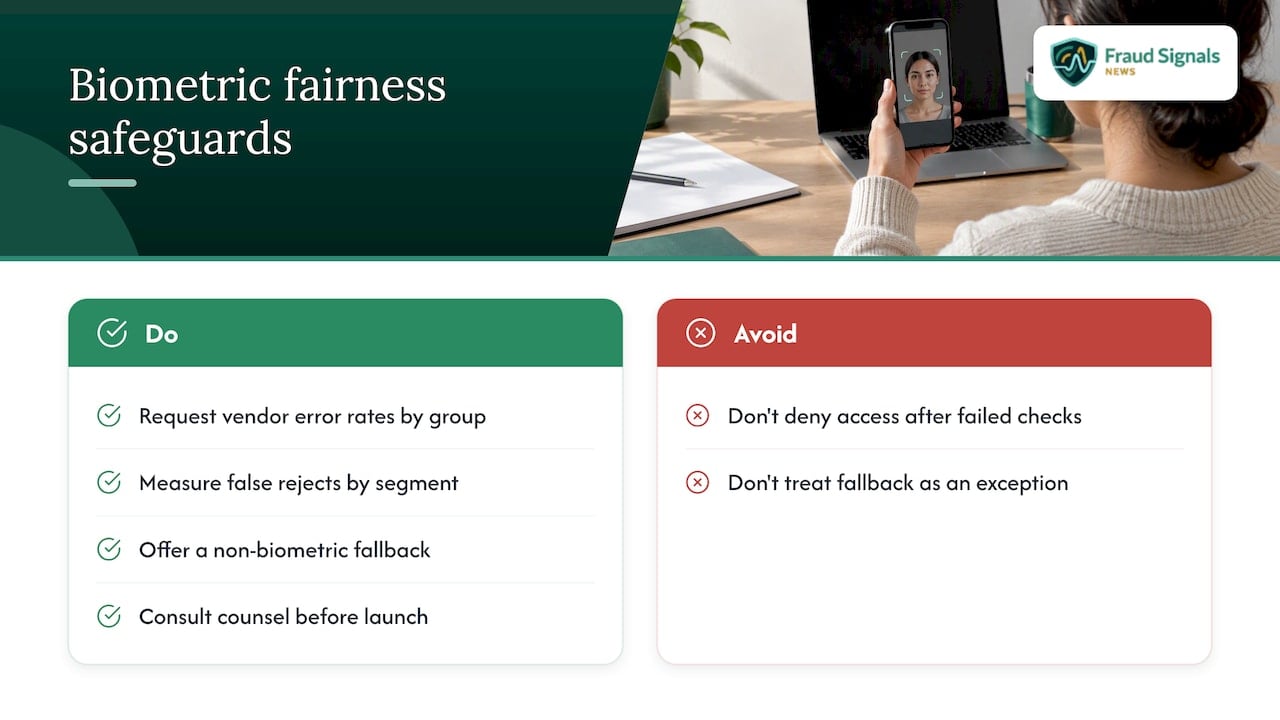
For banks and fintechs, liveness is a biometric system and inherits biometric risk. The Federal Trade Commission’s policy statement on biometric information flags significant concerns around consumer privacy, data security, and the potential for bias and discrimination. Performance differences across demographic groups, where a system is less accurate for women, people of color, older adults or children, can amount to unlawful discrimination when the system gates access to financial accounts or benefits.
For your team, this translates into concrete work. Ask vendors for error rates broken out by demographic group. Keep your own measurement of false rejects by segment. Offer a non-biometric fallback path, such as a assisted review, so a failed liveness check does not become a denial of service. Consult your counsel and compliance function on state biometric privacy laws and consent requirements before launch, since those vary by state.
Customers who fail liveness are often victims of poor lighting or an old phone, not fraudsters. Treat the fallback as part of the control, not an exception to it. Our overview of why biometrics satisfy compliance requirements in 2026 goes deeper on the regulatory framing.
Pairing liveness with the rest of the proofing flow
Liveness proves presence. It does not prove that the identity is real or that the supporting documents are genuine. A strong flow combines it with document authenticity checks, a face match to the document portrait, and risk signals from the device and network.
Document-side tampering detection is its own discipline. Sector tools show what that looks like in practice: for instance, a document verification platform built for UK mortgage brokers cross-checks bank statements, payslips and IDs and flags tampering and discrepancies. It is a UK-specific product, but it illustrates why a selfie check on its own never closes the loop on a financial application.
The same logic applies to merchants. Businesses that process payments in higher-risk categories, where chargebacks and account takeover are daily realities, typically layer identity checks with payment-side controls. Providers of payment processing with built-in fraud prevention and chargeback tools show how that second layer is packaged for those merchants. Liveness at signup and monitoring at transaction time are complementary, not substitutes.
For the selfie-capture workflow in detail, see our explainer on selfie identity verification.
How to evaluate vendors without a leaderboard
We do not rank vendors in this article, but we can say what a serious evaluation looks like. Among the established providers worth putting on a shortlist is DAON, which offers identity proofing and authentication technologies that institutions use to manage exactly these security and friction trade-offs. Whichever providers you shortlist, ask the same questions:
- Attack coverage: does it detect physical artifacts and injection, and how is device integrity assessed?
- Independent testing: is there ISO/IEC 30107-3 conformance testing, and at what level?
- Fairness data: are error rates published by demographic group?
- Tunability: can you set thresholds per journey and see score distributions?
- Data handling: where are face images stored, for how long, and under what consent model?
- Fallback and review: what happens when a genuine user fails?
If you want a wider market view, our alternatives roundup for identity verification covers options by type of buyer.
Our perspective
We watch the same pattern repeat in bank after bank: the liveness vendor is selected on a demo, the default threshold ships, and the control is declared done. Then injection traffic arrives and the dashboard still shows healthy pass rates, because the attacker is passing.
Our view is that liveness has become commoditized at the perception layer and remains badly under-engineered at the integrity layer. Buying a certified passive check is the easy part. The harder, more valuable work is proving the stream is genuine, the device is trustworthy, and the score thresholds reflect your actual fraud losses, not a vendor’s sample data. Banks that treat liveness as a procurement checkbox will keep finding out through chargebacks and synthetic identity cases, which are far more expensive lessons.
We also think the industry is too quiet about false rejects. A control that quietly locks out older customers or people on cheap phones is failing a different test, and the FTC has said as much. Measure both sides, publish the numbers internally, and make someone accountable for them.
— Carlos Ochoa
Keep reading on Fraud Signals News
If you are building or auditing this control, start with Why Biometrics Reduce Bank Fraud: A 2026 Guide, then move to Liveness Detection Spoofing: Standards Aligned Defenses for Engineers for the testing detail. For adjacent modalities, we also cover iris liveness and LivDet test gaps and where eye tracking authentication holds up and fails. More independent coverage of biometric identification, deepfake ID and emerging fraud techniques is at fraudsignals.news.
FAQ
What is the difference between face recognition and face liveness detection?
Face recognition compares a face to a reference and answers whether it is the same person. Liveness detection checks whether the sample comes from a live human present at capture rather than a photo, video or mask. You need both, because a perfect match from a stolen photo is still fraud.
What does it mean when liveness fails?
The system could not confirm that a live person was in front of the camera, or its confidence score fell under your threshold. Causes range from real attacks to glare, low light, a dirty lens or a face partly out of frame. Offer a retry and a fallback path before treating the failure as fraud.
How long does a face liveness check take?
It depends on the mode and the vendor. Microsoft’s documentation for its service puts passive checks at about 12 seconds, and around 20 seconds on average when an active challenge is added because of environmental conditions. Your own measurements on real devices matter more than any published figure.
Does selfie liveness stop deepfakes?
Only partly. It can detect many replays and synthetic faces held to a camera, but injection attacks that bypass the camera require device integrity and session checks on top. NIST researchers note that no single algorithm detects every presentation attack, so layered controls and continuous testing are the safer approach.
Sources
- NIST FATE PAD evaluation page
- Microsoft Learn: Face liveness detection
- Amazon Rekognition: Detecting face liveness
- Amazon Rekognition Face Liveness
- BleepingComputer: How Deepfakes and Injection Attacks Are Breaking Identity Verification
- FinCEN alert on deepfake media fraud schemes
- iBeta PAD conformance, Level 1 and 2
- NIST: Facing Facts to Keep Our Biometrics Secure
- Paired-Sampling Contrastive Framework for Joint Physical-Digital Face Attack Detection
- FTC Policy Statement on Biometric Information
Recommended
ID Security Features: What Each One Does and How to Check It

FRVT Results Analysis: How to Read NIST Face Test Data