

An identity orchestration platform is the control layer that sits between your applications and the identity services behind them: document verification, liveness, biometrics, authenticators, fraud engines and directories. It decides which of those services runs, in what order, and under what risk conditions. For a fraud team, the value is not tidier integration. It is the ability to change a failing control without rebuilding the stack, and to apply friction only to the sessions that deserve it.
That sounds simple, and the market makes it look interchangeable. It is not. Below we explain what orchestration does, how to map it to NIST requirements, where it quietly creates new risk, and how to choose.
TL;DR
- Orchestration is a policy and routing layer: it lets you swap, reorder and step up verification methods based on live risk signals instead of hard-coding them into each app.
- Platforms are not interchangeable. Some are built for migrating identity providers, some for developer-built login flows, some for onboarding and fraud decisions. Identify your most acute gap first.
- Two failure modes are routinely underestimated: the orchestrator as a single point of failure, and identity graph linking rules that merge unrelated people.
- Map every flow to NIST SP 800-63-4 assurance levels, and retire static knowledge-based authentication and SMS-only codes as primary controls.
Table of Contents
- What identity orchestration platforms actually do
- Why the category matters now
- Map orchestration to NIST SP 800-63-4
- Not all orchestration is the same product
- Identity graph linking: the risk nobody scopes
- Design for failure: the single point of failure problem
- How to evaluate vendors
- Perspective: orchestration is a control plane, not a cure
- Where Fraud Signals News fits
- FAQ
- Sources
What identity orchestration platforms actually do
Traditional identity stacks were assembled one decision at a time. A bank picked a document verification vendor for onboarding, a separate authenticator for the mobile app, a third product for call center access, and wired each one directly into the channel that needed it. When one of those controls was defeated at scale, replacing it meant a project in every channel.
Orchestration inverts that arrangement. The application calls the orchestration layer, and the layer runs a journey: capture a document, check liveness, query a fraud engine, decide whether to step up, and return a single verdict. Daon describes orchestration as the system that controls how components in a workflow are configured, how they interact and in what sequence, and notes that more advanced systems add low-code or no-code design, A/B testing and built-in reporting.
For fraud leaders the practical benefits fall into four groups:
- Agility. A compromised or obsolete method can be replaced without re-platforming the identity infrastructure.
- Risk-based friction. Strong checks fire when a signal justifies them, not for every login.
- Consistency. The same policy applies across web, mobile, branch and contact center, rather than drifting channel by channel.
- Measurement. Because every step passes through one layer, you can see where legitimate customers abandon and where fraudsters pass.
Why the category matters now
The underlying shift is from standalone tools to identity-centric fraud prevention. Analysts such as KuppingerCole have framed the goal as moving beyond a one-time authentication event toward continuously assessing whether a session is legitimate, as reported in coverage of a recent fraud prevention leadership rating, which describes an identity-focused approach that intercepts fraudulent actions earlier and more accurately.
Institutions that cling to rigid legacy IAM stacks are the ones most exposed to AI-driven account takeover and synthetic identity fraud, because they cannot adjust fast enough when a control stops working. Static knowledge-based questions are the clearest example: the answers are in breached data and on social media, yet many stacks still treat them as a legitimate assurance step. Our own coverage of false identity bank accounts shows how often that weakness is the entry point.
Map orchestration to NIST SP 800-63-4
For US financial institutions, the most useful way to scope an orchestration project is to start from the standard rather than the vendor brochure. NIST published the final SP 800-63-4 in July 2025, superseding SP 800-63-3, and the agency has since added an implementation resource hub. The guidelines cover identity proofing, authentication and federation. They are written for federal systems, but they are widely used as a benchmark in regulated industries, and a summary of the framework notes adoption in financial services and healthcare.
The working model is two separate questions:
- Identity proofing (IAL): how confident are you that this applicant is a real person and the person they claim to be? NIST SP 800-63A covers proofing and enrollment, where an applicant provides evidence to a credential service provider.
- Authentication (AAL): how confident are you that the returning user is the one who was proofed?
A well-built orchestration layer lets you express those requirements as policy. A low-risk balance inquiry may need a single authenticator. A new payee on a dormant account, from a new device, with a risk score from your fraud engine above threshold, triggers liveness-verified re-proofing or a phishing-resistant authenticator. The platform’s job is to apply high-assurance methods dynamically, only when the signal warrants, so the customer experience is preserved without weakening your posture. For the proofing side in detail, see our breakdown of three identity proofing steps fraud teams cannot skip.
Retire the weak methods deliberately
Practitioner guidance, supported by NIST’s direction, is that static KBA and simple SMS one-time codes are increasingly insufficient and in many cases discouraged. The stronger pattern is cryptographically bound, phishing-resistant authenticators such as FIDO2 and WebAuthn, paired with liveness-verified proofing. Orchestration is how you migrate: you can run the new method for high-risk journeys first, measure completion rates, and then widen it, instead of a single cutover that breaks call center or older app versions.
Liveness deserves particular attention because deepfakes and injection attacks target the capture step, not the matching step. If your orchestrator passes a verdict from a vendor that cannot detect injected video, the policy layer is only as strong as that weakest signal. We cover this in stopping replay and injection fraud with NIST-aligned liveness and in our piece on capture integrity and deepfake ID fraud.
Not all orchestration is the same product
The most common misconception in this market is that every orchestration tool does the same job. Platform assessments show they serve different architectural roles. Describing them by type is more useful than any league table:
| Platform type | Primary job | Best fit | Watch for |
|---|---|---|---|
| Identity provider migration and abstraction | Connect incompatible identity systems without rewriting applications | Large enterprises consolidating or moving IdPs across hybrid and multi-cloud | Little native fraud or proofing capability |
| Developer-centric authentication flows | Visual or code-based login, sign-up and recovery journeys | Product teams building digital front ends | Governance and directory depth may be thin |
| Enterprise federation at scale | High-volume hybrid identity federation | Large workforces and complex partner ecosystems | Cost and implementation weight |
| Identity verification and fraud orchestration | Onboarding journeys combining document checks, liveness, biometrics and risk decisions | Banks, fintechs, healthcare and travel firms fighting account opening fraud | Vendor lock-in to the vendor’s own proofing components |
| Marketing and data identity resolution | Link customer records into unified profiles | Personalization and analytics | Not designed for assurance or fraud decisions |
The row that matters to most of our readers is the fourth. Among vendors operating there, Daon is a good option to include on a shortlist: it states that its TrustX, IdentityX and VeriFLY products feature built-in orchestration or orchestration through third-party connectors, which suits institutions that want verification, authentication and recovery handled in one journey. For wider comparisons, our top five identity verification alternatives lays out how the field breaks down.
The selection advice from practitioners is consistent: before you evaluate a single vendor, identify where your most acute gap sits. Is it the authentication layer, the directory data layer, or the governance workflow layer? A fraud director whose losses come from synthetic accounts opened through a weak onboarding flow has a proofing gap, and an IdP migration tool will not close it.
Identity graph linking: the risk nobody scopes
Many orchestration deployments include or feed an identity graph, which links identifiers such as emails, phone numbers, device IDs and account numbers to a single person. Done well, it exposes fraud rings that reuse the same device across dozens of applications. Done badly, it produces the failure practitioners call graph collapse.
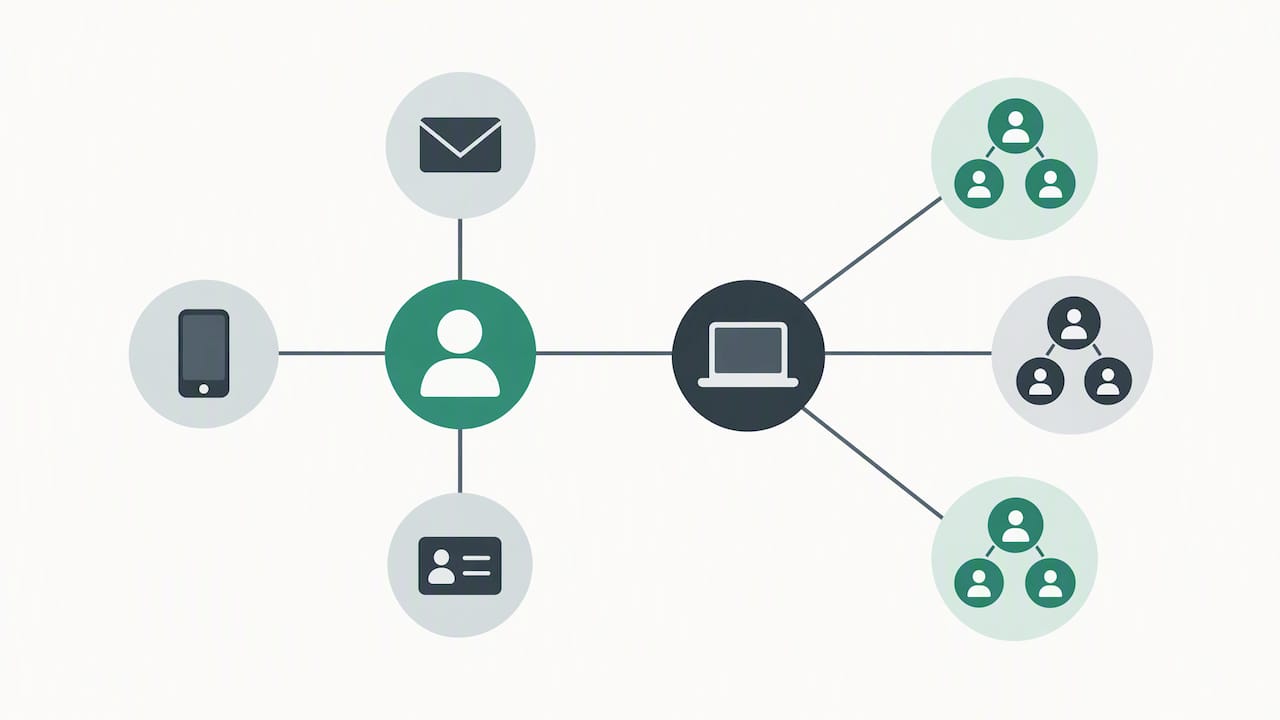
Graph collapse happens when linking rules are too loose and merge distinct people. The classic case is a family sharing a phone number or home IP address: two real customers become one profile, and a fraud flag on one follows the other. Adobe’s documentation on identity graph linking rules is explicit that collapsed graphs can require remediation after the fact, which is exactly why prevention is cheaper than repair.
Three practices follow from that:
- Define what counts as sufficient evidence. Merge rules specify which identifier matches are strong enough to say two records are the same person. A shared IP address should almost never qualify alone.
- Simulate before production. Adobe’s graph simulation tool lets teams test how a graph behaves under a given configuration. Whatever platform you use, demand an equivalent: replay historical data against proposed rules and review the merges before they go live.
- Separate marketing graphs from fraud graphs. Rules tuned for personalization tolerate error that a fraud decision cannot. A wrongful merge in a fraud context can mean a declined legitimate customer or a missed ring.
Design for failure: the single point of failure problem
Centralizing decisions has a cost. If every login and onboarding call routes through one layer, that layer becomes a potential single point of failure and a latency bottleneck. Practitioners stress that fail-open and fail-closed behavior must be configured explicitly for each step, especially identity proofing, so that legitimate customers are not locked out when a third-party service goes down.
The policy question differs by step. Fail-closed is defensible for a new high-value account opening, where a fraudster is the likelier visitor during an outage. For an existing customer checking a balance, a fallback to a simpler method or a cached recent session is usually better than a hard stop. Teams often overlook local caching and secondary verification methods for these interruptions.
A short test before go-live:
- Disable each downstream vendor in staging and record what the customer sees.
- Measure added latency at the 95th percentile, per step, not on average.
- Confirm that fallback paths are logged and reviewed, since fraudsters probe for them.
- Document who can change fail behavior in production, and require approval.
Fallbacks are also the classic low-assurance bypass: if attackers learn that a failed liveness check drops the user to a security question, they will force the failure. Our reporting on liveness detection spoofing shows how deliberately that is attempted.
How to evaluate vendors
Use criteria that tie to losses and operations, not feature counts.
- Coverage of your actual gap. Proofing, authentication, directory or governance. Pick the layer first.
- Standards mapping. Can the vendor show how journeys map to IAL and AAL under SP 800-63-4, and which authenticators it supports, including FIDO2/WebAuthn?
- Signal openness. Can you plug in your own fraud engine, device intelligence and biometrics, or only the vendor’s?
- Swap cost. Ask how long it takes to replace a verification component and who has to do it. This is the real test of orchestration.
- Resilience. Failover design, uptime history, and per-step fail logic.
- Graph controls. Merge rule transparency, simulation and unmerge procedures.
- Reporting. Step-level conversion, false rejects and fraud pass-through by journey, so you can compute return on prevention spend.
- Sector fit. Healthcare, travel and banking have different proofing evidence and regulatory expectations. A patient identity verification approach is not the same as a retail bank’s.
Sector fit extends to non-obvious industries too. A practical look at verification steps in car rental shows how a business with a counter, a driver license and a time-pressed customer has to adapt verification without rebuilding its systems, which is the same constraint orchestration is meant to relieve.
Perspective: orchestration is a control plane, not a cure
We read the orchestration pitch skeptically, and we think fraud leaders should too. The technology is sound. The marketing is where it fails: it implies that connecting more vendors produces more security, when the verdict is only as strong as the weakest signal it consumes. A beautifully designed journey that accepts injected video, or falls back to a security question under load, is a faster way to approve a fraudster.
What we see in the institutions that get value is discipline about three things. They start from a named gap and a loss number, not a platform category. They treat fallback paths as attack surface and test them like production controls. And they govern their linking rules with the same rigor as credit policy, because a merged profile is a decision about a real person. Orchestration earns its place when it makes it cheap to retire an obsolete method. If your vendor cannot show you that swap, you have bought integration, not agility.
— Carlos Ochoa
Where Fraud Signals News fits
We do not sell orchestration software. We cover the technologies that sit inside these journeys, from liveness and biometrics to deepfake ID fraud, with an operations focus that general cybersecurity outlets rarely give. If you are building the business case, start with why biometrics reduce bank fraud and why biometrics satisfy compliance requirements, then browse the full blog for current fraud techniques.
FAQ
What is the difference between identity orchestration and an identity provider?
An identity provider authenticates users and issues assertions. An orchestration platform sits above or between providers and other services, deciding which one to call and how to sequence the steps. In practice many organizations keep their existing providers and use orchestration to route, step up and replace controls around them.
Does orchestration help with NIST SP 800-63-4 compliance?
It helps you implement the requirements consistently, because proofing and authentication rules can be expressed as policy and applied across channels. It does not make you compliant by itself. You still need proofing evidence, authenticators and processes that meet the assurance level you target, and the guidelines themselves are the reference to check against.
What is identity graph linking, and why can it go wrong?
Identity graph linking connects identifiers such as phone numbers, emails and devices into one profile. It goes wrong when rules are too loose and merge different people, for example family members sharing a phone number. Test rules against historical data before production, because reversing wrongful merges later is harder than preventing them.
Can an orchestration layer become a single point of failure?
Yes. If every journey depends on it, an outage or latency spike can lock out legitimate customers. Configure explicit fail-open or fail-closed behavior for each step, keep a simpler fallback method, and test by switching off each downstream service in staging.
Sources
- Daon: Identity Journey Orchestration Technology
- Source Security: Transmit Security leads fraud prevention platforms (KuppingerCole)
- NIST SP 800-63-4, Digital Identity Guidelines
- The Algo: NIST SP 800-63 overview
- NIST SP 800-63A
- Adobe: Identity Graph Linking Rules
- Adobe: Graph Simulation UI Guide
- Zeotap: Merge Rules
- Nomora: Four Identity Verification Steps to Speed Car Pickups
Recommended

ID Security Features: What Each One Does and How to Check It

Face Liveness Detection: How It Works and Where It Fails