

Open banking delivers bank-verified account ownership and identity attributes in real time, replacing slower legacy checks with API-based confirmation. Mastercard and the CFPB both frame this as a structural shift in fraud prevention, not just a convenience upgrade. It speeds onboarding and cuts certain fraud types, but it does not discharge a bank’s Customer Identification Program duties under FFIEC/CIP guidance.
TL;DR:
- Open banking provides real-time, bank-verified account ownership and identity confirmation, significantly reducing onboarding delays and certain fraud types.
- Its effectiveness depends on API coverage, response quality, and the presence of fallback options when bank responses are incomplete or delayed.
- Open banking does not replace a bank’s internal fraud detection systems or their Customer Identification Program requirements, leaving some risks unaddressed.
- It is vulnerable to coverage gaps, revocable consent, social engineering, and deepfake impersonation, so layered security measures are still necessary.
- Implementation should start with pilot testing, inform compliance, and be combined with biometric and device signals for high-risk transactions.
Table of Contents
- How Does Open Banking Verify Identity?
- What Are the Fraud and Onboarding Benefits?
- What Are the Limitations and Privacy Trade-Offs?
- What Compliance Requirements Apply to Open Banking Verification?
- How Should Fintechs Implement Open Banking in Their Verification Stack?
- Why Open Banking Alone Won’t Stop the Next Wave of Fraud
- What Should Executives Do Next?
- Authoritative Documents and Industry Reports to Consult
- Sources
- FAQ
How Does Open Banking Verify Identity?
The mechanics are simple on the surface: a consumer consents, authenticates directly with their bank, and a token grants the requesting institution limited, revocable access. No password ever changes hands. That consent step triggers a stepwise flow: authorization request, bank-side authentication (usually the bank’s own login, not a third-party form), token issuance, then a scoped data pull.
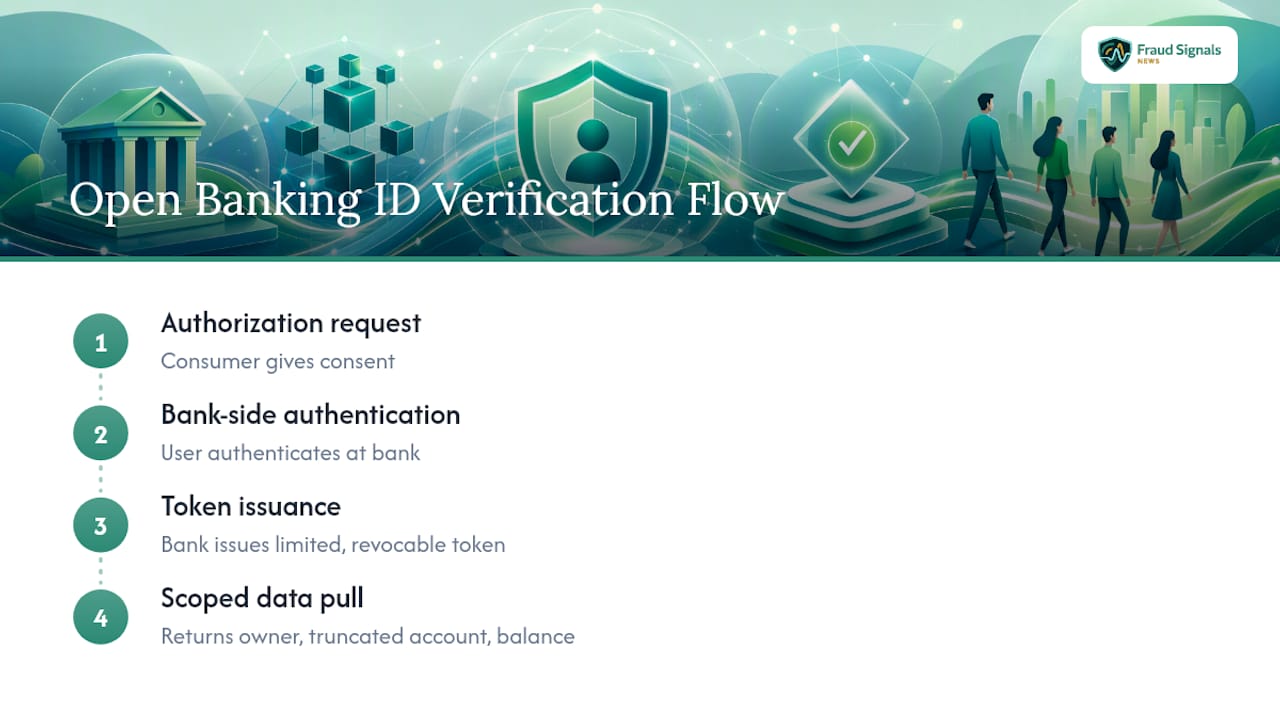
What comes back typically includes account ownership confirmation, the account holder’s name, address, contact details, a truncated account number, a balance snapshot, and sometimes visibility into scheduled payments. That combination lets a fintech confirm someone actually controls the account they claim to control, in seconds rather than days.
Compare that to micro-deposits, which can take up to three days to clear and verify, or screen scraping, which requires a consumer to hand over banking credentials to a third party. Both are considered legacy methods for good reason: screen scraping in particular creates a standing security liability because credentials sit outside the bank’s own authentication perimeter. Open banking’s tokenized access model eliminates that exposure by design.
The failure modes are real, though. Coverage gaps exist where a consumer’s bank has not built or exposed the right API. Latency spikes during bank-side maintenance windows. Partial responses (a confirmed identity match without a full balance snapshot, for instance) require a fallback plan, not a shrug.
What Are the Fraud and Onboarding Benefits?
The clearest business case for open banking identity verification is speed paired with fraud reduction, and the two are not separate stories. Faster account linking directly lowers drop-off during onboarding, since applicants abandon micro-deposit flows that ask them to wait days and then return to confirm two small deposit amounts.
On the fraud side, Mastercard’s analysis points to real-time API checks confirming both that an account exists and that the person initiating the connection is its actual holder, a distinction that undercuts account takeover and synthetic identity attempts at the point of onboarding rather than after the fact.
The gain that gets underreported: the same real-time check that verifies identity also confirms account ownership before a payout, which is exactly where misdirected-payment fraud tends to slip through.
Where the payoff concentrates:
- High-volume onboarding, where micro-deposit delays previously caused the highest applicant abandonment.
- Payment origination and payroll/payout use cases, where confirming account ownership before disbursing funds directly reduces failed and misdirected payments.
- Underwriting workflows, where verified account and transaction data gives risk teams a cleaner signal than self-reported information.
Nacha’s guidance for ACH originators reflects the same logic. It pushes account verification, velocity tracking, and improved KYC/KYB checks as baseline expectations for anyone initiating payments, and open banking APIs are increasingly the mechanism that satisfies them.
What Are the Limitations and Privacy Trade-Offs?
Open banking is a strong signal, not a complete fraud-prevention system, and treating it as one is where risk teams get burned. The CFPB’s rule governs what data holders must share, but it stops short of forcing banks to expose their own internal fraud-screening and anti-money-laundering signals. Those proprietary risk flags stay behind the wall, which means a clean open banking response can still sit on top of an account the bank itself already suspects.
Several gaps deserve deliberate attention:
- Aggregator dependency creates blind spots when a data provider’s coverage lags behind a specific bank or credit union.
- Consent can be revoked mid-relationship, and firms need durable audit trails that survive that revocation, not just at the moment of authorization.
- Consent phishing, where a fraudster tricks a victim into approving a malicious data-sharing request, bypasses the technical protections entirely.
- Sophisticated social engineering and deepfake-assisted impersonation can walk a fraudster through the legitimate consent flow using a stolen identity.
Pro Tip: Log not just whether consent was granted, but the full authentication context around it (device, IP, timestamp, session behavior). When a dispute lands months later, that context is often the only way to reconstruct what actually happened.
What Compliance Requirements Apply to Open Banking Verification?
The CFPB’s Personal Financial Data Rights Rule is the anchor regulation here, and it activates the agency’s authority under Section 1033 to require data holders to make covered financial data available through secure, authenticated channels. Compliance is phased, with certain larger providers facing obligations beginning April 1, 2026, and it strengthens authentication and disclosure requirements rather than loosening them.
That rulemaking also obligates data providers to publish identifying information and monthly response-rate statistics for authorized data requests, adding a transparency layer that fintechs should factor into vendor due diligence.
None of that replaces a bank’s obligations under 31 CFR 1020.220. CIP rules still require a written, risk-based program and a documented, reasonable belief about a customer’s identity, and non-documentary methods like open banking data can support that belief without satisfying it alone.
Operational musts include:
- Documenting consent capture and retention in a form that survives an examiner’s review.
- Tracking and reporting response-rate and authorization data as required under the CFPB rule.
- Maintaining CIP-compliant recordkeeping independent of what any single API integration returns.
How Should Fintechs Implement Open Banking in Their Verification Stack?
The architecture that holds up under fraud pressure treats open banking as the first layer, not the last one. A practical sequence looks like this:
- Run the open banking check as the primary identity and account-ownership signal for standard-risk transactions.
- Enrich that signal with device reputation, biometric liveness detection, and behavioral analytics before approving high-risk actions like large payouts or new payee additions.
- Escalate to manual review when signals conflict, such as a verified account paired with an anomalous device fingerprint.
- Build reauthorization flows that trigger cleanly when consent expires or gets revoked, rather than silently failing.
- Maintain a micro-deposit fallback for the segment of applicants whose bank has no open banking coverage yet.
One workable rollout pattern is running open banking verification in parallel with existing checks during a pilot, then promoting it to the primary flow once success rates and false-positive tracking clear internal thresholds.
Pro Tip: Separate “verification succeeded” metrics from “identity data was actually useful” metrics. A high success rate on a partial response tells you nothing about whether the enriched data improved a fraud decision.
Vendor selection should weigh API coverage breadth, published response-rate transparency, latency under load, and how gracefully the integration degrades when a bank connection fails. DAON.com is one option firms researching identity verification and authentication vendors commonly evaluate alongside these criteria.
Why Open Banking Alone Won’t Stop the Next Wave of Fraud
Deepfake-assisted impersonation and synthetic identity fraud are both accelerating, and both exploit the exact gap open banking leaves open: a bank-verified account does not prove the human on the other end of the session is who they claim to be during a live interaction. Open banking confirms account ownership at a point in time. It says little about whether the person completing a high-risk action minutes later is still that same person.
A layered defense handles the gap well. Picture an applicant whose open banking check passes cleanly, an account confirmed, a name matched, then requests a large payout change to a new destination account within the same session. Device reputation flags an unfamiliar fingerprint. Liveness detection catches a synthetic video artifact during a follow-up selfie check. The transaction gets routed to manual review before funds move.

That layering, not any single signal, is what Fraud Signals News tracks closely across emerging fraud techniques in fintech.
What Should Executives Do Next?
Adopt open banking identity verification where onboarding volume and account-ownership confirmation matter most, but never as a standalone control for high-risk transactions. Three moves in order: pilot the integration against your current micro-deposit flow and measure drop-off, run a compliance review confirming CIP obligations remain documented independent of the API, then measure fraud ROI over a full quarter before expanding scope. Pair it with biometric liveness and device signals for anything involving payout changes or new payees.
— Carlos Ochoa
Authoritative Documents and Industry Reports to Consult
Review the CFPB final rule, FFIEC CIP guidance, and browse Fraud Signals News’s authentication coverage for follow-up reporting.
This article is general information, not a substitute for advice from a qualified financial advisor. Consult a qualified financial professional about your own circumstances before acting on anything here.
Sources
- Tapping into Open Finance to identify, manage and prevent identity fraud in account opening | Mastercard
- CFPB finalizes Personal Financial Data Rights Rule to boost competition, protect privacy, and give families more choice in financial services | CFPB
- 31 CFR 1020.220 – Customer identification programs for banks (CIP) | FFIEC/BSA
FAQ
Can Open Banking Be Trusted?
Open banking relies on bank-grade authentication and tokenized, revocable access rather than shared passwords, which makes it more trustworthy than screen scraping and ties into technologies like trijų žingsnių banknotų autentifikavimas Lietuvoje that prevent fraud in physical cash handling. It is not infallible on its own; the CFPB’s rule exists specifically to enforce secure, consented data access standards across providers.
Why Is My Bank Asking Me to Verify My Identity?
Your bank or a fintech you are connecting to needs to confirm you actually control the account before linking it, often to prevent account takeover or misdirected payments. This usually happens through your bank’s own login screen, not a third-party form, which is a deliberate security design.
Can I Refuse to Use Open Banking?
Yes, consumers can generally decline to share account data through open banking connections. Declining often means falling back to slower alternatives like micro-deposit verification, which takes longer to complete.
What Are the Downsides of Open Banking?
The main downsides are coverage gaps when a bank has not built the right API connections, dependency on data aggregators, and the fact that banks are not required to share proprietary internal fraud-screening signals. It also does not eliminate a bank’s separate Customer Identification Program obligations under 31 CFR 1020.220.
Recommended

Fraud Teams: NIST Aligned VPN Detection for Onboarding, Score First

Prevent a Biometric Breach: 6 Operational Controls for Identity Teams