

Call center fraud risk is rising because brittle identity checks, scalable social engineering, and AI-driven voice impersonation now let attackers bypass agent verification in seconds. The contact center has become the weakest link in identity enforcement: agents make real-time decisions under pressure, privileged workflows sit one social-engineering script away from exploitation, and most verification controls were designed for a threat environment that no longer exists. FTC data show reported fraud losses reached $12.5 billion in 2024, a figure that captures only what consumers reported. The actual exposure is materially higher.
Three actions security teams should take immediately:
- Stop treating knowledge-based authentication (KBA) as a primary identity control. Breached data has made most KBA questions answerable from a $5 dark-web record.
- Instrument cross-channel telemetry so IVR probing patterns, failed authentications, and account-change events feed a unified risk score before an agent makes a privileged decision.
- Add step-up authentication and out-of-band callback requirements for any transaction that changes contact identifiers, resets credentials, or moves funds.
Key Takeaways
Contact center fraud risk is rising because legacy identity checks, AI-amplified social engineering, and channel migration have turned agent-assisted interactions into the path of least resistance for attackers.
| Point | Details |
|---|---|
| Retire KBA as a sole control | Breached data makes KBA answerable by any attacker with a $5 dark-web record. |
| Remove card data from agent screens | DTMF masking and payment links cut phone-channel chargebacks by 40–70% in one quarter. |
| Instrument IVR and cross-channel telemetry | IVR logs, CLI telemetry, and account-change streams are the foundational signals for detecting multi-step attack chains. |
| Align metrics with verification behavior | AHT targets that penalize step-up checks create the verification shortcuts attackers exploit. |
| Evaluate DAON for layered identity | DAON (DAON.com) is a vendor worth including in any evaluation of biometric and step-up authentication for contact center identity programs. |
Table of Contents
- What contact center fraud actually is
- The main types of call center fraud you need to map
- Why these risks are rising now
- How modern attack chains unfold across IVR and agent interactions
- Red flags agents and monitoring systems should watch for
- Which detection technologies are effective, and where they fall short
- Prioritized prevention controls security teams should implement now
- Governance, training, and the KPIs that actually matter
- What the data shows about rising call center fraud volumes
- The contact center is an identity enforcement point, not a support function
- Sources
- FAQ
What contact center fraud actually is
Contact center fraud is the abuse of agent-assisted interactions to impersonate an account holder, extract sensitive data, or authorize a transaction the legitimate customer never requested. The key distinction from web fraud is the human element: an agent can be socially engineered, pressured, or deceived in ways that automated fraud engines cannot be. Web channels carry device fingerprints, behavioral biometrics, and session telemetry. A phone call carries a voice, a caller ID, and whatever the attacker rehearsed.
The two scenarios agents encounter most often:
- Account takeover (ATO): A caller uses breached credentials and personal data to pass verification, then requests a password reset, SIM swap, or contact-information change that locks the legitimate owner out.
- Fraudulent refunds and MOTO card misuse: A caller claims a package was never delivered or a charge was unauthorized, then uses a stolen card number to place a mail-order/telephone-order (MOTO) transaction while the agent processes the refund simultaneously.
Pro Tip: Brief your agents on the “double-dip” pattern: a refund request combined with a new order on the same call is a reliable early signal of MOTO abuse. Flag it for supervisor review before completing either transaction.
The main types of call center fraud you need to map
Understanding the taxonomy matters because each fraud type maps to different detection rules and triage procedures.
- Account takeover (ATO): The attacker impersonates the account holder using breached PII, passes KBA, and changes contact identifiers or credentials. Primary consequence: full account compromise and downstream fraud.
- Vishing (voice phishing): The attacker calls the customer, not the contact center, impersonating a bank or service provider to harvest credentials, then uses those credentials in a follow-up call to the real contact center. Primary consequence: credential theft enabling ATO.
- Agent-assisted card testing and MOTO abuse: Small-value test transactions placed through an agent to validate stolen card numbers before larger fraud. Primary consequence: chargeback losses and card-scheme penalties.
- Refund and chargeback fraud: Fabricated non-delivery or dispute claims processed by agents without sufficient verification. Primary consequence: direct financial loss and inflated chargeback ratios.
- Insider-assisted collusion: An agent, knowingly or under coercion, approves fraudulent requests, bypasses verification steps, or exfiltrates account data. Primary consequence: high-value losses and regulatory exposure.
- Synthetic identity fraud via call channel: An attacker calls to “activate” or “verify” a synthetic identity account, using a combination of real and fabricated data to pass agent checks. Primary consequence: credit exposure and new-account fraud losses.
The escalation pattern to watch: card testing and small-value MOTO attempts are often reconnaissance. They confirm which accounts are live and which agents are susceptible before the attacker escalates to full account takeover or large-value transfers.
Why these risks are rising now
The causes of call center fraud accelerating are structural, not incidental. Each one maps to a specific control gap.
-
Breached and reusable personal data. Billions of records from prior data breaches are indexed and searchable. An attacker can answer most KBA questions, including “last four of SSN,” mother’s maiden name, and prior address, from commercially available credential dumps. The operational consequence: KBA provides false assurance while delivering near-zero friction to a prepared attacker.
-
AI voice cloning and synthetic audio. High-quality voice cloning is now inexpensive and widely accessible. Industry analysis indicates human agents identify synthetic voices at roughly chance levels, which means audio-only controls cannot be trusted in isolation. An attacker can clone a customer’s voice from a few seconds of publicly available audio and use it to defeat passive voice biometric checks.
-
Migration from hardened web channels to phone. As banks and fintechs have layered device fingerprinting, behavioral analytics, and step-up MFA onto web and mobile channels, attackers have shifted to phone. Phone-initiated MOTO transactions commonly lack the device and behavioral signals that web fraud engines rely on, creating an exploitable gap that bypasses existing fraud screening entirely.
-
Remote and outsourced agent models. Distributed contact center operations introduce agent substitution risk: an unauthorized person using an authorized agent’s credentials. EY’s insider-risk guidance identifies agent substitution and social-media recruitment of agents as a major overlooked vector in remote work environments. Reduced physical oversight makes it harder to detect when a credential is being shared or sold.
-
Legacy knowledge-based verification and siloed systems. Most contact centers still rely on KBA as the primary or sole identity check. When verification data lives in a separate system from fraud signals, agents make decisions without visibility into whether the same caller failed authentication three times in the past hour.
-
Incentive metrics that reward speed over verification. Average handle time (AHT) targets create direct pressure to skip or abbreviate verification steps. An agent who takes an extra 90 seconds to complete a step-up check will score worse on the metric their supervisor reviews. The operational consequence: verification shortcuts become normalized behavior, not exceptions.
-
AI-amplified social-engineering iteration. AI accelerates attacker campaign iteration cycles, enabling attackers to test, refine, and repeat social-engineering scripts at a cadence previously impossible. What once required a skilled fraudster operating manually can now be templated, scripted, and executed at scale.
Pro Tip: Measure chargeback clustering by agent ID. A single agent appearing in a disproportionate share of disputed transactions is either a target of social engineering or a participant in collusion. Either way, it is a signal that warrants immediate investigation.
How modern attack chains unfold across IVR and agent interactions
Security teams need a step-by-step model they can instrument with correlation rules, not just a general description of fraud.
- Reconnaissance and credential harvesting. The attacker purchases or scrapes breached PII, validates account existence through public-facing channels, and identifies the target institution’s IVR structure.
- IVR probing and CLI testing. The attacker calls the IVR repeatedly using spoofed caller line identification (CLI) to test which account numbers are active, which PINs work, and whether the IVR exposes balance or transaction data before agent transfer.
- Repeated retries and escalation to agent. After partial IVR authentication, the attacker escalates to an agent, often claiming the IVR “isn’t working” to avoid automated controls. Multiple failed IVR attempts from the same CLI, or from rotating CLIs targeting the same account, are a detectable signal.
- Social engineering to change identifiers or trigger a transaction. The attacker uses urgency, emotional manipulation, or fabricated scenarios (“my account was hacked, I need to change my email right now”) to pressure the agent into bypassing normal verification or approving a privileged change.
- Rapid account edits and outbound transfer. Within minutes of gaining access, the attacker changes the registered email, phone number, and password, then initiates a transfer or places a high-value MOTO order before the legitimate customer can respond.
A concrete scenario: an attacker uses a stolen card number to place three small MOTO test orders through different agents over 48 hours, each under $20. On the fourth call, they claim a fraudulent charge on the account, request a refund to a different card, and simultaneously place a $400 order. The agent, seeing a “returning customer” with a refund history, processes both. The chargeback arrives two weeks later.
Key telemetry points to instrument at each stage:
- IVR logs: Call frequency per CLI, failed authentication counts, IVR-to-agent escalation rate, and account numbers queried per session.
- Call metadata: CLI reputation scores, call duration anomalies, and geographic inconsistencies between CLI and account address.
- Agent desktop events: Verification step completions, override flags, and time-to-action on privileged changes.
- Account-change events: Timestamp clustering of contact-info changes, password resets, and new payee additions within a session.
Red flags agents and monitoring systems should watch for
Agent-facing checklist
- Caller expresses extreme urgency or emotional distress that escalates when verification is requested.
- Caller asks to bypass standard verification (“just this once,” “I’ve already verified with the IVR”).
- Caller requests changes to contact identifiers (email, phone, address) and a high-value transaction in the same call.
- Caller refuses a callback to the registered number and insists on completing everything in the current session.
- Caller asks to remove MFA, disable security alerts, or “temporarily” lower transaction limits.
- Caller provides PII fluently but hesitates or deflects on questions that require real-time knowledge (recent transaction amounts, last login location).
Monitoring signals for security teams
- Repeated IVR authentication failures from the same CLI or a rotating CLI cluster targeting the same account.
- Clusters of small-value MOTO attempts across multiple agent sessions within a short window.
- Unusual volume of password resets or contact-info changes within a single agent’s session log.
- Sudden multi-account activity originating from one agent workstation or credential.
- High rate of exception overrides or supervisor escalations from a specific agent or team.
Escalation threshold guidance: any single call that combines a contact-identifier change with a transaction above a defined threshold should require out-of-band callback verification and supervisor approval before completion. Do not leave this to agent discretion.
Which detection technologies are effective, and where they fall short
No single signal is sufficient. The practical question is which signals to layer and how to feed them into a real-time risk score that reaches the agent before they make a decision.
- IVR analytics: Detects probing patterns, failed authentication clustering, and unusual escalation rates. Limitation: Attackers who know the IVR structure can minimize failed attempts by using partially valid credentials.
- Caller reputation and CLI telemetry: Flags known-bad numbers and spoofed CLIs. Limitation: CLI spoofing is trivial and inexpensive; reputation databases lag behind newly registered numbers.
- Device and phone possession signals (L2 authentication): Confirms the caller is in possession of the registered device. Limitation: SIM swapping and device theft can defeat possession-based checks.
- Voice biometrics (passive and active): Matches voiceprint against enrolled sample. Limitation: High-quality voice cloning can defeat passive voiceprint matching. Human agents identify synthetic voices at roughly chance levels, so voice biometrics must be layered with behavioral and metadata signals, not used as a standalone gate.
- Behavioral analytics: Detects anomalies in call patterns, account-change velocity, and session behavior. Limitation: Requires sufficient baseline data; new accounts and low-frequency callers generate thin profiles.
- Agent desktop monitoring: Surfaces real-time risk prompts and flags override attempts. Limitation: Effective only if agents are trained to act on prompts rather than dismiss them under AHT pressure.
- Cross-channel correlation engines: Links IVR events, web session activity, and agent interactions into a unified timeline. Limitation: Requires data integration across systems that are often siloed; implementation complexity is high.
The practical floor for any contact center fraud program is this: instrument IVR logs, CLI telemetry, and account-change event streams first. Those three signals, correlated in near-real time, will surface the majority of multi-step attack chains before they complete. Voice biometrics and behavioral analytics add material lift, but only when the foundational telemetry is already in place. Building on weak signal infrastructure produces false confidence, not fraud reduction.
For deeper coverage of biometric detection approaches and how they integrate into layered identity programs, Fraud Signals News maintains ongoing analysis of voice, face, and behavioral biometric deployments across financial services.
Prioritized prevention controls security teams should implement now
Practitioners report the most impact from removing agent exposure to card data and moving payment and authentication steps to customer devices, rather than from adding another ML model on top of weak signals. That principle should guide your prioritization.
Short-term (implement within 30–60 days)
- Remove card data from agent screens using DTMF masking or customer-side payment links. Merchants who have implemented this report a 40–70% reduction in phone-channel chargebacks within a single quarter.
- Retire sole reliance on KBA. Replace or supplement with possession-based or biometric signals for any privileged transaction.
- Implement transaction limits and mandatory manual review for MOTO orders above a defined threshold placed on the same call as a refund or dispute.
Medium-term (60–180 days)
- Add step-up authentication and out-of-band callback for contact-identifier changes, password resets, and high-value transfers.
- Instrument cross-channel telemetry connecting IVR logs, agent desktop events, and account-change streams into a unified risk score.
- Deploy agent desktop prompts that surface real-time risk signals and require documented justification for exception overrides.
Organizational
- Secure agent access with role-based controls and active session monitoring to detect credential sharing and agent substitution.
- Revise AHT metrics to remove the implicit penalty for completing step-up verification, and add verification-completion rate as a tracked KPI.
| Control | Risks reduced | Known limitations |
|---|---|---|
| DTMF masking / payment links | MOTO card testing, agent-exposed card data | Requires telephony integration; some customer friction |
| Step-up MFA + out-of-band callback | ATO, contact-identifier hijacking | Adds handle time; must be scoped to high-risk triggers |
| Voice biometrics + telemetry layering | Impersonation, vishing follow-through | Vulnerable to high-quality voice cloning; needs signal layering |
| IVR analytics and CLI telemetry | Probing, credential stuffing via IVR | CLI spoofing limits reliability; requires tuning |
| Agent desktop monitoring | Insider collusion, override abuse | Effective only with training and AHT metric alignment |
| Cross-channel correlation engine | Multi-step attack chains, synthetic identity | High integration complexity; data-silo dependencies |
For step-up authentication design patterns and MFA flow guidance, Fraud Signals News covers the current state of authentication architecture in financial services.
Governance, training, and the KPIs that actually matter
Technical controls fail when governance does not enforce them. The gap between a written verification policy and what agents actually do under AHT pressure is where most contact center fraud programs break down.
Core governance requirements:
- Role-based access controls that limit which agents can approve privileged changes (contact-info updates, high-value transfers, account closures).
- Supervised exception handling with documented justification required for any verification step override.
- Approved “pattern interrupt” scripts that give agents a scripted, non-confrontational way to pause a call and request supervisor review without escalating tension with a legitimate customer.
- Escalation rules that are automatic, not discretionary, for defined high-risk request combinations.
Training should be scenario-based and reinforced by the same desktop prompts agents see in production. A training module that describes social engineering abstractly is far less effective than one that walks an agent through a live simulation of an urgency-manipulation call. Contact centres are now involved in 61% of fraud cases in recent industry reporting, which means the probability that any given agent will encounter a fraud attempt is not hypothetical.
KPIs security leaders should track:
- Chargeback rate by agent ID: The single most actionable metric for detecting both insider collusion and social-engineering susceptibility.
- Exception override frequency: How often agents bypass a required verification step, and which agents do it most.
- IVR-to-agent escalation rate: A spike often signals active probing campaigns.
- Proportion of high-risk requests completing step-up auth: Measures whether the control is actually being applied.
- Time-to-detect a takeover chain: From first IVR probe to account-change event; shortening this window is the primary operational goal.
Reducing identity fraud exposure requires aligning these KPIs with budget requests and governance reviews, not just tracking them in a dashboard no executive sees.
What the data shows about rising call center fraud volumes
The numbers make the case for investment more clearly than any risk narrative.
adults experienced account takeover in 2024](https://nhimg.org/articles/contact-center-fraud-is-exposing-gaps-in-identity-verification/), and fraudulent call volumes reached 12.5 billion in Q1 2025 alone. TransUnion has separately reported rising fraud attacks specifically targeting financial-industry call centers, corroborating the channel-shift pattern described throughout this article.
The FTC’s $12.5 billion in reported consumer fraud losses for 2024 represents only what consumers chose to report. Institutional losses from ATO, MOTO fraud, and insider-assisted schemes are tracked separately and are not fully captured in that figure.
For executive briefings, these one-liners translate the data into budget language:
- “Nearly 1 in 3 U.S. adults was an ATO victim in 2024. Our contact center is a primary attack surface.”
- “Fraudulent call volumes hit 12.5 billion in a single quarter. Volume-based detection is not optional.”
- “The FTC recorded $12.5 billion in reported fraud losses in 2024. Unreported institutional losses are higher.”
The implication for program design: contact center fraud is no longer a tail risk. It is a mainstream attack vector that warrants the same investment level as web-channel fraud prevention, including dedicated tooling, staffing, and executive visibility.
The contact center is an identity enforcement point, not a support function
The framing that most security programs get wrong is treating the contact center as a support channel that occasionally encounters fraud, rather than as an identity enforcement surface that processes privileged transactions under adversarial conditions every day.
Every call that results in a password reset, a contact-information change, or a fund transfer is an identity decision. The agent making that decision is operating with incomplete signals, under time pressure, and against an attacker who has prepared specifically for that interaction. Governance and technology must close that gap, because the attacker’s preparation is only getting better.
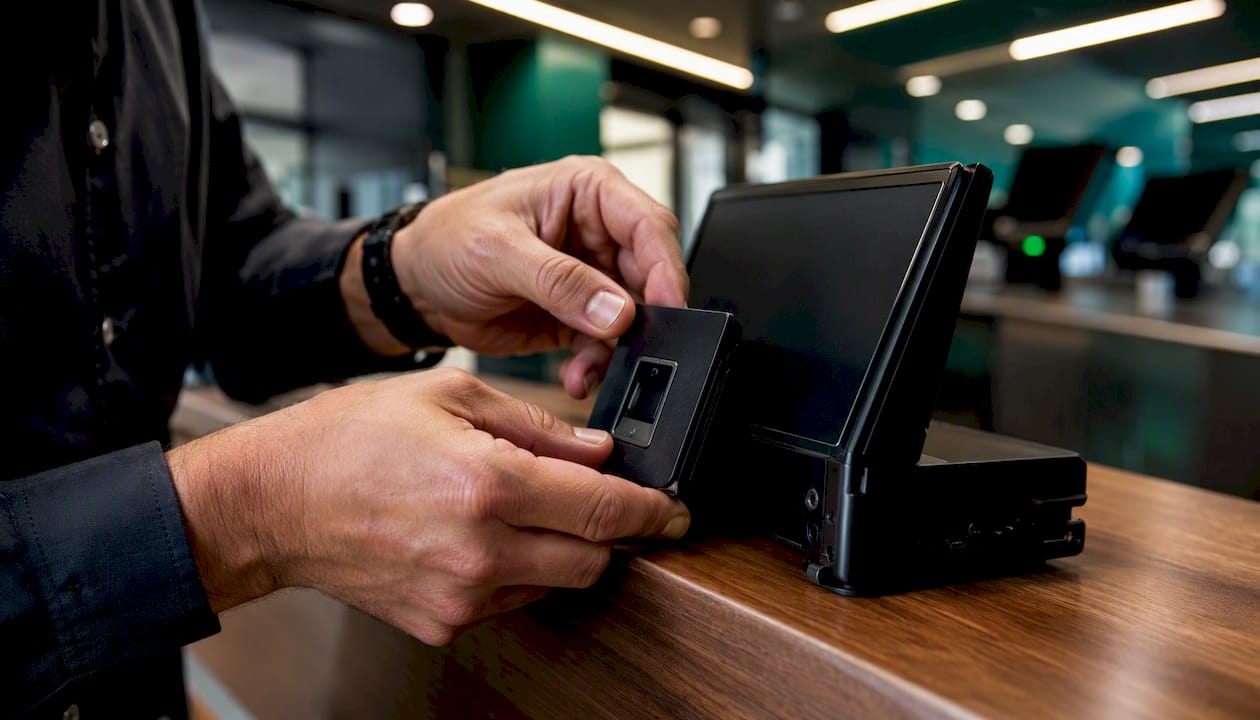
The organizations that have reduced contact center fraud materially share a common pattern: they removed card data from agent screens first, instrumented IVR telemetry second, and then layered biometric and behavioral signals on top of a working data foundation. They also changed the metrics their agents were measured on. None of those changes required a multi-year platform replacement. Most started with a 60-day sprint.
Fraud Signals News covers the deepfake and synthetic audio threats that are reshaping contact center identity risk, including practical guidance on liveness detection and voice biometric deployment for security teams evaluating layered identity strategies.
Sources
- Ftc
- Call centre fraud detection: tools, checks and blind spots
- Insider risk: Safeguarding call centers | EY – US
- Contact centres are now involved in 61% of fraud cases as criminals target customer service teams | Retail Technology Review
FAQ
Why are call center fraud risks increasing so sharply?
The primary drivers are the mass availability of breached personal data, AI voice cloning that defeats audio-based verification, and attacker migration from hardened web channels to phone, where device and behavioral signals are absent. Legacy KBA controls cannot keep pace with these conditions.
What is the main reason for the increasing rate of CNP fraud?
Card-not-present (CNP) fraud rises because phone-channel MOTO orders lack the device fingerprints and behavioral signals that web fraud engines use to screen transactions, making them easier to abuse with stolen card data. Removing card numbers from agent screens and using customer-side payment links directly addresses this gap.
What are the red flags of call center fraud?
Key red flags include extreme caller urgency, requests to bypass verification, refusal to accept a callback to the registered number, and a combination of contact-identifier changes with a high-value transaction in the same call. On the monitoring side, repeated IVR authentication failures from the same CLI and clusters of small-value MOTO attempts are reliable early signals.
Why are call centers considered one of the largest fraud risk channels?
Contact centers process privileged transactions, including password resets, contact-information changes, and fund transfers, through a human agent who can be socially engineered. Unlike web channels, phone interactions lack device telemetry and behavioral signals, and agents operate under AHT pressure that creates incentives to abbreviate verification. That combination makes the channel structurally vulnerable.
Why am I suddenly getting more spam risk calls?
Fraudulent call volumes reached 12.5 billion in Q1 2025, driven by automated dialing infrastructure and AI-scripted vishing campaigns that can iterate and scale at low cost. The increase reflects both the commoditization of attack tooling and the profitability of phone-channel fraud relative to hardened digital channels.
Recommended

Fraud Teams: NIST Aligned VPN Detection for Onboarding, Score First

Prevent a Biometric Breach: 6 Operational Controls for Identity Teams