

Customer identity proofing is defined as the process of collecting, validating, and verifying an individual’s claimed identity at the moment of onboarding or during a high-risk transaction. This is the industry term used by NIST SP 800-63-4, the federal digital identity standard that financial and healthcare auditors now treat as the de facto benchmark. The process is distinct from authentication, which governs repeat access after identity has already been established. Getting this distinction right matters because organizations that conflate the two routinely apply the wrong controls at the wrong time, creating gaps that synthetic identity fraud exploits at scale. Fraud Signals News covers exactly these failure points, and this article gives compliance officers and business leaders a clear framework for understanding what the identity proofing process requires and why it reduces both fraud exposure and regulatory liability.
What is the customer identity proofing process?
Identity proofing is a one-time event at registration, not a recurring check. That single moment establishes the foundational trust record upon which every downstream access decision rests. If that record is weak or fabricated, every subsequent authentication step is built on a false premise.
NIST SP 800-63-4 structures the process into three sequential steps.
- Resolution. The organization collects identity evidence, typically a government-issued ID such as a passport or driver’s license, and uses it to establish a unique identity claim. The goal is to distinguish this individual from all others in the system.
- Validation. The collected evidence is checked for authenticity. This includes verifying document security features, cross-referencing authoritative data sources such as credit bureau records or government registries, and confirming the evidence has not been tampered with.
- Verification. The organization confirms that the person presenting the evidence is the same individual the evidence describes. Biometric comparison, liveness detection, and knowledge-based challenges all serve this step.
After verification, the proofed identity is bound to a credential for future authentication. That binding step is where many programs fail. Issuing a weak credential after rigorous proofing wastes the entire investment, because a stolen or phished credential can then impersonate a legitimately proofed identity.
Pro Tip: Treat the credential binding step as part of proofing, not a separate IT task. A phishing-resistant cryptographic credential issued at the moment of proofing is the only way to preserve the trust you just established.

How do identity assurance levels set standards for proofing?
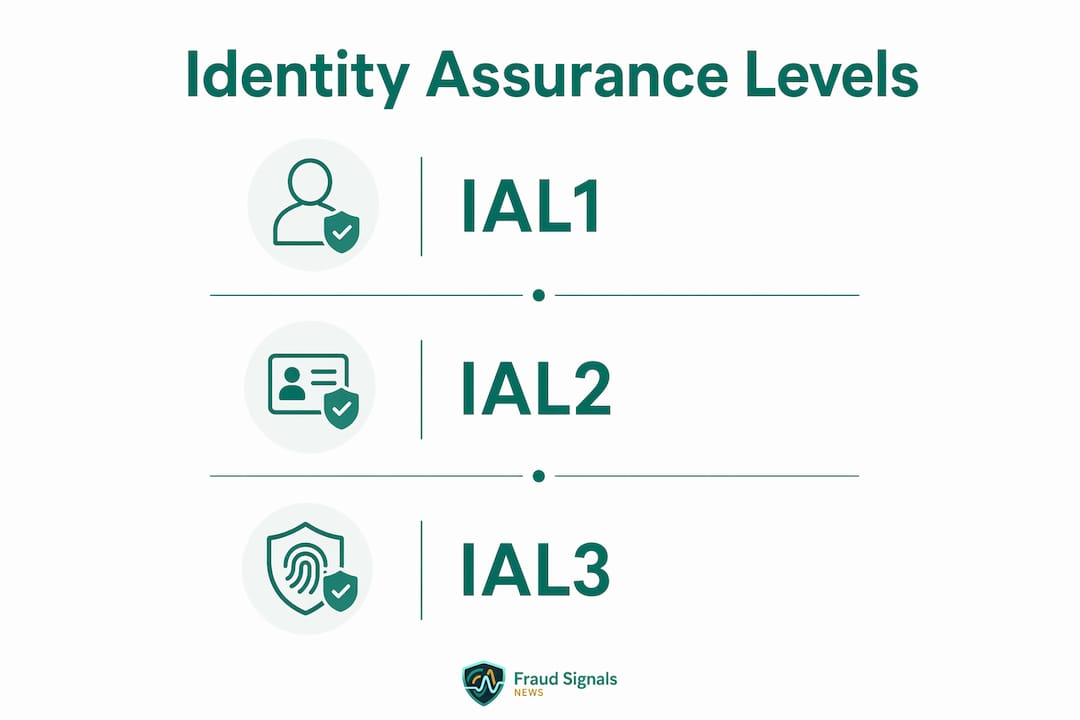
NIST SP 800-63-4 defines three Identity Assurance Levels (IALs), each specifying increasing evidence strength and process rigor. Selecting the wrong level for a given use case is not a minor configuration error. It is a structural vulnerability.
| Assurance Level | Evidence Requirement | Proofing Method |
|---|---|---|
| IAL1 | Self-asserted attributes only | No identity evidence required |
| IAL2 | Verified government ID plus biometric or authoritative data match | Remote or in-person proofing |
| IAL3 | Superior evidence combinations with strict validation | In-person or supervised remote proofing only |
IAL1 is appropriate for low-risk services where the organization accepts the risk of unverified claims. IAL2 covers the majority of regulated financial and healthcare onboarding scenarios. IAL3 mandates either in-person or supervised remote proofing with tamper-resistant hardware and live monitoring. Standard video calls do not meet IAL3 requirements. Organizations that substitute a basic selfie check for supervised remote proofing are operating below the standard they believe they have achieved.
NIST SP 800-63 is widely adopted as a benchmark outside federal government, and financial and healthcare auditors reference it directly. Ignoring its tiered structure exposes organizations to compliance findings and reputational damage when breaches occur.
Pro Tip: Select your Identity Assurance Level based on the risk of the downstream transaction, not the cost of the proofing process. A high-risk account recovery event requires IAL2 or IAL3 controls even if initial onboarding used IAL1.
How does customer identity proofing reduce liability and fraud risk?
Effective identity proofing is the foundational trust boundary that prevents synthetic identity fraud and impersonation attacks. Synthetic identity fraud, where criminals combine real and fabricated data to create a plausible but fictitious person, succeeds precisely when proofing relies on a single document check with no cross-referencing. Multi-signal proofing closes that gap.
The liability reduction argument is direct:
- Fraud losses decrease when proofing combines document validation, biometric verification, and authoritative data cross-referencing. Each additional signal raises the cost of fraud for attackers and reduces the probability of a successful synthetic identity passing through.
- Account recovery attacks fail at a higher rate when proofing controls are applied at the recovery event, not just at initial onboarding. Weak proofing is frequently exploited in account recovery and privileged access requests, because organizations apply strong controls at signup but revert to knowledge-based questions for recovery.
- Regulatory exposure shrinks when proofing records are logged, auditable, and calibrated to the risk of the transaction. Auditors in financial services and healthcare increasingly expect documented evidence of assurance level selection and proofing outcomes.
- Reputational damage is contained because a breach traced to inadequate proofing carries a different regulatory and public relations weight than a breach from an external attack. Treating proofing as a compliance cost rather than a trust boundary is the framing that leads to underinvestment and subsequent exposure.
The cost of a proofing failure is not limited to direct fraud losses. Regulatory fines, mandatory remediation, and customer attrition compound the initial damage. Organizations that invest in identity verification at the front door spend less managing fraud consequences at the back end.
What are best practices and common pitfalls in implementing proofing?
Strong proofing programs share a common design logic: match the rigor of the check to the risk of the transaction, and never decouple proofing from credential binding.
Practices that work:
- Use multi-signal orchestration. Combining identity, device, and behavioral signals at onboarding catches fraud that document checks alone miss. Device fingerprinting and behavioral biometrics add signals that synthetic identities cannot easily replicate.
- Apply risk-calibrated proofing to account recovery. Account recovery is a high-risk event that requires the same rigor as initial onboarding for privileged or financial accounts. Reverting to security questions at recovery is a known low-assurance bypass.
- Bind a phishing-resistant credential at proofing time. Issuing weak credentials after proofing undermines the entire security investment. FIDO2 passkeys and hardware security keys meet this requirement. SMS one-time passwords do not.
- Log and audit proofing outcomes. Regulators and auditors expect documented evidence of assurance level selection, evidence types collected, and proofing results. Undocumented proofing is indistinguishable from no proofing in an audit.
Pitfalls that cost organizations:
- Treating a single document scan as sufficient for IAL2 without biometric or authoritative data verification.
- Applying IAL1 controls to high-risk onboarding scenarios because the friction of IAL2 is considered a conversion risk.
- Misapplying proofing as a static check rather than a risk-calibrated process that escalates for higher-risk requests.
- Separating the proofing program from the authentication program, so that strong proofing is undermined by weak ongoing authentication.
Proofing and authentication assurance levels are independent by NIST design. A compliance officer can specify IAL2 proofing at onboarding and AAL1 authentication for routine low-risk access, then require step-up authentication for sensitive transactions. That flexibility is a feature, not a loophole.
Pro Tip: Map your proofing assurance level to your highest-risk downstream use case, not your average transaction. One privileged account recovery with inadequate proofing can expose the entire organization.
Key Takeaways
Customer identity proofing is the single most consequential control in an organization’s fraud prevention program because every downstream access decision inherits the trust established at that initial moment.
| Point | Details |
|---|---|
| Proofing is a one-time event | It occurs at registration or a high-risk event, not during routine authentication. |
| NIST SP 800-63-4 defines three IALs | IAL1, IAL2, and IAL3 specify increasing evidence strength and proofing rigor. |
| Credential binding is part of proofing | Issuing a weak credential after rigorous proofing defeats the entire security investment. |
| Multi-signal proofing stops synthetic fraud | Combining document, biometric, and behavioral signals closes gaps that single checks miss. |
| Risk calibration is mandatory | Proofing rigor must match the risk of the downstream transaction, especially for account recovery. |
Why proofing failures are a strategic problem, not just a compliance gap
By A. Johnson
After years of watching fraud investigations trace back to the onboarding event, I have come to a firm conclusion: most organizations treat identity proofing as a checkbox and pay for it in fraud losses they attribute to other causes. The synthetic identity that passed through onboarding two years ago does not show up as a proofing failure in the incident report. It shows up as a credit loss, a disputed transaction, or an account takeover. The root cause gets buried.
The friction argument is the one I hear most often from product teams pushing back on IAL2 controls. The claim is that stronger proofing hurts conversion. That argument collapses when you calculate the lifetime fraud cost of the accounts that pass through weak proofing. The customers you lose to friction at onboarding are not the ones committing fraud. The accounts you approve with a single document scan and no biometric check are the ones that cost you.
The future of proofing is not about adding more steps. It is about applying the right signals at the right moment. Supervised remote proofing with liveness detection, cryptographic credential binding, and risk-based escalation for account recovery represent the current state of the art. Organizations that track biometric fraud prevention developments are already ahead of the compliance curve. The ones still debating whether to require a selfie at onboarding are not.
— A. Johnson
Fraud Signals News covers identity proofing and fraud prevention
Fraud Signals News publishes analysis on identity verification, biometric binding, liveness detection, and the fraud techniques that exploit weak proofing programs. If your organization is evaluating a customer identity proofing upgrade or working through NIST SP 800-63-4 compliance requirements, the site provides direct, expert-level coverage without vendor promotion.
The authentication and identity coverage at Fraud Signals News tracks regulatory developments, proofing technology, and real-world fraud cases that illustrate where proofing programs fail. Compliance officers and security leaders use it to stay current on the standards and attack patterns that matter most to their programs.
FAQ
What is identity proofing in simple terms?
Identity proofing is the process of confirming that a person is who they claim to be at the time of account creation or a high-risk transaction. It involves collecting, validating, and verifying identity evidence such as a government ID and biometric data.
How is identity proofing different from authentication?
Identity proofing is a one-time event at onboarding; authentication is the ongoing process of verifying identity at each subsequent login or access request. The two processes have separate assurance levels under NIST SP 800-63-4 and can be set independently based on risk.
What does IAL2 require for customer identity proofing?
IAL2 requires verified government-issued identity evidence plus either a biometric comparison or a cross-reference against an authoritative data source. Remote proofing is permitted at IAL2, unlike IAL3, which requires in-person or strictly supervised remote proofing.
How does identity proofing reduce organizational liability?
Strong proofing stops synthetic identities and impersonation attacks at the front door, reducing direct fraud losses and regulatory exposure. Documented, auditable proofing records also demonstrate due diligence to regulators in financial services and healthcare.
Why does credential binding matter after proofing?
Binding a phishing-resistant cryptographic credential at the moment of proofing prevents a fraudster from using a stolen or weak credential to impersonate a legitimately proofed identity. Issuing a weak credential after rigorous proofing eliminates the security value of the proofing process.
Recommended

ID Security Features: What Each One Does and How to Check It

Face Liveness Detection: How It Works and Where It Fails