
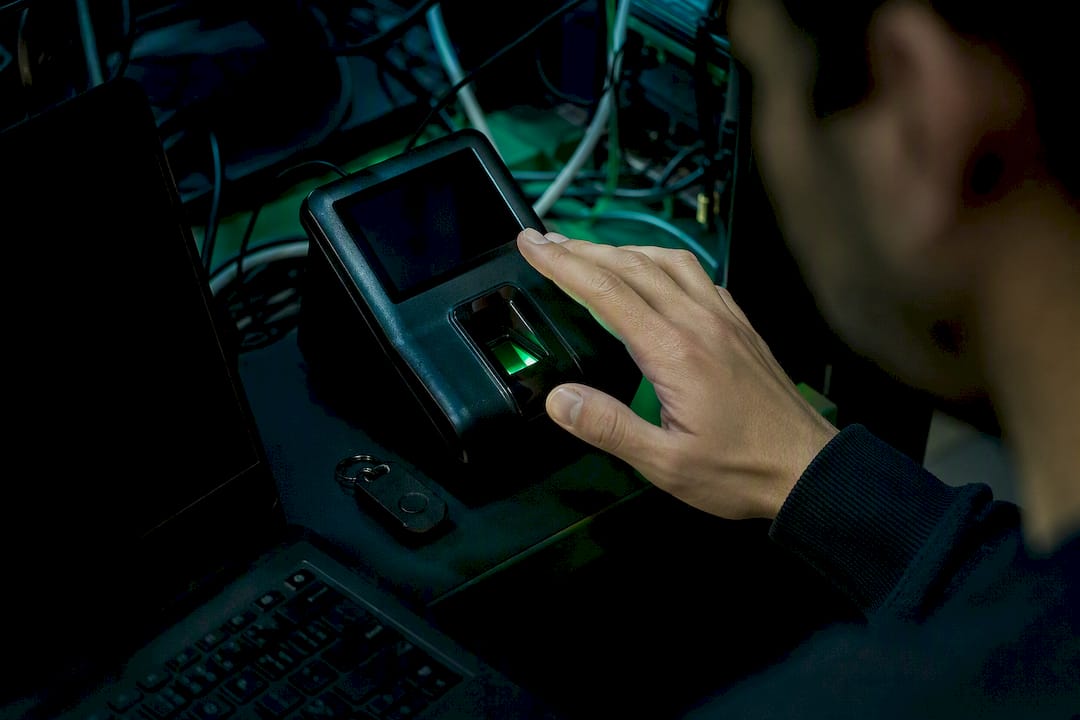
A biometric replay attack reuses a previously captured face, voice, or fingerprint sample, or injects a stolen digital template, to defeat an authentication check that assumes the signal in front of it is live. The three defenses that stop this attack most reliably are per-session freshness through challenge-response or watermarking, template protection through one-time or cancelable templates, and cryptographic session binding that ties every capture to a single, unrepeatable transaction.
- Session freshness: randomized prompts or nonces that expire the moment they’re used
- Template protection: one-time or cancelable templates that render a stolen sample worthless
- Cryptographic session binding: server-side validation that rejects anything without a matching, unexpired token
Verify your session nonces and server-side binding logic today. That single audit closes the door most replay attacks walk through.
Key Takeaways
Replay attacks succeed when a captured biometric sample or template can be reused without the system detecting that it isn’t live, and defeating them requires session freshness, template protection, and cryptographic binding working together rather than any single layer alone.
| Point | Details |
|---|---|
| Two distinct attack paths | Presentation replay hits the sensor directly; digital injection bypasses it and targets the app or server. |
| No single detector wins | NIST testing found no PAD algorithm catches every presentation attack, so layered defenses are required. |
| Template protection removes the payoff | One-time and cancelable templates make a stolen capture worthless for future sessions. |
| Session binding closes injection gaps | Server-side nonces and TLS stop the interception step that injection attacks depend on. |
| Test both vectors separately | Detection rates often diverge between presented replay and injected replay, so evaluate each independently. |
Table of Contents
- What Is a Replay Attack in Biometric Authentication?
- How Are Replay Attacks Executed in the Wild?
- What Detection Techniques Actually Stop Replay Attacks?
- Which Template Protection Methods Stop Reuse?
- How Should You Evaluate Replay Detection Systems?
- What Is the Right Order to Roll Out These Defenses?
- What the Threat Data Is Telling the Industry
- Where Should Security Teams Actually Invest First?
- What Practitioners Get Wrong About Replay Attacks
- Sources
- FAQ
What Is a Replay Attack in Biometric Authentication?
A replay attack occurs when an attacker captures a legitimate biometric signal, a photo, a voice recording, a fingerprint scan, or a raw digital template, and resubmits it later to impersonate the original person. A presentation attack is the physical version: a printed photo, a screen playing a video, or a speaker playing a recorded voice held up to the sensor itself. Digital injection skips the sensor entirely and feeds a captured template directly into the application or server pipeline, often through a compromised endpoint or intercepted API call.
The distinction matters because defenses that stop one rarely stop the other. Modalities affected include:
- Face: printed photos, replayed video, deepfakes, and 3D masks
- Voice: recorded passphrases and synthetic audio injected at the telephony layer
- Fingerprint: lifted prints reproduced on gelatin or silicone molds
- Iris: high-resolution photographs presented under specific lighting
- Brainprint: recorded EEG signals replayed against emerging neural authentication systems
Biometrics can’t be reset like a password. Once a face template or fingerprint pattern leaks, it stays compromised for that person permanently, which is exactly why replay defenses need to be stronger than password hygiene, not equivalent to it.
How Are Replay Attacks Executed in the Wild?
Attackers don’t need exotic tools. Most successful replay attempts use commodity hardware and publicly available footage.
- Face replay: a printed headshot, a tablet playing a looped selfie video, or a deepfake generated from social media images held up to a camera
- Voice replay: a recorded passphrase captured from a call center interaction, or synthetic audio injected directly at the telephony gateway rather than spoken aloud
- Sensor and API injection: packet capture on an unencrypted mobile link, followed by resubmission of the exact same authentication payload to the server
- Man-in-the-middle interception: an attacker sits between the app and server, harvesting valid session data for reuse minutes or days later
- Stolen enrollment data: templates lifted from a breached database and replayed against a different service that reuses the same biometric
Europol’s review of biometric vulnerabilities found that print and screen replay attacks against systems without presentation attack detection can succeed at very high rates. That number should worry anyone still running a face-match check with no liveness layer behind it.
What Detection Techniques Actually Stop Replay Attacks?
Detection splits into two families: passive and active. Passive presentation attack detection (PAD) analyzes the incoming image or video for texture, depth, and reflectance cues that separate a live face from a photo or screen. It works without asking the user to do anything extra, but it’s also the layer attackers target first with better printers and higher-resolution displays. NIST’s ongoing evaluation of face recognition algorithms found that no single PAD algorithm catches every presentation attack, which is why NIST recommends layered defenses rather than relying on any one detector.
Active, or dynamic, liveness closes that gap by demanding a response the attacker can’t have pre-recorded. iProov’s Dynamic Liveness and Flashmark approach projects a randomized sequence of colors onto the user’s face and verifies the reflected pattern matches what was sent, a signal that expires the instant it’s used. A pre-recorded video simply can’t reflect a light sequence that didn’t exist when it was filmed.
- Timestamps and session nonces: every authentication attempt carries a server-generated token that’s checked and burned on first use
- Watermarking and active probing: cyber-physical systems can embed detectable signatures into sensor streams, flagging replayed data streams before they reach the decision layer
- Transport-layer defenses: TLS encryption and packet integrity checks prevent the interception step that makes injection possible in the first place
Pro Tip: Don’t treat active liveness as a universal upgrade. It adds latency and can frustrate users on low-end devices, so reserve it for high-risk transactions like account recovery or large transfers, and lean on passive PAD for routine logins.
The tradeoff is real: active challenge-response defeats more injection attempts, but it also demands more from network conditions and device cameras. A rural user on a three-year-old phone with spotty connectivity is exactly the person who fails a Flashmark check for reasons that have nothing to do with fraud, so false-positive tuning has to happen before rollout, not after complaints arrive.
Which Template Protection Methods Stop Reuse?
Cancelable templates and biohashing transform a raw biometric measurement into a distorted, non-invertible representation. If that transformed template leaks, the operator revokes it and issues a new transformation function, something impossible with a raw fingerprint scan.
One-time templates go further, generating a fresh, cryptographically protected template for every single session. A peer-reviewed scheme published in Computers & Security combines deep-learning feature extraction with biohashing and symmetric encryption, and testing on face and fingerprint datasets showed the resulting templates resist replay even under an adversarial threat model that assumes the attacker has intercepted prior captures.
- Disposable feature extractors (GEFE): a permutation-based protocol discards the feature extractor after each use, so a captured template can’t be matched in a future session
- Secure element integration: pairing template protection with a TPM or SIM secure enclave keeps the transformation keys off the general application layer
- FIDO alignment: binding template protection to FIDO2 credential exchange gives you a standards path rather than a proprietary one
The core idea behind one-time templates is simple: if a captured biometric sample can only ever be valid for one session, intercepting it buys the attacker nothing. That’s a fundamentally different guarantee than “we detected the fake,” because it removes the reward for stealing the data at all.
How Should You Evaluate Replay Detection Systems?
Testing a defense properly means measuring the right things and stressing it against both attack paths.
- Track TAR/FAR and APCER/BPCER alongside an attack-specific detection rate, since a system can post strong general accuracy while still missing a specific replay technique
- Model both vectors separately: test presented replay against the physical sensor and injected replay against the API, because detection performance often diverges sharply between the two
- Vary devices and channels: run the same attack across multiple camera qualities, microphones, and network conditions before trusting a single lab result
- Consult NIST evaluations and CEN/TS 18099 for testbeds and standards-aligned methodology rather than building an evaluation protocol from scratch
NIST’s own testing found that no single algorithm caught every presentation attack it evaluated, a finding that should discourage any vendor claim of a single silver-bullet detector. The most common pitfall isn’t a weak algorithm. It’s a dataset that only contains attacks the team already knew about.
What Is the Right Order to Roll Out These Defenses?
Sequencing matters more than most security teams admit. Trying to deploy watermarking before you’ve fixed transport encryption wastes engineering time on a problem that’s still exposed at a lower layer.
Short term (weeks): enable TLS across every biometric API call, implement server-side session binding, turn on PAD wherever your vendor supports it, and start logging every authentication attempt with enough metadata to reconstruct an incident later.
Medium term (a quarter or two): layer in challenge-response or dynamic liveness for your highest-risk flows, deploy cancelable or one-time templates for newly enrolled users, and harden sensor firmware against known injection paths.
Long term (ongoing): run continuous monitoring against replay-specific indicators, participate in threat intelligence sharing with peer institutions, and schedule red-team exercises that specifically attempt replay and injection rather than generic penetration tests.
- Build replay-specific test cases into your regression suite, not just your annual pen test
- Write an incident response playbook that names replay attacks explicitly, since generic “account compromise” runbooks miss the forensic steps unique to captured biometric data
- Review identity fraud exposure points where a replayed biometric could feed downstream fraud, not just the authentication moment itself
Pro Tip: Log image hash repetition and session-reuse flags even before you’ve built full replay detection. A spike in identical or near-identical hashes across supposedly independent sessions is one of the cheapest early-warning signals available, and most teams already have the logging infrastructure to catch it.
Financial institutions running biometric checks at scale should also review general financial data security best practices alongside replay-specific controls, since the two overlap more than most fraud teams assume.
What the Threat Data Is Telling the Industry
Replay and injection attacks are converging across industries that had nothing to do with each other five years ago. Fintech onboarding fraud, healthcare patient-portal takeover, and travel document verification are all reporting the same underlying pattern: attackers captured a biometric once, then reused it against a completely different service.
- Watch for repeated image hash spikes across sessions that claim to be independent users
- Flag session-reuse indicators where a token appears valid but was issued outside the expected time window
- Track cross-channel mismatches, where a “live” capture arrives through metadata inconsistent with the claimed device
Cloud-based verification platforms with centralized attack telemetry can adapt to new replay variants faster than isolated, on-premises deployments, simply because they see more attempted attacks across more clients. That shared visibility is becoming the difference between catching a new injection technique in days versus months. Fraud Signals News tracks these cross-industry patterns as part of ongoing coverage of biometric fraud trends, and Carlos Ochoa’s reporting on identity verification failures informs the operational recommendations throughout this piece.
Where Should Security Teams Actually Invest First?
Most vendor marketing around biometric security leans on liveness detection as if it’s a solved problem. It isn’t. NIST’s own testing confirms no single PAD algorithm catches every presentation attack, and that finding gets buried under sales decks promising “deepfake-proof” verification. The honest position is that liveness detection buys you time against unsophisticated attackers, not immunity against determined ones.
The bigger gap is template protection, and it’s underinvested almost everywhere. Security teams pour budget into detecting the fake at the door while leaving the template itself replayable indefinitely once it leaks. One-time templates and disposable feature extractors solve a different problem than liveness does: they remove the payoff for theft in the first place, which matters more than catching every individual attempt.
If you’re prioritizing, start with cryptographic session binding and server-side nonce validation. It’s cheap, it’s fast to deploy, and it closes the injection path that active liveness alone can’t touch. For enterprise-grade identity verification that already builds in session freshness and template protection, DAON is worth evaluating alongside your current stack.
What Practitioners Get Wrong About Replay Attacks
The conventional advice treats liveness detection as the finish line. It isn’t, and treating it that way leaves the actual weak point, the template itself, exposed indefinitely. A face or voice sample doesn’t expire like a password does, so once it’s captured, every system that trusts a static template stays vulnerable until that template is replaced with something disposable.
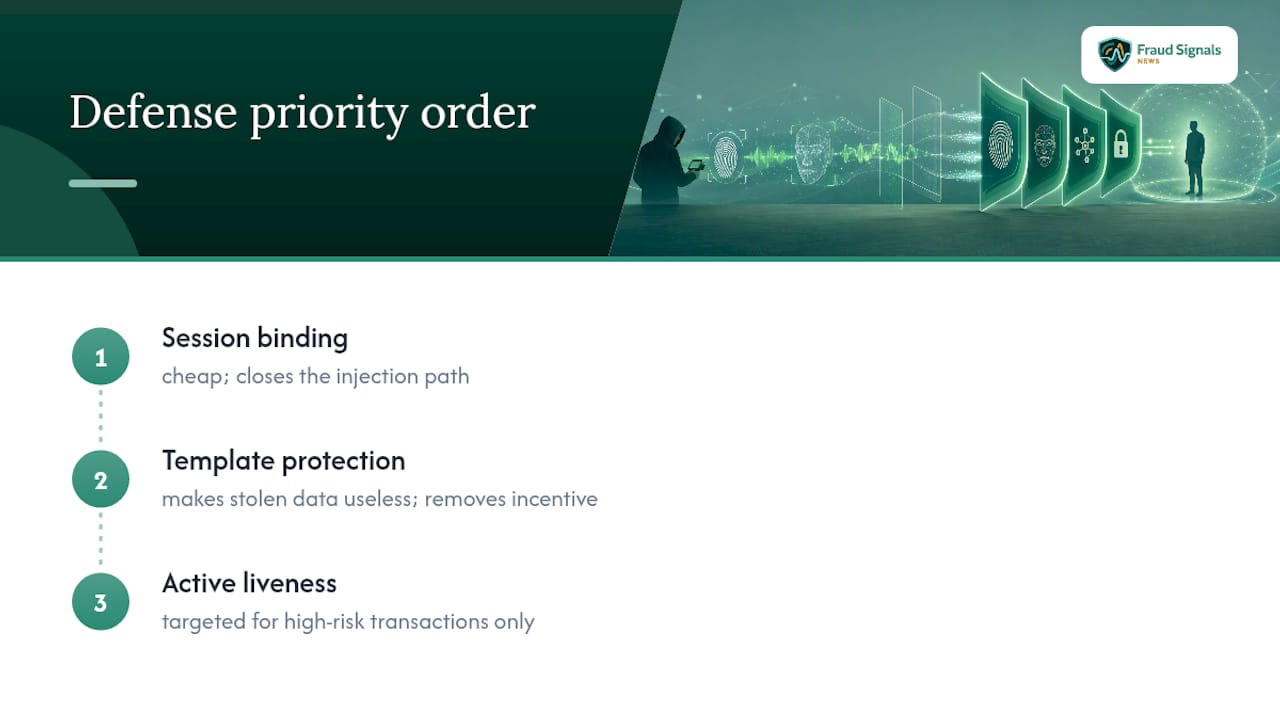
What the research in this piece actually supports is a layered order of operations: fix session binding first because it’s cheap and closes the injection path, then invest in template protection because it removes the attacker’s incentive to steal in the first place, and treat active liveness as a targeted tool for high-risk transactions rather than a blanket requirement. Most teams do the opposite. They buy the flashiest liveness product available and leave templates replayable for years.
The uncomfortable truth is that biometric security has spent more engineering effort on detecting fakes than on making stolen data useless. That priority needs to flip, and the peer-reviewed work on one-time templates and disposable feature extractors shows it’s already technically possible. What’s missing is deployment discipline, not research.
— Carlos Ochoa
Sources
- Robust biometric scheme against replay attacks using one-time biometric templates
- Europol — Biometric vulnerabilities (presentation attacks overview)
- Replay Attack | Biometric Encyclopedia | iProov
- Facing the Facts to Keep Our Biometrics Secure | NIST
FAQ
What Is an Example of a Replay Attack?
An attacker records a person’s voice saying a passphrase during a legitimate call, then plays that recording back to a voice authentication system to gain access later. The same pattern applies to a printed photo held up to a face-recognition camera.
What Are the Main Types of Biometrics Used in Authentication?
The most common modalities are face, fingerprint, iris, voice, hand geometry, retina, and behavioral biometrics like gait or typing rhythm. Face, voice, and fingerprint are the most frequently targeted by replay attacks because captures are easiest to obtain.
How Is a Replay Attack Detected?
Detection relies on session nonces, timestamp validation, and liveness checks that flag a duplicate or expired authentication signal. Systems using dynamic liveness, such as randomized visual prompts, catch replay attempts that pre-recorded footage can’t reproduce.
Can Biometric Data Be Hacked?
Yes. Biometric templates stored in databases can be breached like any other data, and unlike a password, a compromised fingerprint or face template can’t simply be reset. That’s why one-time templates and cancelable biometric schemes exist, to make a leaked template useless even after a breach.
Recommended

Biometric Performance Metrics: What to Measure and Trust
ID Security Features: What Each One Does and How to Check It