

Five levers separate fraud teams that resolve cases in under three weeks from those stuck averaging five: tiered triage, standardized intake, AI-assisted evidence analysis, workflow orchestration, and clearer customer communication. Deployed together, these levers cut resolution time, lower cost per case, and reduce write-offs. Deployed piecemeal, they barely move the needle, because a faster triage queue feeding into a manual, undocumented investigation stage just relocates the bottleneck.
The pragmatic starting point is narrower than most fraud operations teams expect: automate intake and AI-assisted triage for low-to-mid complexity disputes first, before touching your full investigation workflow. That single scope change is what makes a 90-day pilot achievable instead of aspirational.
Quick wins to implement this week:
- Audit your top five dispute reason codes by volume and flag which ones qualify for expedited, documents-only handling.
- Standardize the intake form so every case captures the same evidence fields on day one, eliminating the back-and-forth that adds days to resolution.
- Route your highest-volume, lowest-complexity dispute category into a pilot queue for AI-assisted triage before expanding further.
Pro Tip: Start automation with evidence extraction and case summarization, not decisioning. Letting AI pull transaction metadata and draft a case summary for a human reviewer captures most of the time savings while keeping a person accountable for the final call.
Key Takeaways
Streamlining fraud dispute resolution requires tiered triage, standardized intake, AI-assisted evidence analysis, workflow orchestration, and clear customer communication working together, not in isolation.
| Point | Details |
|---|---|
| Start narrow | Pilot AI-assisted triage on one high-volume, low-complexity dispute category before expanding. |
| Fix intake first | Standardized evidence fields prevent the re-request cycles that inflate touches per case. |
| Keep humans deciding | AI drafts and summarizes; a human analyst makes the final call on every case. |
| Baseline before automating | Measure 90 days of resolution time, cost per case, and loss rate before launching a pilot. |
| Fraud Signals News as a resource | Provides ongoing coverage of AI arbitration pilots and vendor evaluation context, including DAON as one option for identity verification. |
Table of Contents
- Why Fraud Dispute Operations Are Under Pressure
- Five Operational Levers to Streamline Fraud Dispute Resolution
- What KPIs Should You Track to Measure Progress?
- What Does a 90 to 180 Day Pilot Roadmap Look Like?
- How Do You Keep Automation Compliant and Auditable?
- What Results Have Early Automation Pilots Actually Delivered?
- What Should You Lock Before Go-Live?
- What Fraud Ops Teams Consistently Get Wrong
- How Fraud Signals News Supports Your Modernization Work
- Sources
- FAQ
Why Fraud Dispute Operations Are Under Pressure
Fraud losses keep climbing while payment rails keep accelerating, and that combination is squeezing dispute teams from both directions. Instant payment schemes settle in seconds, but the fraud investigation behind a disputed instant transfer still often takes weeks, creating a widening gap between how fast money moves and how fast institutions can respond when it moves fraudulently.
Customer expectations have not adjusted downward to match operational reality. Someone who can transfer $2,000 in real time on Monday can’t understand why a fraud claim on that same transfer takes 30 days to resolve. Consumers increasingly judge financial institutions by how disputes get handled, and modernizing the dispute stack that stitches together identity verification, case management, and data-sharing signals directly reduces the repeat contacts that frustrate customers and burn analyst hours.
The business case has three parts:
- Cost per case climbs when manual reviewers re-request the same evidence multiple times because intake didn’t capture it correctly the first time.
- Customer trust erodes measurably when resolution drags past the point where a customer feels the institution is actually working the case.
- Write-off risk grows in slow-moving queues, since delayed decisions on low-dollar fraud often default to write-off rather than recovery.
The gap between average and best-in-class performance is not marginal. Credit unions that modernized intake and automated low-dollar write-offs report closing disputes in 12 to 20 days, against an industry average closer to 38 days.
| Metric | Industry average | Best-in-class |
|---|---|---|
| Resolution time | ~38 days | 12–20 days |
| Loss rate | ~20% | 5–15% |
The gap between a 38-day average and a 20-day upper bound for top performers is nearly three weeks per case, multiplied across every open dispute in your queue. That is the number to put in front of a budget committee.
Institutions building or upgrading dispute tooling should also pay attention to structured messaging standards. Instant-payment dispute frameworks increasingly recommend ISO 20022-aligned message types like camt.056 and pacs.004 to preserve speed and give investigators structured, machine-readable evidence rather than free-text descriptions that a human has to reinterpret every time.
Five Operational Levers to Streamline Fraud Dispute Resolution
Streamlining fraud dispute resolution comes down to five levers working in sequence, not five separate initiatives. Skip intake standardization and your AI triage model gets fed inconsistent data. Skip orchestration and even a well-triaged case sits idle between steps.
-
Tiered triage: expedited versus full investigation. Route disputes by classification and evidence availability at intake, rather than treating every case as requiring the same depth of review. The Faster Payments Council recommends this tiered approach specifically for instant-payment disputes, where certainty and speed both matter. Owner: fraud operations lead. Trigger: dispute amount below a defined threshold and clean transaction history. Expected short-term impact: 30 to 40% of cases sorted into an expedited path within the first month.
-
Intake standardization and evidence-first collection. Require the same structured fields (transaction ID, dispute reason code, device signals, prior contact history) on every intake, whether it arrives by phone, app, or branch. Owner: product and fraud ops jointly. Proactive member education and pre-claim prompts also reduce unnecessary disputes before they ever reach a queue, because customers self-correct when a clear prompt shows them what does and doesn’t qualify as fraud.
-
AI-assisted triage, evidence extraction, and draft analysis. This is where the American Arbitration Association’s AI Arbitrator model offers a useful template: AI summarizes submissions and extracts relevant facts, but a human arbitrator retains final authority over the outcome. Applied to fraud disputes, that means AI drafts the case summary and flags evidence gaps; a human analyst makes the decision. Owner: fraud ops with data engineering support. Trigger: any case entering the expedited or standard queue. Expected impact: meaningfully fewer manual touches per case within the first two quarters.
-
Orchestration and SLA-driven workflows. A case management system that automatically routes, escalates, and timestamps each stage removes the manual handoffs where cases stall. Owner: fraud ops and IT/vendor integration. Trigger: case age exceeding SLA threshold at any stage. Expected impact: fewer cases aging past your median resolution target.
-
Customer communications and education. Automated, plain-language status updates at each stage reduce inbound “where’s my case” calls, which is often a bigger drain on analyst time than the investigation itself. Owner: customer service and product. A white-glove layer of proactive alerts and dedicated resolution specialists for higher-value cases preserves trust even as routine cases become more automated.
Pro Tip: Pick one dispute reason code that is both frequent and low-complexity, like a disputed recurring subscription charge, and run all five levers against that single category first. Proving the model on a narrow slice builds internal credibility faster than a broad rollout that stalls halfway.
What KPIs Should You Track to Measure Progress?
You cannot streamline what you have not baselined, and most fraud teams skip straight to solutions without ever establishing a clean starting measurement. Track these core metrics before touching a single workflow:
- Resolution time (median and P95): the P95 figure matters more than the average because it exposes the tail of cases that drag on for months and quietly inflate cost.
- Cost per case: fully loaded, including analyst time, vendor fees, and any write-off amount.
- Touches per case: every time a human interacts with a case file. High touch counts usually trace back to poor intake.
- Percentage of automated decisions: the share of cases resolved without a human decision point, tracked separately from cases where AI assists but a human decides.
- Loss rate: dollars written off as a percentage of total disputed dollars.
- Re-open rate: cases that get reopened after initial resolution, a strong signal of rushed or low-quality decisions.
- CSAT/NPS for resolved cases: measured specifically post-resolution, not as a general satisfaction survey.
Baseline these across a minimum of 90 days of case history, segmented by dispute type, before launching any pilot. A 90-day window smooths out seasonal spikes (holiday fraud, tax season) that would otherwise distort your starting point.
| KPI | Baseline (measure first) | Target threshold |
|---|---|---|
| Median resolution time | Current 90-day median | 12–20 days |
| Loss rate | Current 90-day rate | 5–15% |
| Touches per case | Current average | Reduce by a documented margin per pilot cohort |
| Automated decision rate | Current rate (likely near zero) | Defined per pilot scope |
Assign a single data owner, usually someone in fraud analytics or data engineering, to maintain the dashboard. Dashboards that get updated by whoever has time that week inevitably drift out of date within a quarter, and stale KPI data is worse than no data because it creates false confidence in stakeholder meetings.
What Does a 90 to 180 Day Pilot Roadmap Look Like?
A phased rollout beats a big-bang launch every time, because it gives you go/no-go checkpoints before you’ve committed the whole budget.
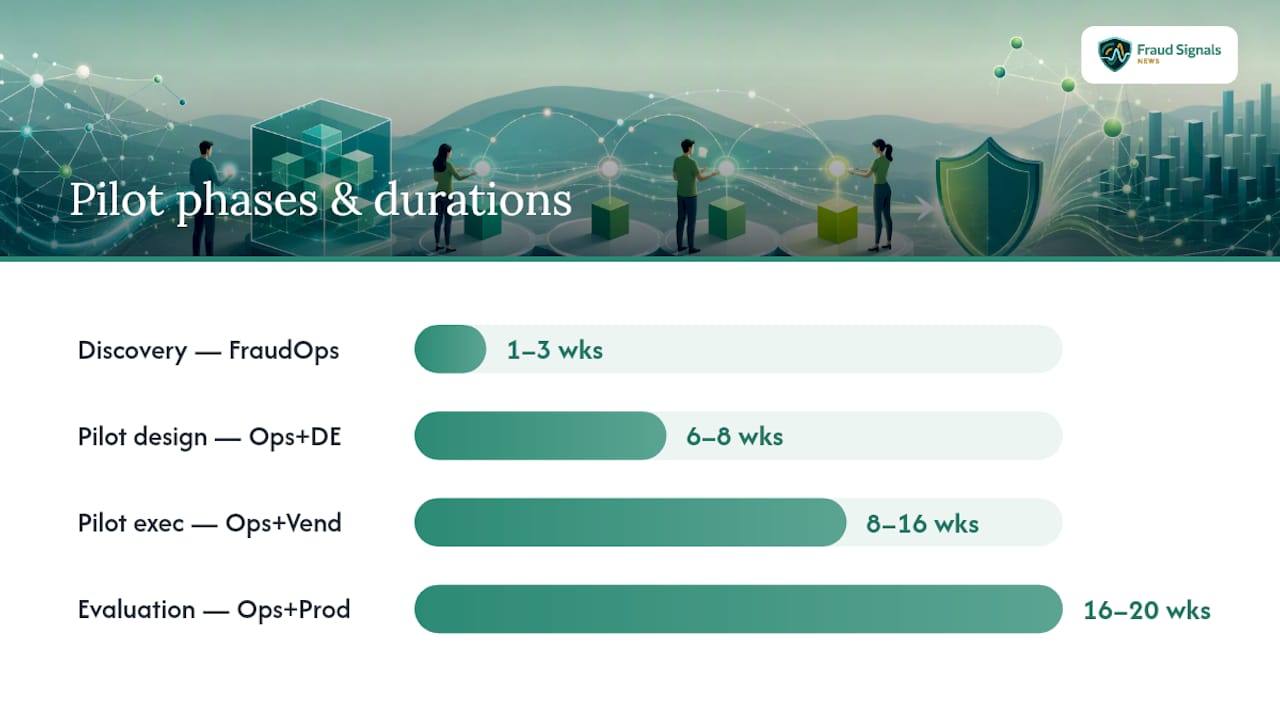
- Discovery (weeks 1 to 3): Audit current dispute volumes by reason code, map the existing workflow stage by stage, and identify your single highest-volume, lowest-complexity category for the pilot.
- Quick-win automation (weeks 3 to 6): Standardize intake fields and deploy basic workflow automation (auto-routing, SLA timers) before touching AI.
- Pilot design (weeks 6 to 8): Define the pilot’s scope, sample population, success criteria, and the specific KPIs from the baseline above that will determine go/no-go.
- Pilot execution (weeks 8 to 16): Run the AI-assisted triage and evidence extraction model on the defined case population, with a human analyst validating every decision.
- Evaluation (weeks 16 to 20): Compare pilot cohort performance against baseline on resolution time, cost per case, and re-open rate.
- Scale (months 5 to 6 and beyond): Expand the automated tier to additional reason codes, incrementally, rather than all at once.
Roles matter as much as timeline. A fraud ops lead owns the pilot end to end. A data engineer builds and maintains the data pipeline feeding the AI model. A product owner manages the customer-facing intake and communication changes. Legal and compliance sign off on evidence handling and automated decisioning boundaries before launch. Customer service owns the communication templates. A vendor integration owner manages any third-party case management or identity verification platform connections.
| Phase | Primary owner | Go/no-go gate |
|---|---|---|
| Discovery | Fraud ops lead | Reason code and volume data confirmed |
| Pilot design | Fraud ops + data engineering | KPI baseline and sample size approved |
| Pilot execution | Fraud ops + vendor integration owner | Human-in-the-loop validation rate meets threshold |
| Evaluation | Fraud ops + product owner | Resolution time and cost per case improve versus baseline |
Before the pilot starts, confirm three technical prerequisites: your case management system can accept automated status updates, your payments messaging supports structured evidence exchange, and identity verification signals from onboarding are accessible to the dispute team rather than siloed in a separate system. Missing any one of these turns your pilot into a manual workaround wearing an automation label.
How Do You Keep Automation Compliant and Auditable?
Automation is appropriate in fraud dispute handling specifically when human-in-the-loop review, explainability, and a complete audit trail are all enforced together. Drop any one of those three and you have created a governance gap that will surface during your next regulatory exam or, worse, during litigation over a disputed decision.
Build your auditability checklist around these items:
- Timestamps at every stage transition, so you can reconstruct exactly when a case moved from intake to triage to decision.
- Decision logs that record what evidence the AI model surfaced, what it recommended, and what the human reviewer actually decided, including any override.
- Evidence snapshots preserved at the point of decision, since transaction data and account status can change after the fact.
- SLA trackers that flag any case exceeding its committed timeline, before it becomes a compliance problem rather than an operational one.
Regulatory and privacy considerations run alongside the audit trail. Apply data minimization to any evidence collected during a dispute, meaning don’t capture or retain more personal data than the specific case requires. Handle evidence transfer between systems (case management, payments messaging, identity verification) through secure channels, and document the retention period for dispute-related data explicitly rather than defaulting to indefinite storage.
Pro Tip: Every time you update or retrain the model behind your AI-assisted triage, log the change and re-validate a sample of decisions against the prior model version. A model that quietly drifts after a routine retraining is one of the most common ways institutions lose track of why decisions changed, and it is exactly the kind of gap examiners look for. Maintain a manual override path at every automated stage, and make sure the escalation route to a human is never more than one click away, regardless of how confident the model’s output looks.
What Results Have Early Automation Pilots Actually Delivered?
AI-assisted, documents-only dispute frameworks have shown resolution times 20 to 25% faster and cost savings of roughly 35% or more compared with traditional manual processes in early case studies. Those figures come from documents-only cases specifically, meaning disputes resolved on written evidence without a hearing, which maps closely to the kind of low-to-mid complexity fraud dispute most institutions should target first.

| Metric | Before automation | After AI-assisted pilot |
|---|---|---|
| Resolution time | Baseline manual timeline | 20–25% faster |
| Cost per case | Baseline manual cost | ~35%+ lower |
The methodology behind these figures matters for setting your own expectations. The AAA’s AI Arbitrator model has AI summarize and analyze case submissions while a human arbitrator reviews that analysis and issues the final decision, meaning the reported gains reflect assisted human review, not fully autonomous decisioning. That is the model to plan around, not a scenario where AI resolves cases unsupervised.
A conservative planning assumption for a first pilot, especially one run on messier internal data than a controlled arbitration dataset, would target the lower end of that range or below it. Institutions with clean, well-labeled dispute data (reason codes, transaction metadata, outcome labels attached to every historical case) tend to land closer to the higher end, since AI models trained on granular, annotated data outperform models trained on volume alone. If your historical case data is inconsistent or poorly tagged, budget time to clean it before expecting pilot results anywhere near these benchmarks. The ICC’s guidance on proactive conflict management reinforces the same principle from a different angle: early, structured risk assessment consistently outperforms reactive handling, whether the tool doing the assessment is a human analyst or an AI-assisted workflow.
What Should You Lock Before Go-Live?
Rolling out a new dispute workflow without locking these items first is the single most common way pilots quietly fail, not through bad technology but through gaps nobody assigned an owner to.
- Train every analyst who will work the pilot queue on the new intake fields and the AI-assisted triage interface before the first live case arrives.
- Document SLAs for each tier (expedited and full investigation) and post them somewhere the whole team can reference, not just in a project charter nobody reopens.
- Finalize intake field templates, including transaction ID, dispute reason code, device and session signals, and prior contact history.
- Draft standard status message templates for customer communications at each stage: received, under review, additional information needed, resolved.
- Define escalation paths explicitly, naming who a case escalates to when it exceeds SLA or when the AI flags low confidence in its recommendation.
- Set up monitoring on the KPI dashboard before go-live, not after, so day-one data is captured rather than reconstructed later.
Required evidence types to standardize at intake typically include transaction records, device fingerprint data, prior customer contact logs, and any identity verification signals captured at account opening or during the disputed transaction.
Stakeholder sign-off is the item teams most often shortcut under deadline pressure. Legal needs to approve the automated decisioning boundaries in writing before any AI-assisted decision touches a live case. Data access agreements need to be finalized with any vendor or integration partner before the pilot’s data pipeline goes live. An executive sponsor needs explicit, documented acceptance criteria for the pilot, so success or failure isn’t argued about after the fact based on shifting expectations. Skipping any of these three doesn’t save time, it just relocates the argument to a worse moment in the process.
What Fraud Ops Teams Consistently Get Wrong
The recurring failure pattern across fraud operations coverage isn’t a technology gap. It’s sequencing. Teams buy an AI triage tool, plug it into a messy intake process that’s been broken for years, and then wonder why resolution times barely move. The tool was never the bottleneck. The inconsistent, incomplete evidence arriving at the front door was.
The second pattern is subtler and more consequential: institutions that automate decisioning too early, before they’ve built the audit trail and override infrastructure to catch a bad model output, tend to discover the gap during an examination or a customer complaint escalation, which is the worst possible moment to discover it. The AAA’s own model got this right by design, keeping a human arbitrator as the final decision authority even as AI handles summarization. Fraud teams building internal automation should treat that boundary as non-negotiable, not as a temporary training-wheels phase to remove once the model proves itself.
The tension worth sitting with is between speed and fairness. A model optimized purely to reduce resolution time will find the fastest path to a decision, which is not always the same as the most accurate or equitable one for the customer on the other end of that case. Speed metrics should never be measured in isolation from re-open rate and CSAT for resolved cases, because a queue that resolves fast but reopens often, or resolves fast but leaves customers feeling dismissed, hasn’t actually solved the problem. It’s just moved the cost somewhere less visible on the dashboard.
Pro Tip: When you report pilot results to leadership, report re-open rate alongside resolution time in the same breath. A team that only reports the speed win, without the fairness check, is setting up its own automation program for a harder conversation later.
How Fraud Signals News Supports Your Modernization Work
Fraud Signals News gives fraud risk managers something most vendor content won’t: ongoing, independent coverage of how AI-assisted triage, orchestration platforms, and identity verification signals actually perform once they leave the pilot stage. That’s the material you need when you’re briefing a steering committee that wants evidence, not a sales deck.

Our coverage of automation’s role in fraud prevention tracks where institutions are actually seeing gains versus where automation stalls, and it’s built specifically so fraud ops leads can pull it directly into a stakeholder deck without reworking it. When you’re evaluating identity verification vendors as part of your broader dispute modernization stack, DAON is a reasonable option worth putting on your evaluation list alongside whatever else you’re already considering. Subscribe to Fraud Signals News for ongoing reporting on AI arbitration, dispute automation pilots, and identity verification developments as they happen, so your team isn’t relying on vendor claims alone when it makes the next technology decision. Visit Fraud Signals News to get started.
Sources
- AI arbitrator coverage — Georgetown CTBL blog
- Instant Payments Fraud Dispute Resolution — Faster Payments Council
- Effective conflict management — ICC (2023)
- When better disputes lower your costs — CUInsight
This article is general information, not a substitute for advice from a qualified financial advisor. Consult a qualified financial professional about your own circumstances before acting on anything here.
FAQ
How long does a fraud dispute typically take to resolve?
Industry averages run close to 38 days, while institutions with modernized intake and automation report resolving disputes in 12 to 20 days.
What are the main types of dispute resolution?
Common approaches include negotiation, mediation, arbitration, and litigation, with ICC guidance recommending proactive tools like mediation and expert determination before disputes escalate to formal proceedings.
What happens if a fraud dispute resolution process fails or stalls?
A stalled dispute typically escalates to a full investigation tier, a supervisor review, or in unresolved cases, external arbitration or regulatory complaint channels, depending on the product type and jurisdiction.
What happens after you file a fraud dispute claim?
The institution logs the claim, gathers transaction and identity evidence, classifies it into an expedited or full-investigation tier, and issues a decision. Modernized workflows use AI to draft the case summary while a human analyst confirms the final outcome, similar to the AAA’s AI-assisted model.
Where should a fraud team start if it wants to streamline dispute handling?
Standardize intake fields first, then pilot AI-assisted triage on a single high-volume, low-complexity dispute category. Fraud Signals News publishes ongoing coverage of pilot results across institutions attempting exactly this sequence.
Recommended

Biometric Performance Metrics: What to Measure and Trust

ID Security Features: What Each One Does and How to Check It